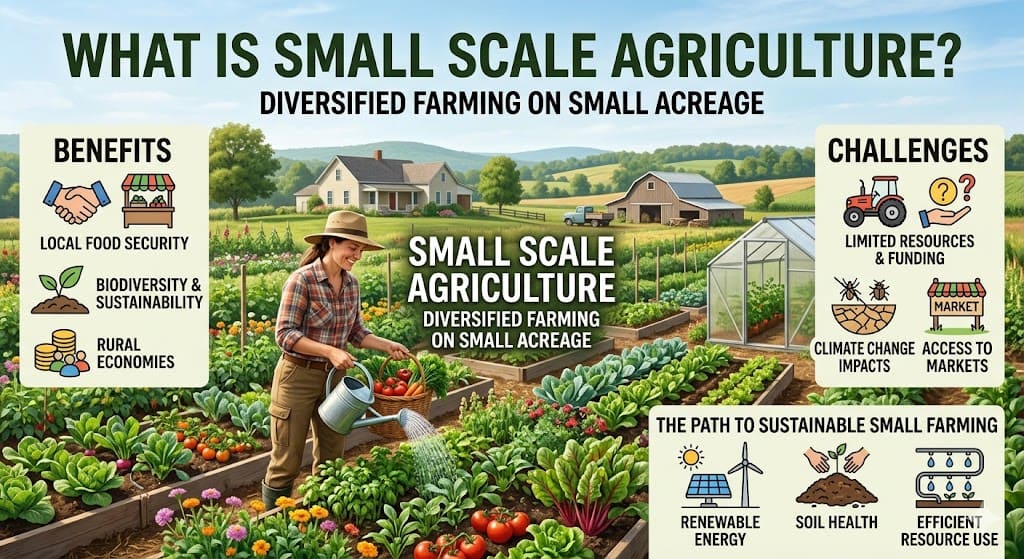
What Is Small Scale Agriculture? Benefits, Challenges, and the Path to Sustainable Small Farming

What Is Small Scale Agriculture?
Benefits, Challenges, and the Path to Sustainable Small Farming
Complete guide to small scale agriculture: learn about smallholder farming benefits, challenges, types of small farms, profitable crops, technology, and sustainable farming practices.

The Quiet Foundation of Global Food Production
When most people think of agriculture, they picture vast commercial fields stretching to the horizon. Enormous grain silos and fleets of modern farm tractors often come to mind. However, the reality of how the world is fed is quite different. Smallholder agriculture — small scale farming practiced by hundreds of millions of family-owned farms across every continent — produces a remarkably large share of the world’s food. Furthermore, it sustains the livelihoods of the majority of the world’s rural poor. Consequently, it forms the bedrock of local food systems in communities everywhere.
Small scale agriculture is not a relic of the past waiting to be replaced by industrial farming. Instead, it is a dynamic, adaptive, and increasingly innovative sector. Moreover, it is evolving rapidly in response to new technologies, changing markets, and climate pressures. Therefore, this guide explains what small scale agriculture is, why it matters, what challenges smallholder farmers face, and how small farms can become more productive, profitable, and sustainable.
What Is Small Scale Agriculture?
Small scale agriculture refers to farming systems where relatively small areas of agricultural land are cultivated. Typically, these operations rely on family labor rather than hired workers. Moreover, they have limited capital inputs compared to commercial farms. Importantly, production serves a combination of household consumption and local market sale. Consequently, small farms are deeply connected to their communities and local food systems.
The definition of “small” varies significantly by region and context. For example, what counts as a small farm in the United States or Australia may be large by the standards of South Asian or sub-Saharan African smallholder farming. The Food and Agriculture Organization of the United Nations defines smallholder farmers as those who manage farms of less than two hectares in most developing country contexts. Therefore, context matters when discussing small scale agriculture.
Regardless of exact definition, small scale farming systems share certain common characteristics. These include reliance on family labor, mixed farming approaches, limited use of purchased inputs, strong connection to local food systems, and farming decisions driven by both household food needs and market opportunities. Thus, understanding these characteristics is essential for supporting smallholder farmers effectively.
The Importance of Small Scale Farming in Global Food Security
Why is small scale farming important? The answer lies in numbers that are often overlooked in discussions dominated by large-scale agribusiness. According to FAOSTAT data from the Food and Agriculture Organization, smallholder farmers manage the majority of the world’s farms by number. Furthermore, they produce a substantial share of global food supply, particularly in developing regions where food security is most vulnerable. In Africa, Asia, and Latin America, smallholder agriculture is the primary source of both food and income for hundreds of millions of rural households. Therefore, supporting small farms is essential for global food security.
🌾 Small Farms & Local Food Systems
Small scale agriculture is the engine of local food production in communities across the world. Family-owned farms supply local markets, community-supported agriculture programs, and direct-to-consumer channels with fresh, diverse, seasonal food. Consequently, the role of small farms in local food systems is not just about quantity — it is about the quality, diversity, and accessibility of food at the community level.
🥗 Nutritional Diversity
Diversified farming — a hallmark of small scale farming systems — supports nutritional diversity both for farming households and for the communities they supply. Where commercial farming tends toward monoculture of commodity crops, small scale agricultural production typically involves multiple crops and livestock integration. Therefore, agricultural economics research consistently shows that communities with active smallholder farming sectors have better dietary diversity outcomes.
🏘️ Rural Livelihoods & Economic Impact
The economic impact of smallholder agriculture on rural communities extends far beyond the farm gate. Small scale farming sustains rural livelihoods and supports local agribusiness ecosystems. The National Bank for Agriculture and Rural Development and similar institutions recognize smallholder agriculture as central to rural development strategy in developing economies. Thus, small farms are economic anchors.
Types of Small Scale Farming Systems
Small scale farming takes many forms, reflecting the diversity of ecological conditions, cultural practices, and market connections that smallholder farmers navigate. Therefore, understanding these different types is essential for supporting small farmers effectively.
🌾 Subsistence Farming
Subsistence farming is the most basic form of small scale agriculture. Farmers grow primarily to feed their households, with little or no surplus for sale. While often associated with poverty, subsistence farming also represents agricultural resilience. Moreover, it provides food security independent of market fluctuations. Thus, the transition from subsistence to mixed farming is an important development pathway.
🔄 Mixed Farming Systems
Mixed farming systems combine crop production with animal farming on the same land. Crop-livestock integration creates valuable synergies. For example, livestock provide manure for soil fertility and draft power for cultivation. Crops provide feed and residues for animals. Consequently, mixed farming systems are among the most resilient and sustainable of all farming approaches.
🌿 Organic Small Farming
Organic small farming relies on natural techniques without synthetic inputs. Farmers use composting, JADAM organic farming methods, and biological pest management instead. Low-input farming aligns naturally with smallholder resource constraints. Additionally, organic products command premium market prices. Therefore, organic farming improves farm income generation significantly.
🌳 Agroforestry & Diversified Farming
Agroforestry integrates trees with crops and livestock on the same land. Trees provide shade, erosion control, nitrogen fixation, fruit, and timber. They also create carbon sequestration farming opportunities. Consequently, agroforestry diversifies income streams and improves long-term agricultural sustainability.
🤝 Community Agriculture
Community agriculture includes community-supported agriculture models and cooperative farming arrangements. These collective approaches enable individual smallholder farmers to access markets and resources that would be unavailable individually. Therefore, community agriculture strengthens agricultural resilience and creates more robust local food systems.
🏡 Backyard & Urban Small Farming
Backyard farming cultivates food in home gardens and small residential land areas. This form of small scale agriculture is expanding rapidly in urban and peri-urban contexts. While the scale is minimal, the aggregate contribution to household food security and nutritional diversity is significant. Thus, urban small farming is increasingly recognized by food security researchers.
Benefits of Small Scale Agriculture
The benefits of small scale agriculture are multiple and interconnected. They span economic, social, environmental, and food security dimensions. Therefore, supporting small farms yields returns across multiple areas.
🍲 Food Security & Dietary Diversity
Small farms contribute to food security in two ways. First, they produce food directly for household consumption, reducing dependence on purchased food. Second, they supply local markets with diverse, fresh products. Consequently, the role of small scale agriculture in food security is particularly important where commercial supply chains are unreliable or expensive.
🌍 Environmental Benefits & Sustainability
Small scale farming systems are often more environmentally beneficial than large-scale intensive farming. Crop diversification supports biodiversity in agriculture systems. Low-input farming reduces pesticide and synthetic fertilizer use. Agroforestry and mixed farming sequester carbon and manage water effectively. Thus, small farms contribute to agricultural sustainability goals.
💰 Economic Resilience & Farm Income
Diversified farming provides economic resilience that specialized commercial farming lacks. When one crop or market fails, diversified small farms have other enterprises to fall back on. Farm income generation from multiple sources creates financial stability. Therefore, small farms are more resilient to commodity price volatility and climate shocks.
🏛️ Social & Cultural Value
Family farming preserves agricultural knowledge, food culture, and rural community identity. Small farms maintain genetic diversity in crops and livestock, preserving traditional varieties. They sustain rural social structures and intergenerational land relationships. Consequently, small farms have social and cultural value far beyond economic measurement.
Challenges Faced by Smallholder Farmers
What challenges do small scale farmers face? The challenges of smallholder farming are real, structural, and deeply entrenched. However, they are not insurmountable. Therefore, understanding these challenges is essential for developing effective solutions.
💰 Limited Access to Finance
Access to agri finance and rural finance is one of the most persistent challenges for smallholder farmers. Without affordable credit, small farms cannot invest in technology, equipment, or infrastructure improvements. Agricultural finance institutions play a critical role in addressing this gap. However, many smallholders remain underserved by formal systems.
📏 Small Farm Size & Fragmentation
Small farm management is made more challenging by fragmented land holdings. Farms divided among multiple non-contiguous parcels face barriers to investment and mechanization. Agricultural land area calculation tools are important for establishing clear records. Therefore, land tenure security is essential for accessing agri finance and government support.
🏪 Market Access & Prices
Connecting smallholder production to reliable markets is a persistent challenge. Small farms often lack the volume, transport infrastructure, or market information to access competitive buyers directly. Consequently, many farmers depend on intermediaries who capture disproportionate value. Digital agriculture platforms are improving market transparency, but structural barriers remain.
🌡️ Climate Vulnerability
Small scale farmers are disproportionately vulnerable to climate change impacts. They operate with limited financial buffers and minimal irrigation infrastructure. Climate smart agriculture approaches are essential for building agricultural resilience. Organizations including the Food and Agriculture Organization provide resources supporting climate resilient agriculture for small farms.
👥 Labor Availability
Rural to urban migration is reducing agricultural labor availability in smallholder communities. This creates particular challenges for labor-intensive small scale farming systems. Smart farming technologies are increasingly important for compensating for labor shortages. However, cost barriers to adoption remain significant for many smallholders.
📚 Knowledge & Extension Access
Smallholder farmers often lack access to up-to-date agricultural science knowledge and best practice guidance. Agricultural extension services are essential for translating research into practical improvements. Therefore, strengthening extension systems is critical for small farm development.

How to Improve Productivity on a Small Farm
How to improve productivity on a small farm is one of the most frequently asked questions in smallholder agricultural development. The answer involves both traditional best practices and modern innovations in agricultural technology. Therefore, a balanced approach yields the best results.
Soil Health & Sustainable Practices
Soil health is the foundation of small farm productivity. Sustainable farming practices that build organic matter — such as composting, cover cropping, and no till farming — improve soil fertility and water retention. These practices increase yields without proportionally increasing purchased input costs. Consequently, regenerative agriculture approaches are particularly well-suited to small scale farming.
Crop Diversification & Integrated Farming
Crop diversification reduces pest and disease pressure while improving soil health. It also provides multiple income streams and food sources. Integrated farming system approaches that combine crops, livestock, and trees create synergies that improve overall farm productivity. Therefore, diversification is a key strategy for small farm success.
Water Management & Irrigation
Efficient agricultural water management is one of the highest-impact investments for smallholder farmers. Garden drip system technology delivers water directly to plant root zones, increasing yield reliability and water use efficiency. Agricultural irrigation systems designed for small scale farming are increasingly accessible. Thus, water management is essential for climate resilience.
Small Farm Technology & Precision Tools
Small farm technology is becoming more accessible and affordable. Smartphone-based agriculture apps provide weather forecasts, market prices, and pest identification. GPS-based land area calculator tools enable accurate field measurement. Affordable small farm tractors extend mechanization benefits. Additionally, drone farming services make aerial crop monitoring accessible to smallholder operations.
Profitable Small Scale Farming Ideas
How can small farms be profitable? Small scale farming profitability depends on matching enterprises to local conditions, market opportunities, and the farm’s specific resources. Therefore, careful planning is essential.
🥬 High-Value Vegetables
High-value vegetable and herb production for local urban markets offers strong margins. Peri-urban and accessible smallholder farms benefit from proximity to consumers. Organic agriculture commands price premiums that significantly improve farm income on small land areas.
🐓 Specialty Livestock
Specialty livestock farming — including poultry, dairy goats, beekeeping, and aquaculture — offers revenue diversification and high value-per-unit-area returns. These enterprises are well-suited to small scale farming systems and require less land than commodity livestock production.
🏠 Greenhouse Farming
Greenhouse farming and controlled environment agriculture enable year-round production of high-value crops on minimal land. This approach is particularly suited to peri-urban small farms serving local fresh produce markets. Consequently, returns per square foot are significantly higher than field production.
🌳 Agroforestry Products
Agroforestry with fruit, nut, or specialty timber trees combines long-term income with short-term crop revenue. Trees provide multiple products over decades while supporting the underlying soil and water systems that annual crops depend on. Thus, agroforestry is a long-term investment in farm productivity.
🏕️ Agritourism
Agritourism — including farm stays, farm education programs, and direct sales — adds revenue streams that capitalize on consumer interest in food origins and rural experiences. This approach is particularly effective for small farms located near urban areas. Therefore, diversification into services can significantly boost income.
The Future of Small Scale Agriculture
The future of small scale agriculture is shaped by several powerful forces. These include rising urban food demand, growing consumer interest in local and sustainable food, advancing smart farming technologies, and recognition by policymakers that smallholder agriculture is essential to food security. Consequently, the outlook is promising.
Modern smallholder agriculture is increasingly technology-enabled. Agriculture apps provide market prices, weather data, and agronomic advice directly to farmers’ smartphones. Digital agriculture platforms connect small farms to urban markets without traditional intermediary chains. Affordable precision agriculture tools bring precision ag capabilities within reach of small scale farming businesses. Therefore, technology is democratizing access to advanced farming tools.
Agroecology and sustainable food systems — championed by the Food and Agriculture Organization and consumer food movements — are increasingly aligned with smallholder farming practices. The reconnection of food systems to diverse, local, small scale agricultural production is a commercial trend that creates genuine market opportunity. Thus, small farms positioned to serve this demand will thrive.
Frequently Asked Questions About Small Scale Agriculture
📖 Understanding Small Scale Agriculture
⚙️ Operations and Technology
🌍 Impact and Future
Conclusion: Small Farms Are Not a Relic — They Are a Resource
The narrative that smallholder agriculture is an inefficient holdover from a pre-industrial past is not supported by agricultural economics or food security evidence. Small scale farming is inefficient when measured by output per unit of labor on a single crop. However, it is highly efficient when measured by output per unit of land across all products, by its contribution to household food security, by its support for agricultural biodiversity, and by its resilience to market shocks and climate stress. Therefore, small farms are not relics — they are strategic resources.
The future of food security does not lie in choosing between large-scale commercial agribusiness and smallholder agriculture. Instead, it lies in ensuring that both can thrive. Consequently, the strengths of small scale agricultural production must be recognized, supported, and amplified by the tools and policies available to the agriculture industry today.
For smallholder farmers, this means access to affordable technology, agri finance, market connections, and agricultural extension support. For agribusiness investors and agritech companies, it means recognizing that billions of people associated with smallholder farming represent both a significant market and a foundational component of the global food system. For policymakers, it means designing agricultural policy that treats smallholder agriculture as the strategic asset it is. Thus, everyone has a role to play in supporting small scale agriculture.
📚 Related Guides from Agri Opportunities
↗️ Agriculture Land Area Calculation ↗️ Sustainable Agriculture Practices ↗️ Organic Farming Guide📚 External Resources & Further Reading
Add Agri Opportunities as a preferred source on Google to see latest blog listings first.
GrowthMaster Franchise Consulting hlps franchyise brands increase franchise sales аcross the USΑ & Canada.
Nееd too sell mү franchise? GrowthMaster
ρrovides targeted franchise development combined ᴡith structured lead follow-ᥙp funnels to tսrn inquiries int᧐ qualified franchisees.
my web-site… your business grow