What Is Nitrous Oxide (N₂O) and Why Do Farms Produce It? A Complete, Simple Explanation

A soil scientist’s complete, accessible explanation of nitrous oxide, why farm soils produce it, and what can actually be done about it.
<Years ago, standing beside a Picarro gas analyzer in a field trial, waiting for a chamber measurement to finish cycling, I remember trying to explain to a visiting undergraduate what exactly we were measuring and why anyone should care. It took a while to convince people that the same molecule, quietly escaping from the soil beneath their feet at that very moment, was doing something far more consequential in the atmosphere. That gap — between how harmless N₂O sounds and how genuinely serious it is — is exactly what this piece is here to close. I want to walk through this properly: what nitrous oxide actually is, exactly how a farm field produces it, why such a small molecule causes such an outsized problem, and what can realistically be done about it without starving anyone of the food they need to grow.

A Quick History: This Gas Has Been Known for a Very Long Time
Nitrous oxide isn’t some newly discovered pollutant. It was first identified by the English chemist Joseph Priestley all the way back in 1772, nearly two and a half centuries ago, and it earned its popular nickname “laughing gas” from its mild, disorienting, euphoria-inducing effects when inhaled in controlled medical settings — a use that continues today in dentistry and minor surgical procedures. For most of its history, this was the only context in which ordinary people ever encountered N₂O: as a curious, faintly funny substance in a doctor’s office. What almost nobody outside of atmospheric science understood until relatively recently is that the same molecule is also continuously produced, in vastly larger and more consequential quantities, by ordinary microbes living in ordinary soil — including, overwhelmingly, soil that’s been treated with nitrogen fertilizer.
Why This Particular Molecule Matters So Much
To understand why scientists worry about nitrous oxide specifically, rather than just lumping it in with the broader category of “greenhouse gases” and moving on, you need to understand two properties that make it unusually dangerous relative to its actual atmospheric concentration.
It’s an Extraordinarily Potent Heat-Trapping Gas
Nitrous oxide has a global warming potential approximately 298 times greater than carbon dioxide over a 100-year period. To put that number in perspective: releasing one kilogram of N₂O into the atmosphere has roughly the same warming effect, over the following century, as releasing 298 kilograms of CO₂. This is why N₂O punches so far above its weight in climate discussions despite existing in the atmosphere at far lower absolute concentrations than carbon dioxide — a relatively small quantity does a genuinely large amount of atmospheric damage.
It Sticks Around for a Very Long Time
Beyond its intensity, nitrous oxide is also remarkably persistent, with an atmospheric lifetime estimated at somewhere between 114 and 116 years. Once released, a molecule of N₂O doesn’t break down or wash out of the atmosphere quickly the way some shorter-lived pollutants do — it continues trapping heat for well over a century, meaning today’s agricultural emissions will still be actively warming the planet when today’s university students are grandparents.
It’s Also the Leading Cause of Ozone Depletion Going Forward
Here’s a fact that surprises most people, including many agriculture students: nitrous oxide is currently the largest remaining substance depleting the stratospheric ozone layer, and it’s projected to remain the dominant ozone-depleting substance for the rest of this century. Most people associate ozone depletion with CFCs and the hole over Antarctica from decades past — but with those substances now heavily regulated and declining, N₂O has quietly become the primary ongoing threat to the ozone layer, a consequence almost nobody discusses when talking about fertilizer use.
Agriculture’s Role: The Numbers Are Larger Than Most People Expect
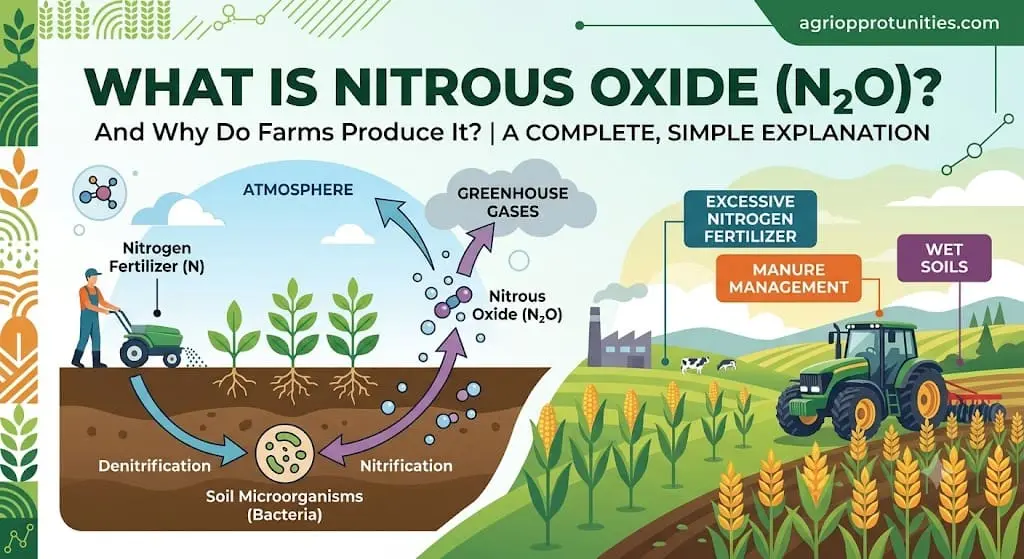
Given everything above, the next natural question is: where does most atmospheric N₂O actually come from? The answer, consistently across recent research, is agriculture. Estimates place agriculture’s share of global anthropogenic (human-caused) nitrous oxide emissions somewhere between 50 and 60 percent — meaning more than half of all the extra nitrous oxide humans are adding to the atmosphere traces back to farming. Within agriculture specifically, the picture is even more concentrated: recent assessments estimate global agricultural N₂O emissions at around 7.26 teragrams of nitrogen per year, with roughly 71.5 percent of that originating specifically from arable soils treated with synthetic nitrogen fertilizers. Nitrification and denitrification — the two microbial soil processes I’ll walk through in detail below — are together responsible for producing this entire agricultural contribution.
It’s also worth knowing that N₂O emissions haven’t been static. Over roughly the past three decades, the anthropogenic share of total N₂O emissions has climbed from around 36.1 percent to 42.9 percent according to IPCC assessments, and N₂O has recently become the fastest-growing major greenhouse gas category, with emissions increasing at a rate that in some recent years has actually exceeded even the higher-end projected emission scenarios climate models had anticipated. Recent research attributes much of this specific acceleration to a rising contribution from denitrification relative to nitrification — a mechanistic shift worth understanding in detail, which is exactly where we’re headed next.
The Two Main Ways Soil Actually Produces N₂O
This is the heart of the science, and it’s genuinely not complicated once you break it into its two core pathways. Both involve soil bacteria (and some archaea) transforming nitrogen compounds as part of their own metabolism, with N₂O escaping as a byproduct along the way—the microbes aren’t “trying” to produce a greenhouse gas; it essentially leaks from their normal biological nitrogen processing.
Pathway One: Nitrification
Nitrification is the microbial process that converts ammonium (NH₄⁺)—the form of nitrogen present in urea-based fertilizer and manure after it breaks down in soil—into nitrate (NO₃⁻), the form plants can most readily absorb through their roots. This process follows a specific sequence: soil microorganisms first oxidize ammonia into an intermediate compound called hydroxylamine. Two distinct groups of microorganisms carry out this transformation: ammonia-oxidizing archaea (AOA) and ammonia-oxidizing bacteria (AOB). Interestingly, AOA are actually more abundant than AOB in many soils, and current research suggests AOA-dominated systems may produce comparatively lower N₂O emissions than AOB-dominated ones, particularly in acidic soils where AOA tend to dominate because of their specific adaptations—though scientists are still working out exactly how much this balance ultimately affects overall emissions.
Crucially, nitrification requires oxygen—it’s fundamentally an aerobic process. The ammonia oxidation pathway produces N₂O as a minor, “leaky” byproduct, even under otherwise normal, well-aerated soil conditions.
Requires OxygenPathway Two: Denitrification
Denitrification works in almost the opposite direction and under almost the opposite conditions. When heavy rain, flood irrigation, or naturally poor drainage leaves soil waterlogged or oxygen-depleted, certain soil bacteria can no longer use oxygen for respiration and instead switch to nitrate (NO₃⁻). They gradually reduce nitrate through a sequence of nitrogen compounds, ultimately producing harmless nitrogen gas (N₂), the same inert gas that makes up most of our atmosphere. Nitrous oxide is one of the intermediate compounds in this reduction sequence, and under incomplete denitrification—which commonly occurs under real field conditions—a meaningful share of that N₂O escapes into the atmosphere before the microbes can fully reduce it to harmless N₂ gas.
Recent research has specifically identified denitrification, rather than nitrification, as the primary driver behind the recent acceleration in global N₂O emissions. This means the increase reflects not only greater fertilizer use but also the greater proportion of fertilizer nitrogen entering oxygen-poor soil conditions, where incomplete denitrification generates more N₂O instead of harmless N₂.
Low OxygenLesser-Known Additional Pathways
Beyond these two dominant processes, soil science recognizes additional, more minor N₂O-producing pathways that are worth understanding if you want to explore this field in greater depth. These include nitrifier denitrification, in which the same ammonia-oxidizing organisms responsible for nitrification also carry out a denitrification-like reduction under low-oxygen microsites within otherwise aerobic soil, and chemodenitrification, a set of purely chemical (non-biological) reactions that can generate N₂O under specific soil chemistry conditions, particularly in acidic soils with elevated nitrite. Researchers study these pathways less frequently than the two dominant ones above, but they complete the mechanistic picture and remain an active area of soil science research.
The “Hole in the Pipe” Way of Thinking About This
Soil scientists sometimes call this the “hole in the pipe” model — a concept I find genuinely useful for explaining N₂O emissions to students. Picture nitrogen moving through soil like water flowing through a pipe, traveling from fertilizer application toward plant uptake. Under ideal conditions, all that nitrogen “water” flows smoothly through to the crop. But the pipe has small holes in it — nitrification and denitrification — and at each hole, a small amount of nitrogen leaks out as N₂O rather than completing its intended path to the plant.
The size of those holes isn’t fixed. It expands or shrinks depending on a specific set of soil and environmental conditions. This variability makes N₂O emissions genuinely difficult to predict and manage compared to, say, straightforward carbon dioxide combustion emissions from a power plant.
What Actually Controls the Size of Those “Holes”: The Key Influencing Factors
N₂O emissions from soil aren’t a fixed, predictable rate. They’re highly sensitive to a specific combination of soil conditions, several of which farmers and researchers can actually influence through management decisions.
💧 Soil Moisture and Oxygen Availability
This factor arguably matters more than any other. Soil moisture directly controls how much oxygen reaches soil microbes. Wetter soil holds less oxygen, pushing the balance toward denitrification and often toward higher, less complete N₂O release. Drier, better-aerated soil favors nitrification instead. Flood irrigation — still the dominant irrigation method across much of Pakistan and South Asia — creates exactly the kind of waterlogged, low-oxygen conditions that favor higher denitrification-driven N₂O emissions. This connection between irrigation practice and greenhouse gas output rarely gets discussed together, yet it represents a concrete link worth understanding.
🌡️ Temperature
Microbial activity generally speeds up as soil temperature rises, within a certain range. Warmer soil conditions tend to accelerate both nitrification and denitrification rates, and by extension, N₂O production. However, extreme heat can eventually suppress microbial activity rather than continuing to boost it.
🧪 Soil pH
Soil acidity or alkalinity shifts which specific microbial populations dominate. Recall the AOA-versus-AOB dynamic mentioned earlier — AOA tend to dominate in more acidic soils. Soil pH also affects the chemical stability of intermediate nitrogen compounds involved in these pathways, directly influencing how much N₂O escapes relative to other nitrogen forms.
🧬 Available Nitrogen (Ammonium and Nitrate Concentrations)
The amount of ammonium and nitrate readily available in the soil — driven directly by fertilizer application timing and quantity — determines how much substrate exists for both nitrification and denitrification to act upon. More available nitrogen generally means more N₂O-producing microbial activity. However, this relationship isn’t simple, linear, or predictable (more on this below).
🌿 Soil Organic Carbon
Denitrifying bacteria need a carbon energy source to fuel their metabolism alongside nitrate. Soils richer in organic carbon tend to support more vigorous denitrification activity. Consequently, organic amendment practices (compost, manure, crop residue incorporation) can, somewhat counterintuitively, increase denitrification-driven N₂O output under certain conditions, even while offering other genuine soil health benefits. This nuance matters — organic inputs aren’t automatically emissions-neutral.
🏞️ Soil Texture and Type
Clay-heavy soils drain more slowly and hold water longer, creating more frequent low-oxygen conditions favorable to denitrification. Sandy, free-draining soils, in contrast, tend to favor nitrification. This explains why N₂O emission rates can vary dramatically between two fields receiving identical fertilizer rates — the difference often comes down to underlying soil texture.
“Hot Moments” and “Hot Spots”: Why N₂O Emissions Are So Unevenly Distributed
One of the more genuinely fascinating and frustrating aspects of N₂O research, from a measurement perspective, is how unevenly these emissions are distributed across both time and space. Research consistently shows that soil N₂O production is highly sensitive to dynamic environmental triggers, capable of producing large, short-lived emission spikes — researchers call these “hot moments” — that disproportionately account for a huge share of a field’s total annual N₂O budget, even though they may only last a few days following a specific rainfall or irrigation event immediately after fertilization. Similarly, “hot spots” exist spatially within a single field — small patches of soil, often correlated with pockets of higher organic matter content, that produce dramatically more N₂O than the surrounding, otherwise similar soil.
This unevenness is exactly why measuring N₂O accurately in the field is genuinely difficult, and why the instrumentation used in this kind of research — gas chromatography, static and dynamic chamber systems, and increasingly, high-precision analyzers like the Picarro systems used in modern flux research — needs to sample frequently enough, and across enough spatial replication, to actually capture these short-lived spikes rather than averaging them away and dramatically underestimating a field’s true annual emissions.
A Crucial Insight: More Fertilizer Doesn’t Mean Proportionally More N₂O
Here’s a finding from recent global meta-analysis research that has real practical significance and challenges an intuitive but incorrect assumption: the relationship between fertilizer nitrogen application rate and resulting N₂O emissions is not linear. For a long time, greenhouse gas inventories and mitigation models assumed a simple, constant “emission factor” — essentially, X percent of every additional kilogram of fertilizer nitrogen applied converts to N₂O, no matter how much fertilizer was already being applied. Recent global research comparing studies that tested multiple fertilizer rates side by side found this assumption doesn’t hold. Instead, N₂O emissions rise disproportionately once nitrogen application exceeds what the crop can actually take up and use — meaning the “extra” nitrogen applied beyond genuine crop demand contributes a disproportionately larger share of emissions than an equivalent amount of nitrogen applied within the crop’s actual uptake capacity.
This has a genuinely important practical implication, especially relevant to the discussion of nitrogen use efficiency in the previous piece in this series: in low-input systems typical of parts of sub-Saharan Africa, modest nitrogen additions have relatively little impact on N₂O emissions, since the crop is genuinely nitrogen-starved and absorbs nearly everything applied. But in already-excessively-fertilized systems — a description that fits a great deal of intensive farming across South Asia — an equivalent addition, or reduction, in fertilizer rate has a disproportionately large impact on N₂O output. In practical terms: cutting back on over-application in an already over-fertilized field yields a bigger emissions reduction, per kilogram of nitrogen saved, than making an equivalent cut in a genuinely nitrogen-limited system elsewhere.
What Real Mitigation Actually Looks Like
Given everything above, meaningful N₂O mitigation isn’t about eliminating nitrogen fertilizer — that would simply collapse crop yields and food security. It’s about closing the “holes in the pipe” as much as possible, so more of the nitrogen applied ends up in the crop and less leaks out as gas. A range of genuinely evidence-backed strategies exist, several of which overlap directly with the nitrogen use efficiency practices discussed in the previous piece in this series.
Enhanced Efficiency Fertilizers and Nitrification Inhibitors
Enhanced efficiency fertilizers (EEFs) are specifically engineered to slow or control the rate at which nitrogen becomes available in the soil, aiming to more closely match the timing of nitrogen release with the crop’s actual uptake demand, rather than flooding the soil with immediately available nitrogen all at once. Nitrification inhibitors, a specific and well-studied category of EEF, work by chemically slowing down the ammonia-oxidizing microbial activity responsible for the first step of nitrification, effectively keeping nitrogen in the more stable ammonium form for longer and reducing the pool of nitrate available to feed subsequent denitrification-driven N₂O losses. Research shows the effectiveness of nitrification inhibitors varies considerably depending on land use type, application method, climate, and specific soil conditions — meaning this isn’t a universal fix, but a genuinely useful tool that requires proper calibration to local conditions to be effective.
The Broader “4R” Nutrient Stewardship Framework
A widely used organizing framework in this space groups mitigation practices into four categories, often summarized as applying the Right source of nitrogen, at the Right rate, at the Right time, and in the Right place. In practice, this means: matching fertilizer type to soil and crop conditions rather than defaulting to a single standard product; calculating application rates based on realistic yield targets and existing soil nitrogen levels rather than a fixed traditional dose; splitting applications and timing them to align with the crop’s actual growth-stage nitrogen demand rather than one large upfront application; and placing or incorporating fertilizer into the soil rather than leaving it exposed on the surface, reducing both ammonia volatilization losses and the nitrate pool available for denitrification.
Water and Irrigation Management
Since soil moisture is one of the single most powerful drivers of the nitrification-versus-denitrification balance, improving irrigation practice is a genuinely direct N₂O mitigation lever, not just a water-conservation one. Moving away from continuous flood irrigation toward more controlled methods — drip irrigation, alternate wetting and drying in rice systems, or simply more precise timing of flood irrigation events relative to fertilizer application — reduces the frequency and duration of the waterlogged, low-oxygen conditions that favor high denitrification-driven N₂O losses.
Organic Amendments and Carbon Management, Used Carefully
Because denitrifying bacteria need organic carbon as an energy source, organic amendment practices require more nuanced management than the blanket assumption that “organic is automatically better for emissions.” Research on this topic distinguishes between the genuine soil health, water retention, and long-term fertility benefits of practices like compost application and crop residue incorporation, and the more complicated, context-dependent effects these same practices can have on short-term denitrification-driven N₂O output. This remains an area of genuinely active research rather than settled consensus, which is why soil scientists study how organic amendments affect gas flux instead of assuming a simple, universal direction of effect.
Exploring Alternative Approaches: Alternative Electron Acceptors
More recent, still-emerging research has explored genuinely creative approaches to this problem—for instance, introducing alternative electron acceptors like sulfate into upland arable soils. The underlying idea is that if researchers can encourage denitrifying microbes to use sulfate instead of nitrate for respiration, less nitrate enters the N₂O-producing denitrification pathway in the first place. Recent field experiments conducted over two growing seasons reported meaningful reductions in yield-scaled N₂O emissions (around 21.5 percent in one study) without compromising crop yield, while a broader meta-analysis of similar approaches reported an average 9 percent reduction in N₂O emissions, with most individual studies showing a decreasing trend. This remains an actively developing research area rather than a widely adopted farm-level practice, but it illustrates the kind of genuinely inventive soil chemistry solutions researchers are exploring to tackle this problem from an entirely different angle than fertilizer management alone.

Why This Matters for Students Considering Research in This Area
If any of this has genuinely interested you, it’s worth knowing that N₂O research sits at a particularly active and well-funded intersection of soil science, microbiology, and climate policy right now, given how disproportionately agriculture contributes to this specific greenhouse gas relative to its carbon dioxide emissions. Understanding both the microbial mechanisms (nitrification and denitrification) and the practical field-level factors that control them (moisture, temperature, carbon availability, nitrogen rate) gives you genuinely useful, employable expertise, whether your future path leads toward academic soil biogeochemistry research, agri-tech product development focused on precision fertilizer application, or policy-facing work connected to national greenhouse gas inventories and climate commitments.
Where This Series Goes Next
This piece has focused specifically on nitrous oxide as an isolated molecule and process. In the next piece in this series, I’ll explore a closely related but distinct challenge: the genuinely frustrating trade-off between nitrous oxide and ammonia losses, where practices that reduce one of these two nitrogen loss pathways can sometimes inadvertently increase the other—a real headache for anyone trying to design a truly comprehensive nitrogen management strategy and a good illustration of why soil nitrogen management is rarely a simple, single-lever problem.
For current research and graduate opportunities in soil science and greenhouse gas research, browse live agriculture scholarship listings on Agri Opportunities.
Frequently Asked Questions
How much more powerful is nitrous oxide than carbon dioxide as a greenhouse gas?
Nitrous oxide has a global warming potential roughly 298 times greater than carbon dioxide over a 100-year period, and it also persists in the atmosphere for over a century, making even small quantities disproportionately damaging.
What percentage of global nitrous oxide emissions come from agriculture?
Agriculture is responsible for approximately 50 to 60 percent of global anthropogenic nitrous oxide emissions, with the majority originating from arable soils treated with synthetic nitrogen fertilizers.
What are the two main soil processes that produce nitrous oxide?
Nitrous oxide is produced mainly through nitrification, the microbial oxidation of ammonium to nitrate, and denitrification, the microbial reduction of nitrate that occurs when soil oxygen is limited, such as in waterlogged conditions.
Does applying more fertilizer always produce proportionally more nitrous oxide?
No. Research shows the relationship between fertilizer nitrogen rate and nitrous oxide emissions is nonlinear, meaning emissions increase disproportionately once fertilizer is applied beyond what the crop can actually use, rather than rising at a steady, predictable rate.
Add Agri Opportunities as a preferred source on Google to see our latest blogs first.