The Second Agricultural Revolution – Complete AP Human Geography

Learn the causes, innovations, and long-term effects of the Second Agricultural Revolution. In addition, this guide explains mechanization, enclosure, crop rotation, and commercial farming in clear APHG terms.
What Was the Second Agricultural Revolution?
The Second Agricultural Revolution was a major transformation in farming methods that occurred between the 1700s and the mid-1800s. Although the movement started in Britain, its influence eventually spread throughout Europe and beyond. More importantly, improved farming systems created the food surpluses needed for industrial growth. As agricultural productivity increased, fewer laborers were required on farms. Consequently, millions of rural residents migrated toward rapidly growing cities.
Why This Topic Matters in AP Human Geography
Within AP Human Geography, the Second Agricultural Revolution serves as a foundational concept in Unit 5. Because the topic connects directly to industrialization and modern agriculture, students must understand its long-term significance. For example, commercial farming, precision agriculture, and agribusiness all trace their origins to this period. Likewise, many sustainable farming practices still reflect ideas developed during the eighteenth century. Ultimately, mastering this topic strengthens both historical analysis and exam preparation skills.
Causes of the Second Agricultural Revolution
Population Growth and Food Demand
During the eighteenth century, Europe experienced rapid population growth. Because more people required reliable food supplies, pressure on traditional farming systems increased dramatically. Existing agricultural methods could no longer produce enough crops efficiently. As a result, landowners and scientists began searching for innovative farming solutions.
Scientific Curiosity and Experimentation
Enlightenment thinking encouraged observation, experimentation, and scientific inquiry. Consequently, agricultural science advanced alongside improvements in soil management and crop production. Across Europe, wealthy landowners tested fertilizers, drainage systems, and planting methods. Furthermore, agricultural societies helped spread successful innovations between regions.
Investment and Commercial Incentives
Wealthy landowners possessed the capital needed to modernize farms and increase production. Because investment opportunities expanded during this period, many farmers purchased improved equipment and drainage systems. In many ways, this economic transformation represented an early form of agribusiness development. Eventually, productivity increased rapidly across enclosed agricultural lands.
Key Innovations and Inventions
The Seed Drill
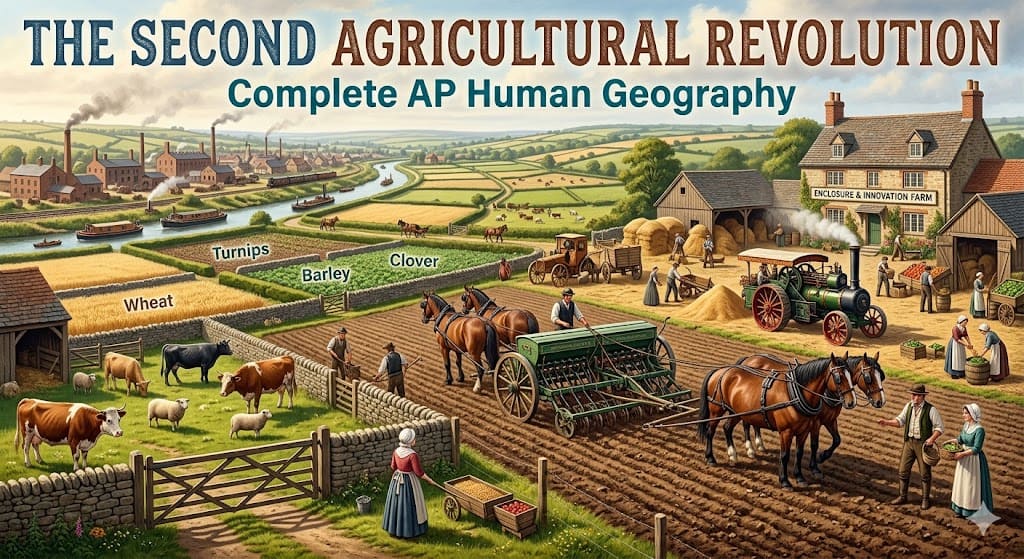
Jethro Tull’s seed drill transformed agricultural efficiency during the early eighteenth century. Instead of scattering seeds by hand, farmers could now plant crops in organized rows. Because seeds were distributed more accurately, crop yields improved substantially. Moreover, this innovation reduced waste while simplifying weeding practices. Over time, the seed drill became the foundation for modern precision planting technology.
🌱 Seed Drill
Improved planting efficiency and reduced waste.
🔄 Crop Rotation
Maintained soil fertility without fallow periods.
🐄 Selective Breeding
Produced healthier and larger livestock.
⚙️ Iron Plows
Allowed deeper cultivation of heavy soils.
Steam-Powered Machinery
By the nineteenth century, steam-powered threshing machines had spread throughout many farming regions. These machines separated grain from stalks far more efficiently than manual labor. Consequently, harvesting became faster and less labor-intensive. At the same time, mechanization displaced many agricultural workers from rural communities. In several areas, social tensions eventually led to protests such as the Swing Riots of 1830.
The Enclosure Movement
Through a series of legal reforms, common lands were consolidated into privately owned farms. As enclosed fields expanded, landowners gained greater control over production methods and investment decisions. Consequently, larger farms adopted improved techniques more efficiently than traditional communal systems. Nevertheless, many small farmers lost access to shared land and resources. Because of these disruptions, rural migration increased significantly throughout Britain.
Positive Effects
- Higher agricultural productivity
- Improved land management
- Greater investment in innovation
- More efficient crop rotation systems
Negative Effects
- Displacement of small farmers
- Loss of communal traditions
- Rapid urban migration
- Growing economic inequality
Crop Rotation and Soil Science
The four-field crop rotation system eliminated the need for fallow land. Instead of leaving fields unused, farmers rotated wheat, barley, clover, and turnips throughout the year. Because legumes restored nitrogen naturally, soil fertility remained stable over longer periods. In addition, livestock gained access to reliable winter feed supplies. As a result, agricultural productivity increased without synthetic fertilizers.
Mechanization of Agriculture
From Manual Labor to Machinery
Iron plows, seed drills, and threshing machines gradually replaced traditional manual labor across Europe. As farming became increasingly mechanized, agricultural efficiency improved at an unprecedented rate. However, many laborers feared unemployment and economic instability. For example, some rural workers destroyed machinery during periods of unrest. Nevertheless, mechanization continued expanding because productivity gains were too significant to ignore.
Long-Term Impact of Mechanization
Modern machinery reduced labor demands while improving speed, consistency, and productivity. Additionally, larger areas of farmland could be cultivated far more efficiently than before. Over time, innovations ranging from seed drills to autonomous tractors dramatically increased output per worker. Because productivity rose so rapidly, fewer farmers could feed substantially larger populations.
Effects on Society and the Economy
Urbanization and Population Growth
Food surpluses supported rapid population growth throughout Europe. Meanwhile, the enclosure movement displaced many rural workers from traditional farmland. Because of these combined pressures, migration toward industrial cities accelerated dramatically. Industrial centers then gained access to a large factory workforce. As industrialization expanded further, urban populations grew at an unprecedented pace.
Commercial Agriculture and Markets
Over time, subsistence farming gradually gave way to commercial agriculture. As a result, farmers increasingly produced crops for profit rather than local survival. In addition, agricultural markets became more interconnected through transportation and trade networks. Eventually, these developments laid the foundation for modern agribusiness systems.
Technological Transformation
As innovation accelerated throughout the nineteenth century, farming gradually became more scientific and data-driven. Improved machinery, better breeding practices, and expanding transportation systems all contributed to higher efficiency levels. Meanwhile, agricultural experimentation encouraged the development of more advanced farming methods. Over time, these breakthroughs influenced modern agritech, automation, and precision agriculture systems used today.
Environmental Consequences
Intensive farming methods increased productivity, yet they also contributed to soil degradation and habitat loss. In response, many modern agricultural systems now emphasize sustainability and regenerative practices. For instance, crop rotation and cover cropping continue supporting long-term soil health. Therefore, several environmental strategies today still reflect lessons learned during this historical revolution.
First vs. Second Agricultural Revolution
| Feature | First Agricultural Revolution | Second Agricultural Revolution |
|---|---|---|
| Time Period | ~10,000 BCE | 1700s–1800s |
| Main Change | Domestication | Mechanization |
| Technology | Hand tools | Seed drills and machinery |
| Labor Impact | Settlement growth | Factory workforce expansion |
The Revolution’s Modern Legacy
Connections to Modern Agribusiness
Beginning with eighteenth-century enclosure reforms and continuing through modern precision agriculture, the Second Agricultural Revolution permanently transformed global food systems. What started as a series of farming improvements eventually reshaped economies, migration patterns, and industrial development worldwide. Furthermore, many contemporary agricultural technologies still reflect innovations introduced during this era. For AP Human Geography students, studying this revolution provides valuable insight into both historical change and modern agriculture.
Frequently Asked Questions
Between the 1700s and 1800s, farming methods changed dramatically through mechanization, enclosure, and scientific innovation. As these advances spread across Europe, agricultural productivity increased substantially.
Large food surpluses and expanding factory employment opportunities accelerated both urbanization and industrial growth. Because of these changes, historians consider the revolution a major turning point in world history.
Modern machinery reduced labor demands while improving speed, consistency, and productivity. Additionally, larger areas of farmland could be cultivated far more efficiently than before.
Agriculture provided food surpluses, labor supply, and capital accumulation for expanding industries. Together, these interconnected factors made industrial growth possible throughout Britain and much of Europe.
APHG Practice Questions
- Which innovation is most closely associated with Jethro Tull?
- How did enclosure contribute to urbanization?
- Why did crop rotation improve productivity?
- In what ways did mechanization support industrial growth?
Conclusion
Beginning with eighteenth-century enclosure reforms and continuing into the age of precision agriculture, the Second Agricultural Revolution permanently transformed global food systems. What started as a series of farming improvements eventually reshaped migration patterns, industrial development, and economic growth worldwide. Moreover, many modern agricultural technologies still reflect innovations introduced during this era. For AP Human Geography students, studying this revolution provides essential insight into both historical change and contemporary agriculture.
Add Agri Opportunities as a preferred source on Google to see our latest blogs first.