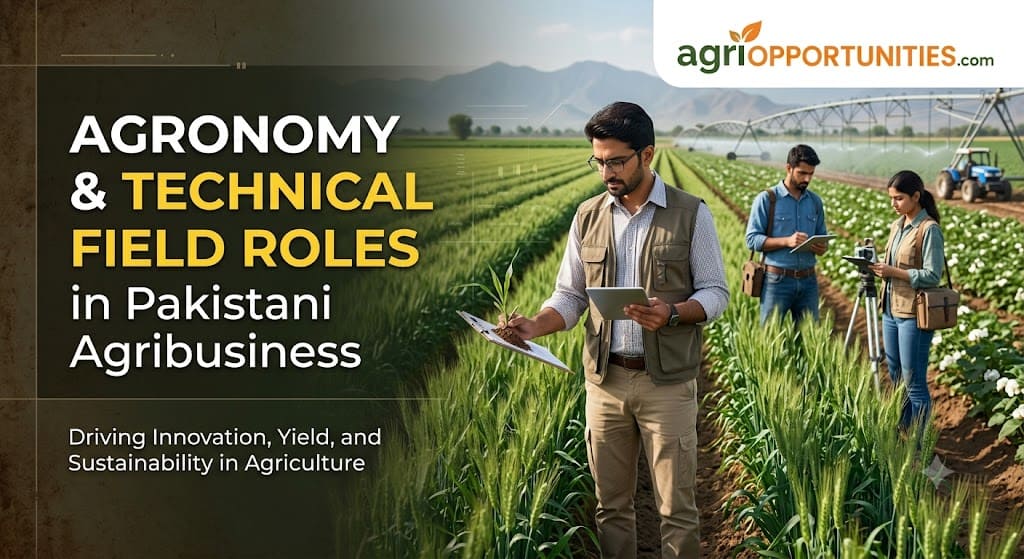
Agronomy and Technical Field Roles in Pakistani Agribusiness

Agronomy and Technical Field Roles in Pakistani Agribusiness
The technical career track — product knowledge, quality assurance, and agronomic expertise
Not everyone working at a fertilizer or agrochemical company in Pakistan is chasing a sales target. A distinct technical career track runs alongside the commercial sales structure — roles built around product knowledge, quality assurance, and agronomic expertise rather than dealer relationships and revenue quotas.
This guide covers that technical side specifically.

Why This Track Exists Separately From Sales
Fertilizer and agrochemical companies need genuine technical credibility to sell effectively — a sales officer without solid agronomic backing can struggle to answer a farmer’s specific crop question convincingly. Rather than expecting every commercial sales employee to also carry deep technical expertise, most companies maintain a separate technical function specifically to support the sales structure with product knowledge, training, and demonstration activity.
The Core Role: Agronomy Manager
An Agronomy Manager provides the technical backbone behind a company’s commercial operation. This role typically involves developing crop-specific fertilizer or product recommendations tailored to particular soil and growing conditions, training field sales staff on technical product content so they can speak credibly to farmers, and overseeing demonstration plots that show a product’s real performance under local conditions — genuinely persuasive evidence for a farmer weighing whether to switch products.
Why Demonstration Plots Matter So Much
A demonstration plot showing a visibly stronger crop stand or higher yield under a specific product regimen is often more convincing to a farmer than any amount of verbal sales pitching. Managing these plots well — choosing representative sites, ensuring fair comparison conditions, and communicating results clearly — is a genuinely skilled part of this role, sitting closer to applied agronomic research than to sales.
How This Role Connects Technical Knowledge to Commercial Outcomes
An Agronomy Manager’s effectiveness is ultimately judged by how well their technical support translates into stronger sales performance for the broader commercial team — meaning this role, while distinct from sales, isn’t disconnected from commercial outcomes either. It sits deliberately at the intersection, providing the credibility and evidence base the sales structure depends on.
Laboratory and Quality Control Roles
A separate technical function exists within manufacturing operations specifically: Lab Assistant roles supporting quality control at a fertilizer or agrochemical production site. This work involves testing product samples for nutrient content, consistency, and compliance with stated specifications — ensuring what actually ships to dealers and farmers matches what the label claims.
Why This Role Sits Entirely Outside the Sales Structure
Unlike nearly every other role covered across the agribusiness career pieces on this site, a Lab Assistant role carries no dealer relationship or commercial target whatsoever. It’s a genuinely distinct entry point for candidates whose interest lies in the analytical and quality assurance side of agriculture rather than field-based relationship management — closer in spirit to the grain and flour quality analysis work covered elsewhere on this site than to any sales-adjacent position.

Understanding the Sales-Tier Title Structure
Job postings in this sector commonly use a tiered set of abbreviated titles — variations built around business, branch, and field-level sales designations — to structure a commercial hierarchy across different levels of territory and responsibility. While the exact naming conventions vary meaningfully between companies, the underlying pattern is broadly consistent with the sales hierarchy covered in our companion pieces on fertilizer and pesticide sales careers: a field-level role covering a defined local area, reporting up through progressively broader territory and business management tiers.
Why This Matters for Understanding a Specific Job Posting
Given how much these abbreviated titles vary by company, it’s genuinely worth reading the actual listed responsibilities in any specific posting rather than assuming a fixed, universal meaning for a given abbreviation — the same three-letter title can carry a meaningfully different scope of responsibility from one company to the next, and the job description itself is a more reliable guide than the title alone.
How the Technical Track Connects to Broader Career Progression
Movement between the technical and commercial sales tracks is genuinely common, and it typically flows in one particular direction more than the other: a strong technical or agronomy-focused background is frequently valued when moving into a more senior commercial or key account management role, since deep product knowledge built through technical work translates directly into commercial credibility with larger, more sophisticated buyers or dealer accounts.
Why Starting on the Technical Side Can Be a Genuine Advantage
Rather than viewing the technical track as a separate, parallel career from commercial sales, it’s often more accurate to see it as a strong foundation that can lead into senior commercial roles later — an agronomy manager who later moves into a regional sales or key account role brings a genuinely differentiated depth of product credibility that someone who started purely in sales may lack.
What Qualifications These Roles Typically Require
Agronomy Manager roles generally require a strong agriculture, agronomy, or soil science background, often at the MSc level given the technical depth expected, alongside genuine field research or extension experience. Lab Assistant roles typically require a BSc in a relevant technical discipline — chemistry, soil science, or agriculture — with laboratory technique proficiency valued explicitly, connecting to the same technical skill set covered in our companion piece on grain and flour quality analysis.
Practical Advice for Building a Career on This Track
If you’re academically strong but less drawn to direct farmer and dealer relationship management, this technical track offers a genuinely credible, well-respected career path within the same agribusiness companies covered throughout the sales-focused pieces on this site. Build genuine depth in a specific technical area — nutrient management, quality analysis, or crop-specific agronomy — since this specialization is exactly what differentiates a technical hire from a general agriculture graduate. And if your longer-term ambition includes senior commercial leadership, recognize that starting on the technical side and building demonstrated product credibility can be a genuinely strong foundation for that later move, rather than a separate, disconnected career path.
For current openings in agronomy, technical, and quality control roles across Pakistan’s agribusiness sector, browse live agriculture job listings on Agri Opportunities.
Technical Excellence in Agribusiness
Agronomy and technical roles offer a credible, well-respected career path within Pakistan’s agribusiness sector — distinct from commercial sales, but essential to the industry’s success. From agronomy management to laboratory quality control, these roles reward genuine technical depth and analytical skill.
Explore agronomy and technical roles in Pakistan →Frequently Asked Questions
What does an Agronomy Manager do at a fertilizer or agrochemical company?
An Agronomy Manager provides technical crop management expertise to support a company’s commercial sales function, advising on fertilizer or product recommendations for specific crops and soil conditions, training field sales staff on technical content, and often overseeing demonstration plots that show a product’s real-world performance.
How is a Lab Assistant role at a fertilizer company different from a sales role?
A Lab Assistant supports quality control processes at a manufacturing site, testing product samples for nutrient content and consistency, and works entirely within technical and production functions rather than the commercial dealer and farmer-facing sales structure.
What is the difference between sales-tier and technical-tier roles at an agrochemical company?
Sales-tier roles, commonly structured across business, branch, and field-level titles, carry direct revenue and territory targets, while technical-tier roles support that commercial structure with product knowledge, quality assurance, and demonstration activities without carrying a direct sales quota themselves.
Can someone move between the technical and sales tracks at an agribusiness company?
Yes, movement between tracks is common, particularly from a technical or agronomy-focused role into a commercial or key account management role, since strong product knowledge built on the technical side is genuinely valued in more senior commercial positions.
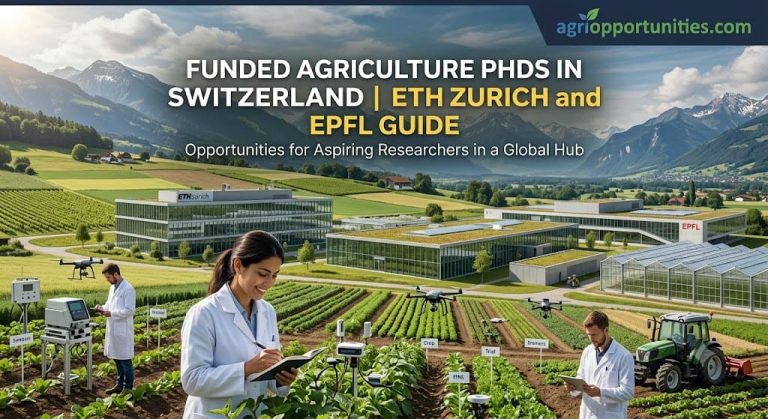
Switzerland runs the same broad employment-based PhD model as Denmark and Sweden, covered elsewhere on this site, but with a few genuinely distinctive details worth understanding before you apply — including some of the highest doctoral compensation in Europe, paired with famously high living costs. This guide focuses on Switzerland’s two federal institutes of technology, ETH Zurich and EPFL, the two most prominent destinations for agriculture-adjacent PhD research in the country.

PhD as Genuine, Well-Paid Employment
As with the Nordic systems covered elsewhere on this site, Swiss PhD students are not typically “scholarship students” in the traditional sense — they’re full-time university employees, commonly referred to as scientific or doctoral assistants, hired on contracts with salaries defined by national scales.
What This Actually Pays
As of 2026, EPFL’s basic starting salary for a doctoral assistant is 55,225 Swiss francs gross per year. More broadly across ETH and EPFL, doctoral stipends range from roughly 50,000 to 62,000 francs annually — genuinely well above typical European PhD compensation, including comparison points like Germany’s DFG-funded positions, which sit closer to 45,000 to 55,000 euros.
The Living Cost Reality Check
It’s worth being honest that this higher pay reflects genuinely higher costs, not just better funding. Zurich and Geneva rank among the most expensive cities globally for cost of living, placing in the same tier as Hong Kong, Singapore, and New York — meaning the higher salary needs to be weighed against a correspondingly higher cost base rather than treated as pure additional purchasing power.
Tuition Is Almost an Afterthought
Given the employment-based structure, tuition fees are genuinely minimal — often just a few hundred Swiss francs per semester, with ETH Zurich specifically citing fees around 809 CHF per semester. Your salary is effectively your entire funding package, rather than needing to separately cover significant tuition costs on top of living expenses.
How PhD Admission Actually Works
You Generally Need a Doctoral Program Behind You First
At EPFL specifically, you must be admitted by a doctoral program before you can be hired as a doctoral assistant. In some cases, a doctoral program may admit a candidate even without a corresponding funded position immediately available — in that situation, the candidate remains eligible for hiring for up to one year while funding is sought, and can pursue individual scholarships and external funding in parallel.
Finding a Supervisor Is the Real First Step
As with Germany’s traditional PhD model covered elsewhere on this site, Swiss admissions tend to be based on genuine fit and research alignment between you and a specific supervisor, rather than a standardized, purely metrics-based admissions process. Direct outreach to a professor whose research matches your interests — following the same approach recommended in the general research assistantship guide elsewhere on this site — is typically the practical starting point, sometimes taking several months of sustained outreach before securing a supervisor’s commitment.
A Concrete, Currently Open Example: ETH Zurich’s Agricultural Economics PhD
To make this genuinely concrete rather than abstract, it’s worth looking at an actual recent ETH Zurich posting closely matching this site’s focus. ETH Zurich advertised a four-year doctoral position in Agricultural Economics and Policy, working under Professor Robert Finger within the Agricultural Economics and Policy Group, as part of the ACHIEVE project — a major national Swiss research initiative focused on pathways to net-zero for Switzerland’s hardest-to-abate emissions sectors, including agriculture.
What Made This Position Attractive
The role offered a full ETH Zurich doctoral salary, social benefits, and direct involvement in a genuinely consequential national climate policy project — connecting real agricultural economics research to Switzerland’s actual net-zero transition planning, rather than purely theoretical academic work disconnected from policy application.
What the Application Actually Required
Applicants needed to submit a cover letter, CV, academic transcripts, and contact details for two referees, all combined into a single PDF document, through ETH Zurich’s online application portal. The position was open to both recent master’s graduates and students still completing their degree in agricultural economics or a related discipline.
A Language Detail Worth Noting
Some Swiss positions, including certain policy-facing roles, may favor or require proficiency in one of Switzerland’s major working languages (German or French) alongside English, which can meaningfully narrow the international applicant pool for those specific roles — worth checking carefully on each individual posting rather than assuming English alone is always sufficient, even at internationally-oriented institutions like ETH and EPFL.
Where to Actually Search for Swiss PhD Positions
Direct University Job Portals
ETH Zurich, EPFL, and other Swiss universities including Zurich, Geneva, Lausanne, Bern, Basel, and Fribourg regularly advertise PhD openings directly on their own job portals, alongside general academic job boards like Academic Positions and FindAPhD.
Structured Graduate Schools
Beyond individually advertised positions, structured graduate schools offer another entry route — the Life Science Zurich Graduate School, a joint programme between ETH Zurich and the University of Zurich, offers over 100 fully funded PhD positions across roughly 500 research groups in the life sciences broadly, a genuinely large and relevant pool for agriculture-adjacent research interests.
Swiss Government Excellence Scholarships
Run by Switzerland’s Federal Commission for Scholarships for Foreign Students, these national-level awards are available to postgraduate researchers from over 180 countries across any discipline, funding either a full PhD (usually up to three years) or a shorter research stay during a PhD already underway elsewhere. Every application must be formally backed by a professor, reinforcing again how central that initial supervisor relationship is across nearly every Swiss funding route.
What Makes ETH and EPFL Genuinely Distinctive as a Career Investment
Beyond the funding mechanics, it’s worth knowing that ETH and EPFL graduates report notably strong academic placement outcomes, with some tracking suggesting a meaningful probability of landing a tenure-track position at a top-100 global university within five years of graduation — among the stronger placement outcomes for any doctoral programme outside a small handful of the most prestigious US and UK institutions. Both universities also maintain well-established industry connections with major companies including Nestlé, relevant for agriculture and food science graduates specifically considering an industry rather than purely academic career path.
Practical Tips for a Competitive Application
Start supervisor outreach well in advance, since securing a professor’s genuine commitment can take several months of sustained contact, and treat this relationship-building as the actual gating step in your application timeline rather than an afterthought. Confirm language requirements explicitly for any specific posting rather than assuming English alone suffices, particularly for policy-facing or applied research roles. And budget realistically for Swiss living costs specifically — the higher salary figures covered in this guide need to be weighed honestly against Zurich and Geneva’s position among the most expensive cities in the world, rather than treated as straightforwardly superior to lower-paying positions in more affordable countries.
For currently open PhD positions in Switzerland and across Europe, browse live agriculture scholarship listings on Agri Opportunities.
Frequently Asked Questions
How much does a PhD student at ETH Zurich or EPFL actually earn?
As of 2026, EPFL’s basic starting salary for a doctoral assistant is 55,225 Swiss francs gross per year, while ETH and EPFL doctoral stipends more broadly range from roughly 50,000 to 62,000 francs annually, well above typical European PhD compensation.
Do I need to find a supervisor before applying for a PhD in Switzerland?
Yes, in most cases. At EPFL specifically, you must be admitted by a doctoral program before you can be hired as a doctoral assistant, and finding a professor willing to supervise your specific research area is typically the first practical step.
How much does PhD tuition cost in Switzerland?
Tuition fees are very low, often only a few hundred Swiss francs per semester, since most PhD students are treated as full-time university employees rather than fee-paying students, meaning your salary functions as your primary source of funding.
What is the Swiss Government Excellence Scholarship?
It’s a national-level award, run by the Federal Commission for Scholarships for Foreign Students, available to postgraduate researchers from over 180 countries, funding either a full PhD of usually up to three years or a research stay during a PhD already underway elsewhere.
Add Agri Opportunities as a preferred source on Google to see latest guide listings first.

Sir mujy job k sakt zarort h mehrbane karo thanks