What Is Biochar, and Can It Really Reduce Farm Emissions?

A soil scientist’s honest look at what biochar can and can’t do for farm emissions and soil carbon.
Of all the soil amendments I get asked about by students, biochar generates the most excitement and the most confusion in equal measure. It gets described online as everything from a minor soil conditioner to a genuine climate solution capable of reversing agriculture’s carbon footprint. Neither extreme is quite right. The real picture is more interesting, and more conditional, than either version — biochar can do a lot, but exactly how much depends heavily on details that most casual coverage skips entirely.

What Biochar Actually Is
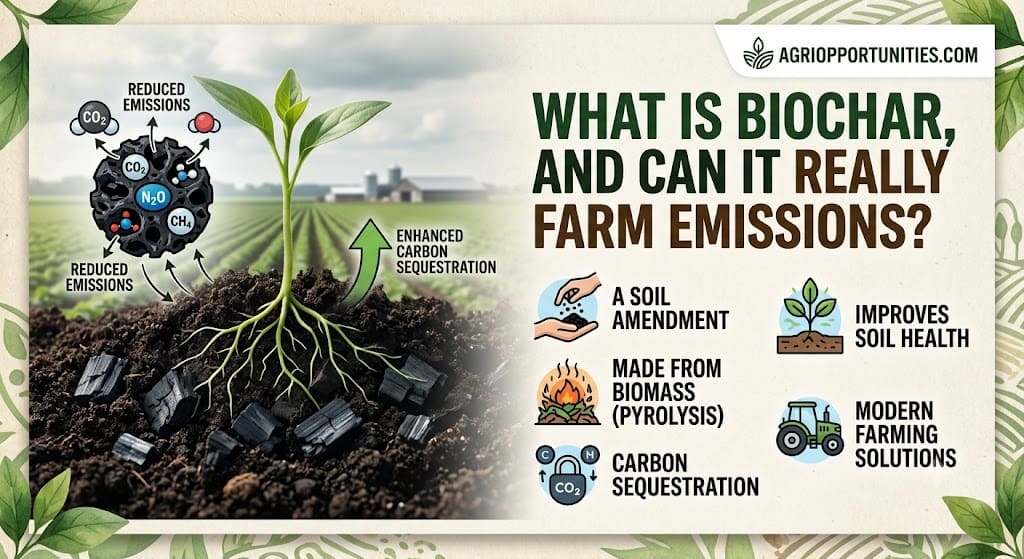
Biochar is produced through pyrolysis: heating biomass — crop residue, wood waste, manure, or other organic material — under low-oxygen conditions rather than letting it fully combust or decompose naturally. This process converts the biomass into a stable, carbon-rich solid with a distinctive, highly porous structure.
That structure is the whole point. Instead of the carbon in a crop residue breaking down within a few years and releasing CO₂ back to the atmosphere, or burning off almost instantly in a field fire, pyrolysis locks a large share of that carbon into a chemically stable, aromatic structure that resists microbial breakdown for a very long time.
Why Scientists Call It a “Negative Emissions” Technology
The Intergovernmental Panel on Climate Change (IPCC) recognizes biochar as a genuine carbon dioxide removal strategy and includes it in virtually every modeled pathway to global net-zero emissions. That represents a significant endorsement, as the IPCC reserves these core scenarios for technologies supported by strong scientific evidence rather than speculation.
The science is straightforward. Instead of allowing biomass to decompose or burn and release its carbon back into the atmosphere within a few years, pyrolysis converts that carbon into a stable form that can remain in soil for decades or even centuries. When farmers apply biochar at scale, they remove carbon from the active atmospheric cycle instead of simply slowing the release of new emissions.
The Scale of Potential Impact
Researchers estimate that widespread biochar application across China’s farmland could increase soil organic carbon by 1.9 petagrams while reducing methane and nitrous oxide emissions by about 25 and 20 million tonnes of CO₂-equivalent per year, respectively. The same studies also project a 19 percent increase in crop yields. These substantial gains from a single agricultural practice explain why biochar continues to attract strong interest from researchers and policymakers.
The Part Most Coverage Leaves Out: It Depends Heavily on Feedstock and Temperature
Here’s where the science gets more conditional than the enthusiastic headlines suggest. Research comparing different biochar types found that high-temperature biochar produced from lignin-rich feedstocks tends to decrease methane and nitrous oxide emissions specifically in acidic soils, thanks to its especially stable aromatic carbon structure.
Low-temperature biochar made from manure behaves quite differently — it can boost crop yield meaningfully in low-fertility soils, but its greenhouse gas effects don’t follow the same pattern as the high-temperature, lignin-based material. In other words: “biochar” isn’t one single product with one guaranteed effect. Feedstock choice and production temperature are doing a lot of the work in determining what you actually get.
How Biochar Actually Suppresses Nitrous Oxide
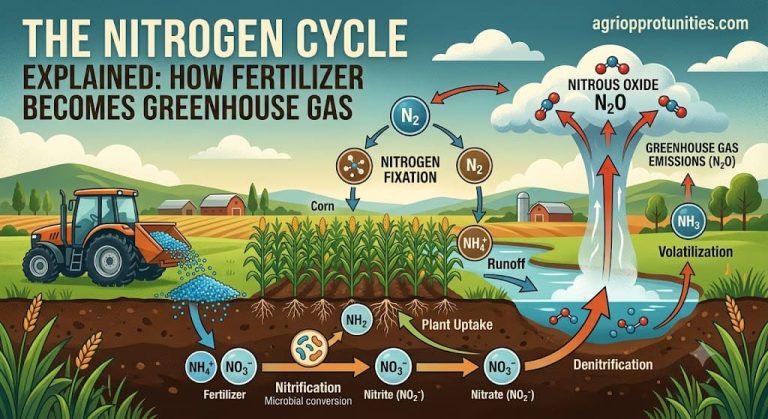
Given everything covered in the earlier pieces in this series about nitrification and denitrification, it’s worth explaining specifically how biochar interacts with those processes. Biochar’s porous structure and surface chemistry can improve soil aeration and alter the availability of nitrogen compounds that feed denitrification, which is part of why well-documented research consistently notes a suppression of N₂O emissions as one of biochar’s more reliable greenhouse gas benefits.
It’s not a complete fix, though. The magnitude of this suppression varies with soil type, moisture conditions, and the same feedstock and temperature factors discussed above — consistent with the broader theme from this series that soil greenhouse gas dynamics rarely respond to a single intervention in a simple, uniform way.

Beyond Emissions: The Soil Health Co-Benefits
Biochar’s appeal isn’t purely about greenhouse gases. Long-term field studies tracking biochar effects over a full decade found sustained improvements in soil organic carbon and soil acidity, meaning biochar can meaningfully reduce a farm’s dependence on repeated lime applications to correct acidic soil.
By buffering acidity and building stable soil carbon at the same time, biochar can also lower the risk of nutrient losses to air and water — directly relevant to the nitrogen loss pathways discussed throughout this series. Depending on feedstock and soil conditions, it can also improve nutrient retention and water-holding capacity, both genuinely valuable in water-stressed farming systems.
Does the Benefit Last, or Fade Over Time?
A natural question for any soil amendment is whether its benefits hold up under repeated, real-world use rather than just in a single trial season. Recent research analyzing 29 long-term field experiments, spanning four to twelve years, found that annual biochar application sustained, and in some cases even enhanced, benefits to crop yield, greenhouse gas mitigation, and soil organic carbon over time.
That’s a genuinely reassuring finding for a technology sometimes accused of being a short-term fix. But the same research flagged an important caveat worth taking seriously.
The Caveat: Repeated Application Isn’t Risk-Free
Continuous, repeated biochar application over many years can raise soil pH further than intended, potentially reduce the effectiveness of certain agrochemicals, and in some cases affect soil microbial communities in ways researchers don’t yet fully understand. This doesn’t undermine biochar as a practice, but it does mean application rates and frequency need genuine site-specific management, not a one-size-fits-all annual dosing schedule assumed to be safe indefinitely.
Why the Carbon Accounting Is Still Genuinely Debated
One more honest caveat, because it matters for anyone considering biochar-related research or carbon credit involvement: scientific debate persists around exactly how to estimate the long-term persistence of biochar-derived carbon in soil. These estimates matter enormously for greenhouse gas inventories, carbon credit markets, and formal life-cycle assessments, and getting them wrong in either direction — overestimating or underestimating persistence — has real consequences for how much climate benefit is actually being claimed versus delivered.
Researchers still face a major challenge when measuring and verifying biochar’s long-term performance, making it an active area of research rather than a fully settled technology. Recent studies highlight the need for better methods to measure soil bulk density and track carbon persistence in biochar-amended soils.
A Personal Connection to This Topic
I find this area particularly compelling because my research focuses on digestate and biochar co-application for improving nitrogen retention and reducing greenhouse gas emissions. Combining biochar’s stable carbon structure with the nutrient value of digestate reflects the systems-level approach emphasized throughout this series: no single soil amendment solves every problem, but carefully combining complementary amendments under the right soil and feedstock conditions can deliver meaningful improvements.
Where This Series Goes Next
Having now covered nitrogen cycling, nitrous oxide, the ammonia trade-off, and biochar, the next piece in this series turns to a related but distinct set of practices: cover crops and organic amendments, and exactly how they influence soil emissions — sometimes helping, sometimes complicating, the same nitrogen dynamics discussed throughout this series.
For current research and graduate opportunities in soil science and carbon management, browse live agriculture scholarship listings on Agri Opportunities.
Frequently Asked Questions
What exactly is biochar made from?
Biochar is produced by heating biomass, such as crop residue, wood waste, or manure, under low-oxygen conditions through a process called pyrolysis, which converts the material into a stable, carbon-rich solid rather than allowing it to fully combust or decompose.
Does biochar always reduce nitrous oxide emissions?
No. Research shows the effect depends heavily on the feedstock and production temperature, with high-temperature biochar made from lignin-rich material more likely to reduce nitrous oxide and methane emissions, particularly in acidic soils, while low-temperature biochar from manure behaves differently.
How long does biochar actually store carbon in soil?
Because of its stable, recalcitrant carbon structure, biochar can persist in soil for decades or even centuries, significantly slowing the return of that carbon to the atmosphere compared to untreated biomass left to decompose or burn.
Are there any downsides to repeated biochar application?
Yes. Long-term studies note that repeated annual biochar application can raise soil pH over time, potentially reduce the effectiveness of certain agrochemicals, and in some cases affect soil microbial communities, meaning application rates need careful, site-specific management.
Add Agri Opportunities as a preferred source on Google to see our latest blogs first.