What Are the Different Types of Supervised Agricultural Experiences? A Complete Breakdown

What Are the Different Types of Supervised Agricultural Experiences?
A Complete Breakdown
Complete guide to Supervised Agricultural Experiences (SAE). Learn about the 4 types of SAE programs: Entrepreneurship, Placement, Research, and Exploratory. Includes examples, benefits, and FFA information.

Learning Agriculture by Living It
There is a fundamental truth at the heart of agricultural education. Specifically, farming cannot be fully learned from a textbook alone. The soil, the seasons, the animals, the markets, and the unpredictable realities of growing food require something that no classroom can provide. Therefore, direct, hands-on experience with the work itself is absolutely essential. Moreover, this practical knowledge builds confidence and competence simultaneously.
This is the philosophy behind Supervised Agricultural Experiences, universally known as SAE programs. Developed as a cornerstone of agricultural education in the United States, the SAE framework gives agriculture students a structured pathway to gain real-world agricultural skills. Furthermore, it helps them explore career options and develop entrepreneurial thinking. Additionally, it enables them to conduct meaningful research and build practical competencies. Consequently, graduates become truly ready for agricultural careers rather than having only studied them in theory.
What Is a Supervised Agricultural Experience?
A Supervised Agricultural Experience — SAE — is a structured, student-led learning program. It is conducted outside of regular classroom instruction. Importantly, it operates under the guidance of an agricultural educator. Moreover, it connects to a real-world agricultural setting. Therefore, SAE programs are one of the three interlocking components of quality agricultural education in the United States. These components include classroom instruction, laboratory instruction, and FFA membership with leadership development.
The supervised agricultural experience framework is rooted in experiential learning. This educational philosophy holds that deep, lasting knowledge is built through doing, reflecting, and applying. In the context of agricultural education SAE programs, this means students plan, execute, document, and evaluate their own agricultural projects. Furthermore, they receive supervision from their agriculture teachers and, where applicable, employers, mentors, or family members. Thus, the learning is both structured and personalized.
SAE programs are associated with the National FFA Organization — formerly the Future Farmers of America. This organization integrates FFA supervised agricultural experiences into its student recognition and award systems. Consequently, students who develop outstanding SAEs can be recognized through FFA proficiency awards, degrees, and scholarships. Therefore, the importance of supervised agricultural experiences lies in their role as the practical bridge between agricultural science education and real-world competencies required for agricultural careers.
Why SAE Programs Matter: The Case for Experiential Learning
Why are SAE programs important? The answer is rooted in research on vocational agriculture training and experiential education. Studies consistently show that students who engage in structured work-based learning agriculture programs develop stronger career readiness skills. Moreover, they gain deeper content knowledge than those whose education remains entirely classroom-based. Additionally, they develop clearer career pathways.
🎯 Career Readiness
The agricultural workforce development challenge facing the agriculture industry is significant. Agribusiness, agricultural science, and agritech companies all report difficulty finding graduates with practical skills. SAE programs address this gap directly by embedding agricultural skill development in real operational settings. Therefore, students graduate with documented, verifiable agricultural work experience that sets them apart.
👥 Agricultural Leadership Development
SAE programs develop leadership qualities that classroom instruction alone cannot cultivate. These include problem-solving under real conditions and responsibility for outcomes. They also include resource management and adaptive judgment. Such qualities come only from managing real agricultural enterprises or conducting original research. Consequently, SAE fosters the leadership that organizations like the National FFA Organization are designed to develop.
🔗 Connecting Education to Careers
Agricultural career pathways — from farming and agronomy to agricultural engineering and agribusiness management — all benefit from the foundation that SAEs provide. Students who complete relevant SAE projects gain early exposure to specific career sectors. Thus, they make more informed decisions about BSc agriculture degree choices, specializations, and long-term career directions. For this reason, SAE is invaluable.
Type 1: Entrepreneurship SAE
What Is an Entrepreneurship SAE?
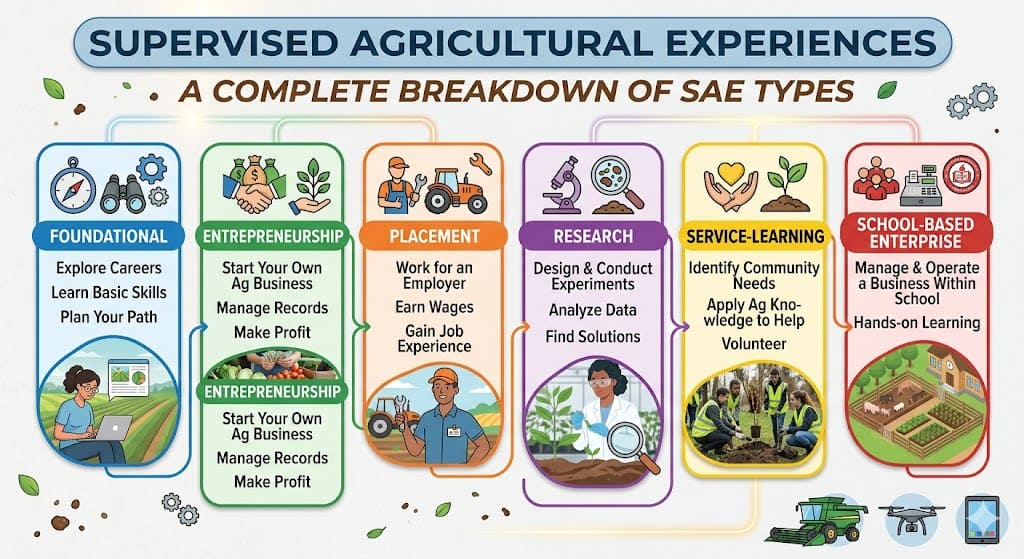
An entrepreneurship SAE is a supervised agricultural experience where the student owns, manages, and operates an agricultural enterprise as a genuine business undertaking. The student invests in the enterprise and makes management decisions. Additionally, they assume financial risk and earn or lose income based on outcomes. Therefore, this is the most traditional form of supervised agricultural experience. Furthermore, it prepares students for farm ownership and agribusiness management careers.
This approach reflects the original vision of agricultural education as preparation for farm ownership and agricultural business management. However, the entrepreneurship SAE has evolved well beyond its traditional roots. Today it encompasses a vast range of student-owned agriculture business activities. For example, livestock production, crop farming, horticultural enterprises, agricultural processing businesses, and agritourism operations are all included. Thus, it reflects the full diversity of the modern agriculture industry. Consequently, almost any agricultural interest can become an entrepreneurship SAE.
Examples of Entrepreneurship SAE Projects
🐷 Livestock Production
Raising and selling market hogs, cattle, sheep, or poultry. This combines animal farming skills with livestock market knowledge. Students manage feeding, health, and marketing of their animals.
🌽 Crop Production
Growing and selling vegetables, herbs, or flowers from a garden plot, school greenhouse, or family farmland. Students learn planting, cultivation, harvesting, and marketing skills.
🥚 Egg Production
Operating a small egg production enterprise. Students purchase hens, manage feeding and health, and sell eggs at local markets. This enterprise teaches daily management and quality control.
🍯 Value-Added Products
Producing and selling honey, jams, baked goods using farm-grown ingredients, or artisan food products. This develops processing, packaging, and direct marketing skills.
What Students Learn from Entrepreneurship SAE
The farming entrepreneurship project experience develops agricultural enterprise experience that encompasses both practical farming skills and business management competencies. Students learn agricultural financial management — tracking income, calculating costs, analyzing profitability, and managing cash flow. They also develop farm management decision-making skills. Furthermore, they build the agricultural entrepreneurship mindset characterized by initiative, risk tolerance, and creative problem-solving. FFA SAE record keeping is a critical component of entrepreneurship SAE. Students maintain detailed records of all income, expenses, inventories, and management decisions. Consequently, they develop the farm accounting habits that professional farming and agribusiness operations depend on. For these reasons, entrepreneurship SAE is highly valued by agricultural employers and colleges.
Type 2: Placement SAE
What Is a Placement SAE?
A placement SAE is a supervised agricultural experience where the student is placed in an agricultural work setting. This could be on a farm, in an agribusiness, at a government agriculture department, with a veterinary practice, or in any other agricultural employment environment. Students gain supervised work-based learning agriculture experience as an employee, intern, or volunteer. Therefore, this SAE type is ideal for students who want to learn from experienced professionals.
Unlike the entrepreneurship SAE where the student owns and manages the enterprise, the placement SAE positions the student as a learner within an existing agricultural operation. The supervised agricultural placement structure ensures that the student’s agriculture teacher maintains regular contact with the employer or supervisor. Therefore, the student’s experience remains educationally meaningful and appropriately challenging. Moreover, this structure provides valuable networking opportunities.
Examples of Placement SAE Programs
🚜 Farm Internship
Working on a crop farm, livestock operation, dairy, poultry facility, or horticultural enterprise during after-school hours, weekends, or school breaks. Students gain hands-on experience in daily farm operations.
🏪 Agribusiness Employment
Working at a feed store, farm equipment dealer, ag machinery supplier, or agri shop. Students learn retail agricultural sales, customer service, and product knowledge.
🐾 Veterinary Assistant
Placement at a large or small animal veterinary practice. Students assist with animal care, learn clinical procedures, and develop animal health knowledge.
🏢 Agricultural Services
Placement with an agricultural extension office, county agriculture department, or agricultural engineering firm. Students learn about government agricultural programs and professional services.
What Students Learn from Placement SAE
Placement SAE programs develop career readiness skills through direct workplace learning agriculture. Students understand professional expectations and develop agricultural skill development through repetition and mentorship. They also gain exposure to the real operational realities of agricultural career pathways. Additionally, students in agricultural placement programs build professional networks and develop references for future employment. Agriculture internship opportunities accessed through placement SAE are often pathways to full-time employment after graduation. For this reason, placement SAE is excellent for career exploration and skill building.
Type 3: Research SAE
What Is a Research SAE?
A research SAE is a supervised agricultural experience where the student designs and conducts an original investigation, experiment, or systematic inquiry into an agricultural question. Research SAE programs represent the intersection of agricultural education and agricultural science. Therefore, they develop the investigative thinking, experimental design, data collection, and analytical skills that underpin agricultural research and innovation. Moreover, they prepare students for careers in agricultural science and agritech.
Research-based SAE programs can take two primary forms. First, experimental research involves designing a controlled experiment and collecting original data. Second, analytical research (also called agriscience research) involves analyzing existing data or conducting systematic literature reviews and case studies on agricultural topics. Thus, there are options for students with different research interests and resources.
Examples of Research SAE Projects
🌱 Crop Experiments
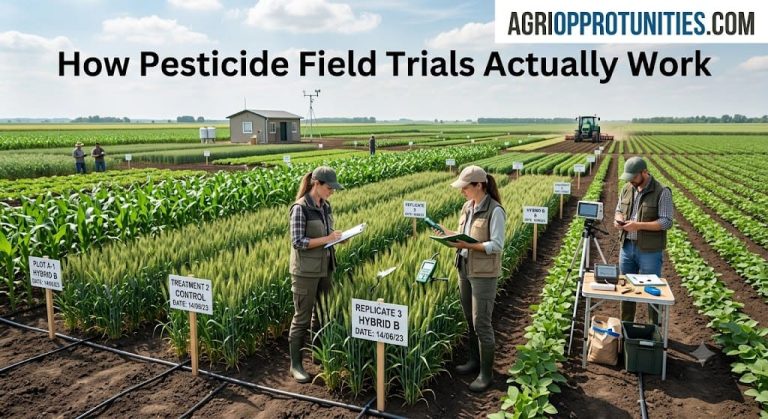
Comparing the yield effects of different fertilizer agriculture treatments or soil amendments on a specific crop. Students learn experimental design and statistical analysis.
🌿 Farming Method Comparisons
Investigating the effectiveness of natural farming or JADAM organic farming methods versus conventional practices on crop health and soil biology. Students conduct side-by-side trials.
📡 Precision Ag Research
Researching precision agriculture tools by comparing the accuracy of different GPS field measurement apps or agricultural land area calculators. Students evaluate technology performance.
🌍 Soil Carbon Research
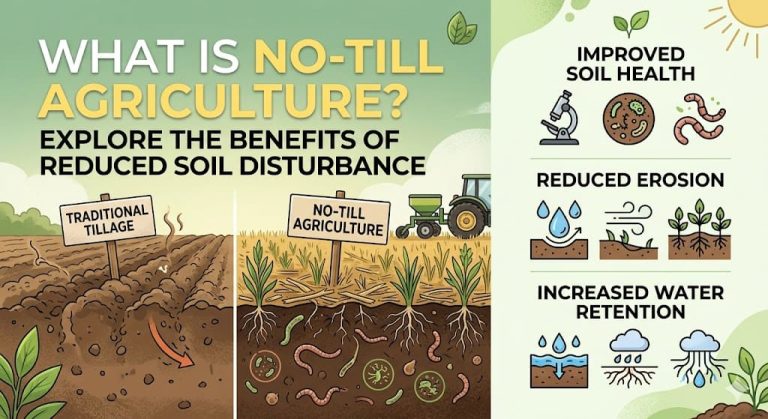
Comparing soil carbon storage under no till farming versus conventional tillage treatments. Students learn soil sampling, laboratory analysis, and carbon accounting.
What Students Learn from Research SAE
Agricultural research projects develop the scientific thinking, experimental design, and data analysis skills that are foundational to agricultural science careers. Students learn to formulate testable hypotheses and design appropriate experimental protocols. They also learn to collect and analyze data rigorously and communicate findings clearly. These competencies are exactly what agricultural research careers, graduate programs, and the rapidly expanding world of agritech demand. Agricultural science investigations conducted through research SAE also contribute to the broader body of agricultural knowledge — especially when students share findings at agricultural education science fairs or FFA competitions. Consequently, research SAE is highly respected in academic and scientific circles.

Type 4: Exploratory SAE
What Is an Exploratory SAE?
An exploratory SAE is a structured agricultural career exploration experience. It is designed for students who are in the early stages of agricultural education — or who are investigating new agricultural career areas. These students are not yet ready to commit to an entrepreneurship, placement, or research SAE. Agriculture job shadowing, informational interviews, facility visits, and introductory hands-on experiences are typical activities. Thus, the exploratory SAE serves as the gateway through which many students enter the SAE system. Furthermore, it helps students discover their passions.
This SAE type provides agricultural career awareness and a low-barrier introduction to the diversity of opportunities within the agriculture industry. From farming and agronomy to agricultural finance, agribusiness, food science, agricultural engineering, and beyond, students discover the breadth of possibilities. Therefore, exploratory SAE is perfect for beginners.
Examples of Exploratory SAE Activities
👥 Job Shadowing
Shadowing a farmer, agronomist, veterinarian, agricultural engineer, agritech professional, or food scientist. Students observe daily work routines and ask career questions.
🏭 Facility Visits
Visiting different types of agricultural operations — crop farms, livestock operations, greenhouse facilities, food processing plants, or agricultural research stations. Students see diverse agricultural environments.
📞 Informational Interviews
Completing structured interviews with agricultural professionals about their careers, educational pathways, and daily work. Students learn directly from experienced practitioners.
🛠️ Hands-On Workshops
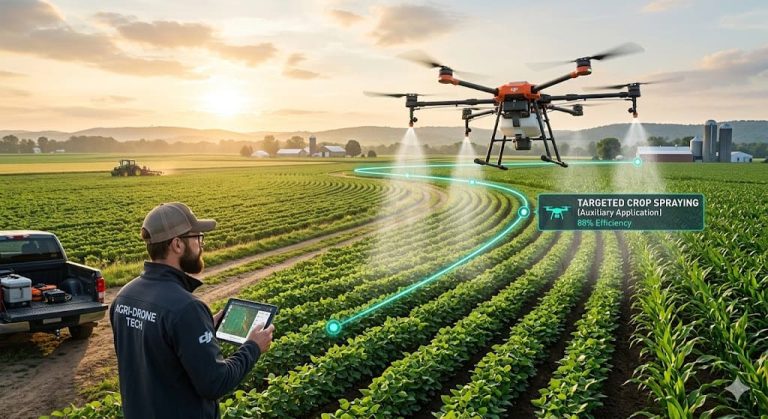
Participating in introductory workshops in specific agricultural areas — soil science, plant propagation, animal handling, drone farming demonstration, or precision agriculture technology. Students develop basic skills.
What Students Learn from Exploratory SAE
Exploratory SAE programs develop agriculture career awareness and informed decision-making. Students choose their future SAE direction with confidence after completing meaningful exploration. They understand the full range of agricultural career pathways available — from traditional farming to cutting-edge agritech, agricultural science research, and agribusiness management. Additionally, they develop professional communication skills — how to conduct informational interviews and how to present themselves in professional agricultural settings. These skills serve them throughout their education and career. Thus, exploratory SAE is a valuable starting point.
SAE Record Keeping: The Documentation Backbone
Across all types of supervised agricultural experiences, FFA SAE record keeping is a non-negotiable component. Students are expected to maintain detailed, accurate records of all SAE activities. This includes hours worked, tasks performed, skills developed, financial transactions in entrepreneurship SAE, experimental data in research SAE, and career exploration contacts in exploratory SAE. Therefore, record keeping is essential for success. Moreover, it builds valuable professional habits.
FFA supervised agricultural experiences documentation serves multiple purposes. First, it creates a verifiable record of student achievement for teacher assessment and FFA proficiency award applications. Second, it develops the agricultural financial management and farm accounting habits essential for real agricultural careers. Third, it provides documented evidence of practical agricultural skill development that college admissions offices, scholarship committees, and future employers value. Finally, it creates a portfolio of growth that students can reflect on — seeing how their agricultural knowledge, skills, and career clarity have developed over time. Agriculture apps and digital agriculture platforms are increasingly supporting SAE record keeping, making high-quality documentation more accessible and engaging for students. Consequently, record keeping is easier than ever before.
Frequently Asked Questions About Supervised Agricultural Experiences
📖 Understanding SAE Basics
🚀 Entrepreneurship & Placement SAE
🔬 Research & Exploratory SAE
🎓 Student Benefits
⭐ Program Importance
Conclusion: Where Agricultural Education Becomes Agricultural Experience
📚 A Thoughtfully Designed System
The supervised agricultural experience framework is one of the most thoughtfully designed systems in all of vocational agriculture education. It recognizes what classroom instruction alone cannot provide. Therefore, it builds a structured pathway for every student to gain real-world agricultural experience that makes learning come alive. Moreover, it prepares students for successful careers in agriculture.
🎯 Diverse Learning Opportunities for Every Student
The different types of supervised agricultural experiences — Entrepreneurship, Placement, Research, and Exploratory — do not represent a hierarchy where one type is better than another. Instead, they represent a diverse menu of genuine learning opportunities. Each type suits different student interests, resources, career aspirations, and circumstances. For example, a student without access to farmland can conduct meaningful agricultural research. Similarly, a student passionate about farming can develop an entrepreneurship SAE. Likewise, a student uncertain about their career direction can use exploratory SAE to discover possibilities. Thus, every student can find an SAE that fits their unique situation.
🔬 The Core Principle of Experiential Learning
What unites all SAE types is the core principle of experiential learning — that doing builds understanding in ways that listening and reading alone cannot. Agricultural education SAE programs embed this principle into every aspect of their design: the student plans, the student acts, the student documents, and the student reflects. Consequently, they develop not just knowledge but competence, not just information but judgment.
💼 An Investment in the Agricultural Workforce
For the agriculture industry itself — which depends on a pipeline of skilled, knowledgeable, motivated young professionals — supervised agricultural experiences are one of the most effective workforce development investments available. Every student who completes a strong SAE program is a future farmer, agronomist, agricultural engineer, agritech innovator, or agribusiness professional who arrives at their career with real experience, real skills, and a real understanding of what the agriculture industry demands and offers. Therefore, SAE participation is invaluable for both students and the agricultural industry.
📚 Related Guides from Agri Opportunities
↗️ Agriculture Education Careers ↗️ Regenerative Agriculture ↗️ What Is Agriculture?📚 External Resources & Further Reading
Add Agri Opportunities as a preferred source on Google to see latest blog listings first.