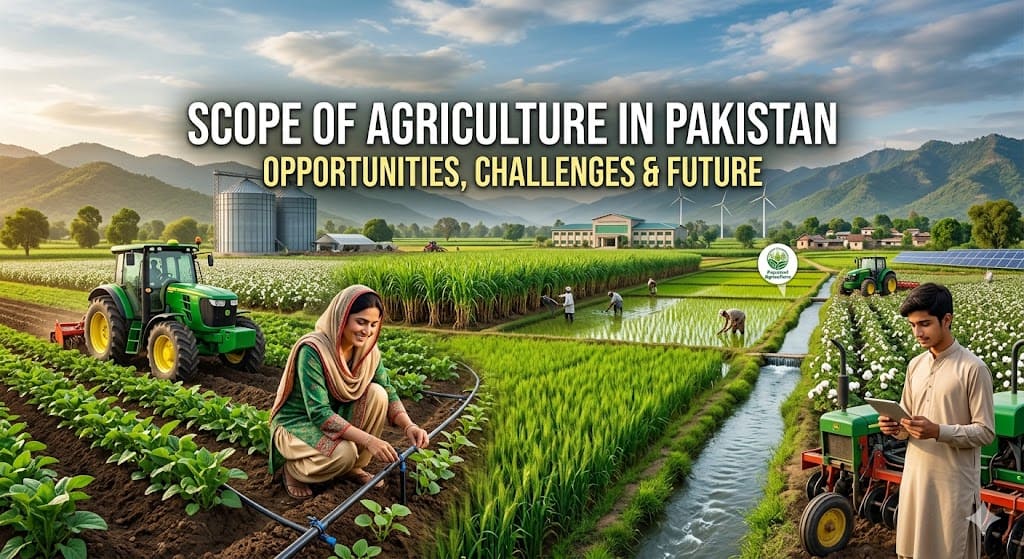
Scope of Agriculture in Pakistan – Opportunities, Challenges & Future

Scope of Agriculture in Pakistan
Opportunities, Challenges & Future
Complete guide to the scope of agriculture in Pakistan: economic importance, major crops, livestock, challenges, opportunities, modern farming techniques, and career prospects.
Pakistan’s Most Vital Industry
Pakistan is an agricultural nation at its very core. From the fertile alluvial plains of Punjab to the river delta farmlands of Sindh, from the fruit-laden mountain valleys of Khyber Pakhtunkhwa to the vast pastoral rangelands of Balochistan — agriculture is woven into the geographic, economic, cultural, and social fabric of the country. Therefore, no other sector can match its significance. Furthermore, it provides livelihoods for millions of rural families.
The scope of agriculture in Pakistan is vast, multidimensional, and deeply consequential. Specifically, it determines whether families have enough to eat, whether rural communities have incomes and livelihoods, whether Pakistan’s textile factories have cotton to process, and whether the country earns enough foreign exchange to fund essential imports. Consequently, understanding this scope is essential for students, investors, and policymakers alike. Additionally, the sector’s growth directly impacts national economic stability.
What Is the Scope of Agriculture in Pakistan?
The scope of agriculture in Pakistan encompasses every dimension of the sector’s size, significance, diversity, and potential. Specifically, it includes the sector’s economic contribution to national GDP, its role in rural employment and livelihoods, the range of crops and livestock produced across different provinces, the industries and value chains that depend on it, and the career and business opportunities it generates. Thus, asking about the scope is asking: how big is this sector, how important is it, and where is it going? Moreover, the answer affects millions of lives.
Agriculture contributes approximately 19% of Pakistan’s GDP directly — one of the highest shares among Asian economies. Moreover, nearly 38% of Pakistan’s national workforce is employed in agriculture, making it the country’s single largest employment sector. Additionally, Pakistan cultivates over 22 million hectares of agricultural land, supported by the largest contiguous irrigation network in the world. Therefore, these numbers alone make clear why understanding the scope and importance of agriculture in Pakistan is essential for anyone seeking to understand the country’s economy and future. For these reasons, agricultural development is a national priority.
Importance of Agriculture in Pakistan’s Economy
The importance of agriculture in Pakistan cannot be overstated. In a country where the majority of the population either lives in rural areas or has deep rural roots, agriculture is simultaneously an economic engine, a social stabilizer, a food security guarantee, and a cultural identity. Consequently, the role of agriculture in Pakistan extends across every dimension of national life. Furthermore, it is intertwined with Pakistan’s history and future development.
Food security Pakistan is one of the most critical national priorities, and agriculture is its primary guarantee. Pakistan must feed a population that has grown from roughly 30 million at independence to over 230 million today. Therefore, the ability of the Pakistan farming sector to produce sufficient quantities of staple foods directly determines whether Pakistani families have access to adequate and affordable nutrition. Furthermore, rural employment generation through agriculture is one of the sector’s most socially significant contributions, providing primary income for tens of millions of households. Thus, the sector’s performance affects every citizen.
Additionally, Pakistan’s textile industry — the country’s largest manufacturing sector — depends entirely on domestically produced cotton. Similarly, the sugar industry depends on sugarcane, and the leather industry depends on livestock hides. Thus, the health of the agriculture industry Pakistan is directly correlated with the performance of these downstream industrial sectors. Consequently, agricultural strength translates into industrial strength.
Major Agricultural Products of Pakistan
Pakistan’s crop production Pakistan is built around a diverse portfolio of food crops, cash crops, fruits, and vegetables. Therefore, understanding these products is essential for grasping the full scope of the sector. Moreover, this diversity provides resilience against market fluctuations.
Wheat is Pakistan’s most important food crop and the dietary staple for the overwhelming majority of the population. Pakistan is consistently among the world’s top ten wheat producers, with production centered primarily in Punjab and Sindh. Consequently, wheat cultivation covers more irrigated area than any other single crop in the country. Additionally, wheat production directly affects national food security and inflation.
Rice is Pakistan’s second most important staple crop and one of its most valuable agricultural exports. Pakistani basmati rice is internationally renowned for its aroma and grain length. Moreover, cotton — often called “white gold” — is Pakistan’s most economically important cash crop and the foundation of its entire textile export industry. Sugarcane, maize, mangoes, kinnow oranges, and dates are also significant contributors to agricultural output. Thus, Pakistan’s agricultural diversity is a national strength.
Livestock Sector Pakistan — The Unsung Agricultural Giant
The livestock sector Pakistan is frequently underestimated in popular discussion, yet it is the single largest contributor to agricultural GDP and a cornerstone of rural livelihoods. Specifically, Pakistan’s livestock population includes approximately 50 million cattle, 45 million buffalo, 80 million goats, 30 million sheep, and over one billion poultry birds. Therefore, the sector’s importance cannot be overstated. Furthermore, it provides livelihoods for millions of rural households.
Pakistan is the world’s fourth-largest milk producer. However, the vast majority of this production never reaches formal processing channels. Consequently, this enormous gap between production potential and formal market realization represents one of the most significant agribusiness opportunities in Pakistan. Investment in value-added agriculture through dairy processing — pasteurized milk, yogurt, cheese, and other products — represents a compelling growth opportunity for investors. Thus, formalizing the dairy sector could transform rural economies.
Additionally, Pakistan’s commercial poultry industry has transformed over the past three decades into one of the country’s most dynamic agricultural sub-sectors. The poultry sector now produces over one billion broiler birds and billions of eggs annually, making it one of the most affordable sources of animal protein for consumers. Thus, the livestock sector offers immense potential for continued growth and modernization. For this reason, it attracts significant investment interest.
Provincial Agriculture — Punjab, Sindh, KPK & Balochistan
One of the defining features of the scope of agriculture in Pakistan is the remarkable diversity of agricultural systems across the four provinces. Consequently, each province has distinct agro-ecological conditions, water availability, and comparative advantages. Therefore, a one-size-fits-all approach to agricultural development is inappropriate.
Punjab agriculture Pakistan forms the absolute backbone of national food production. Pakistan’s largest province by economic output, Punjab is responsible for the majority of wheat, cotton, rice, sugarcane, and maize production. The Indus irrigation system makes Punjab’s central and southern districts extraordinarily productive. Therefore, Punjab leads in commercial dairy farming, horticulture, and agribusiness development. Moreover, Punjab’s agricultural success drives national food security.
The Sindh agriculture sector benefits from the Indus River delta’s rich alluvial soils and a well-developed canal irrigation system. Sindh is Pakistan’s leading producer of rice — including export-quality basmati — as well as cotton, sugarcane, bananas, and vegetables. Meanwhile, agriculture in Khyber Pakhtunkhwa is characterized by diverse highland farming, extensive fruit orchards, tobacco cultivation, and significant forest resources. Finally, Balochistan agriculture development represents significant potential for fruit production — grapes, pomegranates, almonds, and apples — though water scarcity remains a serious constraint. Thus, each province contributes uniquely to national agricultural output.
Challenges Facing Pakistan’s Agricultural Sector
An honest assessment of challenges and opportunities in agriculture in Pakistan requires acknowledging a serious set of structural, environmental, and institutional constraints. Therefore, understanding these challenges is essential for constructive engagement with the sector’s future. Moreover, addressing them is critical for long-term sustainability.
Water scarcity is arguably the most critical challenge facing Pakistan’s agricultural sector. The country is classified as water-stressed, and its irrigation systems suffer from significant inefficiencies. Consequently, combined with climate change impacts — reduced glacial flow, erratic monsoons, and increasing frequency of floods and droughts — water scarcity threatens to become an existential constraint on Pakistan’s agricultural future. Therefore, water conservation must be a national priority.
Additionally, Pakistan is one of the countries most severely affected by climate change globally. The devastating floods of 2010 and 2022 destroyed crops, livestock, and agricultural infrastructure on a catastrophic scale. Therefore, addressing these threats requires urgent investment in climate-smart farming Pakistan, development of drought-tolerant crop varieties, and improved flood management infrastructure. For this reason, climate adaptation is essential for agricultural resilience.
The structure of Pakistan’s farming sector — dominated by millions of small and fragmented landholdings — creates significant challenges for productivity improvement. Most farms are smaller than five acres, making it economically difficult for individual farmers to invest in modern equipment or quality inputs. Thus, addressing this challenge requires innovative approaches to agricultural economics at the farm level, including farmer cooperatives and contract farming arrangements. Consequently, collective action models are needed to overcome scale barriers.

Agricultural Opportunities in Pakistan
Despite the challenges, the agricultural opportunities in Pakistan are substantial, diverse, and increasingly attractive. The convergence of rising food demand, advancing agricultural technology, growing export markets, and supportive government policy is creating a genuinely favorable environment for agriculture growth in Pakistan. Therefore, investors and entrepreneurs should take notice.
High-value horticulture and export agriculture represent significant opportunities. Pakistan’s diverse climate enables it to grow a remarkable range of high-value fruits and vegetables that command premium prices in international markets. However, these opportunities remain largely untapped due to post-harvest handling and cold chain gaps. Therefore, closing these gaps represents a high-return farming opportunity in Pakistan for investors. Additionally, export-oriented production can generate valuable foreign exchange.
Organic agriculture in Pakistan is an emerging sector with significant potential for premium export market access. With growing global demand for certified organic produce, Pakistani farmers who can meet organic certification standards can command price premiums of 20 to 100% above conventional commodity prices. Thus, the transition to organic production is particularly viable for smallholder farmers who already use relatively low levels of synthetic inputs. For this reason, organic certification programs deserve support.
Greenhouse farming Pakistan and hydroponics farming Pakistan are gaining significant momentum. These approaches produce high-value vegetables and fruits year-round, independent of seasonal constraints. Consequently, the economics of greenhouse farming are compelling in Pakistan’s context: high yield per unit area, better water use efficiency, and reduced pest pressure. Moreover, these methods can be implemented in peri-urban areas close to markets.
Modern Farming Techniques and Precision Agriculture Pakistan
Understanding how technology can improve agriculture in Pakistan requires appreciating both the transformative potential of modern agricultural tools and the real barriers to their adoption. Nevertheless, agricultural technology adoption is accelerating across Pakistan, driven by government incentives, private sector investment, and growing farmer awareness. Therefore, the future looks promising.
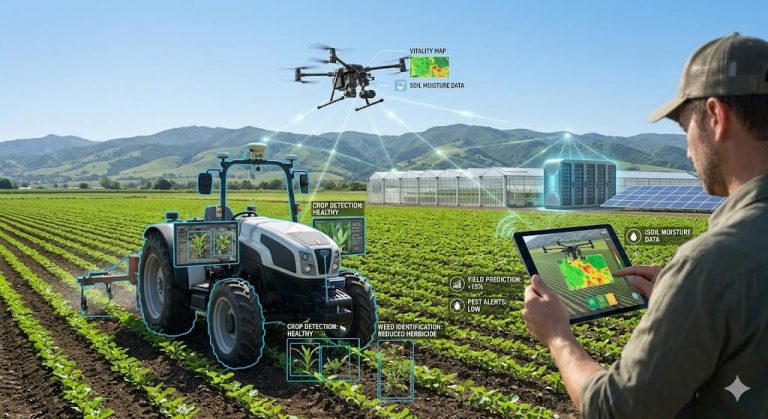
Precision agriculture Pakistan is slowly but meaningfully expanding beyond the early adopter stage. GPS-guided tractors and implements are being used on larger farms. Soil testing services are helping farmers make better-informed fertilization decisions. Satellite-based crop monitoring and weather forecasting tools are providing farmers with data-driven guidance. Therefore, these smart farming Pakistan approaches represent the early stages of a major productivity transformation. Additionally, mobile technology is making information more accessible to small farmers.
Irrigation systems Pakistan are undergoing gradual modernization, with significant emphasis on high-efficiency technologies such as drip irrigation and sprinkler systems. Government programs have subsidized the installation of drip and sprinkler systems on hundreds of thousands of acres, producing documented water savings of 30 to 60% compared to traditional flood irrigation. Consequently, the expansion of these modern farming techniques is critical for Pakistan’s agricultural future. For this reason, water-efficient technologies should be prioritized.
Agricultural technology Pakistan is increasingly driven by a dynamic and growing agritech startup ecosystem. Pakistani agritech companies are building digital platforms, mobile applications, and satellite analytics specifically designed for Pakistani agricultural conditions. Thus, this agricultural innovation ecosystem is attracting growing investment and has genuine potential to catalyze transformative change. Moreover, these startups are creating new employment opportunities for tech-savvy youth.
Career Opportunities in Agriculture in Pakistan
For students and young professionals, the scope of agriculture in Pakistan for students has never been broader or more genuinely exciting. The agricultural sector’s growing technological complexity, expanding agribusiness ecosystem, and urgent need for highly trained professionals create real and growing demand for graduates across a wide range of disciplines. Therefore, agricultural education is a smart career investment.
Agriculture jobs in Pakistan are available across the full spectrum of the sector — from technical field roles and laboratory research to policy analysis, business management, technology development, and rural entrepreneurship. Major agricultural universities — including the University of Agriculture Faisalabad, Sindh Agriculture University Tandojam, and others — prepare graduates for research, extension, industry, and government careers. Additionally, international organizations offer employment opportunities for qualified Pakistani agricultural professionals.
Key career pathways include agronomist, livestock specialist, veterinarian, irrigation engineer, agricultural economist, food scientist, agribusiness manager, agricultural researcher, extension officer, agritech entrepreneur, and rural development specialist. Additionally, agricultural entrepreneurship is an increasingly viable career pathway — from greenhouse farming and dairy processing to agritech startups and premium export businesses. Thus, the field offers diverse and rewarding career paths for motivated individuals.
Future of Agriculture in Pakistan
The future of agriculture in Pakistan will be shaped by the interaction of powerful forces — both challenging and enabling. Climate change will intensify pressure on water resources. Population growth will increase domestic food demand. Technology will offer transformative new tools. And policy choices will determine whether these forces combine to produce crisis or opportunity. Therefore, proactive planning is essential.
Climate-smart agriculture will transition from an aspirational policy objective to a practical necessity. This means widespread adoption of drought-tolerant crop varieties, expansion of efficient irrigation systems, and the mainstreaming of climate-resilient farming approaches. Therefore, sustainable agriculture Pakistan is becoming a central pillar of national agricultural policy. Moreover, climate adaptation is not optional but essential for survival.
The agricultural technology adoption curve in Pakistan is steepening as smartphone penetration rises and agritech solutions become more affordable. The future Pakistani farmer will increasingly make decisions informed by real-time soil, weather, and market data. Consequently, this digital transformation of smart farming Pakistan will not happen overnight, but its trajectory is clear and accelerating. For this reason, digital literacy programs for farmers are crucial.
Agricultural modernization Pakistan will continue to advance through the spread of mechanization services, improved seed systems, better agricultural extension, and greater access to agricultural credit. The goal is to raise agricultural productivity to the levels already achieved by comparable agricultural economies — a goal that is entirely achievable with sustained investment, technology access, and policy support. Thus, the future holds tremendous promise for those who invest wisely.
Frequently Asked Questions About the Scope of Agriculture in Pakistan
📖 Understanding the Scope
💡 Opportunities and Challenges
🚜 Technology and Careers
Conclusion: Pakistan Agriculture — A Sector of Extraordinary Promise
From the fertile plains of Punjab to the mountain orchards of Khyber Pakhtunkhwa, from the delta rice fields of Sindh to the vast rangelands of Balochistan — agriculture in Pakistan is a story of extraordinary natural endowment, resilient rural communities, and enormous unrealized potential. The challenges are real and serious: water scarcity, climate change, smallholder fragmentation, infrastructure deficits, and post-harvest losses. However, the agricultural opportunities in Pakistan are equally real and far larger in their long-term significance. Therefore, optimism is warranted.
The future of agriculture in Pakistan will be written by the students who choose agricultural careers and bring new knowledge and ambition to the sector, the entrepreneurs who invest in agribusiness value chains, the farmers who adopt modern techniques and build more productive operations, the researchers who develop better crop varieties, and the policymakers who create enabling environments for agriculture growth in Pakistan at scale. Consequently, every stakeholder has an important role to play.
The scope of agriculture in Pakistan — in terms of economic importance, employment, food security, export potential, career opportunities, and transformative possibilities — has never been greater. Therefore, for those who engage with it seriously, knowledgeably, and ambitiously, neither has the opportunity. Thus, now is the time to invest in Pakistan’s agricultural future.
📚 Related Guides from Agri Opportunities
↗️ Small Scale Agriculture Guide ↗️ Regenerative Agriculture ↗️ Carbon Footprint Calculator for AgricultureSwitzerland runs the same broad employment-based PhD model as Denmark and Sweden, covered elsewhere on this site, but with a few genuinely distinctive details worth understanding before you apply — including some of the highest doctoral compensation in Europe, paired with famously high living costs. This guide focuses on Switzerland’s two federal institutes of technology, ETH Zurich and EPFL, the two most prominent destinations for agriculture-adjacent PhD research in the country.

PhD as Genuine, Well-Paid Employment
As with the Nordic systems covered elsewhere on this site, Swiss PhD students are not typically “scholarship students” in the traditional sense — they’re full-time university employees, commonly referred to as scientific or doctoral assistants, hired on contracts with salaries defined by national scales.
What This Actually Pays
As of 2026, EPFL’s basic starting salary for a doctoral assistant is 55,225 Swiss francs gross per year. More broadly across ETH and EPFL, doctoral stipends range from roughly 50,000 to 62,000 francs annually — genuinely well above typical European PhD compensation, including comparison points like Germany’s DFG-funded positions, which sit closer to 45,000 to 55,000 euros.
The Living Cost Reality Check
It’s worth being honest that this higher pay reflects genuinely higher costs, not just better funding. Zurich and Geneva rank among the most expensive cities globally for cost of living, placing in the same tier as Hong Kong, Singapore, and New York — meaning the higher salary needs to be weighed against a correspondingly higher cost base rather than treated as pure additional purchasing power.
Tuition Is Almost an Afterthought
Given the employment-based structure, tuition fees are genuinely minimal — often just a few hundred Swiss francs per semester, with ETH Zurich specifically citing fees around 809 CHF per semester. Your salary is effectively your entire funding package, rather than needing to separately cover significant tuition costs on top of living expenses.
How PhD Admission Actually Works
You Generally Need a Doctoral Program Behind You First
At EPFL specifically, you must be admitted by a doctoral program before you can be hired as a doctoral assistant. In some cases, a doctoral program may admit a candidate even without a corresponding funded position immediately available — in that situation, the candidate remains eligible for hiring for up to one year while funding is sought, and can pursue individual scholarships and external funding in parallel.
Finding a Supervisor Is the Real First Step
As with Germany’s traditional PhD model covered elsewhere on this site, Swiss admissions tend to be based on genuine fit and research alignment between you and a specific supervisor, rather than a standardized, purely metrics-based admissions process. Direct outreach to a professor whose research matches your interests — following the same approach recommended in the general research assistantship guide elsewhere on this site — is typically the practical starting point, sometimes taking several months of sustained outreach before securing a supervisor’s commitment.
A Concrete, Currently Open Example: ETH Zurich’s Agricultural Economics PhD
To make this genuinely concrete rather than abstract, it’s worth looking at an actual recent ETH Zurich posting closely matching this site’s focus. ETH Zurich advertised a four-year doctoral position in Agricultural Economics and Policy, working under Professor Robert Finger within the Agricultural Economics and Policy Group, as part of the ACHIEVE project — a major national Swiss research initiative focused on pathways to net-zero for Switzerland’s hardest-to-abate emissions sectors, including agriculture.
What Made This Position Attractive
The role offered a full ETH Zurich doctoral salary, social benefits, and direct involvement in a genuinely consequential national climate policy project — connecting real agricultural economics research to Switzerland’s actual net-zero transition planning, rather than purely theoretical academic work disconnected from policy application.
What the Application Actually Required
Applicants needed to submit a cover letter, CV, academic transcripts, and contact details for two referees, all combined into a single PDF document, through ETH Zurich’s online application portal. The position was open to both recent master’s graduates and students still completing their degree in agricultural economics or a related discipline.
A Language Detail Worth Noting
Some Swiss positions, including certain policy-facing roles, may favor or require proficiency in one of Switzerland’s major working languages (German or French) alongside English, which can meaningfully narrow the international applicant pool for those specific roles — worth checking carefully on each individual posting rather than assuming English alone is always sufficient, even at internationally-oriented institutions like ETH and EPFL.
Where to Actually Search for Swiss PhD Positions
Direct University Job Portals
ETH Zurich, EPFL, and other Swiss universities including Zurich, Geneva, Lausanne, Bern, Basel, and Fribourg regularly advertise PhD openings directly on their own job portals, alongside general academic job boards like Academic Positions and FindAPhD.
Structured Graduate Schools
Beyond individually advertised positions, structured graduate schools offer another entry route — the Life Science Zurich Graduate School, a joint programme between ETH Zurich and the University of Zurich, offers over 100 fully funded PhD positions across roughly 500 research groups in the life sciences broadly, a genuinely large and relevant pool for agriculture-adjacent research interests.
Swiss Government Excellence Scholarships
Run by Switzerland’s Federal Commission for Scholarships for Foreign Students, these national-level awards are available to postgraduate researchers from over 180 countries across any discipline, funding either a full PhD (usually up to three years) or a shorter research stay during a PhD already underway elsewhere. Every application must be formally backed by a professor, reinforcing again how central that initial supervisor relationship is across nearly every Swiss funding route.
What Makes ETH and EPFL Genuinely Distinctive as a Career Investment
Beyond the funding mechanics, it’s worth knowing that ETH and EPFL graduates report notably strong academic placement outcomes, with some tracking suggesting a meaningful probability of landing a tenure-track position at a top-100 global university within five years of graduation — among the stronger placement outcomes for any doctoral programme outside a small handful of the most prestigious US and UK institutions. Both universities also maintain well-established industry connections with major companies including Nestlé, relevant for agriculture and food science graduates specifically considering an industry rather than purely academic career path.
Practical Tips for a Competitive Application
Start supervisor outreach well in advance, since securing a professor’s genuine commitment can take several months of sustained contact, and treat this relationship-building as the actual gating step in your application timeline rather than an afterthought. Confirm language requirements explicitly for any specific posting rather than assuming English alone suffices, particularly for policy-facing or applied research roles. And budget realistically for Swiss living costs specifically — the higher salary figures covered in this guide need to be weighed honestly against Zurich and Geneva’s position among the most expensive cities in the world, rather than treated as straightforwardly superior to lower-paying positions in more affordable countries.
For currently open PhD positions in Switzerland and across Europe, browse live agriculture scholarship listings on Agri Opportunities.
Frequently Asked Questions
How much does a PhD student at ETH Zurich or EPFL actually earn?
As of 2026, EPFL’s basic starting salary for a doctoral assistant is 55,225 Swiss francs gross per year, while ETH and EPFL doctoral stipends more broadly range from roughly 50,000 to 62,000 francs annually, well above typical European PhD compensation.
Do I need to find a supervisor before applying for a PhD in Switzerland?
Yes, in most cases. At EPFL specifically, you must be admitted by a doctoral program before you can be hired as a doctoral assistant, and finding a professor willing to supervise your specific research area is typically the first practical step.
How much does PhD tuition cost in Switzerland?
Tuition fees are very low, often only a few hundred Swiss francs per semester, since most PhD students are treated as full-time university employees rather than fee-paying students, meaning your salary functions as your primary source of funding.
What is the Swiss Government Excellence Scholarship?
It’s a national-level award, run by the Federal Commission for Scholarships for Foreign Students, available to postgraduate researchers from over 180 countries, funding either a full PhD of usually up to three years or a research stay during a PhD already underway elsewhere.
- • Funded Agriculture PhDs in Germany: DAAD, DFG, and the System Explained
- • Funded Agriculture PhDs in the Netherlands: The Wageningen University Guide
- • Funded Agriculture PhDs in Denmark: Aarhus and DTU Guide
- • Funded Agriculture PhDs in Sweden: The SLU Guide
Add Agri Opportunities as a preferred source on Google to see latest blog listings first.
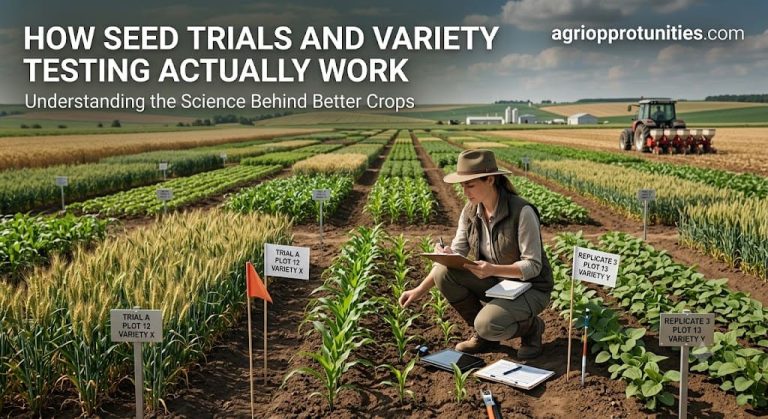


Apply for Lab tecnision