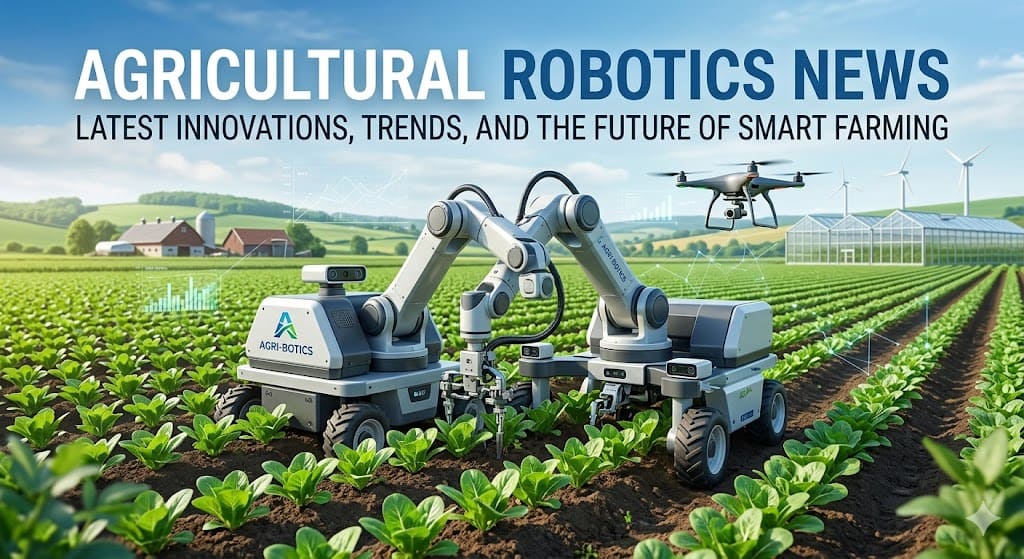
Agricultural Robotics News- Latest Innovations, Trends, and the Future of Smart Farming

Agricultural Robotics News
Latest Innovations, Trends, and the Future of Smart Farming
Complete guide to agricultural robotics news: latest innovations in autonomous tractors, robotic harvesting, AI weed control, drone farming, and the future of smart farming robotics.
The Machines Have Arrived on the Farm
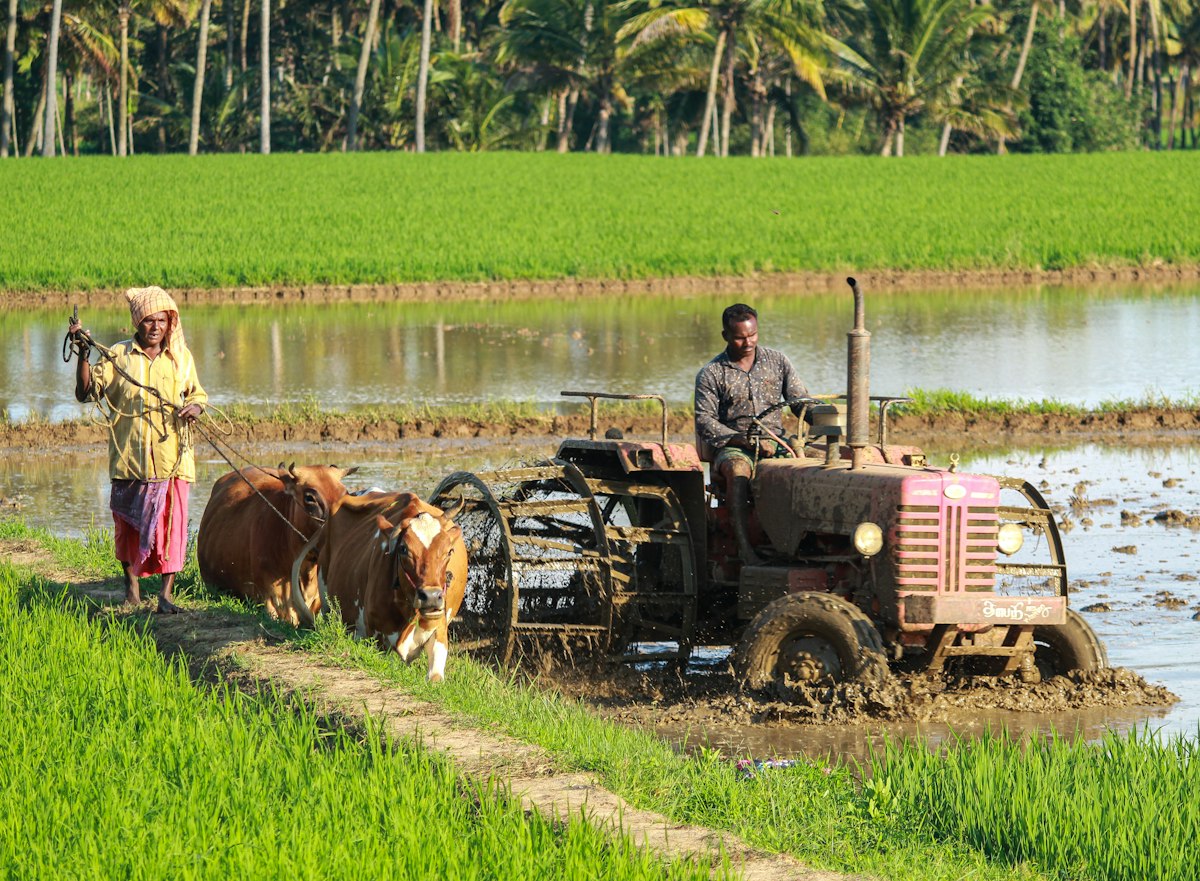
For decades, agricultural robotics existed only in research labs and demonstration fields. These machines were certainly impressive in concept. However, they remained distant from everyday farming realities. Fortunately, that distance has now closed completely.
Agricultural robotics news today is not about what might be possible in the distant future. Instead, it focuses on what is already happening at scale right now. As a result, robots now work on farms across every continent. Therefore, understanding these rapid developments is absolutely essential for modern agriculture.
For instance, robotic fruit picking systems now harvest strawberries with skilled precision. Similarly, autonomous tractors navigate vast fields without any drivers. Likewise, AI-powered weeding robots eliminate almost all herbicide use. Consequently, the agricultural robotics technology landscape has transformed faster in five years than in the previous five decades.
What Is Agricultural Robotics?
Agricultural robotics means using robotic systems in modern farming. These advanced machines perform various tasks autonomously or semi-autonomously. Moreover, they combine sophisticated hardware with artificial intelligence. Machine vision and precision farming technology are also key components. As a result, they effectively replace some human labor and conventional farm machinery.
Agricultural drone applications are remarkably broad in scope. Ground-based robotic systems are similarly diverse in their capabilities. For example, agricultural robots handle planting and seeding operations. They also perform crop monitoring and field scouting. Additionally, they do precision spraying and robotic weed control. Robotic fruit picking is another major application. Soil sampling, livestock management, and post-harvest handling are automated too. Thus, the range of applications continues to expand rapidly.
Automation is the unifying characteristic of all these systems. Specifically, these systems operate with minimal human supervision. Sensor-based robots and AI systems guide their movements. They interpret the physical environment in real time. Therefore, agricultural robots do much more than simply replace labor. Furthermore, robotics enables unprecedented precision, consistency, and data collection. This fundamentally changes what is possible in farm management. Consequently, it supports precision agriculture and smart farming systems. Sustainable agriculture goals also benefit greatly from this technology.
Why Agricultural Robotics Is the Biggest Story in Agtech Right Now
Agricultural technology news has been dominated by robotics for several years. Moreover, there are powerful structural reasons why this trend is intensifying. Consequently, understanding these key drivers is absolutely essential for agribusiness professionals.
👥 Labor Shortages
The global shortage of farm labor is an extremely powerful driver. Farmers worldwide report significant difficulty finding seasonal workers. Rural to urban migration continuously removes workers from farming communities. Aging populations further reduce the available labor pool. Therefore, agricultural robotics provides practical and effective solutions to this ongoing crisis.
🌍 Sustainability Demands
Agriculture faces growing pressure to reduce its environmental impact. Less pesticide, water, nitrogen, and carbon are now required. Fortunately, agricultural robotics enables the kind of precision that dramatically reduces waste. For instance, a robotic weeder uses only a fraction of the herbicide. Consequently, smart farming robotics is both efficient and genuinely sustainable.
💰 Falling Technology Costs
Agricultural robotics has attracted significant investment in recent years. Venture capital and corporate funding have flowed heavily into agtech. This investment drives down component costs substantially. It also expands the engineering talent base significantly. Finally, it creates commercial ecosystems for deployment. Thus, adoption barriers continue to fall each year.
Latest Agricultural Robotics Innovations
🚜 Autonomous Tractors
Autonomous tractors have dominated robotics news for several years. Moreover, 2024 and 2025 have seen decisive progress in this field. Consequently, this technology has moved rapidly from demonstration to commercial deployment.
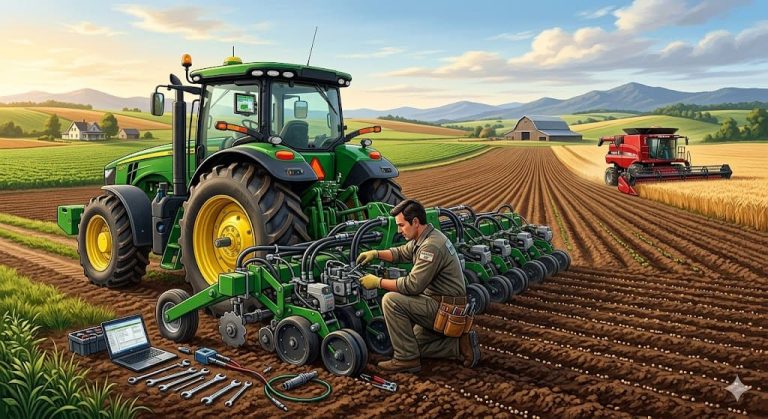
The John Deere autonomous tractor leads this important transformation. It has six pairs of stereo cameras for navigation. Additionally, it uses GPS guidance and AI obstacle detection. This advanced tractor is now commercially available in several markets. Therefore, farmers can now set field tasks remotely. They can monitor operations while the machine works independently. This shift is historically significant. In fact, it compares to when tractors first replaced horses and oxen.
Other manufacturers have followed this trend successfully. For example, Agco, CNH Industrial, and Kubota are developing autonomous platforms. Many agtech startups are also entering this space rapidly. These systems integrate seamlessly with existing tractor implements. They also work effectively with precision ag systems. The electric tractor sector is advancing too. Furthermore, battery-powered autonomous machines offer zero-emission operations. Consequently, autonomous guidance is becoming standard equipment rather than a premium option.
🍓 Robotic Harvesting
Harvesting automation has historically been very difficult to achieve. Robots must identify individual fruits or vegetables accurately. They must also reach and extract each item without damage. However, plant structures are complex and highly variable. Nevertheless, recent breakthroughs have changed this picture dramatically.
Robotic harvesting is now viable for several high-value crops. Strawberry harvesting robots lead the way in commercial adoption. For instance, Tortuga AgTech, Dogtooth Technologies, and Agrobot are achieving commercial harvest rates. Apple and pear harvesters are currently in advanced field trials. Similarly, tomato and pepper robots operate effectively in greenhouse environments. Structured growing conditions make machine vision more reliable there. Thus, robotic harvesting continues to improve each season.
🌿 Robotic Weed Control
Robotic weed control is commercially advanced and proven. It is compelling for both economic and sustainability reasons. The core challenge of weed management is identifying weeds without harming crops. Fortunately, machine vision and AI excel at this specific task.
For example, Carbon Robotics’ LaserWeeder uses high-powered lasers for weed destruction. Machine vision guides the lasers precisely. The system destroys weeds individually and effectively. Importantly, it uses no chemicals whatsoever. Precision spraying robots also reduce chemical use substantially. Companies like Bilberry, Naio, and Trimble lead this important field. They apply herbicide only to detected weeds. Consequently, chemical use drops by up to 90 percent. Thus, robotic weed control transforms both organic and sustainable farming practices.
🚁 Agricultural Drones
Agricultural drone technology is very active in robotics news today. Drone farming has moved from novelty to standard practice recently. Many farming systems now use drones regularly and effectively.
DJI Agriculture leads the global market currently. XAG drone systems are also increasingly popular. The DJI Agras T40 represents current commercial technology. Similarly, the XAG P100 is another leading platform. These systems are high-capacity and GPS-guided. Additionally, AI assists their complex operations. They cover large field areas with remarkable precision. Therefore, they reduce chemical inputs significantly compared to conventional methods.
Beyond spraying, drones advance sensor-based farming capabilities. They carry multispectral cameras and thermal sensors. LiDAR payloads are also common on these platforms. These sophisticated sensors generate precision farming maps. They also produce NDVI crop analysis data. Consequently, drones are becoming indispensable tools for modern farmers.
🧠 AI Crop Monitoring
AI crop monitoring uses artificial intelligence for real-time assessment. It analyzes imagery and sensor data continuously. This technology integrates deeply with drone farming. It also works effectively with ground-based field robotics systems.
Machine learning models train on large agricultural datasets. They can now identify specific pest infestations accurately. They also detect disease symptoms with remarkable precision. Nutrient deficiencies and water stress are identified too. Consequently, this AI capability deploys through agriculture apps. Smartphone access makes it widely available to all farmers.
Drone-mounted sensors also use this advanced technology. Autonomous ground robots navigate crop rows systematically. They conduct detailed plant-level inspections efficiently. Field robotics and AI monitoring combine effectively. This creates powerful automated crop management capabilities. Therefore, the scale and frequency of agronomic insights is unprecedented.
Agricultural Robotics Companies Driving Innovation
What companies develop agricultural robots? The sector includes established machinery makers, agtech startups, and technology firms. Therefore, the competitive landscape is both diverse and dynamic.
🚜 John Deere
John Deere has made autonomous equipment a strategic priority. Its autonomous tractor and See & Spray robot lead the market. Moreover, machine learning is integrated throughout its product line.
🤖 Carbon Robotics
Carbon Robotics developed the innovative LaserWeeder. This system uses lasers guided by machine vision. It destroys weeds effectively without any chemicals. Thus, it represents a breakthrough in sustainable weed management.
🍓 Tortuga AgTech
Tortuga AgTech specializes in strawberry harvesting robots. They have achieved commercially meaningful harvest rates. Furthermore, their systems combine sophisticated vision with delicate manipulation.
🚁 DJI Agriculture
DJI Agriculture is the leading agricultural drone platform globally. It advances drone spraying, AI monitoring, and smart farming integration. The Agras T40 represents current commercial technology.
🌾 FarmWise
FarmWise develops autonomous crop management robots. Their platforms perform both weeding and crop scouting. Additionally, they combine sensor navigation with AI plant identification.
🇫🇷 Naïo Technologies
Naïo produces ground-based weeding robots. Their systems serve vegetable and vine crops effectively. They focus on reducing chemical inputs and labor requirements.
How AI Works With Agricultural Robotics
How does AI work with agricultural robotics? AI is a collection of advanced capabilities. It enables robotic systems to perceive, reason, and act intelligently. Therefore, understanding these capabilities is essential for evaluating the technology.
Machine vision is the most central AI capability. Computer vision systems train on large image datasets. Consequently, they enable robots to identify individual plants accurately. They also detect disease symptoms effectively. Furthermore, they distinguish weeds from crops reliably. They locate ripe fruit for harvesting precisely. Finally, they navigate fields without predefined maps. Thus, computer vision is a defining characteristic of smart farming.
Machine learning enables robots to improve over time significantly. They learn to recognize new crop varieties automatically. They adapt to variable field conditions effectively. Additionally, they refine decisions based on outcome data. Reinforcement learning trains harvesting systems optimally. They develop better picking strategies without explicit programming.
Sensor fusion combines data from multiple sensors intelligently. Cameras, LiDAR, GPS, and soil sensors work together seamlessly. This gives robots a rich understanding of their environment. It also enables reliable autonomous operation in complex field conditions. Therefore, AI is truly the brain behind agricultural robotics.

The Future of Agricultural Automation and Robotics
Where is agricultural robotics headed? The future points toward integrated, collaborative, and intelligent systems. Robotics, AI, digital data, and human expertise will work seamlessly together. Thus, several key trends are emerging in this space.
Collaborative Robot Fleets
Collaborative robot fleets represent the next generation of automation. Multiple autonomous platforms will work simultaneously on farms. They will share data and coordinate tasks effectively. Rather than one large tractor doing sequential operations, swarms of smaller robots will work in parallel. Consequently, this approach would reduce soil compaction substantially. It also increases operational flexibility significantly.
Digital Twin Technology
Digital twin technology creates precise farm models virtually. Robots use these models for navigation and planning. Combined with GIS tools and real-time sensors, digital twins enable comprehensive smart management. Moreover, biotechnology convergence with robotics is also emerging. Plant-level interventions will create new capabilities at the intersection of science and automation.
Accessibility Improvements
Accessibility remains a critical challenge for widespread adoption. Advanced robotics is currently accessible mainly to large farms. However, drone-as-a-service and robot-as-a-service models are emerging. Shared equipment models are also developing rapidly. Therefore, small farms may soon access these technologies through affordable services. Additionally, costs continue to fall each year, making ownership more feasible.
Agricultural Robotics and Sustainable Farming
Agricultural robotics news is increasingly framed by sustainability concerns. Smart farming robotics is not just about productivity anymore. It is also about environmental sustainability. Thus, the two are deeply connected.
Precision spraying and robotic weed control reduce herbicide use dramatically. Therefore, they support organic agriculture and sustainable practices effectively. They also protect soil health and biodiversity significantly. Autonomous crop monitoring enables early pest detection. This prevents large-scale chemical intervention. It also reduces total pesticides applied per season. Furthermore, worker safety improves due to less chemical exposure.
Electric tractors and battery-powered robots reduce farm emissions substantially. They lower the carbon footprint of farming operations. Additionally, regenerative agriculture practices are made more feasible by robotics. No till farming, cover cropping, and diverse rotations benefit from robotic navigation. Conventional machinery performs poorly in these conditions.
Climate smart agriculture depends on precise field data. Agricultural robotics generates this data automatically and reliably. As carbon farming programs expand, this data becomes increasingly valuable. Thus, robotics enables both economic and environmental benefits simultaneously.
Frequently Asked Questions About Agricultural Robotics
🤖 Understanding Agricultural Robotics
💡 Innovations and Technology
🏭 Companies and Future Outlook
Conclusion: Agricultural Robotics Is Not the Future — It Is the Present
🤖 The Current Reality
Agricultural robotics has crossed from emerging technology to operational reality. Machines once confined to research now work in commercial fields. They earn revenue for farming businesses. Furthermore, they reshape what is expected of modern farm operations. Therefore, the transformation is well underway and accelerating each year.
⚠️ Challenges Remain
The transformation is not yet complete, however. Robotic harvesters cannot yet match human pickers for every crop. Autonomous machinery still requires oversight in complex situations. Advanced automation costs remain prohibitive for many small farms. Nevertheless, the direction is clear and the pace is accelerating. Machine vision is improving rapidly. Equipment costs are falling steadily. AI monitoring is becoming more accurate. The agtech ecosystem is growing quickly. Therefore, remaining challenges are solvable with continued effort.
🌱 The Path Forward
For farmers, the question is when and how to engage with available technology. For students, agricultural robotics offers a dynamic field of study. For investors, the automation market represents a multi-decade investment theme. For the food system, robotics helps answer a critical question: how do we feed a growing, urbanizing world with less land, less water, less labor, and less environmental impact? The answer is being written now in fields and greenhouses globally. Agricultural robotics is not just the future of farming. It is increasingly the present of farming. Thus, staying informed is absolutely essential for everyone in agriculture.
📚 Related Guides from Agri Opportunities
↗️ The Second Agricultural Revolution ↗️ What Is Agriculture? ↗️ Precision Agriculture Guide📚 External Resources & Further Reading
Add Agri Opportunities as a preferred source on Google to see latest blog listings first.


I do not even know how I ended up here, but I thought this post was great.
I don’t know who you are but certainly you’re going to a famous blogger
if you are not already 😉 Cheers!