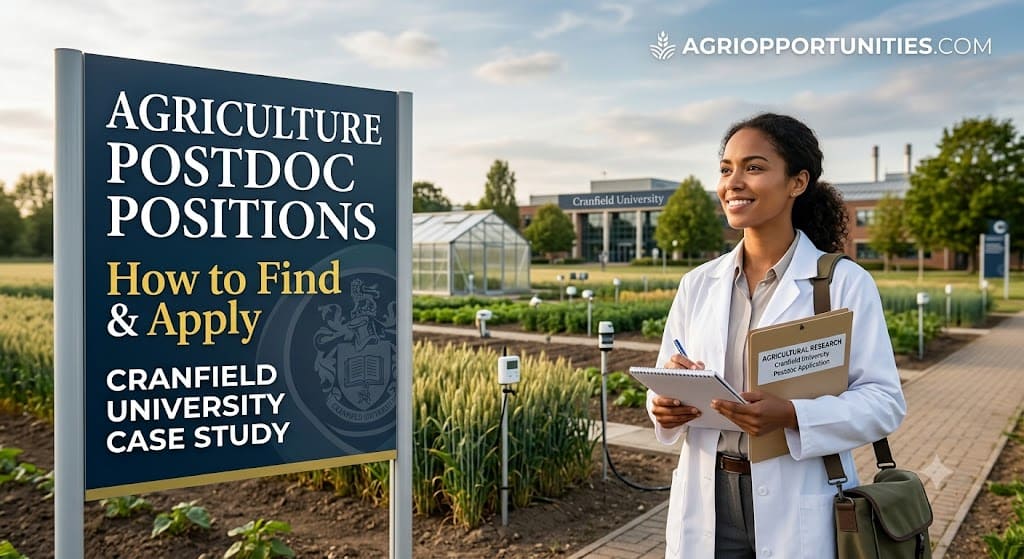
How to Find and Apply for Agriculture Postdoc Positions: A Cranfield University Case Study

How postdoc hiring actually works — from fixed-term contracts to named fellowships
How to Find and Apply for Agriculture Postdoc Positions: A Cranfield University Case Study
A postdoctoral research position is a genuinely different kind of application from a PhD, and treating it the same way is one of the more common mistakes early-career researchers make. I want to walk through exactly how postdoc hiring actually works, where to search, and use Cranfield University’s own current postdoc landscape as a concrete, real example of what these positions actually look like in practice.

How a Postdoc Is Genuinely Different From a PhD
As explained throughout the country guides on this site, PhD positions often give candidates the flexibility to shape their own research direction, and admissions committees evaluate applicants largely on their academic potential and future trajectory. A postdoc works differently. It centers on a specific, already-funded research project with a defined scope and timeline, and the research team hires you because your existing skills and publication record match the project’s immediate needs—not because of your future potential.
What This Means for Your Application
This difference means postdoc applications place much greater emphasis on your publication record and directly relevant technical skills. While PhD applicants may not always need publications, postdoc candidates usually do. Hiring committees want evidence that you can already work as an independent researcher, not just that you have the potential to become one.
Contract Structure: Fixed-Term, Not Open-Ended
Nearly all postdoc positions come with fixed-term contracts that match the duration of the research grant funding them. Recent Cranfield University postings illustrate this clearly, with contracts lasting 12 months, 24 months, 30 months, or ending on specific dates such as 31 October 2027 or 22 November 2028. In each case, the grant determines the contract length rather than a standard academic appointment.
Why This Matters for Your Career Planning
Since postdoc contracts end when project funding ends, it’s genuinely common for researchers to hold several sequential postdoc positions across different institutions before securing a permanent academic post — a career reality worth planning for honestly rather than assuming a single postdoc automatically leads directly to permanent employment.
What Postdoc Positions Actually Pay: The Cranfield Example
Cranfield University’s recent postdoc and research fellow postings illustrate a genuinely useful, concrete salary range. Positions have offered starting salaries in the range of roughly £34,450 per annum for candidates whose PhD is close to completion but not yet finished, rising to £37,337 once the PhD is fully obtained — a distinction worth noting, since some institutions genuinely do pay a lower rate to candidates who haven’t yet formally completed and defended their doctorate.
Salary Progression Within a Single Role
More senior or specialized postdoc and research fellow positions at Cranfield have offered ranges extending considerably higher, with some postings showing starting salaries around £37,897 to £45,580 per annum, with potential progression up to £52,067 depending on qualifications and experience — illustrating that “postdoc” isn’t a single fixed pay grade, but a category spanning early-career researchers through more senior, experienced research fellows.
Concrete Examples of the Kind of Projects Currently Hiring
To make this genuinely tangible rather than abstract, Cranfield’s recent postdoc-relevant postings have spanned genuinely diverse project types: a Research Fellow position in biosensing, microfluidics, and microbiology, working on a five-year Leverhulme Research Leadership Award project focused on sensing wastewater for real-time public health monitoring; a role focused on the socially responsible use of novel biologies; a social science-focused position examining hydrogen transition and energy justice; and, directly relevant to readers of this site, postdoctoral opportunities in food mycology and environmental sustainability themes connected to Cranfield’s broader agri-food and environmental research portfolio.
Where to Actually Search for Postdoc Positions
jobs.ac.uk
This is the single most comprehensive resource specifically for UK academic positions, including a dedicated Agriculture, Food & Veterinary category alongside broader physical and environmental sciences listings. Recent postings on this platform have shown a genuinely wide salary spread, from around £33,000 up to £76,000 per annum depending on seniority and institution, giving a useful sense of the overall market range across UK postdoc positions generally.
EURAXESS Jobs
For postdoc searches extending beyond the UK specifically, EURAXESS Jobs aggregates research positions across the European continent, functioning as a genuinely useful complement to country-specific job boards when your search isn’t limited to a single destination.
Direct University Career Pages
Given how specific postdoc positions are to individual funded projects, checking target universities’ own career pages directly — as covered throughout the country guides on this site for PhD searches — remains genuinely valuable for postdoc searches too, since a position might be posted on an institution’s own site before it’s aggregated onto a broader external job board.
Named Fellowship Schemes Worth Knowing About Specifically
Beyond project-specific postdoc hires, several prestigious, named fellowship schemes fund postdoctoral research more independently, worth researching directly if you have a strong existing publication record.
Marie Skłodowska-Curie Actions (MSCA) Postdoctoral Fellowships
These EU-funded fellowships support postdoctoral researchers working across a huge range of disciplines, including agriculture-adjacent fields like agricultural robotics, AI, computer vision, and remote sensing — one recent example specifically advertised through Harper Adams University’s Institute of Technology covered exactly this combination of AI and precision agriculture research.
The British Academy Postdoctoral Fellowship
Aimed at outstanding early-career researchers specifically in the humanities and social sciences, this fellowship is worth knowing about if your agriculture-adjacent research interests lean toward agricultural economics, policy, or rural sociology rather than pure natural science — fields that sometimes get overlooked in agriculture-specific funding searches that assume a purely biological or environmental science focus.
What a Strong Postdoc Application Actually Requires
A Genuine, Demonstrated Publication Record
Since postdoc hiring assumes an already-functioning independent researcher, your publication list carries real weight — not just quantity, but genuine relevance to the specific project you’re applying for. A publication record heavy in an adjacent but distinct subfield is worth explicitly framing in your cover letter to show the transferable skills and methodology relevant to the new position.
Directly Applicable Technical Skills
Given how project-specific postdoc hiring is, technical skills genuinely matter more concretely here than in a PhD application — if a position requires specific instrumentation experience (gas chromatography, remote sensing platforms, specific statistical or machine learning methods), your application should demonstrate this explicitly and specifically, rather than relying on a general statement of research interest.
References Who Can Speak to Independent Research Capability
Since postdoc positions assume genuine research independence, your references should be positioned to speak specifically to your ability to design, execute, and publish research with appropriate but reduced supervision — a different framing than a PhD reference letter, which more often speaks to potential and trainability.
Practical Tips for a Competitive Postdoc Application
Read the specific funded project’s description carefully and tailor your application to demonstrate direct relevance to that exact research question, rather than a broader statement of interest in agriculture or environmental science generally — postdoc hiring committees are looking for someone who can contribute immediately, not someone who needs to be trained into the role. Check whether the position distinguishes pay based on PhD completion status, as Cranfield’s postings illustrate, and factor your own specific timeline honestly into your salary expectations and negotiation. And given how fixed-term and project-specific these positions are, build a genuine strategy for sequential postdoc positions or named fellowship applications, rather than assuming a single postdoc automatically bridges directly into permanent academic employment.
For currently open postdoctoral and PhD positions across agriculture and environmental science, browse live agriculture scholarship listings on Agri Opportunities.
Frequently Asked Questions
How is applying for a postdoc different from applying for a PhD?
Postdoc hiring is closer to a genuine job application than PhD admissions, since positions are tied to a specific, already-funded project with a defined timeline, and candidates are expected to already hold relevant publications and directly applicable technical skills rather than being trained from scratch.
What does a postdoc position at a UK university like Cranfield typically pay?
Recent Cranfield University postdoc and research fellow postings have offered starting salaries in the range of roughly £34,450 to £45,580 per annum depending on qualifications, experience, and whether the candidate has already completed their PhD at the time of appointment.
Where should I search for agriculture-related postdoc positions?
Key resources include jobs.ac.uk for UK-based academic positions, EURAXESS Jobs for pan-European listings, individual university career pages, and funding-body-specific fellowship schemes like Marie Skłodowska-Curie Actions and the British Academy Postdoctoral Fellowship.
Do I need publications to apply for a postdoc position?
While not always an absolute requirement, publications are usually expected for postdoc roles, unlike PhD applications where they are recommended but not required, since postdoc hiring assumes a candidate can already demonstrate an independent research track record.
Add Agri Opportunities as a preferred source on Google to see latest guide listings first.