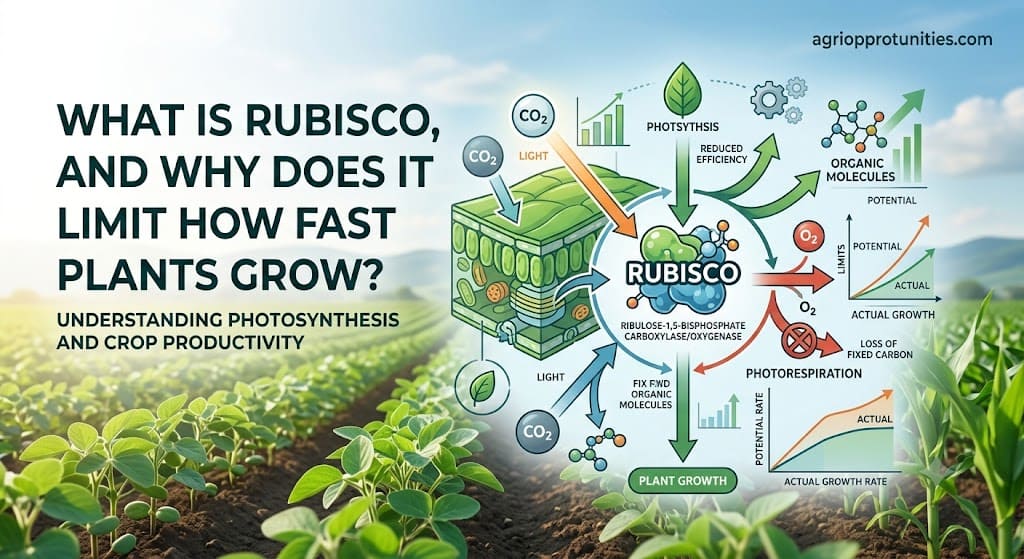
What Is Rubisco, and Why Does It Limit How Fast Plants Grow?

Here’s a surprising fact: the most abundant protein on Earth is also one of the least efficient enzymes at its job. That protein is Rubisco, the enzyme at the heart of photosynthesis in nearly every crop we grow. In this article, I’ll explain what Rubisco does, why it often makes a costly mistake, and how scientists are trying to improve it. Because so much crop productivity depends on this single enzyme, organizations such as the Gates Foundation continue to invest heavily in research aimed at boosting its efficiency.

What Rubisco’s Name Actually Means
Rubisco stands for ribulose-1,5-bisphosphate carboxylase/oxygenase. The name reflects both its function and its biggest weakness. As a carboxylase, it attaches carbon dioxide to a sugar molecule. As an oxygenase, it can mistakenly bind oxygen instead—and that competing reaction reduces photosynthetic efficiency.
What Rubisco Is Designed to Do
Rubisco captures carbon dioxide from the atmosphere and combines it with a five-carbon sugar called ribulose-1,5-bisphosphate (RuBP). This reaction initiates carbon fixation in the Calvin cycle, the process plants use to convert atmospheric carbon into compounds that support sugar production and growth.
Nearly all the food humans consume depends, directly or indirectly, on photosynthetic carbon fixation. Rubisco therefore plays a central role in plant growth, agricultural productivity, and the global food supply.
Why It’s Also Remarkably Inefficient
Despite its essential role, Rubisco cannot perfectly distinguish between carbon dioxide and oxygen. When it reacts with oxygen instead of carbon dioxide, it initiates photorespiration, a metabolic pathway that consumes energy and can reduce the efficiency of photosynthesis. The frequency of this reaction varies with temperature, carbon dioxide availability, and plant species.
Why This Happens More at High Temperatures
High temperatures generally favor Rubisco’s oxygenation reaction relative to carbon fixation, particularly when plants close their stomata to conserve water. Stomatal closure limits carbon dioxide entry and can lower its concentration inside leaves, making oxygenation more likely. As a result, photorespiration can become a greater constraint on photosynthesis during hot, dry conditions, raising concerns about crop productivity as the climate warms.
What Happens When Rubisco Makes This Mistake
When Rubisco binds oxygen instead of carbon dioxide, it produces one molecule of 3-phosphoglycerate and one molecule of 2-phosphoglycolate. Plants cannot feed 2-phosphoglycolate directly into the Calvin cycle, so they must process it through a series of reactions to recover useful carbon and recycle its components.
This Recovery Process Is Called Photorespiration
Photorespiration is the metabolic pathway that recycles the products of Rubisco’s oxygenation reaction. The pathway moves compounds through three organelles: chloroplasts, peroxisomes, and mitochondria. It recovers some of the carbon and returns it to the Calvin cycle, but the process also consumes energy and releases carbon dioxide. This reduces the net efficiency of photosynthesis compared with carbon fixation alone.
The Yield Cost Is Significant
Photorespiration can substantially limit crop productivity, but its effects vary with crop species, growing conditions, and the way researchers measure losses. Estimates of yield penalties differ across studies, so a single percentage range should not be treated as universal. Under hot, dry conditions, photorespiration can significantly reduce net carbon assimilation, especially when carbon dioxide availability inside leaves declines. Because crops such as rice, wheat, and soybean are central to global food security, researchers are investigating ways to improve photosynthetic efficiency, including strategies to reduce the costs of photorespiration and improve Rubisco’s performance.

Why Rubisco Evolved to Be This Way
It’s worth pausing on why an enzyme this important would evolve with such an obvious flaw. The most widely accepted explanation traces back to when Rubisco first evolved, in an ancient atmosphere with far higher carbon dioxide and far lower oxygen concentrations than exist today. Under those ancient conditions, the risk of accidentally grabbing oxygen was much lower simply because there was so little oxygen around.
As Earth’s atmosphere gradually shifted toward its modern, oxygen-rich composition, Rubisco’s oxygen-versus-carbon-dioxide selectivity problem became a much bigger liability than it originally was — the enzyme essentially never had strong enough evolutionary pressure to fully correct a flaw that only became serious relatively recently in geological terms.
Nature’s Own Partial Fix: C4 Photosynthesis
Interestingly, evolution has already produced at least one genuinely effective workaround, just not in every plant. Crops like maize and sorghum use an alternative photosynthetic pathway called C4 photosynthesis, which relies on specialized leaf anatomy and biochemistry to concentrate carbon dioxide directly around Rubisco before it ever gets a chance to accidentally bind oxygen.
Why This Matters for Crop Science
This natural design solution is exactly why C4 crops like maize tend to be more efficient photosynthesizers than C3 crops like rice, wheat, and soybean, which lack this carbon-concentrating mechanism and rely on Rubisco operating directly in a normal, oxygen-rich atmospheric environment. A major thread of current crop engineering research is specifically focused on trying to introduce C4-like carbon-concentrating mechanisms into C3 staple crops, essentially borrowing a solution nature already built into a different set of plants.
Another Natural Workaround: Cyanobacterial Carboxysomes
Photosynthetic bacteria called cyanobacteria have evolved their own distinct solution: specialized internal compartments called carboxysomes that concentrate carbon dioxide directly around their own version of Rubisco, similarly shielding it from the oxygen-binding mistake that plagues Rubisco in most crop plants.
Why This May Have Evolved
Research suggests these specialized compartments may have originally evolved in response to periods of low atmospheric carbon dioxide in Earth’s ancient history, and may also benefit organisms living in dim-light environments where maximizing every bit of captured carbon matters even more. Researchers working within the RIPE (Realizing Increased Photosynthetic Efficiency) project, a partnership between the University of Illinois and the Australian National University, are actively working to engineer similar specialized Rubisco compartments directly into crop plants, aiming to replicate this natural cyanobacterial solution in an entirely different type of organism.
The Rubisco Activase: The Enzyme That Keeps Rubisco Working
Rubisco has a genuinely important behind-the-scenes partner worth knowing about: an enzyme called Rubisco activase (often abbreviated RCA), which regulates Rubisco’s ongoing activity. Rubisco activase catalyzes the release of RuBP from Rubisco once it’s been used, freeing up the enzyme’s active site to bind fresh carbon dioxide and magnesium and continue the carbon-fixing cycle.
Why Activase Matters for Heat Tolerance Specifically
Rubisco activase is also responsible for releasing certain sugar phosphate inhibitors that can otherwise block Rubisco’s activity, restoring its catalytic function when needed. Because Rubisco activase itself is notably heat-sensitive, and can lose function under high-temperature stress even before Rubisco itself is affected, researchers have specifically worked on engineering more thermostable versions of this activase enzyme as a separate but complementary strategy for improving crop heat tolerance.
How Scientists Are Actually Engineering Around These Limits
Given everything covered above, it’s worth walking through the specific, real engineering strategies researchers are testing, several of which have already produced genuine, measured field trial results rather than remaining purely theoretical.
Strategy One: Building a More Efficient Photorespiratory Bypass
Rather than trying to fix Rubisco’s oxygen-binding mistake directly, one major strategy accepts that the mistake will keep happening and instead focuses on making the recovery process (photorespiration) itself less wasteful. RIPE researchers engineered tobacco plants with alternative pathways to break down the toxic glycolate byproduct more efficiently, inserting glycolate-processing enzymes borrowed from bacteria and algae into the plant’s own genome.
The Field Trial Results Were Genuinely Striking
This photorespiratory bypass approach produced a 40 percent increase in crop yield in field trials — a remarkably large gain for a single genetic engineering intervention, and one that helped validate photorespiration as a genuinely promising target for crop improvement rather than a purely academic curiosity.
Strategy Two: Increasing Rubisco Levels, But Carefully
A separate research team led by the University of Essex took a different approach, genetically engineering a model crop to overexpress a specific protein (the H-protein) involved in the photorespiratory recycling process. Over two years of field trials, this specifically increased Rubisco enzyme levels in the plants’ leaves and boosted yield by 27 to 47 percent.
Why This Approach Requires Careful Targeting
Here’s a genuinely important caveat researchers discovered: simply increasing Rubisco expression throughout the entire plant, rather than specifically targeting leaf tissue, backfired — it stunted overall growth and metabolism, producing four-week-old plants only half the size of unaltered counterparts. This is a good illustration of a theme running throughout this whole science-explainer series: a biological intervention that helps in one specific location can actively harm the plant if applied indiscriminately elsewhere, which is exactly why the Essex team specifically used a promoter that targeted expression to leaf tissue rather than the whole plant.
Strategy Three: Reducing Chlorophyll to Free Up Resources
A more unusual RIPE research direction asked a genuinely creative question: since chlorophyll production consumes substantial plant resources, would reducing a plant’s chlorophyll levels free up those resources for other uses, potentially improving yield or nutritional quality elsewhere in the plant? This remains an active area of ongoing investigation rather than a settled, field-validated strategy at this stage.
Strategy Four: Making Rubisco Itself More Selective
The most direct-sounding approach — simply engineering Rubisco to be inherently better at distinguishing carbon dioxide from oxygen — has proven surprisingly difficult in practice. Research has found that making the enzyme more selective for carbon dioxide tends to slow its overall catalytic rate down, meaning the engineered plants don’t actually grow faster or larger despite Rubisco making fewer oxygen-binding mistakes — a frustrating trade-off between accuracy and speed that has limited this particular approach’s real-world success so far.
A More Recent, Ambitious Direction: “C3.5” Photosynthesis
Given the well-established efficiency advantage of C4 photosynthesis discussed earlier, some of the newest research has explored intermediate engineering approaches sometimes described as “C3.5” photosynthesis — attempting to couple a plant’s own mitochondrial energy production more directly with Rubisco’s carbon-fixing efficiency in C3 crops like rice, wheat, and soybean, aiming to capture some of C4’s efficiency benefits without requiring the full anatomical restructuring that natural C4 plants rely on.
Why This Matters Given Rising Food Demand
This research is explicitly motivated by a genuinely pressing numbers problem: global food demand is projected to rise more than 50 percent by 2050, even as crop productivity gains from conventional breeding are increasingly stagnating. Given that photorespiration alone can reduce net carbon assimilation by up to 40 percent under heat and drought stress, closing even part of that gap through photosynthetic engineering represents one of the more promising remaining levers for meeting future food demand without simply expanding farmland further.
A Note of Healthy Skepticism Worth Including
Not every researcher in this field is equally optimistic that engineering photosynthesis directly is the most promising path forward. Some published perspectives have specifically argued that increasing photosynthesis is an unlikely solution to the world’s broader food problem, pointing out that yield in real field conditions depends on many other interacting factors beyond photosynthetic efficiency alone — soil nutrient availability, water supply, pest pressure, and post-harvest losses among them. This is a genuinely useful caution: even a fully successful Rubisco or photorespiration engineering breakthrough would need to be combined with the other agronomic factors covered throughout this series, not treated as a silver bullet on its own.
Why This Research Attracts Serious Global Funding
The RIPE project itself is backed by the Bill & Melinda Gates Foundation, the U.S. Foundation for Food & Agriculture Research, and the U.K. Foreign, Commonwealth & Development Office — a genuinely significant coalition of funders, reflecting how seriously the global food security community takes this specific research direction. The project’s stated goal is explicit: improve photosynthesis and equip farmers worldwide with higher-yielding crops to help ensure everyone has enough food to lead a healthy, productive life.
Why This Matters for Students Considering This Research Area
Rubisco and photorespiration research sits at a genuinely rich, well-funded intersection of plant biochemistry, genetic engineering, and global food security policy. It rewards students comfortable working at a genuinely molecular level of detail — enzyme kinetics, gene expression targeting, protein engineering — while also staying connected to practical, field-scale outcomes like yield and heat tolerance, rather than remaining purely theoretical laboratory work. Given the scale of funding and institutional backing behind this research direction, it also represents a genuinely active and growing area for future graduate study and career opportunities.
For current research and graduate opportunities in plant physiology and photosynthesis research, browse live agriculture scholarship listings on Agri Opportunities.
Frequently Asked Questions
What does Rubisco actually do in a plant?
Rubisco captures carbon dioxide from the atmosphere and attaches it to a five-carbon sugar molecule, kicking off the process that converts that carbon into the sugars a plant uses for growth and energy, making it the entry point for nearly all carbon fixation in photosynthesis.
Why is Rubisco considered inefficient?
Rubisco cannot fully distinguish between carbon dioxide and oxygen molecules, and roughly 20 to 35 percent of the time it mistakenly grabs oxygen instead of carbon dioxide, triggering a costly recovery process called photorespiration that wastes energy and can reduce crop yield by 20 to 50 percent.
What is photorespiration?
Photorespiration is the energy-expensive process a plant must go through to recycle the toxic byproduct created when Rubisco mistakenly fixes oxygen instead of carbon dioxide, a repair process that spans three different compartments within the plant cell.
Have scientists successfully engineered crops to overcome Rubisco’s limitations?
Yes, in field trials. Researchers at the RIPE project engineered tobacco with a more efficient photorespiratory bypass pathway and saw a 40 percent yield increase in field trials, while a separate approach increasing Rubisco levels specifically in leaves boosted yield by 27 to 47 percent.
Add Agri Opportunities as a preferred source on Google to see latest blog listings first.






Scholorship