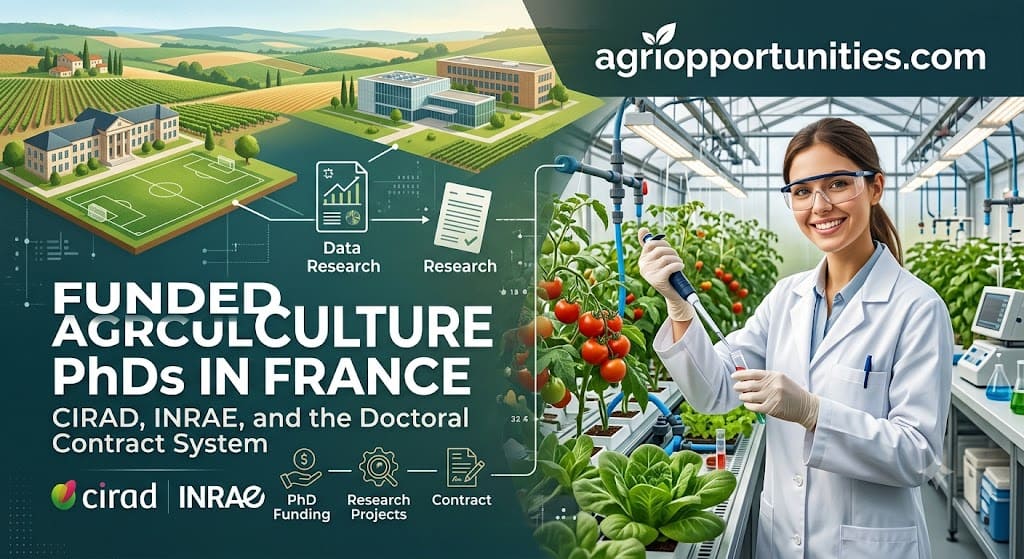
Funded Agriculture PhDs in France: CIRAD, INRAE, and the Doctoral Contract System

How CIRAD, INRAE, and the contrat doctoral system fund agriculture research — and how you can secure a position.
Funded Agriculture PhDs in France: CIRAD, INRAE, and the Doctoral Contract System
France runs one of the more structurally interesting PhD systems in Europe for agriculture research specifically, built around two major public research institutes — CIRAD and INRAE — that work in close partnership with France’s university doctoral school network. This guide walks through exactly how funding works, what each institute specializes in, and the concrete steps to actually finding a lab, a supervisor, and a funded position.

The Foundational Structure: The Contrat Doctoral
The single most distinctive feature of the French PhD system is the contrat doctoral — a genuine three-year employment contract offering PhD candidates a salaried position at their university or research institute. These positions typically pay a gross monthly income of roughly 1,800 to 2,200 euros, rising to around 2,300 euros in some specific institute-funded positions, and include comprehensive French social security coverage.
Why This Structure Matters for Your Legal Status
In France, your official status as a doctoral student depends directly on your funding source. Everyone doing a PhD is formally recognized as a student, since enrollment in an accredited doctoral programme is mandatory regardless of funding type. However, many doctoral candidates are also simultaneously salaried workers, since they hold a genuine contractual employment relationship with their host institution. International doctoral students funded through a foreign grant, by contrast, typically hold pure student status in France rather than combined student-employee status — a distinction worth understanding since it affects your tax situation, social security access, and visa category.
France’s Doctoral School System
Every PhD candidate in France must enrol in an accredited doctoral programme — known as an école doctorale, or doctoral school — run under the authority of the French Ministry of Higher Education and Research. This structure provides a genuinely high level of personalized training and supervision: you’re supervised by one or more thesis advisors, you carry out your work within an affiliated research laboratory and take part in its daily activities, you can participate in courses and seminars building your broader scientific foundation, and a thesis committee formally evaluates your training conditions and research progress at defined intervals throughout your degree.
Two Doctoral Schools Specifically Relevant to Agriculture
CIRAD, France’s agricultural research organization focused specifically on the Global South, maintains partnership agreements with two doctoral schools directly relevant to agriculture research: ABIES (covering agriculture, food, biology, environment, and health) and GAIA (covering biodiversity, agriculture, food, environment, Earth, and water). If your research interests sit anywhere within these broad categories, one of these two schools is likely to be your actual enrollment pathway, regardless of which specific research institute or laboratory hosts your day-to-day work.
CIRAD: France’s Agricultural Research Organization for the Global South
CIRAD’s explicit institutional remit is agricultural research for sustainable, inclusive development, positioning it deliberately at the intersection of global development challenges rather than purely domestic French agricultural science. This makes it a particularly natural fit for Pakistani and South Asian applicants specifically, given CIRAD’s institutional focus on tropical and Mediterranean agricultural systems rather than temperate European farming alone.
The Scale of CIRAD’s PhD Training
Each year, CIRAD’s research units and support services welcome almost 1,000 interns, PhD students, and researchers from both France and abroad, with 172 CIRAD researchers holding an HDR accreditation (the formal French qualification permitting a researcher to supervise doctoral candidates independently) — a genuinely substantial supervisory capacity spread across a wide range of scientific disciplines, from life sciences through social and political sciences.
How CIRAD PhD Funding Actually Works
CIRAD offers scholarships funded jointly with partner organizations including ANSES, INRAE, and various territorial authorities, and also welcomes students who arrive with their own scholarships funded by other bodies — French government grants, funding from your own home country, or funding from your parent institution back home. This last route is genuinely important for Pakistani applicants specifically: bringing an HEC scholarship or similar indigenous funding to a CIRAD-hosted PhD is an entirely viable path, provided your funding source meets CIRAD’s sufficiency requirements and your chosen doctoral school’s specific registration rules.

INRAE: France’s National Institute for Agriculture, Food, and Environment
INRAE positions itself as the world’s leading public research organization specializing in sustainable agricultural transitions, food security, and environmental safety, comprising a community of roughly 12,000 people spread across 272 highly specialized research units, and ranking among the global elite in ecological and plant-and-animal sciences.
The Full Range of INRAE Funding Types
Several distinct funding mechanisms exist for an INRAE-hosted PhD, and the practical first step for nearly all of them is the same: talk directly to the director of the research unit that interests you, since they can clarify which specific funding types are actually available for your intended project. The main categories include: INRAE funding itself (either 100 percent institute-funded, or combined with regional, ANR — the French National Research Agency — or European project funding); CIFRE funding, provided through a formal partnership with a private company that serves as your official employer while your research proceeds in academic collaboration; doctoral programme funding, where selection can be either candidate-based or candidate-and-project-based (in the latter case, you must first independently contact and establish an agreement with the specific research unit); Marie Skłodowska-Curie Action or Erasmus funding; and funding brought from your own country of origin, exactly as covered for CIRAD above.
The Standard Employment Terms
At INRAE, PhD students hired as contractual employees sign doctoral contracts requiring full-time employment for a three-year term, governed by French public law and INRAE’s own internal charter for contractual staff. The trial period lasts two months and is non-renewable, during which either party can terminate the contract via registered letter. If your research remains incomplete after three years — due to genuine research delays, maternity leave, or sick leave — your contract can be extended, renewable twice for one-year periods, though under no circumstances can the total PhD exceed six years.
A Practical Detail Worth Knowing: Visa Requirements
International doctoral students at INRAE must hold a valid residence permit; without one, INRAE will terminate your doctoral contract outright. This isn’t a minor administrative formality — it’s an explicit, strictly enforced condition of continued employment, so ensuring your visa and residence permit paperwork stays current throughout your entire PhD is a genuinely serious ongoing responsibility, not a one-time task completed only at arrival.
A Concrete Example of What’s Currently Available
To make this genuinely tangible, one recent INRAE posting offered a fully funded Life Sciences PhD at the Laboratory of Environmental Biotechnology in Narbonne, part of INRAE’s Occitanie-Montpellier Centre — a 4,757 square metre facility recognized as an international leader in anaerobic digestion and waste-to-energy technologies, hosting over 50 continuous bioreactors and high-performance metagenomic infrastructure. The three-year position, paying around 2,300 euros gross monthly, focused on mapping horizontal gene transfer pathways relevant to antimicrobial resistance in circular agricultural systems — genuinely relevant background reading for anyone who found the digestate-biochar piece elsewhere on this site interesting, given the shared focus on circular agricultural waste valorization.
The Practical Application Sequence
Step One: Find a Host Laboratory, Topic, Advisor, and Funding — Together
France’s own official guidance recommends beginning this entire process at least one year before your intended start date, since finding a laboratory, a thesis topic, a thesis advisor, and funding genuinely happen in parallel rather than as neatly sequential steps. Start by reviewing thesis topic lists posted by doctoral programmes and institutions, or contact laboratories working in your specific area of interest directly.
Step Two: Let Your Future Advisor Help With Funding
As a general rule, your prospective thesis advisor will actively help you identify and secure funding — this isn’t something you’re expected to arrange entirely independently before even making contact. International students can supplement this with other funding sources, including embassy fellowships, home-country government scholarships, or institutional partnership agreements between your home university and a French institution.
Step Three: Submit Your Project for Formal Approval
Once your laboratory, advisor, and funding are all resolved, you submit your project to your chosen doctoral programme for approval, with your thesis advisor and laboratory director jointly evaluating the quality and feasibility of your proposal before final registration.
Two Genuinely Distinct PhD Structures Worth Knowing About
Beyond the standard single-advisor model, France recognizes co-supervised theses, where one advisor comes from your main research laboratory (affiliated with your enrollment institution) and a second comes from an entirely separate institution, either within France or abroad — genuinely useful if your research interests span two distinct areas of expertise not held by a single supervisor. A more formal version of this, the individual dual degree agreement (convention individuelle de co-tutelle), establishes a fuller joint research framework between two institutions, sometimes resulting in a jointly awarded degree recognized by both countries.
Master’s-Level Funding Worth Knowing About in Parallel
If you’re pursuing a master’s degree as a stepping stone toward a French PhD, the French government’s Eiffel Excellence Scholarship is worth researching directly, alongside Marie Skłodowska-Curie Actions for those specifically pursuing international mobility projects, and various bilateral exchange scholarships and industry partnerships particularly active in applied science and engineering fields.
Practical Tips for a Genuinely Competitive Application
Read your target supervisor’s recent publications closely and send a concise, well-prepared email introducing your background, research interests, and specific motivation — mirroring the direct-outreach approach recommended throughout every country guide on this site, and genuinely the single most decisive step in the entire French PhD search process. If your interests lean toward tropical, Mediterranean, or Global South-focused agricultural research specifically, prioritize CIRAD and its ABIES or GAIA doctoral school affiliations over a purely domestic-French-focused institution, since CIRAD’s institutional mission aligns unusually well with research questions relevant to Pakistani agriculture specifically. And whichever institute you approach, begin your search at least a full year ahead of your intended start date, exactly as INRAE’s own guidance recommends, since laboratory placement, advisor confirmation, and funding negotiation together take genuine time to resolve.
France funds agriculture PhDs through genuine employment contracts, not stipends — with CIRAD and INRAE offering structured, salaried positions through the contrat doctoral system. Start your search at least one year ahead, contact laboratories directly, and bring funding options to your supervisor conversation. The system rewards proactive, well-prepared candidates.
Browse live agriculture PhD scholarships in France and across Europe →Frequently Asked Questions
What is a contrat doctoral in France?
A contrat doctoral is a three-year salaried employment contract that funds most PhD students in France, offering a gross monthly income of roughly 1,800 to 2,300 euros with comprehensive social security coverage, functioning as genuine employment rather than a traditional scholarship stipend.
What is CIFRE funding for a PhD in France?
CIFRE, the French industrial convention for research-based training, is a funding route provided through a partnership with a private company, which serves as the doctoral student’s official employer while the research is conducted in collaboration with an academic institution.
What are ABIES and GAIA?
ABIES and GAIA are two French doctoral schools with formal partnership agreements with CIRAD, covering agriculture, food, biology, environment, and health (ABIES) and biodiversity, agriculture, food, environment, Earth, and water (GAIA), through which CIRAD-affiliated PhD students formally register and receive academic oversight.
Do I need to find my own funding before applying for a PhD in France?
Yes, in most cases. You must have a work contract associated with sufficient funding, and certain doctoral programmes require proof of sufficient funding before students can even register, meaning securing funding and finding a supervisor typically happen together rather than funding being arranged only after admission.
Switzerland runs the same broad employment-based PhD model as Denmark and Sweden, covered elsewhere on this site, but with a few genuinely distinctive details worth understanding before you apply — including some of the highest doctoral compensation in Europe, paired with famously high living costs. This guide focuses on Switzerland’s two federal institutes of technology, ETH Zurich and EPFL, the two most prominent destinations for agriculture-adjacent PhD research in the country.

PhD as Genuine, Well-Paid Employment
As with the Nordic systems covered elsewhere on this site, Swiss PhD students are not typically “scholarship students” in the traditional sense — they’re full-time university employees, commonly referred to as scientific or doctoral assistants, hired on contracts with salaries defined by national scales.
What This Actually Pays
As of 2026, EPFL’s basic starting salary for a doctoral assistant is 55,225 Swiss francs gross per year. More broadly across ETH and EPFL, doctoral stipends range from roughly 50,000 to 62,000 francs annually — genuinely well above typical European PhD compensation, including comparison points like Germany’s DFG-funded positions, which sit closer to 45,000 to 55,000 euros.
The Living Cost Reality Check
It’s worth being honest that this higher pay reflects genuinely higher costs, not just better funding. Zurich and Geneva rank among the most expensive cities globally for cost of living, placing in the same tier as Hong Kong, Singapore, and New York — meaning the higher salary needs to be weighed against a correspondingly higher cost base rather than treated as pure additional purchasing power.
Tuition Is Almost an Afterthought
Given the employment-based structure, tuition fees are genuinely minimal — often just a few hundred Swiss francs per semester, with ETH Zurich specifically citing fees around 809 CHF per semester. Your salary is effectively your entire funding package, rather than needing to separately cover significant tuition costs on top of living expenses.
How PhD Admission Actually Works
You Generally Need a Doctoral Program Behind You First
At EPFL specifically, you must be admitted by a doctoral program before you can be hired as a doctoral assistant. In some cases, a doctoral program may admit a candidate even without a corresponding funded position immediately available — in that situation, the candidate remains eligible for hiring for up to one year while funding is sought, and can pursue individual scholarships and external funding in parallel.
Finding a Supervisor Is the Real First Step
As with Germany’s traditional PhD model covered elsewhere on this site, Swiss admissions tend to be based on genuine fit and research alignment between you and a specific supervisor, rather than a standardized, purely metrics-based admissions process. Direct outreach to a professor whose research matches your interests — following the same approach recommended in the general research assistantship guide elsewhere on this site — is typically the practical starting point, sometimes taking several months of sustained outreach before securing a supervisor’s commitment.
A Concrete, Currently Open Example: ETH Zurich’s Agricultural Economics PhD
To make this genuinely concrete rather than abstract, it’s worth looking at an actual recent ETH Zurich posting closely matching this site’s focus. ETH Zurich advertised a four-year doctoral position in Agricultural Economics and Policy, working under Professor Robert Finger within the Agricultural Economics and Policy Group, as part of the ACHIEVE project — a major national Swiss research initiative focused on pathways to net-zero for Switzerland’s hardest-to-abate emissions sectors, including agriculture.
What Made This Position Attractive
The role offered a full ETH Zurich doctoral salary, social benefits, and direct involvement in a genuinely consequential national climate policy project — connecting real agricultural economics research to Switzerland’s actual net-zero transition planning, rather than purely theoretical academic work disconnected from policy application.
What the Application Actually Required
Applicants needed to submit a cover letter, CV, academic transcripts, and contact details for two referees, all combined into a single PDF document, through ETH Zurich’s online application portal. The position was open to both recent master’s graduates and students still completing their degree in agricultural economics or a related discipline.
A Language Detail Worth Noting
Some Swiss positions, including certain policy-facing roles, may favor or require proficiency in one of Switzerland’s major working languages (German or French) alongside English, which can meaningfully narrow the international applicant pool for those specific roles — worth checking carefully on each individual posting rather than assuming English alone is always sufficient, even at internationally-oriented institutions like ETH and EPFL.
Where to Actually Search for Swiss PhD Positions
Direct University Job Portals
ETH Zurich, EPFL, and other Swiss universities including Zurich, Geneva, Lausanne, Bern, Basel, and Fribourg regularly advertise PhD openings directly on their own job portals, alongside general academic job boards like Academic Positions and FindAPhD.
Structured Graduate Schools
Beyond individually advertised positions, structured graduate schools offer another entry route — the Life Science Zurich Graduate School, a joint programme between ETH Zurich and the University of Zurich, offers over 100 fully funded PhD positions across roughly 500 research groups in the life sciences broadly, a genuinely large and relevant pool for agriculture-adjacent research interests.
Swiss Government Excellence Scholarships
Run by Switzerland’s Federal Commission for Scholarships for Foreign Students, these national-level awards are available to postgraduate researchers from over 180 countries across any discipline, funding either a full PhD (usually up to three years) or a shorter research stay during a PhD already underway elsewhere. Every application must be formally backed by a professor, reinforcing again how central that initial supervisor relationship is across nearly every Swiss funding route.
What Makes ETH and EPFL Genuinely Distinctive as a Career Investment
Beyond the funding mechanics, it’s worth knowing that ETH and EPFL graduates report notably strong academic placement outcomes, with some tracking suggesting a meaningful probability of landing a tenure-track position at a top-100 global university within five years of graduation — among the stronger placement outcomes for any doctoral programme outside a small handful of the most prestigious US and UK institutions. Both universities also maintain well-established industry connections with major companies including Nestlé, relevant for agriculture and food science graduates specifically considering an industry rather than purely academic career path.
Practical Tips for a Competitive Application
Start supervisor outreach well in advance, since securing a professor’s genuine commitment can take several months of sustained contact, and treat this relationship-building as the actual gating step in your application timeline rather than an afterthought. Confirm language requirements explicitly for any specific posting rather than assuming English alone suffices, particularly for policy-facing or applied research roles. And budget realistically for Swiss living costs specifically — the higher salary figures covered in this guide need to be weighed honestly against Zurich and Geneva’s position among the most expensive cities in the world, rather than treated as straightforwardly superior to lower-paying positions in more affordable countries.
For currently open PhD positions in Switzerland and across Europe, browse live agriculture scholarship listings on Agri Opportunities.
Frequently Asked Questions
How much does a PhD student at ETH Zurich or EPFL actually earn?
As of 2026, EPFL’s basic starting salary for a doctoral assistant is 55,225 Swiss francs gross per year, while ETH and EPFL doctoral stipends more broadly range from roughly 50,000 to 62,000 francs annually, well above typical European PhD compensation.
Do I need to find a supervisor before applying for a PhD in Switzerland?
Yes, in most cases. At EPFL specifically, you must be admitted by a doctoral program before you can be hired as a doctoral assistant, and finding a professor willing to supervise your specific research area is typically the first practical step.
How much does PhD tuition cost in Switzerland?
Tuition fees are very low, often only a few hundred Swiss francs per semester, since most PhD students are treated as full-time university employees rather than fee-paying students, meaning your salary functions as your primary source of funding.
What is the Swiss Government Excellence Scholarship?
It’s a national-level award, run by the Federal Commission for Scholarships for Foreign Students, available to postgraduate researchers from over 180 countries, funding either a full PhD of usually up to three years or a research stay during a PhD already underway elsewhere.
Add Agri Opportunities as a preferred source on Google to see latest guide listings first.