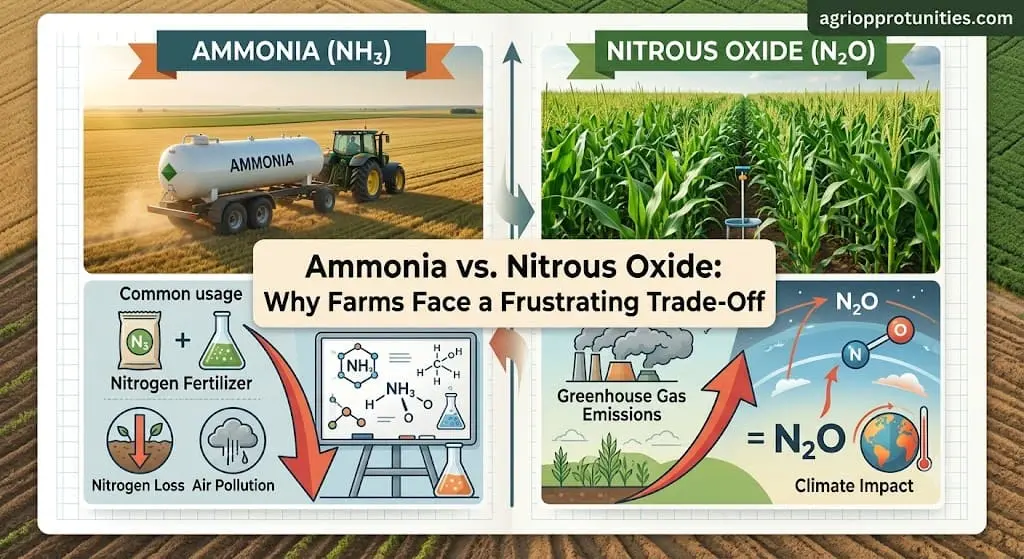
Ammonia vs. Nitrous Oxide: Why Farms Face a Frustrating Trade-Off

Why fixing one nitrogen loss problem on a farm can quietly create another, and what the research says about solving both together.
I ended the last piece in this series with a promise, and I want to make good on it here. This is genuinely one of the more humbling lessons in soil nitrogen management — the kind of thing that looks simple from a textbook diagram and turns out to be considerably trickier once you’re actually managing a real field.
Imagine you’ve just learned that a significant share of your fertilizer nitrogen is evaporating straight into the air as ammonia gas within days of application. So you do the sensible thing: you switch to a urea product treated with a urease inhibitor, specifically designed to stop that ammonia loss. You’ve solved the problem.
Except, in a meaningful share of documented field trials, you haven’t solved it — you’ve moved it. The nitrogen that didn’t escape as ammonia often stays in the soil a little longer. It gets converted through the nitrogen cycle and shows up instead as extra nitrous oxide, a gas nearly 300 times more potent as a greenhouse driver than carbon dioxide.
This is what researchers call “pollution swapping.” Understanding it properly is essential if you’re serious about nitrogen management rather than just chasing whichever loss pathway happens to be easiest to measure.

First, a Quick Refresher: Two Different Gases, Two Different Problems
Before getting into the trade-off itself, it’s worth being clear that ammonia (NH₃) and nitrous oxide (N₂O) are genuinely different problems. They are not two names for the same thing.
Ammonia: A Fast-Acting Local Problem
Ammonia volatilization is the process by which nitrogen fertilizer, particularly urea-based products, converts into ammonia gas and evaporates directly from the soil surface. This happens especially when fertilizer is left unincorporated, applied under warm conditions, or exposed for an extended period before rainfall or irrigation moves it into the soil.
It’s a major and genuinely fast-acting pathway of nitrogen loss — occurring within days of application. It contributes to acid rain, fine particulate air pollution, and unpleasant odors near heavily fertilized or manured land.
Nitrous Oxide: A Long-Term Global Threat
Nitrous oxide, as I covered in detail in the previous piece in this series, forms through entirely different soil microbial processes — nitrification and denitrification. Its primary danger isn’t local air quality but its outsized contribution to global warming and stratospheric ozone depletion.
So these are two distinct forms of nitrogen loss, through two distinct mechanisms, causing two distinct kinds of environmental harm. The complication is that they’re not independent of each other. They’re connected through the same underlying pool of soil nitrogen, and a change that affects one pathway frequently has knock-on effects on the other.
The Actual Mechanism Behind the Trade-Off
Here’s the chain of cause and effect, laid out step by step. Understanding the mechanism is what makes this trade-off intuitive rather than mysterious.
Step 1: Urea Breaks Down to Ammonium
When urea fertilizer is applied to soil, it doesn’t stay as urea for long. An enzyme called urease, produced by soil microorganisms, rapidly breaks urea down into ammonium. This hydrolysis reaction also temporarily raises the soil’s pH right around each urea granule, creating a brief, localized spike in alkalinity.
That combination — freshly available ammonium and a temporary pH spike — is exactly what drives rapid ammonia volatilization. This is particularly true when the fertilizer is left exposed on the soil surface rather than incorporated.
Step 2: Urease Inhibitors Slow the Reaction
A urease inhibitor works by directly slowing down that urea-to-ammonium hydrolysis reaction. Slow the reaction, and you slow both the ammonium buildup and the pH spike that drives ammonia gas formation. This is exactly why urease inhibitors are so effective at cutting ammonia losses.
Field trials show reductions as high as 45 to 55 percent. In some injection-based comparisons, reductions have been as extreme as 99 percent relative to untreated surface-broadcast urea.
Step 3: The Nitrogen Stays in the Soil
But here’s the catch: slowing urea hydrolysis doesn’t make that nitrogen disappear. It simply keeps more of it in the soil, in ammonium form, for a longer period, rather than letting it escape as gas immediately.
And ammonium sitting in the soil for longer is exactly the substrate that feeds nitrification — the first step in producing nitrous oxide, as covered in the previous piece in this series.
Step 4: Nitrous Oxide Is Produced Instead
So the nitrogen that would have volatilized as ammonia within the first few days instead sticks around long enough to be converted, at least in part, into nitrate and then into nitrous oxide through nitrification and subsequent denitrification.
One research team studying this effect explicitly described the pattern this way: due to the ability of urease inhibitors to reduce ammonia volatilization, the nitrogen that would have been lost that way instead becomes available for the microbial pathways that generate nitrous oxide. This is pollution swapping, essentially moving the same underlying nitrogen loss from one gaseous form to another.

How Big Is Each Loss Pathway, Really?
Before deciding how to manage this trade-off, it helps to understand the relative scale of the two losses. They are not remotely equal in absolute quantity, even though nitrous oxide is far more dangerous per unit of mass released.
Ammonia Losses Dwarf Nitrous Oxide in Quantity
Research comparing gaseous losses side by side found that ammonia volatilization losses from urea were roughly 164 times greater, in absolute quantity, than nitrous oxide losses from the same fertilizer source. For dairy slurry applications, ammonia losses were around six times greater.
In raw quantity, ammonia loss dwarfs nitrous oxide loss. But nitrous oxide’s global warming potential is roughly 298 times that of an equivalent mass of carbon dioxide.
A Small N₂O Increase Has a Big Climate Impact
So a comparatively small nitrous oxide increase can still represent a genuinely significant climate impact, even while remaining a much smaller absolute nitrogen loss than the ammonia pathway it’s replacing.
This asymmetry is exactly why the trade-off matters so much for policy and management decisions. A mitigation strategy that looks like an unambiguous win when measured purely in “kilograms of nitrogen saved” can look considerably more complicated once you weigh the climate impact of where that saved nitrogen actually ends up.
Urease Inhibitors vs. Nitrification Inhibitors: Two Different Tools for Two Different Jobs
Given everything above, it’s worth being precise about what each specific category of fertilizer additive actually targets. Conflating them is a common source of confusion.
Urease Inhibitors (UIs)
The most widely used urease inhibitor compounds — NBPT (N-(n-butyl) thiophosphoric triamide), NPPT, and hydroquinone among them — work specifically by delaying urea hydrolysis. This moderates the transient pH spike that drives ammonia loss and reduces NH₃ volatilization and other reactive nitrogen losses in the days immediately following application.
Their primary, well-documented benefit is cutting ammonia loss substantially. Field research has repeatedly shown this effect to be strong and consistent across different application contexts. This is particularly true for surface broadcast application, elevated temperatures, and limited soil incorporation — exactly the conditions where ammonia loss is normally worst.
Nitrification Inhibitors (NIs)
Nitrification inhibitors, such as DMPP (which works by competitively binding to a specific enzyme subunit involved in ammonia oxidation), target an entirely different step. They slow down the first stage of nitrification itself — the oxidation of ammonium into nitrite.
This prolongs the amount of time nitrogen stays in the more stable ammonium form and directly reduces both nitrous oxide emissions and nitrate leaching. Research shows nitrification inhibitors can increase nitrogen recovery efficiency by 4 to 93 percent. They can boost crop yields by 6 to 13 percent.
They can also reduce nitrous oxide emissions by a wide range of 8 to 94 percent depending on soil type, climate, and management context. Importantly, nitrification inhibitors generally have limited and inconsistent direct impact on ammonia volatilization itself. They’re solving a different part of the nitrogen cycle, not the same one urease inhibitors target.
Why You Can’t Just Pick One and Call It Solved
Urease inhibitors specifically target ammonia, while nitrification inhibitors target nitrous oxide emissions and nitrogen leaching. Using only one can solve one nitrogen loss problem while leaving the other pathway unaddressed.
As the pollution-swapping scenario above illustrates, choosing one inhibitor can even worsen the other problem. A newer category of products aims to close this gap.
Dual Inhibitors: Targeting Both Pathways at Once
Dual-acting inhibitors combine a urease inhibitor and a nitrification inhibitor in a single product. They target both ammonia volatilization and nitrous oxide emissions simultaneously, helping farmers reduce one form of nitrogen loss without increasing the other.
What the Research Shows
Field research comparing urease-inhibitor-only, nitrification-inhibitor-only, and dual-inhibitor treatments side by side found meaningfully different reduction profiles for each. In one study, the urease inhibitor alone achieved a 45.61 percent reduction in ammonia emissions but only an 11.06 percent reduction in nitrous oxide.
The nitrification inhibitor alone achieved a negligible 0.44 percent reduction in ammonia but a substantial 29.51 percent reduction in nitrous oxide. The dual inhibitor achieved a 26.74 percent reduction in ammonia alongside a 32.43 percent reduction in nitrous oxide.
This was the only treatment among the three that meaningfully addressed both loss pathways at once. Its ammonia reduction alone was somewhat less dramatic than the urease-inhibitor-only treatment. But it covered both bases.
When to Use Each Type
This is a genuinely useful, practical finding for real-world fertilizer management decisions. If your specific field or region has a particular loss pathway that dominates — say, ammonia loss in a hot, high-pH soil with surface-applied urea, or nitrous oxide loss in a poorly drained, frequently waterlogged field — a single-target inhibitor matched to that dominant pathway may be the more cost-effective choice.
But where both pathways are genuinely significant, or where you don’t have detailed enough site information to know which dominates, a dual inhibitor product offers a more balanced, “cover both bases” approach.

What Else Influences This Trade-Off Besides the Choice of Inhibitor
Irrigation Level
Research examining ammonia and nitrous oxide emissions under different irrigation levels alongside different nitrogen synergists found that water-filled pore space (WFPS) — essentially how saturated the soil is — plays a major role in determining which loss pathway dominates.
In one detailed study, the relative contribution of WFPS, ammonium concentration, and nitrate concentration to each gas differed substantially. Ammonium concentration was the dominant driver of ammonia volatilization, contributing 72.6 to 82.0 percent of the variation. Nitrate concentration was the dominant driver of nitrous oxide emissions, contributing 50.8 to 77.2 percent of the variation.
Water-filled pore space played a comparatively smaller but still meaningful role in both. This reinforces a theme from the previous piece in this series: soil moisture management isn’t just a yield or water-conservation issue. It’s a direct lever on which specific nitrogen loss pathway your field is more prone to.
Soil Organic Matter and Inhibitor Degradation
Nitrification inhibitors like DCD (dicyandiamide) degrade faster in soils with higher organic matter content. This means their effective window of action can be shorter in organically rich soils than in soils with lower organic matter.
This is a genuinely important practical detail. Applying a nitrification inhibitor without accounting for how quickly it will break down in your specific soil type can lead to disappointing real-world results compared to the trial conditions where the product was originally tested.
Biofertilizers and Biological Approaches
Interestingly, some research has found that biofertilizers containing specific nitrogen-fixing bacteria, such as Azotobacter, can independently reduce nitrous oxide emissions through a genuinely different biological mechanism. These organisms are capable of nitrous oxide fixation and can help reduce N₂O all the way to harmless N₂ gas.
This essentially completes the denitrification pathway that would otherwise leak N₂O partway through. This represents a promising, still-developing biological complement to the chemical inhibitor strategies discussed above. It’s worth watching as this research area matures.
The Bigger Picture: Why This Matters Especially in Places Like Pakistan and China
This trade-off isn’t an abstract academic curiosity. It has real, practical stakes in exactly the kind of intensively fertilized agricultural systems common across South Asia.
The Scale of the Problem
Research on this topic specifically highlights China as a stark example. Despite possessing only 7.8 percent of the world’s arable land, China accounts for approximately 22.7 percent of global nitrogen fertilizer consumption. This reflects a serious problem of excess nitrogen fertilization relative to genuine crop need.
Under these conditions, studies estimate that nearly 50 percent of applied nitrogen fertilizer is lost from agricultural soils through the combined pathways of ammonia volatilization, nitrate leaching and runoff, and nitrous oxide emissions. This almost exactly mirrors the nitrogen use efficiency figures discussed in the first piece in this series.
Relevance to Pakistan and South Asia
This is directly relevant to similarly nitrogen-intensive farming systems across Pakistan and much of South Asia. In these high-input systems, getting the ammonia-versus-nitrous-oxide balance right isn’t a minor optimization. It’s a genuinely significant lever on both the agronomic and environmental performance of an enormous share of global food production.
Practical Recommendations: How to Actually Think About This as a Farmer or Agronomist
Given everything above, here’s how I’d summarize the practical decision-making framework. It draws directly from the mechanisms and research discussed throughout this piece.
- Identify your field’s dominant loss pathway first, rather than defaulting to a single generic solution. A hot, high-pH, surface-broadcast urea system with limited incorporation is likely to lose more nitrogen to ammonia volatilization. A frequently waterlogged, flood-irrigated, or heavy clay soil system is more likely to lose nitrogen through denitrification-driven nitrous oxide. Match your inhibitor choice to your actual dominant risk rather than assuming one product handles everything equally well everywhere.
- Consider dual-acting inhibitors where both pathways are genuinely significant, or where you lack the detailed soil and climate information needed to confidently identify a single dominant pathway — the research above shows this is the only category of product that meaningfully addresses both problems simultaneously, even if it doesn’t maximize reduction on either single pathway compared to a targeted single-purpose product.
- Incorporate fertilizer into the soil rather than leaving it on the surface, since this single practice reduces ammonia volatilization directly (by increasing the diffusion distance nitrogen needs to travel before reaching the atmosphere) without meaningfully increasing nitrous oxide risk the way a urease inhibitor alone might, making it one of the few genuinely “free” wins in this trade-off — no product cost, no swapping risk, just a change in application method.
- Manage irrigation timing relative to fertilization, since water-filled pore space is a major independent driver of the nitrification-versus-denitrification balance discussed in the previous piece, and avoiding waterlogged conditions immediately following fertilizer application reduces nitrous oxide risk regardless of which inhibitor product you’re using.
- Don’t treat “reduced ammonia loss” as automatically equivalent to “reduced total environmental impact.” This is the single most important takeaway from this entire piece. A genuinely complete evaluation of any nitrogen management practice needs to account for where the “saved” nitrogen actually ends up, not just which single loss pathway improved on paper.
Why This Is a Genuinely Rich Area for Further Research
If this kind of mechanistic, trade-off-aware thinking about nitrogen management appeals to you as a student or early-career researcher, this is exactly the kind of nuanced, systems-level problem that soil biogeochemistry and nutrient management research is built around.
Simple, single-variable solutions are rare in this field. Nearly every intervention has secondary effects that ripple through the broader nitrogen cycle. Understanding those ripple effects, rather than optimizing for a single easily-measured metric, is what separates genuinely useful agronomic research from research that inadvertently creates a new problem while solving an old one.
Where This Series Goes Next
Having now covered the nitrogen cycle broadly, nitrous oxide specifically, and this ammonia-nitrous oxide trade-off, the next piece in this series will turn to a genuinely different, though related, soil science topic. It will cover biochar, and the increasingly popular but sometimes overstated claims around its ability to reduce farm emissions and improve soil carbon storage.
For current research and graduate opportunities in soil science and nutrient management, browse live agriculture scholarship listings on Agri Opportunities.
Frequently Asked Questions
What is ‘pollution swapping’ in nitrogen management?
Pollution swapping occurs when a practice that reduces one form of nitrogen loss, such as ammonia volatilization, inadvertently increases another, such as nitrous oxide emissions. The nitrogen that stays in the soil instead of escaping as ammonia becomes available for microbial processes that produce nitrous oxide.
What is the difference between a urease inhibitor and a nitrification inhibitor?
A urease inhibitor slows the enzymatic breakdown of urea into ammonium, directly reducing ammonia volatilization, while a nitrification inhibitor slows the microbial conversion of ammonium into nitrate, primarily targeting nitrous oxide and nitrate leaching rather than ammonia loss.
Can a single product reduce both ammonia and nitrous oxide losses?
Yes. Dual-acting inhibitors that combine both a urease inhibitor and a nitrification inhibitor are specifically designed to address both loss pathways simultaneously, and research shows they can meaningfully reduce both ammonia volatilization and nitrous oxide emissions together.
Which nitrogen loss pathway is generally larger, ammonia or nitrous oxide?
Ammonia volatilization losses are typically far larger in absolute quantity than nitrous oxide losses from the same fertilizer source, with some studies finding ammonia losses over 100 times greater than nitrous oxide losses from urea, even though nitrous oxide is the far more potent greenhouse gas per unit of mass.
Add Agri Opportunities as a preferred source on Google to see latest blog listings first.