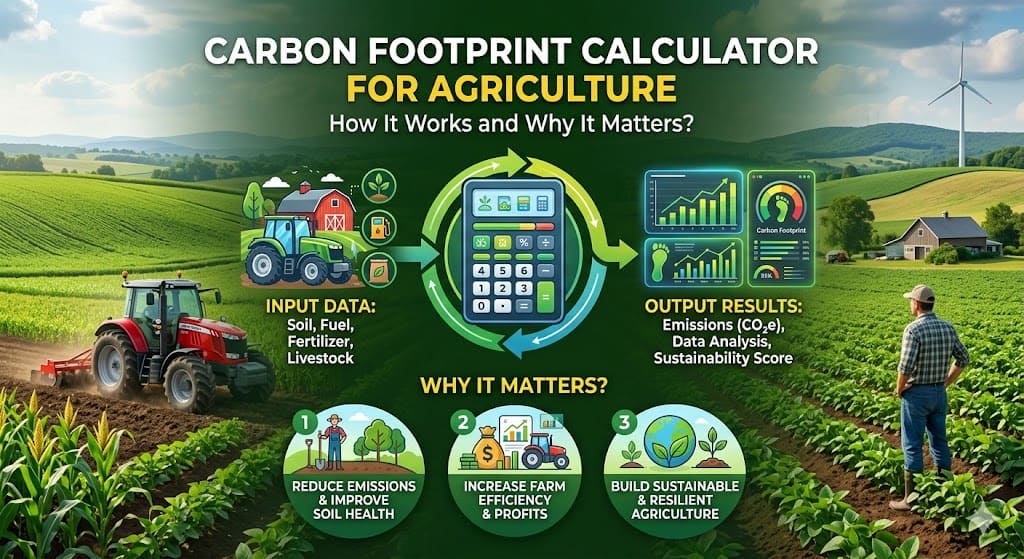
Carbon Footprint Calculator for Agriculture – How It Works and Why It Matters?

Carbon Footprint Calculator for Agriculture
How It Works and Why It Matters
Complete guide to agricultural carbon footprint measurement: learn how farm emissions are calculated, major sources of greenhouse gases, reduction strategies, and carbon farming opportunities.

The Climate Conversation Has Reached the Farmgate
Agriculture has always been shaped by the environment — by rainfall, temperature, soil quality, and seasonal cycles. However, today farming is not just responding to climate. It is also contributing to it. Moreover, that contribution is measurable, trackable, and in many cases, reducible. Therefore, understanding agricultural emissions has become essential for modern farm management.
The carbon footprint calculator agriculture sector has developed over the past decade is not just a scientific instrument. Instead, it is a practical farm management tool that helps farmers, agribusiness investors, researchers, and policymakers understand the true climate impact of agricultural activities. This includes everything from the livestock in the barn to the tractor in the field to the fertilizer spread across the soil. Consequently, these tools are transforming how farms operate.
What Is a Carbon Footprint in Agriculture?
A carbon footprint in agriculture refers to the total volume of greenhouse gases — expressed in CO2 equivalent emissions farming — produced directly or indirectly by a farming operation over a defined period, typically one year or one production season. Therefore, it provides a comprehensive picture of the farm’s climate impact.
The carbon footprint calculator agriculture tools are designed to quantify emissions from all major sources on a farm. These include livestock methane emissions, nitrous oxide soil emissions from fertilized cropland, fuel use in agriculture emissions from tractors and farm machinery, manure management emissions, and the energy consumed by irrigation and farm buildings. Consequently, the result is a single number — or set of numbers — expressed in tonnes of CO2 equivalent (CO2e). This figure can then be benchmarked against industry averages, tracked over time, and used to identify where emissions reductions are most achievable. Thus, understanding what is carbon footprint in agriculture is the first step, but acting on that understanding is where the real opportunity lies.
Why Carbon Footprint Matters in Farming
The importance of carbon footprint in farming extends well beyond environmental concern. In fact, it touches financial performance, regulatory compliance, market access, and long-term farm viability. Therefore, every farmer should understand this concept.
🌍 Agriculture and Climate Change
Is agriculture a major contributor to greenhouse gases? According to FAOSTAT data from the Food and Agriculture Organization, the answer is yes. Agriculture and related land use account for a significant share of global emissions. Moreover, the relationship is bidirectional: climate change threatens agricultural productivity while agricultural emissions contribute to warming. Therefore, addressing this relationship is essential.
💰 Financial Incentives & Carbon Markets
Farmers who accurately measure and reduce their farm emissions measurement can access carbon markets. Regenerative agriculture carbon credits and carbon sequestration farming activities are financially rewarded. Additionally, USDA grant programs and agri finance options increasingly link sustainable practices to eligibility. Consequently, carbon-smart farming can improve profitability.
📋 Regulatory & Reporting Requirements
Across many regions, agricultural emissions reporting is becoming mandatory for certain farm types. Agribusiness operations face growing pressure to document their agricultural carbon footprint. Thus, having an accurate farm carbon footprint calculator result is essential for compliance and stakeholder reporting. Furthermore, early adopters gain competitive advantages.
🏷️ Market Differentiation & Premium Access
Organic agriculture and regenerative farming practitioners can use verified carbon accounting data to access premium markets. Certification programs and community supported agriculture buyers value low-emission food production. Therefore, carbon footprint measurement provides a real and growing competitive advantage for sustainable farmers.
How Carbon Footprint Is Calculated in Agriculture
The carbon accounting methods in agriculture follow established scientific frameworks. These primarily draw from guidelines developed by the Intergovernmental Panel on Climate Change (IPCC), the Food and Agriculture Organization of the United Nations, and national bodies like the US Department of Agriculture. Consequently, these methods are scientifically rigorous and globally consistent.
The Core Principle: Emission Factor Calculation Agriculture
At the heart of every agricultural emissions calculator is the concept of emission factors. An emission factor is a coefficient that converts a measurable farm activity — such as kilograms of nitrogen fertilizer applied, number of dairy cattle, or liters of diesel fuel consumed — into an equivalent volume of greenhouse gas emissions. Thus, the formula is straightforward: Emissions (CO2e) = Activity Data × Emission Factor. For example, if a farm applies 1,000 kilograms of synthetic nitrogen fertilizer, the resulting nitrous oxide emissions can be converted to CO2e. This emission factor calculation agriculture approach is applied across every source of farm emissions.
Life Cycle Assessment Agriculture
More comprehensive carbon accounting methods in agriculture use life cycle assessment (LCA). This methodology tracks emissions across the entire production cycle, from the manufacture of inputs like fertilizer and pesticides through to the final agricultural product leaving the farm gate. Therefore, life cycle assessment agriculture provides a fuller picture of the environmental footprint analysis. It is increasingly required by food companies seeking to report Scope 3 supply chain emissions.
Agroecosystem Carbon Balance
Advanced carbon accounting for farms also considers the agroecosystem carbon balance — the net difference between carbon emitted and carbon sequestered. Soil carbon storage in agricultural soils, carbon captured by trees in agroforestry systems, and biomass accumulation in permanent pastures all represent carbon sinks. Consequently, these can partially or fully offset a farm’s gross emissions. Regenerative agriculture practices are specifically designed to maximize this offset potential.
Major Sources of Carbon Emissions in Agriculture
Understanding what are the main sources of emissions in agriculture is essential for both measuring and reducing them. Furthermore, different farming systems have different emission profiles.
🐄 Livestock Methane Emissions
Methane emissions from livestock — particularly from enteric fermentation in cattle, sheep, and other ruminants — represent one of the largest individual sources globally. Methane has a global warming potential approximately 80 times that of CO2 over a 20-year period. Therefore, livestock carbon emissions calculator tools are essential for farms with animals. Livestock methane reduction strategies can meaningfully reduce this source.
🌾 Nitrous Oxide Soil Emissions
Nitrous oxide (N2O) from agricultural soils is the second major source. It is produced by soil microbes processing nitrogen from synthetic fertilizer, organic manure, and nitrogen-fixing crops. N2O has a global warming potential approximately 273 times that of CO2. Consequently, fertilizer emissions agriculture tracking is a priority. Reducing nitrous oxide through precision application represents high-impact action.
⛽ Carbon Dioxide from Farm Energy Use
Fuel use in agriculture emissions — from farm tractors, agricultural machinery, and farm buildings — contributes CO2 directly proportional to consumption. Every liter of diesel burned produces a calculable volume of CO2e. Additionally, irrigation energy consumption is often overlooked. Therefore, improving energy efficiency is crucial for reducing farm carbon footprint.
💩 Manure Management Emissions
Manure management emissions arise from both methane (produced during anaerobic decomposition of stored manure) and nitrous oxide (released during application). The management approach significantly affects the emission profile. Thus, smart agriculture systems for manure management can substantially reduce these emissions while also recovering value as organic fertilizer.
🌳 Land Use Change and Deforestation
Conversion of forests, wetlands, or natural grasslands to agricultural land releases large quantities of stored carbon. While often excluded from farm-level tools, these emissions represent a significant component globally. Consequently, conservation agriculture and regenerative agriculture policy discussions prioritize preventing land use change emissions.
Farm Carbon Footprint Calculator: How the Tools Work
A farm carbon footprint calculator is a digital tool — web-based, app-based, or software-based — that guides farmers through structured data entry. It then applies emission factors to each activity and produces a total farm emissions estimate expressed in CO2e. Therefore, these tools make complex carbon accounting accessible to all farmers.
What Data Goes Into a Farming Carbon Footprint Tool?
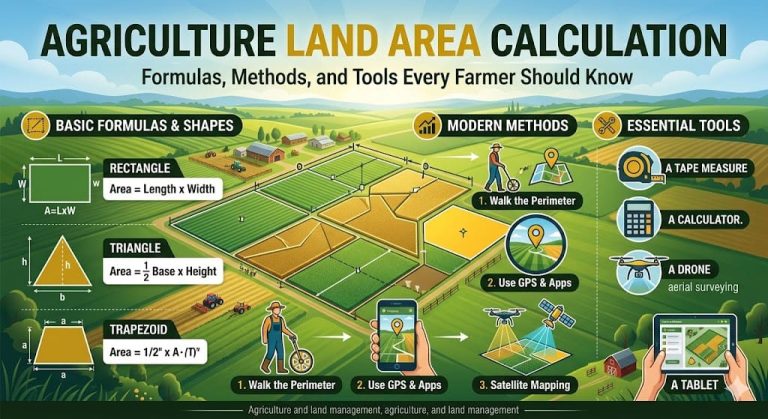
A typical agricultural carbon footprint calculator requests data across several categories. For livestock, it needs numbers and types of animals, production system, manure management approach, and feed composition. For cropland, it requires crop types, area (using agriculture land area calculation), nitrogen fertilizer quantity, and tillage practices. For energy, it asks for diesel and electricity consumption. For land use, it needs areas under different management. Finally, for inputs, it requires quantities of purchased fertilizer, pesticides, and seeds.
How Does the Calculator Process This Data?
Each data input is multiplied by its relevant emission factor to produce an emissions figure in CO2e. Where carbon sinks exist — such as soil organic matter accumulation under regenerative agriculture — these are subtracted from gross emissions to produce a net carbon balance. Furthermore, the most sophisticated tools allow users to model scenarios. For example, farmers can compare the impact of switching from conventional to organic agriculture or adopting no till farming.
🛠️ Cool Farm Tool
Developed with support from agribusiness partners, this web-based tool covers crop, livestock, and energy emissions with IPCC-aligned emission factors.
🛠️ Farm Carbon Toolkit
Used extensively in the UK and internationally, this tool is designed for practical use by farmers and agricultural extension advisors.
🛠️ USDA COMET-Farm
A free tool from the USDA designed specifically for US agriculture, covering soil carbon storage, crop emissions, and livestock emissions.
🛠️ Agritech Platforms
Many agritech companies are integrating carbon accounting modules into broader smart farming system platforms, connecting carbon data with precision farming maps.
Sustainable Farming Carbon Reduction Strategies
How can farmers reduce carbon emissions? The good news is that many of the most effective carbon reduction strategies also improve farm productivity, reduce input costs, and enhance long-term soil health. Therefore, they are economically as well as environmentally compelling.
🌱 Regenerative Agriculture & Soil Carbon
Regenerative agriculture practices build soil organic matter through cover cropping, composting, reduced tillage, diverse rotations, and integrated livestock grazing. Consequently, regenerative farming increases soil carbon storage at rates that can meaningfully offset gross emissions. Moreover, regenerative agriculture carbon markets are expanding rapidly.
🎯 Precision Agriculture & Emissions Reduction
Precision agriculture and emissions reduction are closely linked. When fertilizer applications are precisely matched to crop need using NDVI crop analysis, nitrogen losses to the atmosphere as nitrous oxide are reduced. Therefore, smart farming technologies enable the input precision that makes emissions reduction possible at scale.
🐄 Livestock Management & Methane Reduction
Livestock methane reduction strategies include improved animal nutrition, feed additives that inhibit methane-producing microorganisms, rotational grazing systems, and selective breeding. Additionally, manure management improvements — including covered slurry stores and anaerobic digestion — can significantly reduce emissions.
⚡ Renewable Energy & Farm Efficiency
Replacing diesel-powered farm tractors with electric models, installing solar panels on farm buildings, and using renewable energy for irrigation systems all reduce fuel use in agriculture emissions. Thus, energy efficiency improvements directly lower the farm carbon footprint.
🌳 Agroforestry & Natural Farming
Agroforestry systems that integrate trees with crops and livestock are particularly powerful carbon sinks. Trees sequester carbon in both above-ground biomass and root systems. Furthermore, natural farming and JADAM organic farming approaches typically show lower emission factor results for nitrogen-related emissions.
🚜 Conservation Agriculture
Conservation agriculture practices — including reduced tillage, permanent soil cover, and diversified crop rotations — reduce CO2 emissions from soil disturbance. Consequently, the carbon farming potential of conservation agriculture is recognized by the Food and Agriculture Organization and the USDA worldwide.

Carbon Farming: Turning Emissions Reduction Into Revenue
Carbon neutral farming techniques are increasingly connected to financial opportunity. Carbon farming refers to the practice of managing agricultural land in ways that maximize carbon sequestration while minimizing emissions — and receiving payment for verified carbon outcomes through carbon markets or government programs. Therefore, it represents a new revenue stream for farmers.
For agribusiness investors and farm owners, carbon farming provides income that can complement traditional agricultural commodity revenue. For smaller operations and small scale farming practitioners, carbon farming income can provide financial resilience during periods of low commodity prices. Thus, carbon farming benefits farms of all sizes.
Key requirements for participating in carbon farming programs include: accurate baseline measurement using a farm carbon footprint calculator; documented implementation of approved carbon farming practices (regenerative agriculture, no till farming, agroforestry); third-party verification of carbon sequestration outcomes; and registration with a recognized carbon registry or government program. Consequently, ag credit institutions are increasingly supporting carbon farming initiatives through specialized agri finance products.
Frequently Asked Questions About Carbon Footprint in Agriculture
📖 Understanding Carbon Footprint
🏭 Sources and Impacts
🛠️ Tools and Reduction Strategies
💰 Carbon Farming and Economics
Conclusion: Measuring Emissions Is the First Step to Changing Them
Agriculture’s relationship with climate change presents one of the world’s most important and complex challenges. Farming faces the impacts of climate disruption while also contributing to greenhouse gas emissions. However, agriculture can also help address climate change through carbon sequestration, regenerative agriculture, sustainable farming practices, and precision agriculture technologies. A farm carbon footprint calculator helps farmers take the first step toward this solution.
You cannot manage what you do not measure. Today, farmers can use tools ranging from smartphone-based agricultural carbon calculators to advanced life cycle assessment platforms to measure emissions. These tools help farmers identify emission sources, prioritize effective mitigation measures, and explore opportunities to earn revenue through carbon farming initiatives.
Organizations such as the Food and Agriculture Organization of the United Nations, the United States Department of Agriculture, and local agricultural extension services are investing in climate-smart agriculture. This growing commitment signals a clear direction for the future. Farmers who measure their carbon footprints, adopt sustainable farming systems, and reduce greenhouse gas emissions can strengthen their resilience and prepare for a changing agricultural landscape.
📚 Related Guides from Agri Opportunities
↗️ Drone Surveying for Farm Land ↗️ GIS Applications in Agriculture ↗️ Sustainable Agriculture Practices📚 External Resources & Further Reading
Add Agri Opportunities as a preferred source on Google to see our latest blogs first.


One Comment