Agricultural Irrigation Systems: Technologies and Solutions for Pakistan’s Water Crisis


Agricultural Irrigation Systems: Technologies and Solutions for Pakistan’s Water Crisis
Why so much of Pakistan’s irrigation water never reaches a crop, and the technologies that can actually change that.
Anyone who grew up around farmland in Pakistan has seen it: a farmer standing at the head of a field, opening a channel, and simply letting the water go — flooding the whole plot and hoping enough of it soaks in before the rest runs off, evaporates, or seeps away into ground it was never meant to reach. It’s how irrigation has worked here for generations, and it’s also, quietly, one of the biggest reasons Pakistan is running out of water. This isn’t a distant, abstract crisis. Agriculture consumes roughly 90 percent of the country’s freshwater, and by most estimates, close to a third of that water never even makes it to a crop’s roots. That’s not a rounding error — that’s the difference between a country that manages its water and one that’s slowly draining itself dry.
Where All That Water Actually Goes
The numbers here are genuinely sobering. Pakistan loses an estimated 30 percent of its irrigation water — around 54 billion cubic meters a year — mostly to seepage through unlined canal networks, evaporation under the sun before water ever reaches the field, and the sheer inefficiency of flood irrigation once it does. Layer onto that a canal infrastructure that in many stretches hasn’t been meaningfully modernized in decades, and you start to understand why the same volume of water that used to comfortably serve a region now barely stretches far enough.
Then there’s the groundwater story, which is arguably worse. Pakistan is now the fourth-largest user of groundwater in the world, with more than 1.2 million tube wells pulling water out of the ground at a pace nature simply can’t replenish. Water tables under Punjab and Sindh are dropping by half a meter to a full meter every single year. And in more than half of the Indus Basin, what groundwater remains is already brackish or saline — meaning even where the water is technically still there, it’s becoming less and less usable for growing anything. This isn’t a future problem. It’s happening under our feet right now.
The Technologies That Actually Move the Needle
| Technology | How It Works | Water Savings | Best For |
|---|---|---|---|
| 💧 Drip Irrigation | Delivers water directly to root zone through tubes and emitters | ~50% | High-value crops, vegetables, orchards |
| 🌊 Sprinkler Systems | Pressurized nozzles distribute water like controlled rainfall | ~30-40% | Middle-ground option for various crops |
| 📐 Laser Land Leveling | GPS-guided grading makes fields perfectly flat | ~20-30% | Works with existing flood irrigation |
| 🌧️ Rainwater Harvesting | Check dams and recharge structures capture monsoon runoff | Variable | Communal and regional water capture |
Drip Irrigation
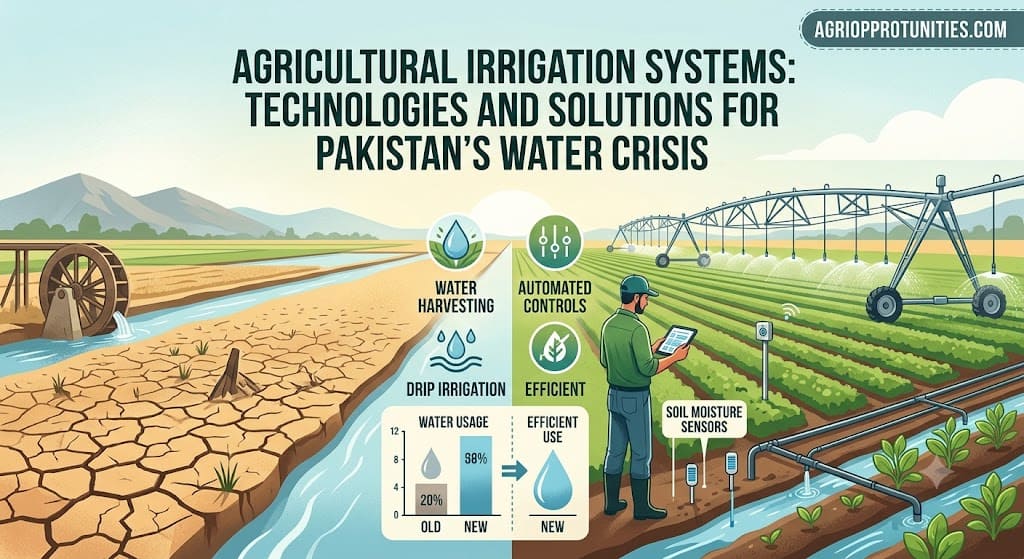
Instead of flooding an entire field, drip irrigation delivers water directly to a plant’s root zone through a network of tubes and emitters, drop by drop, exactly where it’s needed and nowhere else. The water savings compared to flood irrigation are commonly cited at around 50 percent — essentially doubling the effective use of every liter that enters a field. It’s especially well suited to high-value crops like vegetables, orchards, and cash crops where the upfront cost of installing drip lines pays for itself through both water savings and often higher, more consistent yields.

Sprinkler Systems
A step less precise than drip but still vastly more efficient than open flooding, sprinkler systems distribute water through pressurized nozzles, mimicking rainfall in a controlled, targeted way. They’re a genuinely practical middle-ground option for crops or farm layouts where drip infrastructure isn’t yet feasible, and they still cut water waste substantially compared to traditional methods.
Laser Land Leveling
This one doesn’t get talked about nearly as much as drip irrigation, but it might matter just as much, especially for farmers who aren’t ready to invest in an entirely new irrigation system. Laser land leveling uses GPS and laser-guided grading equipment to make a field perfectly, precisely flat. That sounds like a small thing until you realize how much water is wasted simply because a field has low spots where water pools uselessly and high spots where it runs straight off. Pakistan’s own Ministry of National Food Security and Research has pointed to laser leveling as a genuine, near-term lever for improving on-farm water application efficiency, and unlike drip or sprinkler systems, it works with a farmer’s existing flood irrigation setup rather than requiring a complete overhaul.
🤔 Why Adoption Has Been So Slow
If these technologies work, and they clearly do, the obvious question is why flood irrigation still dominates. The honest answer is a mix of upfront cost, limited farmer access to credit for infrastructure investment, and a genuine information gap — many smallholder farmers simply haven’t had meaningful exposure to how drip or sprinkler systems actually perform on land like theirs. There’s also a governance dimension that shouldn’t be understated: water allocation across provinces remains politically fraught, canal infrastructure investment has historically been inconsistent, and groundwater extraction has continued largely unregulated in many areas even as depletion accelerates. Punjab’s 2022 tube well licensing law, which reportedly cut illegal drilling by around 40 percent, shows that regulation can work when it’s actually enforced, but enforcement at that scale remains the exception rather than the rule.
For current opportunities in irrigation engineering, water resource management, and related agricultural roles, browse live agriculture job listings on Agri Opportunities.
Frequently Asked Questions
How much irrigation water does Pakistan actually lose before it reaches the crop?
Estimates suggest Pakistan loses around 30 percent of its irrigation water, roughly 54 billion cubic meters annually, mainly through seepage in unlined canals, evaporation, and the inefficiency of flood irrigation at the field level.
How much water can drip irrigation actually save compared to flood irrigation?
Drip irrigation is commonly cited as saving around 50 percent more water than traditional flood irrigation, since it delivers water directly to the root zone rather than flooding the entire field surface.
Is groundwater a reliable long-term backup for Pakistan’s irrigation needs?
No. Pakistan is already the fourth-largest user of groundwater globally, with over 1.2 million tube wells pumping at unsustainable rates, and water tables in Punjab and Sindh are falling by roughly 0.5 to 1.0 meters every year.
What is laser land leveling and why does it matter for irrigation efficiency?
Laser land leveling uses GPS and laser-guided equipment to make a field perfectly flat, which allows irrigation water to spread evenly instead of pooling in low spots and running off high spots, meaningfully improving on-farm water application efficiency.
Add Agri Opportunities as a preferred source on Google to see our latest blogs first.