What Does “DOC:NO₃⁻ Stoichiometry” Actually Mean? Breaking Down a Complex Soil Science Concept

Breaking down one of the most useful, least accessible concepts in soil greenhouse gas science — in plain language.

Of everything I’ve written about in the series of soil science so far, this next concept is probably the one that sounds the most intimidating on paper and yet, once you actually sit with it, turns out to be one of the more genuinely useful things a soil scientist can understand. It’s also directly tied to my own PhD research proposal work, framed specifically around this exact ratio. I want to break it down properly, piece by piece, because the phrase “DOC:NO₃⁻ stoichiometry” hides a genuinely important and fairly intuitive idea once you strip away the jargon.

Breaking Down the Term, Word by Word
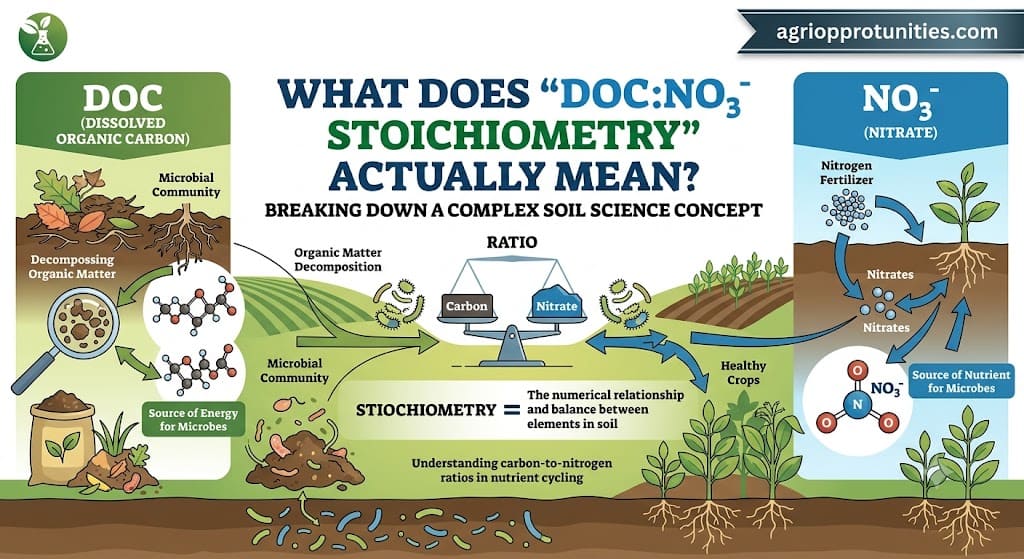
Let’s start simply. “DOC” stands for dissolved organic carbon — carbon-containing compounds, largely coming from decomposing plant matter, manure, or root exudates, that are dissolved in the water within soil pores rather than sitting as solid organic matter. “NO₃⁻” is nitrate, the form of nitrogen that plants absorb and that soil bacteria use during denitrification, as covered in the second piece of this series.
“Stoichiometry” is simply a chemistry term for the ratio between reactants in a chemical or biological process. Put together, “DOC:NO₃⁻ stoichiometry” just means: the ratio between how much dissolved organic carbon and how much nitrate are both available in the soil solution at the same time.
🔑 The Key Insight
What matters isn’t how much carbon or how much nitrate is present in isolation, but the balance between the two. The same absolute amount of carbon can behave completely differently depending on how much nitrate happens to be sitting alongside it.
Why This Ratio Matters So Much for Nitrous Oxide
To understand why this balance is so important, we need to revisit denitrification in a bit more mechanistic detail than the second piece in this series covered. Denitrification is a sequential process: soil bacteria reduce nitrate (NO₃⁻) step by step, through nitrite (NO₂⁻) and nitric oxide (NO), to nitrous oxide (N₂O), and ideally, all the way to harmless nitrogen gas (N₂).
Each of those reduction steps requires an electron donor (organic carbon, functioning much like fuel) and consumes a specific electron acceptor at each stage. The final step — reducing N₂O to N₂ — is carried out by a specific microbial enzyme, often referred to by the gene that encodes it, nosZ.
The Critical Fork in the Road
Whether that final step actually happens, or whether the process stops at N₂O and releases it into the atmosphere, depends heavily on competition between nitrate and nitrous oxide for that same final electron-accepting role. This competition is precisely what DOC:NO₃⁻ stoichiometry is trying to capture and predict.
The Core Finding: Nitrate Competes With N₂O for Reduction
Research studying this mechanism directly has established something genuinely important: nitrate itself acts as a competing electron acceptor against nitrous oxide. When plenty of nitrate is available, denitrifying bacteria preferentially use that nitrate rather than continuing to reduce nitrous oxide onward to nitrogen gas.
In practice, this means high nitrate concentrations can effectively block or inhibit the final N₂O-to-N₂ reduction step, leaving more nitrous oxide stranded in the soil, available to escape into the atmosphere rather than being safely converted to harmless N₂.
The Ratio Scientists Actually Track
Given this dynamic, researchers commonly express the outcome using a specific ratio: N₂O/(N₂O + N₂), which describes what share of the total gaseous nitrogen released from denitrification comes out as the harmful greenhouse gas versus the harmless inert gas. A lower ratio is good news — more complete reduction to N₂. A higher ratio is bad news — more N₂O escaping.
Where Carbon Comes Into the Picture
This is where dissolved organic carbon enters directly. Available carbon serves as the electron donor fueling the entire denitrification chain, and research has found that when labile (easily available) carbon is abundant, it can substantially lower the N₂O/(N₂O + N₂) ratio, meaning more complete reduction to harmless nitrogen gas.
But — and this is the genuinely important, easy-to-miss nuance — this carbon benefit doesn’t operate independently of nitrate levels. It depends directly on how much nitrate is also present at the same time, which is exactly why this is a stoichiometric relationship rather than two separate, independent factors.
The Threshold Effect Researchers Have Documented
Specific experimental research found that at low nitrate concentrations (2 millimolar or less), the availability of carbon substantially lowered the N₂O/(N₂O + N₂) ratio. But at higher nitrate concentrations (10 millimolar or more), the amount of available carbon made essentially no difference to that ratio at all.
In plain terms: adding more carbon to soil only helps reduce nitrous oxide emissions when nitrate levels are already relatively low. In a heavily over-fertilized field with abundant residual nitrate, simply adding more organic carbon won’t meaningfully fix the nitrous oxide problem, because the nitrate itself is actively blocking the final reduction step regardless of carbon supply.
Why Manure and Mineral Fertilizer Behave Differently
This stoichiometric relationship also helps explain a pattern that shows up repeatedly in field research: manure-fertilized soils often show lower N₂O/(N₂O + N₂) ratios than mineral-fertilizer-treated soils, even under otherwise similar conditions.
The likely explanation connects directly to what we’ve just covered: manure typically brings a meaningfully larger supply of dissolved organic carbon alongside its nitrogen content, compared to mineral fertilizers, which supply nitrogen with essentially no accompanying carbon at all. That extra carbon load shifts the DOC:NO₃⁻ ratio in a more favorable direction, supporting more complete denitrification.
Not All Carbon Is Created Equal
Here’s an added layer of complexity worth knowing, because it moves this from “just count total carbon” toward genuinely sophisticated soil chemistry. Research comparing different organic carbon compounds directly — glucose, sucrose, acetate, malic acid, butyrate, succinate, and the amino acid cysteine — found real differences in how effectively each one supported complete reduction of N₂O to N₂.
Organic acids (acetate, butyrate, succinate, and malic acid) tended to support more complete reduction to nitrogen gas than simple sugars or the amino acid tested, likely because organic acids are more readily and directly usable by the microbial metabolic pathways involved.
Why This Matters for Choosing Organic Amendments
This finding connects directly back to the previous piece in this series on cover crops and organic amendments. It suggests that the specific chemical composition of an organic amendment — not just how much total carbon it contains — genuinely matters for its greenhouse gas outcome, an area of soil science that researchers themselves describe as one of the least explored, most promising directions for further study.
Oxygen and pH Add Further Layers
DOC:NO₃⁻ stoichiometry doesn’t operate in isolation from the other soil factors covered earlier in this series. Research on long-term liming effects in acidic sandy soil found that soil nitrate levels and oxygen availability were both key factors controlling how effectively N₂O gets reduced to N₂, alongside the carbon-nitrate balance discussed here.
This is a good reminder that DOC:NO₃⁻ stoichiometry is best understood as one major piece of a larger, interacting system — pH, oxygen, temperature, and moisture (all covered in earlier pieces) all interact with this carbon-nitrate balance rather than operating as fully separate, independent variables.

Why Measuring This Ratio in the Field Is Genuinely Difficult
It’s worth being honest about a real limitation here. Researchers studying this topic have specifically noted that denitrification remains one of the most enigmatic processes in the entire nitrogen cycle, largely because precisely quantifying N₂ production (as opposed to N₂O) is technically difficult, and the N₂O/(N₂O + N₂) ratio varies enormously across space and time within a single field.
The Measurement Methods Researchers Actually Use
Depth Matters Too: This Isn’t Just a Surface-Soil Story
Research examining this dynamic across a soil profile extending more than five meters deep found that dissolved organic carbon content differs significantly across different soil depths and nitrogen fertilization rates, meaning the DOC:NO₃⁻ balance driving denitrification outcomes isn’t uniform even within a single field — it shifts as you go deeper into the soil profile.
The same research found that high nitrate additions produced an immediate, measurable inhibition of the enzyme responsible for reducing N₂O to N₂, and that this effect persisted as a meaningful long-term shift in the N₂O/(N₂O + N₂) ratio even well below the surface — a genuinely important finding for understanding how deep fertilizer leaching, discussed in the first piece of this series, might affect greenhouse gas dynamics far below where anyone would normally think to measure.
Connecting This Back to My Own Research Interest
This is precisely the conceptual framework behind my own proposed PhD research on digestate and biochar co-application, using a subtropical maize cropping system as the test environment. The core research question is essentially: can we deliberately engineer a more favorable DOC:NO₃⁻ ratio, through combined organic and biochar amendments, to push denitrification more reliably toward complete reduction to nitrogen gas rather than leaking nitrous oxide?
Given everything covered above — the threshold effects at different nitrate concentrations, the differences between carbon compound types, and biochar’s own documented effect on nitrous oxide suppression discussed in an earlier piece in this series — this kind of engineered co-application represents a genuinely promising, evidence-grounded research direction rather than a speculative one.
Why This Concept Is Worth Learning, Even If the Term Sounds Intimidating
If you take one practical lesson from this piece, let it be this: the same fertilizer or organic amendment can produce very different greenhouse gas outcomes depending on what else is already present in the soil at the same time. A carbon-rich amendment applied to a nitrate-depleted soil behaves completely differently than the identical amendment applied to a heavily over-fertilized, nitrate-saturated field.
This is exactly why blanket recommendations like “add more compost” or “use manure instead of urea” oversimplify what’s actually a genuinely conditional, ratio-dependent relationship — and why researchers and students working in this space need to think in terms of balances and ratios, not single-variable totals.
Why This Matters for Students Considering This Research Area
If this kind of mechanistic, ratio-based thinking appeals to you, DOC:NO₃⁻ stoichiometry sits at exactly the kind of technically rich, still-developing research frontier that rewards careful experimental design over broad generalization. Understanding it well requires comfort with both microbiology (the specific enzymes and pathways involved) and soil chemistry (how carbon and nitrogen actually move and interact in soil solution) — a genuinely interdisciplinary skill set that’s increasingly valued across academic research, agri-tech product development, and international soil science collaborations alike.
Where This Series Goes Next
Having now worked through nitrogen cycling, nitrous oxide, the ammonia trade-off, biochar, cover crops and organic amendments, dryland systems, and this DOC:NO₃⁻ stoichiometry concept, the final piece in this series will step back to a broader, increasingly commercial question: carbon farming and carbon credits, and what farmers actually need to understand before treating soil carbon as a tradable asset.
For current research and graduate opportunities in soil biogeochemistry and greenhouse gas research, browse live agriculture scholarship listings on Agri Opportunities.
Frequently Asked Questions
What does DOC:NO3- stoichiometry actually measure?
It measures the ratio between dissolved organic carbon (DOC) and nitrate (NO3-) available in soil, which together determine whether soil microbes performing denitrification complete the process into harmless nitrogen gas or stop partway, releasing nitrous oxide instead.
Why does nitrate concentration affect whether N2O gets fully reduced to N2?
Nitrate acts as a competing electron acceptor against nitrous oxide during the final step of denitrification, so when nitrate is abundant, microbes preferentially use it over nitrous oxide, effectively blocking the enzyme that would otherwise reduce nitrous oxide to harmless nitrogen gas.
Does adding more carbon to soil always reduce nitrous oxide emissions?
Not necessarily. Research shows available carbon only lowers the nitrous oxide-to-nitrogen gas ratio effectively when nitrate concentrations are relatively low; at high nitrate concentrations, carbon availability has little to no effect on that ratio.
Do all carbon compounds affect denitrification the same way?
No. Research comparing different organic carbon substrates found that organic acids tend to support more complete reduction of nitrous oxide to nitrogen gas than simple sugars or amino acids, meaning the chemical identity of available carbon matters, not just its total quantity.
Add Agri Opportunities as a preferred source on Google to see our latest blogs first.