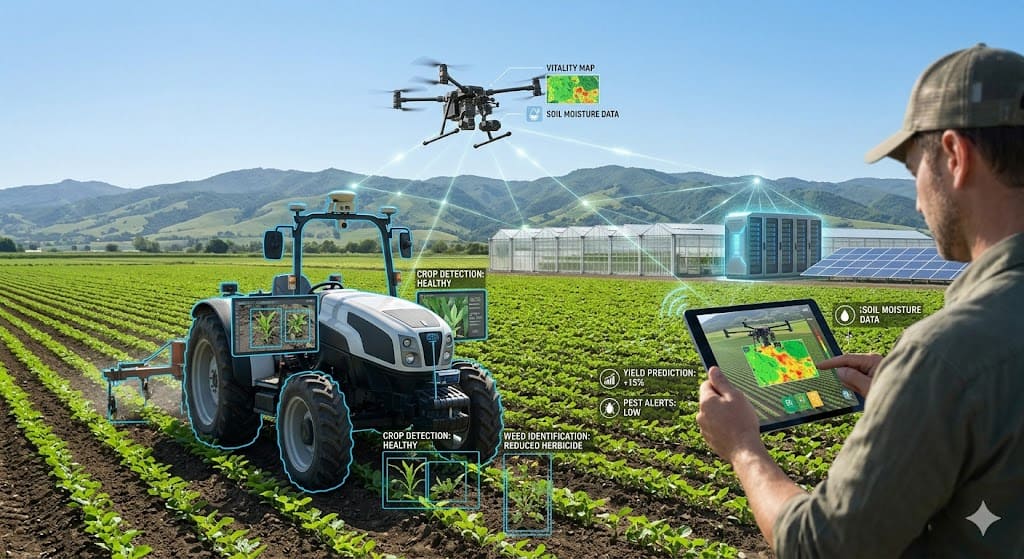
Computer Vision in Agriculture – Transforming Farming Systems for a Smarter Future

Computer Vision in Agriculture
Transforming Farming Systems for a Smarter Future
Discover how computer vision, artificial intelligence, and image processing are revolutionizing agriculture. From precision farming and drone technology to smart farming systems and sustainable agriculture — this complete guide covers everything you need to know.
Introduction: Where Technology Meets the Farmland
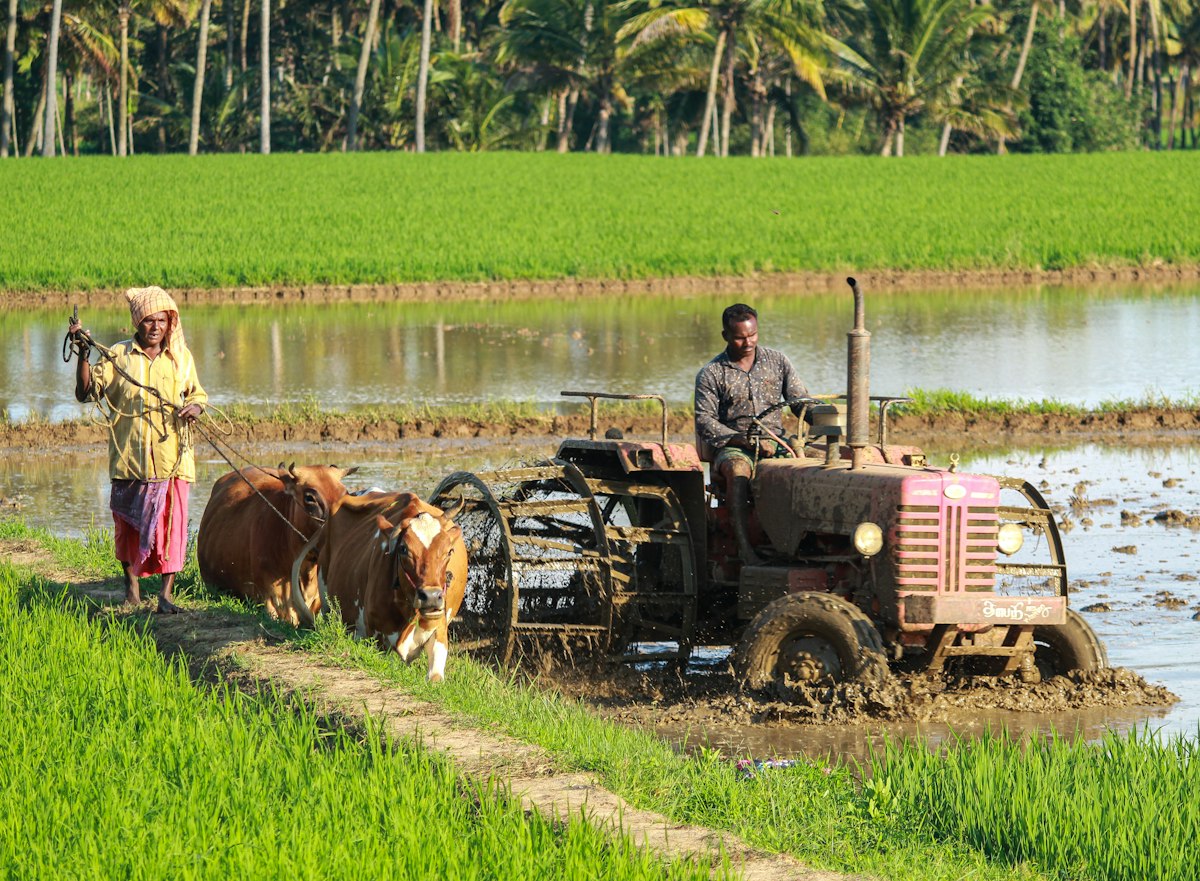
Agriculture has always been the backbone of human civilization. From the earliest days of shifting cultivation to today’s precision agriculture, farming has evolved continuously. However, nothing has reshaped the agriculture industry quite like the rise of digital tools. At the forefront of this revolution stands computer vision.
Computer vision in agriculture refers to the use of artificial intelligence and image-processing technology to help machines “see” and interpret the physical world of farming. Whether it is scanning crops from a drone, monitoring livestock in a barn, or guiding autonomous farm tractors across a field, computer vision is quietly becoming one of the most powerful tools in modern agriculture. Therefore, understanding this technology is essential for anyone involved in food production.
What Is Farming System in Agriculture?
Before understanding how computer vision changes farming, it helps to understand what a farming system in agriculture actually means. A farming system in agriculture is defined as a resource management strategy that a farmer uses to produce crops, manage livestock, and maintain the land — while meeting both family and economic goals. In simple terms, it is the overall approach or method by which agricultural activities are planned, organized, and executed on a piece of agricultural land.
The farming systems in agriculture definition goes beyond just what crops are grown. For example, it includes how land is used, what inputs (fertilizer, water, pesticides) are applied, how farm equipment is operated, how income is generated, and how sustainable the practice is over time. Therefore, understanding farming systems is essential for anyone involved in food production. Moreover, these systems provide the framework within which new technologies like computer vision can be effectively deployed.
Farming System Meaning: A Simple Explanation
For beginners, here is a farming systems in agriculture for beginners breakdown. Think of a farming system as a business model for a farm. Just as a business has goals, processes, and resources, a farming system organizes all the activities on a farm — crop production, animal farming, irrigation, pest control, and marketing of agricultural products — into one connected plan. Consequently, when farmers adopt computer vision, they are upgrading the intelligence of their entire farming system.
10 Types of Farming Systems in Agriculture Explained
There are many types of farming systems, each suited to different climates, land sizes, economic conditions, and cultural practices. Here is a farming system classification with examples for each major type. Furthermore, each system can benefit from computer vision in different ways.
Traditional and Small-Scale Systems
1. 🌾 Subsistence Farming System
One of the oldest and most basic types of agriculture farming. Farmers grow only enough food to feed themselves and their families. Common in rural Africa, South Asia, and Latin America. Key features include small-scale farming, minimal machinery use, and heavy reliance on manual labor. However, even subsistence farmers can benefit from low-cost computer vision tools like smartphone-based crop disease detection apps.
2. 🔥 Shifting Cultivation
A traditional system where farmers clear a patch of forest, farm it for a few years, and then move to a new area when soil is exhausted. While historically important, this method is increasingly unsustainable due to deforestation concerns. Nevertheless, remote sensing and computer vision can help monitor forest regrowth and guide sustainable land use.
3. 🐫 Nomadic Herding System
A form of livestock farming where herders move with their animals across large areas in search of pasture and water. Common in arid and semi-arid regions of Africa and Central Asia. This system supports rural farming livelihoods in challenging environments. Additionally, satellite-based computer vision can help herders locate optimal grazing areas based on vegetation health maps.
Commercial and Market-Oriented Systems
4. 💰 Commercial Farming System
Designed for profit. Farmers grow crops or raise livestock specifically for market sale. This system relies heavily on farm tractors, agricultural machinery, and modern agritech tools. Key features include large-scale operations, precision agriculture, and integration with agribusiness supply chains. Therefore, commercial farming is the primary adopter of advanced computer vision technologies like drone mapping and autonomous tractors.
5. ⚡ Intensive Farming
Maximizes agricultural production from limited land using high levels of inputs — seeds, water, pesticides, and fertilizer. While highly productive, it raises concerns about soil degradation and environmental sustainability. Consequently, computer vision is being used to optimize input application in intensive systems, reducing waste while maintaining high yields.
6. 🌴 Plantation Agriculture System
Large-scale cultivation of a single cash crop — tea, coffee, rubber, or sugarcane — on large estates. These operations require significant investment, a large workforce, and advanced farm machinery. Moreover, computer vision is revolutionizing plantation management through automated disease detection, yield prediction, and harvest timing optimization.
7. 🌍 Extensive Farming
Uses large areas of land with fewer inputs and lower labor per acre. Common where land is abundant but capital or labor is scarce. The difference between intensive and extensive farming is essentially a trade-off between productivity and resource use. For extensive farms, drone-based computer vision offers a cost-effective way to monitor vast areas without expensive ground equipment.
Integrated and Sustainable Systems
8. 🐄🐔 Mixed Farming System
Combines crop farming and animal farming on the same land. Considered one of the most balanced and efficient approaches, as the two activities support each other — livestock waste becomes natural fertilizer for crops. Benefits include improved resource management and diversified income. Additionally, computer vision can monitor both crop health and animal welfare simultaneously in mixed systems.
9. 🌳 Agroforestry Systems
Combines trees, crops, and sometimes livestock on the same land. This integrated approach improves biodiversity, enhances soil management, and contributes to carbon farming. The FAO organization promotes agroforestry as a climate-smart agriculture strategy. For these complex systems, computer vision is invaluable for monitoring multiple vegetation layers and tracking carbon sequestration over time.
10. 🔄 Integrated Farming System
A holistic model that combines multiple farming activities — crops, livestock, fisheries, and forestry — in a coordinated, resource-efficient way. Benefits include efficient resource use, reduced chemical input costs, diversified income streams, and improved soil health. Therefore, integrated systems represent the ideal environment for comprehensive computer vision deployment across all farm enterprises.
The Role of Computer Vision Across Farming Systems
Now that we understand the types of farming systems, let us explore how computer vision technology integrates with each of them. Furthermore, understanding these integrations is crucial for farmers considering technology adoption.
Precision Agriculture and Computer Vision
Precision agriculture — also known as precision farming or precision ag — uses technology to monitor and manage crop and soil variations within a field. Computer vision is one of the core technologies that makes precision farming possible. In precision agriculture, computer vision-powered sensors and cameras can detect crop stress, disease, or pest infestations early, monitor plant growth stage by stage, map field zones with varying fertility levels, and guide variable-rate application of fertilizer and pesticide operations. Consequently, precision agriculture powered by computer vision reduces input costs while increasing yields.
Smart Farming and Digital Agriculture
It is also known as smart agriculture 4.0 — uses connected technologies including computer vision, IoT sensors, GPS, and AI analytics to create a fully data-driven farming operation. Smart farming technologies powered by computer vision include autonomous farm tractors that navigate fields without a driver (such as the John Deere autonomous tractor), drone farming systems that map entire fields in minutes, controlled environment agriculture with automated plant monitoring, and indoor vertical farming systems where lighting, humidity, and plant health are all managed by AI cameras. Thus, smart farming represents the convergence of multiple advanced technologies.
Drone Farming: The Eye in the Sky
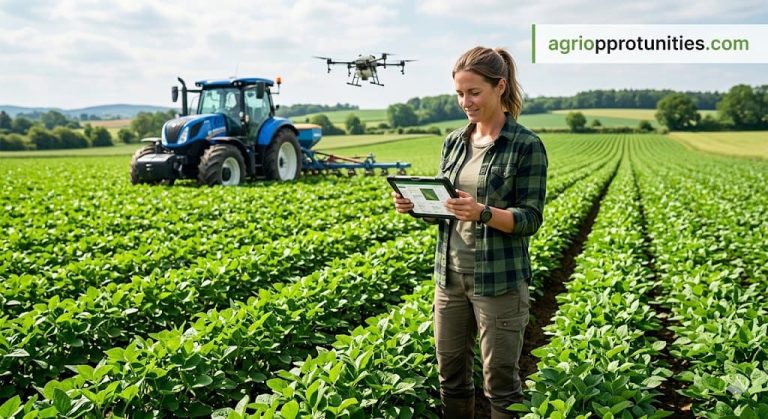
One of the most visible applications of computer vision in agriculture is drone farming. Unmanned aerial vehicles equipped with cameras and multispectral sensors can fly over farmland, capturing detailed images that are then processed by computer vision algorithms. Moreover, this technology has become increasingly affordable for farmers of all scales.
How Drone Farming Works
First, a drone — such as the DJI Agras T40 or XAG P100 — is launched over a field. Then, it captures high-resolution images of crop rows, soil conditions, and water levels. After that, computer vision software processes the images to create crop health maps (NDVI maps). Subsequently, farmers receive actionable data: which zones need water, fertilizer, or pest treatment. Finally, automated drone sprayers apply precise amounts of pesticide or fertilizer only where needed. Therefore, drone farming dramatically reduces chemical use and labor requirements.
Benefits of Drone Farming Across Systems
🚜 Commercial Farming
Covers thousands of acres efficiently, reducing labor costs and improving precision. Consequently, large farms see rapid return on investment.
🌱 Small Scale Farming
Reduces the need for expensive farm machinery while providing professional-grade crop monitoring. Thus, small farmers can access advanced analytics affordably.
🏠 Greenhouse Farming
Monitors plant health indoors with cameras, detecting issues before they spread. Moreover, automated systems can respond instantly to detected problems.
🌿 Organic Agriculture
Detects pest and disease issues early, reducing the need for pesticide applications. For this reason, organic farmers particularly value early warning systems.
🌳 Agroforestry Systems
Maps tree canopy and understory crop health simultaneously, enabling integrated management. Therefore, complex multi-layer farms can be monitored comprehensively.
Computer Vision in Livestock Farming Systems
Animal farming is another area where computer vision is making a significant difference. Traditional livestock farming systems relied on manual checks to monitor animal health, behavior, and feeding patterns. Today, however, computer vision systems can identify individual animals by facial or body markings, detect early signs of illness through behavior changes, monitor feeding patterns and nutrition intake, automate the weighing and sorting of animals, and reduce stress while improving welfare in large-scale operations.
These capabilities are especially relevant for large agribusiness operations managing hundreds or thousands of animals, where manual monitoring is simply not practical. Consequently, livestock productivity and animal welfare are both improving through these technologies. Furthermore, early disease detection prevents outbreaks that could cost millions in losses.
Sustainable Farming Systems and Computer Vision
Sustainable agriculture is no longer optional — it is essential. With growing pressure from climate change, population growth, and soil degradation, sustainable farming systems must deliver more with less. Fortunately, computer vision supports sustainable agriculture practices in several important ways. For instance, it enables precision application of water, fertilizer, and pesticides.
Regenerative Agriculture
Regenerative agriculture and regenerative farming focus on restoring soil health, increasing biodiversity, and drawing carbon back into the land. Computer vision helps by monitoring soil cover, tracking regenerative agriculture practices like no till farming, and measuring the effectiveness of carbon farming programs. Therefore, farmers can verify their regenerative claims with hard data.
Climate Smart Agriculture
Climate smart agriculture practices involve adapting farming to changing weather patterns while reducing emissions. Computer vision enables climate resilient agriculture by providing early warning systems for drought, flood, or extreme temperature conditions — allowing farmers to take preventive action before crops are damaged. Consequently, crop losses from extreme weather events can be significantly reduced.
Conservation Agriculture
Conservation agriculture relies on minimum soil disturbance, permanent soil cover, and crop rotation. Computer vision tools can monitor these indicators automatically, helping farmers stay compliant with sustainable farming practices and qualify for programs like USDA grants or agri finance support. Moreover, automated monitoring reduces paperwork and improves accuracy.
No-Till Farming
No till farming reduces soil erosion, retains moisture, and improves soil management practices. Computer vision can monitor ground cover and detect any unauthorized tillage, supporting both conservation farming and carbon farming initiatives. For this reason, no-till farmers increasingly rely on satellite and drone imagery to verify their practices.
From Traditional to Modern: The Evolution of Farming Systems
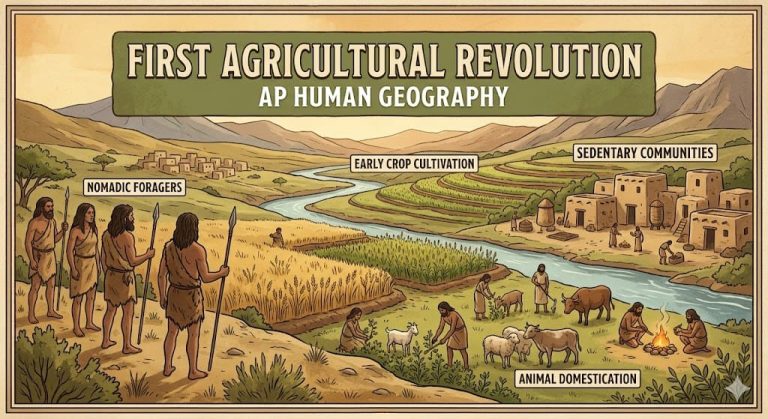
The evolution of farming systems is a fascinating journey through human history. In the ancient era, the nomadic herding system and shifting cultivation dominated. During the medieval era, the subsistence farming system with basic crop rotation was widespread. In the industrial era, the commercial farming system expanded with mechanization. During the 20th century, intensive farming rose with chemical inputs and large farm machinery. Now, in the 21st century, integrated farming systems, precision agriculture, and smart farming have emerged.
Today, we are witnessing a new phase — agriculture 4.0 — where biotechnology in agriculture, digital farming, and computer vision converge to create the most intelligent agricultural system management ever seen. Therefore, the future of farming is smarter, more efficient, and more sustainable than any previous era. Furthermore, this transformation is accelerating as technology costs continue to fall.
Subsistence Farming → Self-consumption | Best for small rural farms
Commercial Farming → Profit-oriented | Best for large-scale agribusiness
Mixed Farming → Crops + Livestock | Best for diversified income
Intensive Farming → High inputs, high yield | Best for land-scarce regions
Extensive Farming → Large land, low inputs | Best for land-abundant areas
Shifting Cultivation → Rotational land use | Best for tropical regions
Plantation Agriculture → Single cash crop | Best for export-focused farming
Nomadic Herding → Mobile livestock | Best for arid regions
Agroforestry → Trees + Crops | Best for biodiversity goals
Integrated Farming → All-in-one system | Best for sustainable modern farms
Agribusiness, Investment, and the Future of Farming
For business owners and agri investors, computer vision integration offers significant opportunity. Agribusiness management teams already use digital agriculture. They reduce costs and improve yields with these tools. They also attract agri finance from institutions like the Farm Credit System. The National Bank for Agriculture and Rural Development provides additional support. Consequently, agtech startups receive record levels of venture capital investment.
Farm Equipment for Sale: What’s New?
The smart farm equipment market is booming. Major manufacturers now offer New Holland tractors for sale. Mahindra tractors for sale are also widely available. Claas tractors, LS tractors, and Case International tractors complete the lineup. All these brands integrate computer vision and GPS guidance. Key smart equipment includes autonomous farm tractors. Drone sprayers like the DJI Agras T40 and XAG P100 are popular choices. Precision ag crop sprayers and power sprayers are also in high demand. Smart tractor implements and disc ploughs improve field operations. AI-guided farm irrigation systems save water and energy. Therefore, farmers should evaluate these technologies carefully.
Agricultural Finance and Grants
Modern farming technologies can be expensive. However, significant support is available. Programs include USDA greenhouse grant opportunities. The USDA website offers many helpful resources. Agri credit and rural finance programs operate through the Farm Credit System. Commercial banks also provide agricultural finance options. The National Bank for Agriculture and Rural Development supports farmers too. Regional Departments of Agriculture offer additional assistance. For this reason, farmers should explore available funding first.
Global Organizations Shaping Agricultural Farming Systems
Several global and national bodies guide farming system policies and innovations. The Food and Agriculture Organization of the United Nations (FAO) sets global standards. It also publishes FAOSTAT data. The FAO promotes sustainable food production and agroecology. The United States Department of Agriculture (USDA) regulates US agriculture. It funds research through various programs. The USDA website offers resources on organic agriculture. It also covers precision farming topics. Additionally, the National Bank for Agriculture and Rural Development supports agri finance. It focuses on agricultural investment in developing economies. Regional Departments of Agriculture and Rural Development provide extension services. They support sustainable farming practices at local levels. Consequently, these organizations offer valuable resources. Farmers adopting computer vision can benefit greatly from them.
Why Farming Systems Matter: Importance in Agriculture Development
The importance of farming systems in agriculture development cannot be overstated. Here is why these systems are critical to global food production and sustainability. Moreover, understanding these reasons helps justify technology investments like computer vision.
🌾 Food Security
Different farming systems support food production for billions worldwide. Therefore, improving these systems directly improves food availability.
💰 Economic Stability
Agricultural commodities depend on well-organized farming systems. Agribusiness management and agricultural finance also rely on them. Consequently, system improvements boost rural economies.
🌍 Environmental Health
Sustainable agriculture practices operate through structured systems. Conservation agriculture and regenerative farming follow this pattern too. For this reason, system design directly impacts ecological outcomes.
👩🌾 Social Equity
Women in agriculture benefit from clear farming system frameworks. Small-scale farmers gain advantages as well. Community supported agriculture (CSA farm) models also rely on good systems. Thus, better systems create more equitable opportunities.
💻 Technological Adoption
Modern farming systems create infrastructure for digital agriculture. Drone farming and smart farming scale through these systems. Furthermore, computer vision works best when integrated into a well-designed system.
Conclusion: A Smarter Future for Agriculture
Computer vision in agriculture is not a distant concept — it is already being used on farmland across the world. From precision farming fields in the United States to small-scale farming plots in Africa, from greenhouse farming facilities in the Netherlands to urban agriculture rooftops in Asia, computer vision is helping farmers work smarter, not just harder. Therefore, the technology is globally relevant and locally adaptable.
Whether you are a farmer looking to adopt smart farming technologies, a BSc agriculture student exploring agriculture research topics, an agribusiness investor evaluating agri finance opportunities, or someone simply curious about where food comes from — understanding both farming systems and the technologies reshaping them is essential. Consequently, this knowledge will become increasingly valuable as agriculture continues to digitize.
The future of agriculture lies at the intersection of traditional wisdom and modern innovation. It lives in the integration of integrated farming systems with artificial intelligence. It thrives in sustainable farming systems that protect our soil, water, and climate. And it will be shaped by organizations, agtech companies, governments, and individual farmers who choose to embrace the tools of digital agriculture to feed the world more efficiently and responsibly. For all these reasons, now is the time to learn about and invest in computer vision for agriculture.
📚 Related Guides from Agri Opportunities
↗️ Farming System in Agriculture ↗️ Precision Agriculture Guide ↗️ Smart Farming Technologies ↗️ Farming System in Agriculture📚 External Resources & Further Reading
Add Agri Opportunities as a preferred source on Google to see latest blog listings first.

One Comment