How Is Urbanization Affecting Agriculture? Benefits, Challenges, and the Path Forward

How Is Urbanization Affecting Agriculture?
Benefits, Challenges, and the Path Forward
Complete guide to the urbanization-agriculture relationship: learn about agricultural land loss, rural to urban migration, peri-urban farming, urban agriculture benefits, and sustainable solutions for feeding growing cities.
Two Forces Reshaping the World Simultaneously
Two of the most powerful transformations of the modern era are happening at the same time, in the same places, and in direct tension with each other. On one side stands urbanization — the rapid growth of cities as millions of people migrate from rural areas in search of employment, education, and opportunity. On the other side stands agriculture — the ancient, essential practice of growing food that has sustained human civilization since its earliest days. Therefore, understanding how these two forces interact is crucial for food security and sustainable development. Moreover, this relationship will define the future of both cities and farms.
The question of how is urbanization affecting agriculture is not abstract or academic. Instead, it is a question with real consequences for food security, for farmers whose livelihoods are being squeezed by urban expansion, for investors navigating agricultural land markets, for students studying agricultural economics, and for ordinary people who depend on a stable, affordable food supply. Consequently, this guide examines the urbanization-agriculture relationship from every angle — its causes, its consequences both positive and negative, the challenges it creates, and the strategies that help communities balance urban growth with sustainable farming. Thus, readers will gain a comprehensive understanding of this critical issue.
Understanding the Urbanization and Agriculture Relationship
What Is Urbanization?
Urbanization refers to the process by which an increasing proportion of a population moves from rural areas to urban centers. Simultaneously, land previously used for farming or natural habitat is converted to urban uses — housing, roads, commercial buildings, and infrastructure development. This shift is driven by population growth and food demand, economic development, and the concentration of employment opportunities in cities. According to FAOSTAT data from the Food and Agriculture Organization of the United Nations, the world’s urban population has grown dramatically over the past century and is projected to continue expanding. Therefore, this urban geography shift has profound implications for agricultural land, rural economies, and global food systems. Furthermore, the pace of this transformation is accelerating in developing regions.
How Does Urbanization Affect Agriculture?
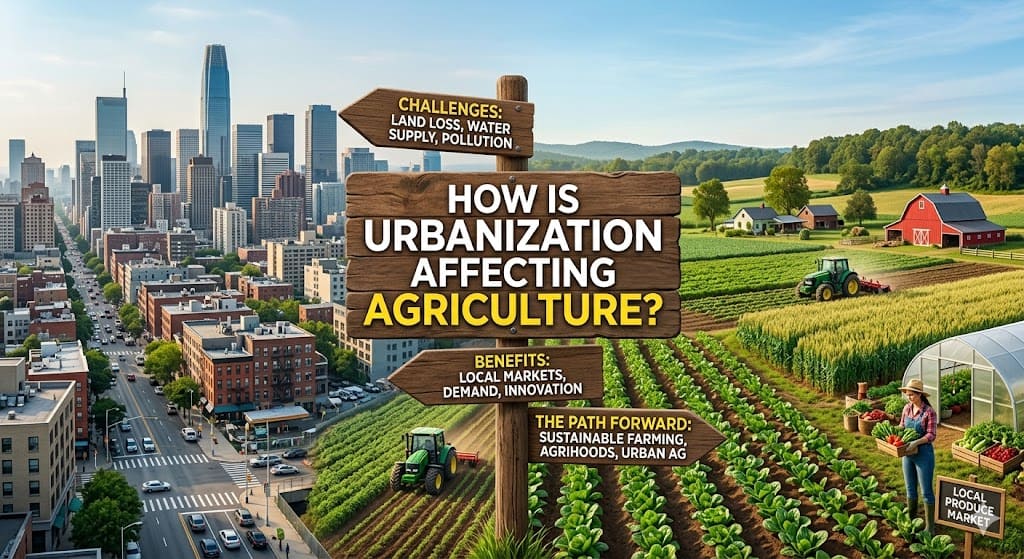
The impact of urbanization on agriculture operates through several interconnected mechanisms. First, as cities expand, they consume agricultural land at their edges — a process known as urban sprawl agriculture. Consequently, this reduces the total area available for food production. Second, rural to urban migration draws labor away from farming communities, creating labor shortages that affect agricultural productivity. Third, land use change driven by urban development alters the patterns of farming that remain, often pushing agriculture toward more intensive or peri-urban models. Finally, rising urban populations increase food demand, creating both challenges and opportunities for the agricultural sector. Thus, the urbanization-agriculture relationship is neither simply harmful nor simply beneficial. Instead, it is complex, context-dependent, and constantly evolving. For this reason, context-specific solutions are necessary.
The Negative Effects of Urbanization on Farming
When most people ask about the effects of urbanization on farming, they are thinking of the losses. And those losses are real, significant, and accelerating in many parts of the world. Therefore, understanding these challenges is essential for developing effective solutions. Nevertheless, awareness of these problems is the first step toward addressing them.
🏞️ Agricultural Land Loss
The most direct impact of urbanization on agriculture is the physical loss of farmland. Urban expansion converts agricultural land to residential neighborhoods, commercial zones, roads, and industrial areas. This farmland conversion is often irreversible — once land is built upon, returning it to productive use is extraordinarily difficult. Moreover, urban expansion tends to consume the most productive agricultural land first, because cities historically developed in fertile river valleys and coastal plains. Consequently, the loss is disproportionately harmful to food production capacity.
👥 Labor Shortages in Farming
Rural to urban migration — the movement of people from farming communities to cities — is one of the defining demographic trends of the modern era. While urbanization creates economic opportunity for migrants, it creates serious challenges for farming communities left behind. How does migration impact agriculture? When young, working-age people leave rural areas, farming communities face labor shortages that affect planting, harvesting, and daily operations. Consequently, older farmers without successors face difficult choices about whether to continue farming. Thus, the demographic impact is profound.
🏘️ Urban Sprawl Agriculture
Urban sprawl — the unplanned, low-density expansion of cities into surrounding rural areas — is one of the most damaging forms of urban development for farming. Peri-urban farming zones — the agricultural areas immediately surrounding cities — are among the most productive and economically important in many regions, supplying fresh produce to urban markets. However, urban sprawl consumes these zones at an accelerating rate. Speculative land conversion drives up land values, making farming economically unviable even before land is formally rezoned. Therefore, sprawl threatens food production near cities.
💧 Water Competition
Urbanization creates intense competition for water resources. As cities grow, demand for municipal water supply increases, often drawing from the same aquifers, rivers, and reservoirs that feed agricultural irrigation systems. Consequently, reduced water availability for farming affects crop yields, particularly in arid and semi-arid regions. The environmental impacts also include increased runoff and pollution from urban areas that can contaminate agricultural land and water sources. Thus, water scarcity is a growing concern for peri-urban farmers.
🍽️ Food Security Challenges
The urbanization and food security relationship is a central concern of agricultural economics. As urban populations grow, food demand increases — yet the agricultural land available to meet that demand is simultaneously shrinking. Therefore, rapidly urbanizing regions face higher food prices, greater dependence on imported food, reduced dietary diversity, and growing populations of urban poor who spend a high proportion of income on food. For this reason, food security planning must integrate urban and rural strategies.
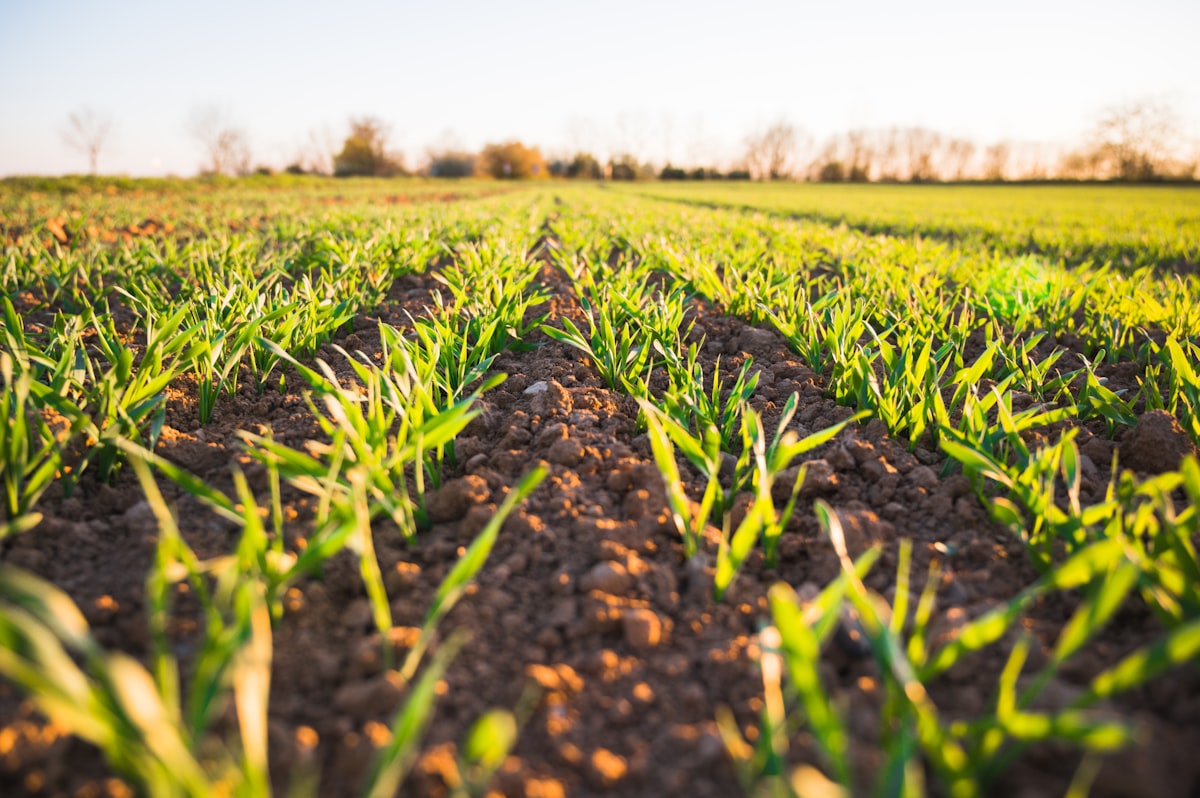
The Positive Effects of Urbanization on Agriculture
While the negative effects dominate many discussions, urbanization also creates significant opportunities for farming — particularly for farmers and agribusinesses positioned to adapt. Therefore, a balanced perspective recognizes both challenges and benefits. Moreover, proactive farmers can capitalize on these opportunities.
📈 Growing Urban Food Markets
Does urbanization increase food demand? Unquestionably yes. Growing food demand is, from a market perspective, a significant opportunity for agriculture. Urban populations consume more diverse, higher-value food products than rural populations — more processed foods, more protein, more fresh produce. Consequently, this shift creates opportunities for farmers who can access urban markets directly through community supported agriculture programs, farmers markets, or modern agribusiness supply chains. Thus, proximity to cities becomes an economic advantage.
💡 Technology Adoption & Innovation
Urbanization concentrates economic activity, investment capital, and technological expertise in cities — and this has historically driven agricultural innovation. Agritech companies, digital agriculture startups, and precision agriculture technology providers tend to cluster in or near urban centers. As a result, ecosystems of innovation benefit farming through new farm equipment, smart farming technologies, and agricultural apps. The agriculture 4.0 movement is largely a product of urban economic dynamism applied to farming challenges. Therefore, urban proximity accelerates technology adoption.
🏙️ Urban Agriculture Diversification
One of the most visible positive responses to urbanization’s pressure on conventional farming is the growth of urban agriculture — the cultivation of food within city boundaries. Urban farming takes many forms: rooftop gardens, community gardens, indoor vertical farming, and controlled environment agriculture. Therefore, urban agriculture initiatives produce fresh food close to consumers, reduce transportation emissions, provide green space, and create entrepreneurial opportunities. Additionally, they build community resilience.
💰 Agricultural Land Values
Rising land values in peri-urban areas — while problematic for farmers facing development pressure — also represent wealth creation for agricultural landowners. Farmers who own their land may use increased equity to invest in farm improvements, adopt new technologies, or transition to higher-value agricultural enterprises. Consequently, for some landowners, urbanization creates capital that enables agricultural modernization. However, this benefit is unevenly distributed.
🛣️ Infrastructure Development
Infrastructure development driven by urbanization — road networks, electricity grids, communications systems, and logistics infrastructure — improves market access for rural farmers. Better roads reduce post-harvest losses. Reliable electricity enables on-farm refrigeration. Mobile communications support digital agriculture tools. Thus, infrastructure development has been among the most significant contributors to improved agricultural productivity in many developing regions. For this reason, urban growth indirectly benefits rural farmers.
Peri-Urban Agriculture: Farming in the Shadow of the City
Peri-urban agriculture — farming in the zones immediately surrounding cities — occupies a unique and increasingly important position. Peri-urban farming zones experience the sharpest version of the urbanization impact: highest development pressure, most fragmented farm landscapes, and most direct competition with urban uses for land, water, and labor. Therefore, farming near cities requires special strategies and support. Nevertheless, these zones are also where innovation is most likely to emerge.
Yet peri-urban agriculture also enjoys the greatest proximity to urban food markets, the best access to urban infrastructure, and the closest connection to agritech innovation ecosystems. Farmers who successfully navigate peri-urban conditions often transition to high-value, intensive agricultural enterprises — greenhouse farming, organic agriculture, specialty crops, and direct-to-consumer models. Thus, these operations remain economically viable despite elevated land costs and competitive pressures. Furthermore, they contribute significantly to urban food security.
Sustainable urban development policies that protect peri-urban farming zones — through agricultural land use planning, right-to-farm legislation, urban growth boundaries, and urban food systems strategies — are essential for maintaining the food production capacity of rapidly urbanizing regions. Consequently, organizations including the Food and Agriculture Organization and the USDA are increasingly engaged in land use planning efforts to protect agricultural land from urban encroachment. For this reason, policy matters enormously.
Agriculture in Developing Cities: A Special Challenge
The urbanization impact on agriculture is felt most acutely in developing regions. In these areas, urban growth rates are highest, agricultural land is often least protected by formal land use planning, and farming communities are most economically vulnerable to disruptions caused by urban expansion. Therefore, the challenges are more severe and the need for solutions more urgent. Moreover, the consequences of inaction are more dire.
In many countries across Africa, South Asia, and Southeast Asia, rapid urban growth is simultaneously reducing agricultural land availability, drawing labor from farming communities, and creating enormous new urban food demand that domestic agriculture may struggle to meet. Agriculture in developing cities faces particular challenges: informal land tenure systems that offer little protection against urban encroachment; limited access to agri finance and rural finance; inadequate agricultural extension services; and weak enforcement of land use planning frameworks. Consequently, farmers in these regions are especially vulnerable.
Yet these same regions also offer some of the greatest opportunities for agricultural development. They have large and growing urban food markets, significant potential for agricultural productivity improvement through smart farming technologies, and expanding access to digital agriculture tools through mobile platforms. Consequently, targeted investment and policy support can make a tremendous difference. Thus, international development organizations are focusing on these regions.
Can Agriculture Survive Rapid Urbanization?
This is perhaps the most fundamental question in the urbanization-agriculture relationship. Can agriculture survive rapid urbanization? The honest answer is: it depends entirely on the choices made by governments, farmers, investors, and communities. Therefore, the future is not predetermined but rather shaped by collective action. Nevertheless, there is reason for optimism.
Agriculture can survive — and in many ways thrive — alongside urbanization if several conditions are met. First, land use planning frameworks must protect prime agricultural land from urban encroachment. Second, peri-urban agriculture must be recognized and supported as an essential component of urban food systems. Third, precision agriculture and smart farming technologies must be made accessible to farmers of all scales to offset labor shortages through productivity improvement. Fourth, urban agriculture initiatives must be supported as a genuine complement to conventional farming, not a replacement. Finally, agricultural economics must evolve to recognize and reward the full range of values that farming delivers — food production, carbon sequestration, biodiversity, water management, and rural livelihoods. For these reasons, a multi-stakeholder approach is essential.
The 7 practices of sustainable agriculture, regenerative agriculture principles, climate smart agriculture frameworks, and agroecology approaches all provide models for how farming can adapt to urban pressures while maintaining productivity and environmental integrity. Thus, there are proven pathways forward. However, implementation requires political will and investment.

How Cities Can Support Agriculture
How can cities support agriculture? Urban geography and sustainable development thinking are increasingly focused on this question, recognizing that cities have both responsibility and self-interest in protecting the food systems that sustain them. Therefore, practical approaches are being implemented worldwide. Moreover, successful examples provide models for replication.
🛡️ Protect Agricultural Land
Establish urban growth boundaries that protect agricultural land at city edges. Create dedicated agricultural zones in land use planning frameworks with strong protections against rezoning. These policies prevent the most damaging forms of urban sprawl. Consequently, prime farmland remains available for food production.
🤝 Support Local Food Systems
Support community supported agriculture programs and urban farmers markets that connect city residents directly with local producers. Incorporate food systems planning into sustainable urban development strategies. Use public procurement to support local agricultural products in schools and hospitals. Thus, local food economies thrive.
🌱 Invest in Urban Agriculture
Invest in urban agriculture infrastructure including garden drip systems, rooftop farming facilities, and community garden programs. Support urban agriculture initiatives through grants, technical assistance, and access to vacant land. Recognize urban farming as a legitimate land use. Therefore, cities become food producers as well as consumers.
💰 Provide Financial Support
Ensure agribusiness management, agri finance, and farm credit system support for peri-urban and urban farmers. Provide access to capital that enables adaptation to urban pressures. Create incentive programs for farmers who maintain agricultural land near cities. Consequently, economic pressures on farmers are reduced.
The Future of Agriculture in Urban Areas
The future of agriculture in urban areas is being shaped by technological innovation, changing consumer values, and evolving urban food systems thinking. Therefore, several trends are converging to create new possibilities. Moreover, these trends are accelerating as urban populations grow.
Indoor vertical farming facilities are expanding rapidly in major cities, producing leafy greens and herbs in highly controlled environments using a fraction of the land and water required by conventional farming. Controlled environment agriculture technology is advancing quickly, supported by investment from agritech companies. Consequently, urban-grown food is becoming more viable and scalable. For example, several major cities now have large-scale vertical farms supplying local supermarkets.
Precision agriculture tools — from drone farming and GPS field measurement to agricultural GIS tools — are making it possible for peri-urban farms to be highly productive on smaller land areas. The John Deere autonomous tractor and electric farm tractor platforms reduce the labor dependence that makes peri-urban farming vulnerable to rural to urban migration effects. Thus, technology is helping farmers adapt. Additionally, these tools improve environmental outcomes.
Regenerative agriculture and natural farming approaches are being adopted by peri-urban farmers who recognize that soil health, water efficiency, and biodiversity are their most durable competitive advantages in a landscape shaped by urban pressures. Therefore, the future of farming near cities may be more sustainable than the past. Furthermore, these practices sequester carbon and build climate resilience.
Frequently Asked Questions About Urbanization and Agriculture
📖 Understanding the Basics
✅ Positive Impacts and Opportunities
👥 Labor and Migration Challenges
🛡️ Survival Strategies and Policy Solutions
Conclusion: The Future Depends on How We Balance Growth and Food
🏙️ The Inevitable Trend of Urbanization
Urbanization is not stopping. The movement of people to cities, the expansion of urban economies, and the transformation of rural landscapes are among the defining trends of the twenty-first century. Therefore, the question is not whether urbanization will continue to affect agriculture — it will, profoundly and everywhere. Instead, the question is whether the choices made by governments, planners, farmers, investors, and communities will allow food production to keep pace with the demands of a more urban world. Moreover, the speed of these changes demands urgent action.
⚠️ The Serious Challenges We Face
The impact of urbanization on agriculture is real and in many respects serious. Agricultural land loss, labor shortages, water competition, and the fragmentation of rural farming communities are genuine threats to food security and agricultural sustainability. In regions where land use planning is weak, where peri-urban farming zones are unprotected, and where agricultural economics do not support adaptation, the effects on farmers can be devastating. However, the story is not only one of loss. Nevertheless, acknowledging these challenges is the first step toward addressing them.
💡 Urbanization as a Driver of Innovation
Urbanization is also a driver of agricultural innovation. It creates food markets that reward quality and diversity. It generates capital that funds agritech companies and smart farming technologies. It builds infrastructure that connects rural farmers to urban consumers. And it creates the urgent need for urban agriculture, precision farming, regenerative agriculture, and sustainable development solutions that are shaping the future of food. Consequently, the farms that survive and thrive will be those that find their place in the new geography of food — close to cities, responsive to urban demand, equipped with modern technology, and grounded in sustainable practices that maintain the soil, water, and ecosystem health that all farming ultimately depends on. Therefore, adaptation is the key to resilience.
🌍 A Call to Action for All Stakeholders
For farmers, this means adapting to urban proximity and market opportunities. For policymakers, it means protecting agricultural land while supporting urban growth. For investors, it means recognizing the value of peri-urban agriculture and food system infrastructure. For consumers, it means supporting local farmers and sustainable food systems. And for everyone, it means understanding that food security in an urbanizing world depends on how well we balance competing demands for land, water, and labor. Thus, everyone has a role to play in shaping a sustainable food future.
📚 Related Guides from Agri Opportunities
↗️ Agriculture Land Area Calculation ↗️ Carbon Footprint Calculator for Agriculture ↗️ Sustainable Agriculture Practices📚 External Resources & Further Reading
Add Agri Opportunities as a preferred source on Google to see latest blog listings first.