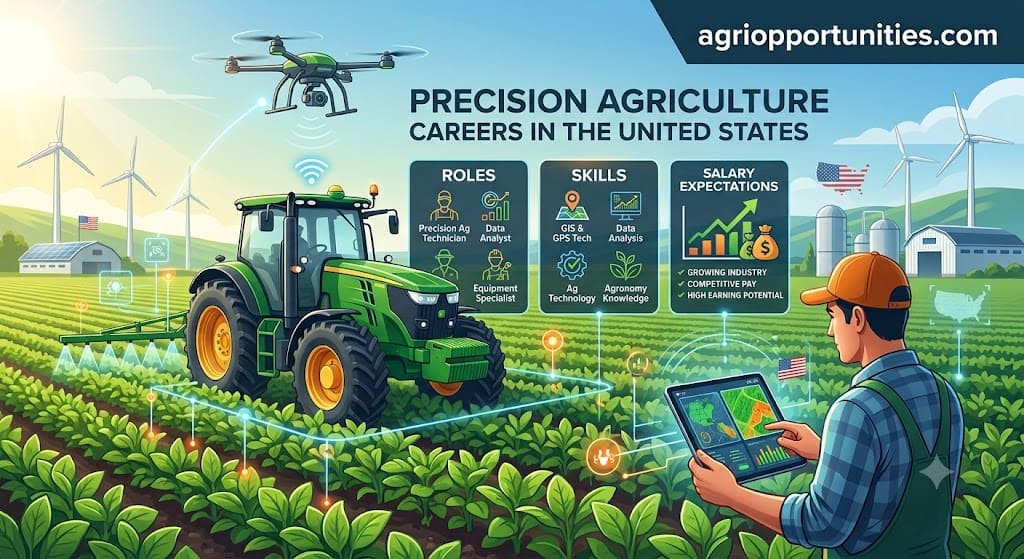
Precision Agriculture Careers in the United States: Roles, Skills, and Salary Expectations


Precision Agriculture Careers in the United States
Real job titles, required skills and tools, and realistic salary ranges across precision agriculture roles in the USA.
“Precision agriculture” gets used loosely in a lot of career content — as a buzzword attached to almost any tech-adjacent farming job. It’s more useful to break the field down into the actual, distinct roles people are hired for, what each one really involves day to day, and what the market realistically pays. This guide profiles the core precision agriculture career paths in the US, drawing on the U.S. Department of Labor’s official occupational classification system alongside current market listings, so you can see not just job titles but the specific tasks and tools tied to each one.
Precision Agriculture Technician
🔧 Precision Agriculture Technician
$45,000 – $55,000This is the foundational, most common entry point into the field, officially recognized by the U.S. Department of Labor’s O*NET occupational database under code 19-4012.01. A precision agriculture technician sets up, calibrates, and maintains GPS-guided vehicle systems, sensors, and mechanical controls; collects field data on soil attributes, yield, and field boundaries; divides fields into georeferenced management zones; and recommends crop varieties or seeding rates based on geospatial data analysis.
Remote Sensing Analyst
🛰️ Remote Sensing Analyst / Precision Ag Remote Sensing Specialist
$55,000 – $70,000A more specialized role at the intersection of agronomy and geospatial data science. Remote sensing analysts work with satellite and drone-based imagery to translate raw geospatial data into actionable insight — identifying crop stress, monitoring soil variability, and detecting pest or disease outbreaks before they’re visible on the ground. This role works closely with agronomists and farm managers, serving as the technical bridge between raw imagery and a farmer’s actual decisions.
Drone Pilot / UAV Operator
✈️ Drone Pilot / UAV Operator (Agricultural Applications)
$25+/hrA narrower but genuinely growing niche, particularly for tasks like crop imaging, health monitoring, and increasingly, targeted pesticide or treatment application via drone. Some roles require an FAA Part 107 remote pilot certification, and specialized applications may require additional chemical handling and application certifications.
Precision Agriculture Data Analyst
📊 Precision Agriculture Data Analyst / Agribusiness Analyst
$65,000 – $75,000A step further up the value chain from field-level technician roles, this position focuses on aggregating and interpreting farm-level and enterprise-level data — yield trends, input efficiency, cost-per-acre analysis — to guide broader agribusiness decisions. This role increasingly requires comfort with ERP software, broader data analytics platforms, and sometimes blockchain-based traceability systems.
Agricultural Consultant
📋 Agricultural Consultant (Precision-Focused)
$60,000 – $100,000+Consultants advise farms and agribusinesses on best practices, sustainability compliance, and technology adoption strategy, often bringing together technical precision-ag knowledge with broader business and regulatory understanding. This role typically requires several years of hands-on experience in more technical roles first, since clients are paying for judgment and credibility as much as raw technical skill.
Career Snapshot
| Role | Salary Range | Entry Point |
|---|---|---|
| Precision Ag Technician | $45,000 – $55,000 | Bachelor’s degree + internship |
| Remote Sensing Analyst | $55,000 – $70,000 | GIS/agronomy background |
| Drone Pilot / UAV Operator | $25+/hr | FAA Part 107 certification |
| Agribusiness Data Analyst | $65,000 – $75,000 | Analytics + agribusiness background |
| Agricultural Consultant | $60,000 – $100,000+ | 5+ years experience |

What Ties These Roles Together
Across every role profiled above, a few consistent skill threads show up repeatedly in current job postings and official occupational data:
🚀 How to Build Toward These Roles
- Prioritize coursework in GIS, remote sensing, and agricultural data analysis alongside core agronomy training.
- Seek internships specifically involving precision ag tools — GPS-guided equipment, yield mapping, or drone-based data collection.
- Consider a focused certification in a specific GIS platform or farm management software system to stand out.
For current openings across precision agriculture, agribusiness analytics, and related technical roles in the USA, browse live agriculture job listings on Agri Opportunities.
Frequently Asked Questions
What does a precision agriculture technician actually do day to day?
A precision agriculture technician sets up, calibrates, and maintains GPS and sensor-based farming equipment, collects and analyzes field data on soil and crop conditions, and helps develop site-specific management zones and variable-rate application plans.
Do I need a specific degree to work in precision agriculture?
Most roles require a degree in agriculture, agronomy, environmental science, or a related technical field, though specific certifications in GIS software and precision agriculture systems can meaningfully strengthen a candidacy alongside the degree.
What software and tools should I learn for a precision agriculture career?
Core tools include GIS platforms such as ESRI ArcGIS, farm management software like John Deere Apex or Ag Leader SMS, GPS-based guidance systems, and increasingly, drone operation and basic data analytics skills.
How does salary vary across precision agriculture roles?
Entry-level precision agriculture technician roles generally start somewhere in the high-40,000 to high-50,000 dollar range in the US, while more specialized or senior positions involving agribusiness analytics, remote sensing leadership, or agronomic consulting can reach well into six figures depending on region and employer.
Browse live, currently open precision agriculture, agribusiness, and technical agriculture positions across the United States.
Add Agri Opportunities as a preferred source on Google to see latest guide listings first.


Your way of describing everything in this article is truly nice, every one be able to easily understand it,
Thanks a lot.
Terrific work! This is the kind of info that are supposed to be shared around the web.
Disgrace on Google for now not positioning this post upper!
Come on over and consult with my website . Thanks =)
Grown ups in these days must gain knowledge of even more pertaining to a lot of these subjects,
although there will by no means quite possibly be a sufficient quantity of free time.
Right after precious time for friends and relations, and surely working, just what period
of time is remaining to devote to understanding the concepts of
these kinds of foremost theories? As an individual practicing post-natal massage, in conjunction with constructing website pages and
running many different web servers, spare time is totally a
thing which i do not have sufficient quantiities of. Ideally, I’ll be able to
find the occasion essential to examine this critical subject matter more honestly.
Thanks to you for presenting this specific crucial source.
Greetings I am so excited I found your site, I really found you by error, while I
was looking on Yahoo for something else,
Nonetheless I am here now and would just like to say kudos for a incredible post and a all round interesting blog (I also love the theme/design),
I don’t have time to browse it all at the minute but I have bookmarked it and also
added your RSS feeds, so when I have time I will be back to
read a great deal more, Please do keep up the awesome job.
Thanks for the good writeup. It actually was
a enjoyment account it. Look complex to far brought agreeable from you!
By the way, how can we keep up a correspondence?
Hello to all, the contents existing at this web page are truly remarkable for people
experience, well, keep up the good work fellows.
Excellent post. I was checking constantly this blog and I’m impressed!
Extremely useful information specifically the last part :
) I care for such info a lot. I was looking for this certain information for a very long time.
Thank you and good luck.
Thank you for any other wonderful post. The place else may
anybody get that kind of information in such a perfect method of writing?
I have a presentation next week, and I’m on the search for such information.
This design is wicked! You obviously know how to keep a reader entertained.
Between your wit and your videos, I was almost moved to start my own blog (well, almost…HaHa!) Great job.
I really enjoyed what you had to say, and more than that,
how you presented it. Too cool!