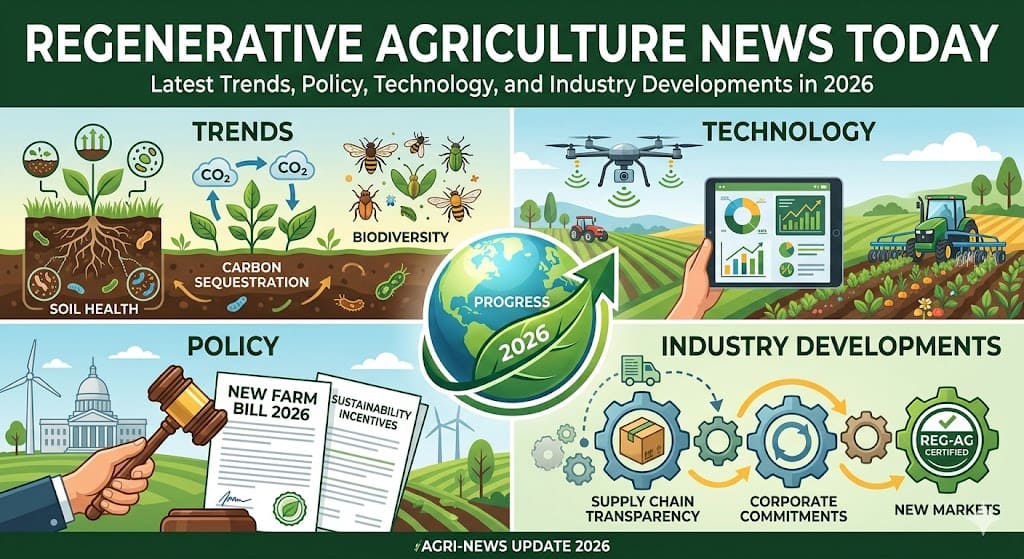
Regenerative Agriculture News Today – Latest Trends, Policy, Technology, and Industry Developments in 2026

Regenerative Agriculture News Today
Latest Trends, Policy, Technology, and Industry Developments in 2026
Complete guide to regenerative agriculture news: USDA $700M program, corporate commitments, investment trends, certification standards, technology innovations, and industry developments shaping the future of farming.
Why Regenerative Agriculture Is Dominating the Headlines
Regenerative agriculture news today is coming from everywhere — government agencies, global food corporations, investment funds, certification bodies, and farmers on the ground. In 2026, regenerative farming has moved from the margins of agricultural conversation to its very center. Consequently, it is attracting billions of dollars in funding, reshaping food supply chains, and becoming central to debates about climate change, soil health, and the future of food.
This comprehensive guide covers the latest regenerative agriculture updates across every major dimension: policy and government programs, corporate commitments, investment trends, certification standards, technology innovation, and real-world farming practices. Therefore, whether you are a farmer, researcher, investor, or simply someone who wants to understand what is happening in regenerative agriculture today, this is your complete briefing. Moreover, the momentum behind regenerative farming continues to accelerate.
What Is Regenerative Agriculture? A Quick Foundation
Before diving into the latest regenerative agriculture headlines, it is worth grounding the discussion in a clear definition. Notably, the debate around what the term actually means is itself one of the biggest regenerative agriculture news stories of 2026. Therefore, understanding the foundation is essential.
What is regenerative agriculture? At its core, regenerative agriculture is a farming approach that goes beyond simply reducing harm. Instead, it actively works to restore and improve the health of agricultural ecosystems. According to the USDA’s Natural Resources Conservation Service, regenerative agriculture is a conservation management approach that emphasizes natural resources through improved soil health, water management, and natural vitality.
In practice, regenerative agriculture practices include no-till agriculture and reduced tillage systems that protect soil structure; cover crop systems that keep living roots in the ground year-round; regenerative grazing that mimics natural animal movement to restore grassland health; agroecology approaches that work with natural ecosystem processes; and biodiversity conservation agriculture that restores the variety of life in farming landscapes. Consequently, these practices work together to rebuild soil health and ecosystem function.
STORY 1: The USDA’s $700 Million Regenerative Agriculture Program
The biggest regenerative agriculture policy update of the past year is the United States Department of Agriculture’s launch of a major new Regenerative Agriculture Pilot Program. Specifically, the USDA announced the launch of a regenerative agriculture pilot program that includes a $700 million investment to encourage the adoption of regenerative agricultural practices. These funds run through two existing NRCS programs.
In fiscal year 2026, the U.S. is dedicating $400 million through the Environmental Quality Incentives Program (EQIP) and $300 million through the Conservation Stewardship Program (CSP). Therefore, the first year of regenerative agricultural projects is now fully funded. Moreover, the program focuses on whole-farm planning that addresses every major resource concern — soil, water, and natural vitality — under a single conservation framework.
The practices included fall into three categories: soil health, water quality, and habitat vitality. Additionally, the NRCS will establish a Regenerative Agriculture Advisory Council consisting of 15 members — nine regenerative farmers, three corporate supply-chain representatives, and three consumer representatives. Consequently, diverse perspectives will guide program implementation.
STORY 2: Corporate Regenerative Farming Commitments Scale Up
Government is not the only force driving regenerative agriculture market growth. Major food and beverage corporations are making increasingly significant commitments to sourcing regeneratively produced ingredients. For instance, in September 2025, a group of major retail and global food and beverage companies, including PepsiCo and Unilever, launched the STEP up for Agriculture initiative. This program provides resources and training to support farmers in adopting regenerative farming practices.
A pilot program for 2026 aims to get farmers to establish regenerative agriculture practices across approximately 16,000 acres of corn and soybean fields in Minnesota and Illinois. Furthermore, it will enroll about 2,500 acres of soybean fields in Hungary. The program’s goal is to enhance soil health, reduce carbon intensity, reduce soil erosion, improve water quality, increase biodiversity, and support long-term agricultural resilience. Therefore, these commitments are both substantial and measurable.
In the brewing sector, Carlsberg Brewery has committed to regeneratively sourced ingredients. Consequently, it now buys regeneratively produced malt barley from approximately 50 Danish farmers. For the 2026 cropping season, they plan to increase supply to 15,000 tons. Thus, corporate commitments are translating into real farm-level action.
STORY 3: Regenerative Agriculture Investment Hits $458 Million in Q1 2026
The regenerative agriculture funding landscape remains active even as the broader agrifood investment market faces headwinds. In Q1 2026 (January through March), 34 regenerative agriculture and food investments totaling more than $458 million were tracked. Notably, this represents fewer deals than in each quarter of the previous year. However, the total deal value outpaced the last three quarters of 2025. Thus, investment per deal is increasing.
Six new funding and investment vehicles launched in Q1. For example, Lucerne Capital’s regenerative farmland vehicle is targeting $500 million. Similarly, The Rockefeller Foundation and Builders Vision launched a $10 million Food is Medicine Impact Fund. Importantly, biologicals and other regenerative inputs were the leading investment theme, representing 38% of deals by count. Consequently, investor confidence in biological solutions remains strong.
STORY 4: Regenerative Agriculture Certification Standards Expand and Multiply
One of the most important and fast-moving areas of regenerative agriculture trends 2026 is the expansion and diversification of certification and verification systems. The question of what genuinely qualifies as regenerative agriculture — and how to prove it — is central to the credibility of the entire movement. Consequently, certification standards are evolving rapidly.
An estimated 25 million acres are now certified under third-party regenerative agriculture standards globally. For instance, the Savory Institute’s Land to Market program, launched in 2018, now certifies over 6 million acres. It uses the Ecological Outcome Verification (EOV) method to scientifically measure land health improvement. Similarly, the Regenagri standard has been adopted by 332,456 farms managing 4.37 million acres of certified farmland. Thus, the certified acreage is growing steadily.
In January 2026, Whole Foods Market approved Green America’s Soil and Climate Initiative (SCI) as a regenerative agriculture certification program. Consequently, SCI joins Regenerative Organic Certified, Regenified, Ecological Outcome Verification, and Certified Regenerative by AGW in Whole Foods Market’s roster of trusted certifications. Therefore, market access for certified regenerative products is expanding significantly.
STORY 5: New Soil Evidence Puts Regenerative Farming on Firmer Ground
A persistent challenge for the regenerative agriculture industry has been the variability and uncertainty of scientific evidence for soil health outcomes. However, regenerative agriculture reports from 2026 show that new research confirms soil gains are real yet variable. Consequently, tools, verification, and standards continue to evolve simultaneously.
This nuance matters enormously for regenerative agriculture policy, investment, and certification. Soil organic carbon — the primary measure of soil health improvement — increases as organic matter accumulates in soil under regenerative management. Moreover, carbon sequestration farming claims are increasingly subject to rigorous verification requirements. Therefore, the science of measuring soil organic carbon at field scale is rapidly advancing.
The link between soil regeneration and farm financial performance is also becoming clearer. Healthy soils produce more resilient crops, require less synthetic input spending over time, and improve water retention. Thus, soil health improvement is not just an environmental goal but a core component of farm resilience strategies and long-term agricultural sustainability.
STORY 6: Regenerative Agriculture Technology Accelerates
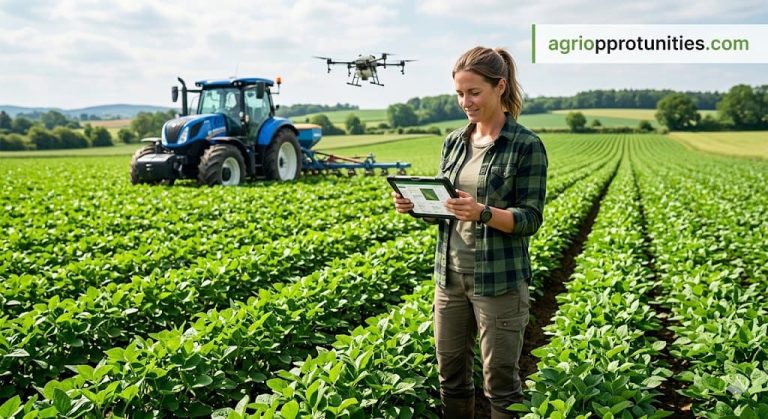
Technology is playing an increasingly important role in making regenerative agriculture scalable, measurable, and financially viable. Regenerative agriculture technology news in 2026 covers a wide spectrum — from digital farm management platforms and soil sensing tools to satellite imagery and artificial intelligence applications. Consequently, farmers have more tools than ever before.
The challenge of measuring regenerative outcomes at scale — particularly soil organic carbon — has driven significant innovation in agricultural technology. Specifically, new sensor technologies, remote sensing platforms, and machine learning models are making soil carbon measurement faster and cheaper than traditional laboratory analysis. Therefore, verification costs are decreasing.
Digital farming platforms are helping farmers plan and implement regenerative practices, track their progress against measurable outcomes, and connect with supply chain partners. For instance, companies like Klim are developing financial modeling tools that help food companies and investors understand how regenerative transitions affect their financial performance. Thus, technology is making regenerative agriculture “financially legible” for corporate decision-makers.
STORY 7: The Definition Debate — What Does Regenerative Agriculture Actually Mean?
One of the most significant ongoing stories in regenerative agriculture industry news is the debate over definition and standards. What actually counts as regenerative agriculture? Who gets to decide? And does the absence of a clear, universal definition undermine the credibility of the entire concept? Consequently, this debate shapes everything from policy to marketing.
At the policy level, the USDA’s broad definition — emphasizing soil health, water quality, and habitat vitality without excluding synthetic pesticides — has been criticized by organic agriculture advocates. They argue it allows conventional chemical-dependent farming to claim regenerative status. Therefore, this tension between inclusive and restrictive definitions shapes both government programs and corporate supply chain commitments.
The consensus emerging from regenerative agriculture events and forums in 2026 is that the definition debate, while sometimes contentious, is a sign of a maturing field. Thus, one in which the stakes are high enough that precision matters and accountability is demanded. Moreover, regulatory pressure from the EU Green Claims Directive is forcing greater clarity and accountability in regenerative agriculture communications.

STORY 8: Regenerative Agriculture Goes Global
While much of the regenerative agriculture news today originates from the United States and Europe, regenerative farming developments are accelerating worldwide. Notably, regenerative agriculture is proving adaptable to enormously diverse agricultural contexts — from arid pasturelands in sub-Saharan Africa to intensively farmed grain belts in Eastern Europe. Consequently, global adoption is expanding rapidly.
Global south farmers are often finding that regenerative agriculture practices align naturally with traditional farming knowledge — agroecology, mixed farming, and minimal-input approaches that communities practiced for generations. Therefore, in these contexts, regenerative farming is less a new concept than a return to and formalization of existing wisdom. Moreover, new market connections and certification opportunities are supporting this transition.
In Europe, the Rainforest Alliance’s new regenerative certification standard taking effect in March 2026 signals that regenerative sourcing is becoming a mainstream expectation for global commodity supply chains. Thus, coffee, cocoa, tea, citrus, and other tropical crops will increasingly be expected to meet measurable regenerative standards. Consequently, this has significant implications for farmers and agribusinesses throughout producing countries.
STORY 9: Regenerative Grazing and Livestock Farming in the News
Regenerative grazing — the use of planned livestock movement to restore grassland ecosystems — is one of the most dynamic and sometimes controversial areas of regenerative farming developments. Well-managed grazing is increasingly recognized as a powerful tool for soil regeneration, carbon sequestration, and biodiversity restoration on rangelands that cover vast areas of the planet. Therefore, livestock farmers are paying close attention.
The Land to Market program’s use of Ecological Outcome Verification to scientifically measure land health improvement is specifically designed for rangelands and livestock operations. Consequently, this approach is being adopted by beef, lamb, dairy, and wool producers globally. Thus, it represents a significant broadening of the regenerative agriculture market beyond crop farming.
For farmers and ranchers, the practical case for regenerative grazing rests on farm resilience strategies — reducing input costs, improving pasture productivity, and building resistance to drought and flooding. Additionally, certification and premium pricing provide market incentives. Therefore, regenerative livestock farming is gaining momentum worldwide.
STORY 10: Sustainable Food Systems and Supply Chain Transformation
Perhaps the most transformative dimension of regenerative agriculture trends 2026 is the integration of regenerative farming into mainstream food supply chains. The days when regenerative food supply chains were a niche concern of specialty food brands are giving way to an era in which major food companies are restructuring their ingredient sourcing around regenerative outcomes. Consequently, this is a fundamental shift.
This supply chain transformation is driven by multiple forces simultaneously: consumer demand for transparency and sustainability, corporate sustainability commitments and net-zero targets, investor pressure on food company sustainability performance, regulatory requirements in major markets, and growing awareness that soil degradation and climate disruption represent existential threats to food supply security. Therefore, the momentum is powerful and multifaceted.
Environmental stewardship in agriculture — covering soil, water, biodiversity, and climate — is increasingly being demanded not just from farms but from the entire supply chain ecosystem. Thus, this whole-supply-chain approach is what makes the current wave of regenerative agriculture market expansion fundamentally different from earlier sustainability initiatives that focused primarily on farm-level practices without integrating them into commercial systems.
Frequently Asked Questions About Regenerative Agriculture News Today
📰 Latest Developments
💰 Policy and Investment
📜 Certification and Standards
🌍 Future Outlook
Conclusion: The Regenerative Agriculture Moment
The regenerative agriculture news landscape in 2026 reflects a sector that is simultaneously exciting and messy — full of genuine promise, significant investment, important scientific progress, and unresolved debates about definitions, standards, and accountability. Therefore, the moment is both promising and challenging.
The $700 million USDA Regenerative Pilot Program, the scale-up of corporate regenerative supply chain commitments from 40 global food companies, the $458 million in Q1 2026 investment, the expansion of certified regenerative farmland to 25 million acres globally, and the rollout of rigorous new standards collectively represent a genuine transformation. Consequently, the agricultural industry is approaching sustainability in fundamentally new ways.
At the same time, the debates around greenwashing, definitional clarity, the sufficiency of public investment, and the pace of real farm-level change serve as important reminders that momentum is not the same as transformation. Thus, scaling regenerative agriculture from an inspiring movement to a genuinely reformed global food system will require sustained effort, honest accountability, and willingness to prioritize measurable ecological outcomes over convenient marketing.
📚 Related Guides from Agri Opportunities
↗️ Agriculture Homemade Games ↗️ Carbon Footprint Calculator for Agriculture ↗️ Farming System in AgricultureAdd Agri Opportunities as a preferred source on Google to see latest blog listings first.