What Is No Till Agriculture? Benefits, Methods & Soil Health Guide

From definition to real-world practice — everything you need to know about no till farming, its impact on soil health, the environment, and the future of sustainable agriculture.
What Is No Till Agriculture? — Definition and Meaning
No Till Agriculture Meaning
No till agriculture — also written as no-till or zero tillage farming — is a crop production system in which the soil is not ploughed, turned, or mechanically disturbed between growing seasons. Instead of breaking up the soil before planting, seeds are drilled directly into the ground through existing crop residue using specialised no till planting equipment.
The no till agriculture meaning goes beyond simply skipping the plough. It represents a fundamental shift in the philosophy of soil management — from treating soil as an inert growing medium to treating it as a living ecosystem that must be nurtured, protected, and kept as undisturbed as possible.
📖 No Till Farming Definition — Core Concept
No till farming is a method of crop farming and conservation tillage in which the ground is left structurally intact between growing cycles. Seeds are planted directly into undisturbed soil, preserving soil structure, organic matter, microbial life, and moisture. It is a cornerstone practice of sustainable farming, regenerative agriculture, and conservation agriculture globally.
Key Terms to Know
Conservation tillage is the broader category that includes no till as well as other reduced-disturbance systems such as strip-till and minimum-till. Zero tillage farming is another common term for no till, emphasising that mechanical soil disturbance is reduced to essentially zero. Direct seeding refers to the practice of placing seeds into undisturbed soil — the technical mechanism at the heart of no till crop farming.
No Till Farming Explained in Simple Words
What Is No Till Farming in Simple Words?
In traditional farming, farmers use heavy machinery to plough and turn over the soil before each planting season. This breaks up the earth, buries weeds, and creates a fresh seedbed. No till farming, as the name suggests, simply skips that step entirely.
Instead of ploughing, the farmer uses a special drill that cuts a narrow slot directly into the ground — through last season’s leftover stalks and leaves — and drops the seed in. The soil stays intact. The roots from last season’s crop remain in place. The worms, fungi, and microbes living in the soil are not disturbed. That leftover plant material on the surface, called crop residue, acts as a protective mulch, keeping the soil moist and cool.
🌾 No Till Agriculture for Beginners — The Simple Version
Think of conventional farming as repeatedly digging up a carpet to lay new carpet underneath. No till cultivation is like sliding the new carpet under the old one — the floor (soil) is never exposed, never disrupted, and stays healthier for longer. That is the essence of what no till agriculture means in practice.
Why Does It Matter?
Every time soil is ploughed, its structure is broken. The tunnels created by earthworms collapse. Fungal networks are severed. Carbon stored in the soil is released into the atmosphere. Water evaporates quickly from the exposed surface.
No till soil management prevents all of this. By leaving the soil undisturbed, farmers protect its structure, retain moisture, build soil organic matter, and support the billions of microscopic organisms that make healthy farmland productive. It is one of the simplest — and most powerful — shifts available to modern farmers seeking eco-friendly farming.
History of No Till Agriculture
Ancient Roots of Reduced Tillage
While no till farming is often described as a modern innovation, the concept of minimal soil disturbance has ancient roots. Indigenous farming communities across the Americas, Africa, and Asia practised forms of direct seeding and no till cultivation for thousands of years — using digging sticks to plant seeds without turning the soil.
The history of no till agriculture as a formally recognised scientific practice begins in the 20th century, shaped largely by ecological disaster and research-driven innovation.
The Dust Bowl — A Turning Point
The 1930s Dust Bowl in the United States stands as one of the most dramatic demonstrations of what happens when soil is excessively tilled and left exposed. Years of deep ploughing had destroyed the natural grass root networks that held the Great Plains soil together.
When drought hit, the bare, pulverised topsoil simply blew away in massive dust storms — devastating farms, destroying livelihoods, and displacing hundreds of thousands of families. This catastrophe prompted a major rethinking of tillage practices and gave birth to the modern soil conservation movement.
Key Milestones in No Till History
The Dust Bowl Disaster
Catastrophic soil loss across the American Great Plains triggers the birth of the soil conservation movement and demands fundamentally new farming approaches.
Edward Faulkner’s Challenge
American farmer-author Edward Faulkner publishes Plowman’s Folly, arguing that ploughing is destructive and unnecessary — laying intellectual groundwork for the no till movement.
First Commercial No Till Experiments
Researchers at the University of Kentucky conduct the first successful large-scale no till crop experiments in the United States, proving the commercial viability of no till crop farming.
Herbicide Development Accelerates Adoption
The development of broad-spectrum herbicides dramatically increases the practicality of no till planting, reducing dependence on mechanical weed control through ploughing.
Global Spread of No Till
No till rapidly expands across South America, Australia, Canada, and Europe. Brazil becomes a world leader in conservation tillage, with tens of millions of hectares under no till systems.
Regenerative Agriculture Movement
No till becomes a central pillar of regenerative agriculture, recognised for its role in carbon sequestration, climate mitigation, and long-term agricultural sustainability.
How Does No Till Farming Work?
The No Till Planting Process
Understanding how no till farming works starts with understanding what it replaces. In conventional systems, farmers plough, disc, and harrow the soil to prepare a smooth, loose seedbed. In a no till system, all of this is skipped.
A specialised no till planter or drill is used to cut through the surface residue and deposit seeds at the correct depth in a single pass. The process involves three key actions: cutting through residue, opening a narrow seed slot, and then closing the slot firmly around the seed to ensure good soil-to-seed contact.
Weed Management in No Till Systems
One of the biggest challenges in no till cultivation is weed management. Conventional ploughing physically buries weed seeds and disrupts weed growth. Without that mechanical control, no till farmers must use alternative strategies.
These include herbicides (most conventional no till systems), cover crops that smother weeds naturally, mulching with crop residue, and carefully timed planting to outcompete weeds. Organic no till relies entirely on non-chemical methods such as dense cover cropping and thick mulch layers.
Residue Management
Effective residue management is critical to a successful no till operation. After harvest, the stalks, leaves, and roots of the previous crop are left on or near the soil surface rather than being ploughed under or burned.
This residue protects the soil surface from raindrop impact, reduces moisture evaporation, moderates soil temperature, and decomposes slowly to feed soil organic matter. Managing residue thickness and distribution is a key no till farming practice that farmers must master for long-term success.
No Till Agriculture Methods — Step by Step
1. Harvest & Leave Residue
After harvesting the cash crop, stalks and plant material are left on the field surface rather than being incorporated into the soil or removed.
2. Plant Cover Crops
Many no till farmers seed cover crops after harvest to protect bare soil, fix nitrogen, suppress weeds, and build organic matter through the off-season.
3. Terminate Cover Crops
Before the next cash crop is planted, cover crops are terminated by herbicide, roller-crimping, or frost — leaving a thick mulch layer on the surface.
4. Direct Seed with No Till Drill
A no till planter cuts through the residue and places seeds in undisturbed soil below. No ploughing, discing, or harrowing takes place.
5. Monitor & Manage
Farmers monitor crop emergence, weed pressure, and soil moisture. Targeted interventions are used only as needed to minimise further disturbance.
6. Repeat with Rotation
Crop rotation is combined with no till to manage pest and disease cycles and maintain nutrient retention and soil fertility year after year.
Benefits of No Till Farming
Why Is No Till Farming Important?
The benefits of no till farming are wide-ranging and well-documented. Decades of research and farmer experience across multiple continents confirm that well-managed no till systems deliver significant advantages for soil health, farm economics, water conservation, and the environment.
1. Improved Soil Health and Structure
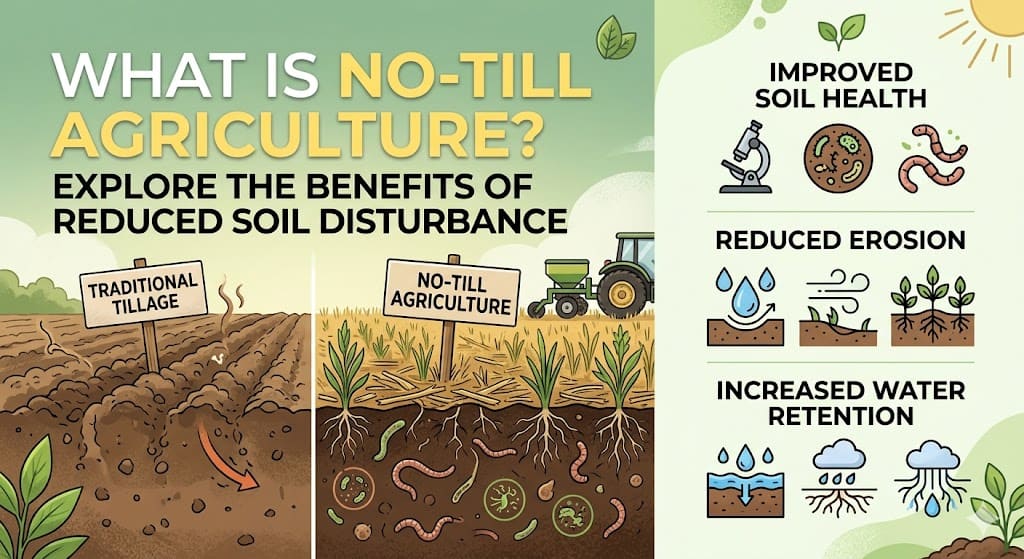
The most fundamental benefit of no till agriculture for soil is the preservation and gradual improvement of soil structure. When soil is not ploughed, the complex aggregates that give healthy soil its crumbly, porous texture remain intact. These aggregates improve water infiltration and create the air pockets that plant roots and soil organisms need to thrive.
2. Reduced Soil Erosion
Erosion control is one of the most compelling arguments for no till. Ploughed soil, left bare and loosened, is highly vulnerable to loss through wind and water. No till farming dramatically reduces erosion by keeping the soil surface covered with residue and intact root systems. Studies consistently show erosion reductions of 50–90% in no till fields compared to conventionally tilled fields.
3. Enhanced Moisture Retention
Moisture retention is significantly improved under no till systems. The crop residue covering the soil surface acts as a mulch, shading the ground and slowing evaporation. The intact soil structure allows rainfall to infiltrate quickly and be stored in soil pores rather than running off.
In drought-prone regions, improved moisture retention from no till practices can be the difference between a profitable harvest and a crop failure.
4. Increased Soil Organic Matter and Biodiversity
Over time, no till crop farming builds soil organic matter as crop residues decompose on and near the surface. Higher organic matter levels improve soil fertility, water-holding capacity, and the activity of soil biodiversity — earthworms, fungi, and bacteria that cycle nutrients and support plant growth.
5. Cost Savings and Farm Productivity
For many farmers, the economic case for no till agriculture is compelling. By eliminating multiple tillage passes, farmers save substantially on fuel, labour, and machinery wear and tear. Established no till farmers typically report lower input costs and stable or improved yields over the long term, making farm productivity in well-managed systems comparable to or better than conventional systems.
6. Carbon Sequestration and Climate Benefits
Every time soil is ploughed, carbon stored in organic matter is released as CO₂. No till farming dramatically reduces this carbon loss. Over time, the build-up of soil organic matter in no till fields represents genuine carbon sequestration — contributing to greenhouse gas reduction and making no till a meaningful climate mitigation tool.
✅ Benefits of No Till Agriculture — Summary
No till farming improves soil health, reduces erosion, enhances moisture retention, builds soil organic matter, supports soil biodiversity, reduces farm costs, and contributes to carbon sequestration. It is one of the most accessible and impactful transitions for farmers seeking eco-friendly farming and long-term agricultural sustainability.
Disadvantages of No Till Farming
No Till Agriculture — The Challenges
An honest assessment of no till agriculture advantages and disadvantages must acknowledge that no till is not a perfect solution for every farm in every context. There are genuine challenges and trade-offs that farmers must understand and manage before making the transition.
✅ Advantages
- Reduced soil erosion (up to 90%)
- Lower fuel and labour costs
- Improved soil structure over time
- Better moisture retention
- Increased soil organic matter
- Greater soil biodiversity
- Reduced carbon emissions
- Supports regenerative agriculture goals
- Long-term improvement in farm productivity
⚠️ Disadvantages
- Higher herbicide dependence initially
- Weed management more complex
- Higher upfront equipment costs
- Transition period yield dips possible
- Soil compaction risk on heavy soils
- Pest and disease risks from residue
- Slow soil warming in spring (cool climates)
- Requires management skill and knowledge
- May need adapted approach per soil/climate type
Weed Management Complexity
Without ploughing to bury weed seeds, weed management becomes more complex in no till systems. Growers who rely purely on herbicides may face increasing weed resistance over time — a well-documented problem in heavily herbicide-dependent no till systems.
The solution lies in integrated weed management: combining cover crops, crop rotation, targeted herbicide use, and sometimes strategic spot tillage to break weed cycles without abandoning the no till philosophy entirely.
Transition Period Challenges
Many farmers who switch from conventional to no till farming experience a “transition dip” — a period of 2–5 years during which yields may be slightly lower as the soil adjusts and the farmer learns new management techniques.
This transition period requires patience and investment. Farmers who successfully navigate it typically find that yields recover and costs fall. Joining farmer networks and trialling no till on a portion of the farm before full adoption are recommended strategies for beginners.
Soil Compaction Risk
Without tillage to loosen the soil, some no till fields — particularly those with heavy clay soils — can develop compaction issues over time, especially if heavy machinery is used repeatedly on wet ground.
Addressing this requires careful traffic management, the use of deep-rooting cover crops (like radishes or turnips) to biologically break compaction, and occasionally targeted deep tillage in problem areas — a practice known as “strategic tillage.”
No Till vs Conventional Tillage — Key Differences Explained
How Is No Till Farming Different from Traditional Farming?
The comparison between no till vs conventional tillage highlights fundamentally different philosophies about how soil should be managed. Conventional tillage treats soil disturbance as a necessary and routine part of crop preparation. No till cultivation treats soil disturbance as harmful and to be avoided wherever possible.
Side-by-Side Comparison
| Factor | No Till Farming | Conventional Tillage |
|---|---|---|
| Soil Disturbance | Minimal — seed slot only | High — ploughing, discing, harrowing |
| Erosion Risk | Very Low | High on exposed bare soil |
| Soil Organic Matter | Builds over time | Often depleted by repeated tillage |
| Soil Biodiversity | Protected and enhanced | Disrupted each season |
| Moisture Retention | High — residue mulch helps | Lower — bare soil loses moisture fast |
| Fuel Use | 30–50% less | High — multiple passes required |
| Equipment Cost | Higher upfront (specialist drill) | Lower upfront (existing equipment) |
| Weed Control | Herbicides + cover crops + rotation | Mechanical tillage + herbicides |
| Carbon Footprint | Lower — less fuel, sequesters C | Higher — fuel use + carbon released |
| Long-term Soil Health | Improving over years | Risk of degradation over time |
How Does No Till Farming Improve Soil Health?
Soil Health as the Foundation
The relationship between no till farming and soil health is at the core of why this practice has gained such strong scientific and agricultural support. Healthy soil is not simply dirt — it is a complex, living ecosystem home to billions of organisms per teaspoon, intricate fungal networks, and a carefully balanced chemistry of minerals, organic matter, water, and air.
Soil Organic Matter Accumulation
One of the most important long-term effects of no till agriculture is the gradual accumulation of soil organic matter. In conventional tilled systems, ploughing repeatedly exposes organic matter to oxygen, accelerating its decomposition and loss as CO₂.
In no till systems, surface residues decompose slowly from the top down, feeding the soil with carbon year after year. Studies confirm that long-term no till soil management increases organic matter levels — particularly in the upper soil layers — which in turn improves fertility, structure, and water-holding capacity.
Soil Biodiversity and Microbial Life
Tillage is catastrophically disruptive to soil biodiversity. The mycorrhizal fungi networks that help plant roots absorb nutrients are physically shredded by ploughs and discs. Earthworm tunnels that aerate soil are destroyed. Complex microbial communities that cycle nitrogen, phosphorus, and other nutrients are repeatedly set back to square one.
No till cultivation allows these communities to establish, grow, and develop over years and decades — creating a richer, more resilient soil ecosystem that provides more natural fertility and better supports crop growth with fewer external inputs.
Water Infiltration and Reduced Runoff
Improved water infiltration is one of the most consistently documented benefits of no till farming. The combination of intact soil structure and surface residue allows rainfall to enter the soil quickly and efficiently. In conventionally tilled fields, heavy rain falling on bare, crusted soil often runs off rather than soaking in — carrying valuable topsoil with it.
In no till fields, earthworm channels and intact aggregate structure allow water to move freely into the soil profile, supporting crops through dry periods and reducing pressure on irrigation systems.
Cover Crops in No Till Systems
What Are Cover Crops?
Cover crops are plants grown primarily to benefit the soil and farming system rather than for direct harvest. Common examples include legumes (clover, vetch, field peas), grasses (ryegrass, oats, rye), and brassicas (radishes, turnips, mustard). They are typically planted after the main cash crop has been harvested and before the next one is seeded.
In no till farming, cover crops are not just helpful — they are often essential. They bridge the critical gap between cash crop harvests, keeping the soil covered, protected, and biologically active year-round.
Benefits of Cover Crops in No Till Farming
Weed Suppression
Dense cover crop growth shades the soil, preventing weed germination and reducing herbicide needs in the following cash crop season.
Nitrogen Fixation
Legume cover crops fix atmospheric nitrogen into the soil, reducing synthetic fertiliser needs and supporting nutrient retention naturally.
Soil Biological Activity
Living roots feed soil microbes and earthworms, keeping the soil ecosystem active and productive through the off-season.
Erosion Prevention
Ground cover prevents raindrop impact erosion and slows surface water movement, making erosion control effective even between cash crop seasons.
Compaction Breaking
Deep-rooted species like radishes and turnips physically break up compaction and create channels for water and air movement in the soil profile.
Organic Matter Addition
When terminated, cover crop biomass adds significant organic matter to the soil surface, feeding the soil food web and building long-term fertility.
Cover Crops and Regenerative Agriculture
The combination of no till cultivation with diverse cover crops is a foundational practice of regenerative agriculture — a farming philosophy focused on restoring and enhancing natural ecosystems. Regenerative farmers often use complex, multi-species cover crop mixes that mimic the diversity of natural grassland communities, maximising ecological services delivered to the soil.
No Till Farming Equipment and Tools
What Equipment Is Used in No Till Farming?
The right no till farming equipment is fundamental to successful implementation. The most important specialised piece is the no till planter or drill — a machine designed to cut through surface residue and place seeds at precise depth in undisturbed soil without the soil preparation that conventional seeders require.
The No Till Drill / Planter
A quality no till drill is the centrepiece of any no till operation. Key features include: a coulter or disc opener that cuts through residue cleanly, a seed boot that places the seed at the correct depth, press wheels that close the seed slot and ensure soil-to-seed contact, and heavy-duty construction to handle the additional force required to penetrate unworked ground.
There are several types: disc-type drills (most common), tine-type drills (suited to lighter soils and lower residue), and precision air seeders (large-scale systems for broad-acre farming with GPS guidance).
Supporting Equipment
Roller-Crimper
Used in organic no till systems to mechanically terminate cover crops without herbicides, creating a flat mulch mat through which cash crops are direct-seeded.
Combine with Residue Spreader
Even residue distribution from harvest is critical. Modern combines with wide straw choppers ensure residue is spread uniformly, preventing clumping that can impede seeding.
Drones and Soil Sensors
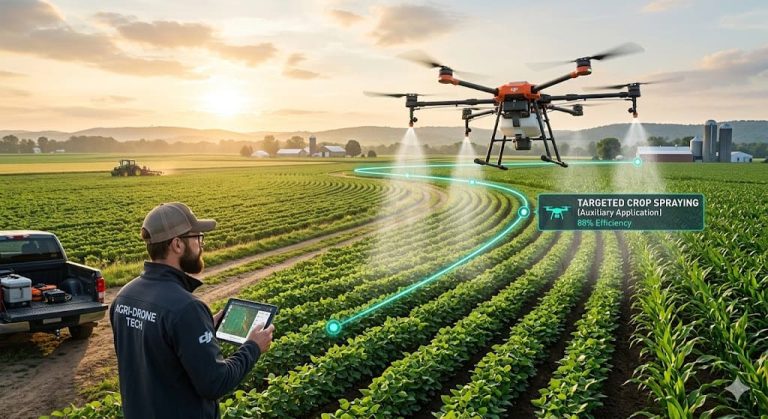
In precision agriculture setups, drones and sensors monitor crop emergence, weed pressure, and soil conditions to allow targeted management with minimal disturbance.
Controlled Traffic Systems
GPS-guided controlled traffic farming keeps all machinery on permanent wheel tracks, concentrating compaction and leaving the majority of field soil untouched.
No Till Farming Equipment for Small Farms
For no till farming for small farms, large-scale machinery is not always necessary or affordable. Small-scale options include narrow hand-pushed jab planters for garden-scale operations, walk-behind garden tools modified for minimal disturbance, small tractor-mounted no till drills, and wheel hoe systems. Many small-scale no till farming techniques for beginners rely on simple hand tools combined with mulch and cover cropping to achieve the same soil protection goals at low cost.
Environmental Impact of No Till Farming
How Does No Till Farming Help the Environment?
The environmental impact of no till farming is broadly positive and spans multiple ecological systems. From protecting waterways to supporting biodiversity, no till farming contributes to environmental health at the field, watershed, and global scale.
Water Quality Protection
By dramatically reducing soil erosion and surface runoff, no till agriculture protects the quality of rivers, lakes, and groundwater. Conventional tillage releases soil particles laden with phosphorus and nitrogen into waterways — contributing to algal blooms and aquatic ecosystem damage.
In no till systems, the combination of intact soil structure, surface residue, and improved water infiltration keeps more of these nutrients on the farm and out of the water system — a significant environmental co-benefit in agricultural watersheds.
Biodiversity Support
Undisturbed soil supports a far richer community of organisms than regularly tilled soil. From earthworms and beetle larvae to mycorrhizal fungi and soil bacteria, no till cultivation creates stable habitat for soil biodiversity to flourish.
Above ground, the presence of cover crops and standing residue provides food and nesting habitat for farmland birds, beneficial insects, and pollinators — all of which are in steep decline under intensive conventional farming systems.
Reduced Agricultural Fuel Emissions
Eliminating multiple tillage passes reduces tractor hours and diesel consumption significantly. Studies suggest that no till systems use 30–50% less fuel than conventional tillage, leading to a direct reduction in the carbon footprint of crop production. This fuel saving compounds with the soil carbon storage benefit to make no till one of the most effective emission-reduction tools in the agricultural sector.
No Till Farming and Climate Change
No Till as a Climate Solution
The relationship between no till farming and climate change is increasingly central to global agricultural and environmental policy. Soil is the world’s largest terrestrial carbon store — holding approximately three times more carbon than the atmosphere. Agriculture, through ploughing and land use change, has historically been a net emitter of this stored carbon.
No till agriculture reverses this trend in two key ways: it stops the annual carbon losses caused by tillage, and it actively builds soil organic matter — a stable form of carbon storage. The potential global impact of widespread no till adoption is significant for greenhouse gas reduction.
Greenhouse Gas Reduction Beyond Carbon
Beyond carbon sequestration, no till systems can also reduce emissions of nitrous oxide (N₂O) — a greenhouse gas approximately 300 times more potent than CO₂. When soils are tilled, nitrous oxide release from soil organic nitrogen is accelerated. Undisturbed no till soils tend to produce less nitrous oxide than conventionally tilled alternatives, particularly when paired with good cover crop management.
Resilience to Climate Extremes
In addition to mitigating climate change, no till farming for sustainable agriculture helps farmers adapt to its consequences. Improved moisture retention makes crops more resilient during drought periods. Reduced surface runoff makes farms less vulnerable to flash flooding and soil loss during extreme rainfall events — both of which are increasing as global temperatures rise.
🌍 No Till Farming & Carbon Farming
Carbon farming — managing land specifically to sequester atmospheric carbon — increasingly identifies no till agriculture as a primary tool. In some countries, farmers can now earn carbon credits for verifiably sequestering carbon through no till and regenerative practices, creating a new revenue stream that rewards environmental stewardship alongside productive farming.
Best Crops for No Till Farming
Does No Till Work for All Crops?
Not all crops perform equally well under no till conditions, particularly during the transition period. Some crops are well-suited to direct seeding into undisturbed soil, while others require conditions that no till systems may take time to provide. The best crops for no till farming tend to be those with vigorous germination and good tolerance for the cooler, moister soils that no till can create.
Top Crops for No Till Systems
Maize (Corn)
One of the most widely practised no till crops globally. Maize has strong germination vigour and responds well to the improved moisture retention of no till soils.
Wheat & Small Grains
Winter wheat, barley, and oats are among the most suitable crops for no till, establishing well through direct seeding and benefiting from retained soil moisture.
Soybeans
Highly successful in no till systems, particularly following a cereal crop. No till soybeans represent a major share of global no till acreage, especially in South America.
Sunflowers
Large-seeded and vigorous, sunflowers perform well in no till systems. Their deep taproot also helps break up compaction in established no till fields.
Cover Crop Mixes
Multi-species mixes of grasses, legumes, and brassicas are ideal for off-season no till cover — maximising soil protection, biological diversity, and organic matter building.
Pasture & Forage Grasses
Permanent pastures are the ultimate no till system — soil is never disturbed, root systems build continuously, and organic matter accumulates over decades.
Crops That Require More Care Under No Till
Crops with small seeds requiring precise seeding depth — such as canola, sugar beet, and some vegetables — can be more challenging in no till systems, particularly in heavy residue or on compacted soils. These crops may require more precise equipment or careful residue management to establish successfully under zero tillage farming conditions.
No Till Farming for Small Farms
Beginner Guide to No Till Farming
A common misconception is that no till farming is only relevant to large-scale commercial operations. In reality, the principles of reduced soil disturbance, cover cropping, and residue management are equally applicable — and often even more rewarding — on small and family farms.
For small-farm operators and market gardeners, no till farming for small farms offers reduced physical labour, lower input costs, improved soil quality over time, and the ability to farm more sustainably without expensive machinery.
Simple No Till Farming Methods for Small Farms
Core simple no till farming methods available to small-scale growers include: using a broadfork or minimal hand tools instead of rototilling, applying thick mulch layers of straw, wood chip, or compost to suppress weeds and protect soil, using the sheet mulching method to transition from tilled to no till beds, and employing dense planting to shade out weeds naturally.
Small-scale no till market gardens — pioneered by farmers like Jean-Martin Fortier and Charles Dowding — have demonstrated remarkable productivity with minimal inputs using no till principles, making these models increasingly popular with beginning farmers seeking sustainable no till farming ideas.
Getting Started — Practical Tips
🌱 No Till Farming Techniques for Beginners
- Start with one field or bed — don’t convert everything at once
- Test your soil to understand its current health baseline
- Choose a robust cover crop mix suited to your climate
- Invest in quality residue management at harvest time
- Be patient — the soil takes 2–5 years to fully respond
- Connect with local no till farmer networks and extension services
- Use crop rotation to manage disease and weed pressure
- Keep records of costs, yields, and soil health indicators year by year
Future of Conservation Agriculture
Where Is No Till Agriculture Headed?
The future of conservation agriculture and no till farming looks increasingly bright. Converging pressures — climate change, soil degradation, rising input costs, and growing consumer demand for sustainably produced food — are accelerating the adoption of no till and related practices worldwide.
Technology Driving No Till Forward
Technological innovation is making no till agriculture methods more effective and accessible than ever. GPS-guided precision agriculture systems allow no till drills to place seeds with millimetre accuracy even in heavy residue. AI-powered weed mapping enables targeted micro-herbicide applications that reduce chemical use while maintaining effective weed management.
New biologically-based herbicides and cover crop roller-crimper systems are opening pathways to fully organic, chemical-free no till — one of the most exciting frontiers in sustainable crop production.
Policy Support and Carbon Markets
Governments and financial institutions are increasingly recognising the environmental value of no till cultivation. Carbon credit schemes, agri-environment payments, and sustainability-linked supply chain programmes are creating financial incentives for farmers to adopt and maintain no till practices — beyond the farm-level economic benefits that already make it attractive.
No Till and Food Security
At the global level, widespread adoption of conservation tillage and no till is increasingly recognised as essential to long-term food security. The world loses an estimated 24 billion tonnes of fertile soil to erosion every year — equivalent to losing roughly 3.4 million hectares of arable land annually.
Reversing this trend through no till and sustainable farming is not a luxury but a necessity if agriculture is to feed future generations sustainably and reliably.
🔭 The Future Vision
The future of agriculture is one in which no till cultivation, cover crops, regenerative agriculture, and precision agriculture converge into highly productive, ecologically sound farming systems. No till is not a niche practice — it is a scientifically validated, economically proven approach that is reshaping how millions of farmers around the world think about soil, productivity, and the future of farming.
Frequently Asked Questions (FAQs)
Basics and Definitions
Soil, Environment & Benefits
Getting Started
No Till Agriculture: Farming with the Soil, Not Against It
From the Dust Bowl lessons of the 1930s to the climate-smart farms of the 2020s, no till agriculture has evolved from a fringe idea into one of the most scientifically validated, economically sound, and environmentally important practices in modern farming.
Whether you are a student learning about conservation tillage, a farmer considering the transition, a researcher exploring soil health science, or a business owner evaluating sustainable supply chains — the message is clear: protecting the soil beneath our feet is not just good farming. It is essential for the future of food.
© 2026 · Agri Opportunities · All information for educational purposes
Add Agri Opportunities as a preferred source on Google to see our latest blogs first.
Useful Links
How to Calculate Agricultural Density: Formula, Examples & Expert Insights
Regenerative Agriculture: The Future of Sustainable Farming and Soil Health
What Is Agriculture? Definition, Types, Importance & More