Microplastics in Soil: What We Actually Know So Far

How microplastics get into farmland, what they do to crops and soil biology, and what remains genuinely uncertain.
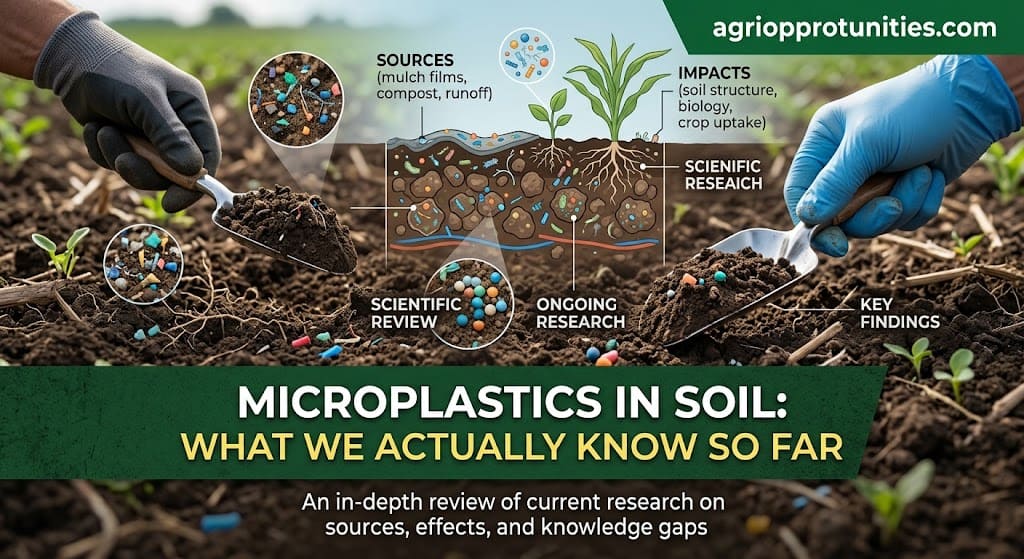
Plastic pollution in the ocean gets most of the public attention, but a genuinely comparable problem has been building quietly in the soil beneath our feet, and it’s directly tied to farming practices most people would never associate with plastic pollution at all. I want to walk through where these microplastics actually come from, what research has found about their effects on crops and soil biology, and where the honest scientific answer right now is still “we don’t fully know yet.”

What Counts as a Microplastic
Microplastics are generally defined as plastic particles smaller than 5 millimeters, while nanoplastics are an even smaller category, typically defined as particles smaller than 1 micrometer. Manufacturers do not necessarily produce these particles at such small sizes. Instead, most agricultural microplastics form when larger plastic items gradually break down.
Where Agricultural Microplastics Actually Come From
Ocean plastic pollution often comes from industrial discharges and municipal waste, while agricultural soils accumulate plastics through a different set of pathways. Many of these sources stem directly from farming practices that help farmers improve productivity.
Plastic Mulch Film: The Single Biggest Source
Farmers worldwide use plastic mulch film to warm the soil, reduce water evaporation, and suppress weeds, often improving crop yields and quality. However, mulch film also ranks among the most frequently identified sources of microplastic contamination in agricultural soils. One review of soil-focused studies found that 39 percent identified plastic mulch as the primary contamination source. The Food and Agriculture Organization (FAO) also estimates that plastic films account for more than 75 percent of the plastics used in global crop and livestock production.
Other Direct Agricultural Sources
Other sources include polymer-coated fertilizers, drip irrigation systems, greenhouse coverings, and shade nets. Farmers use these materials for legitimate production purposes, but exposure to sunlight, wind, and soil movement gradually degrades them through photooxidation and mechanical abrasion. This breakdown generates secondary microplastics that can accumulate in agricultural soils.
Indirect Sources
Microplastics also reach farmland through less obvious routes, including treated sewage sludge, irrigation water, and some organic fertilizers and composts. These materials can carry plastic fragments that entered the waste stream earlier, introducing microplastics into agricultural soils when farmers apply them to their fields.
How Much Plastic Are We Actually Talking About
The scale here is genuinely substantial. Estimates suggest approximately 32 percent of global plastic waste may end up in terrestrial ecosystems, with a significant fraction of that accumulating specifically in agricultural land rather than more visible locations like landfills or waterways.
Which Farming Systems Are Most Affected
Recent comprehensive review research has found that greenhouse-based cultivation, vegetable crops, orchards, and vineyards are significant contributors to elevated microplastic soil contamination — a useful, specific finding for identifying which parts of the agricultural sector deserve the most immediate research and mitigation attention.
What Microplastics Actually Do to Soil
Once present in soil, microplastics don’t just sit there inertly. They measurably alter the soil’s basic physical structure, affecting porosity, water retention, and nutrient dynamics in ways that can genuinely hinder root growth and reduce nutrient uptake efficiency.
Chemical Effects Beyond Physical Structure
Beyond physical disruption, plastic additives and leachates — chemical compounds released as plastics break down — can alter a soil’s chemical profile, sometimes resulting in phytotoxic (plant-harming) effects and reduced agricultural productivity as a consequence.
Effects on Soil Biology
Microplastics don’t only affect the physical and chemical soil environment — they measurably harm the living organisms within it, including invertebrates critical to soil health like earthworms, nematodes, and springtails, alongside disrupting soil microbial communities more broadly.
A Specific Threat to Beneficial Bacteria
This connects directly to the soil and crop microbiome piece earlier in this series. Research testing biodegradable microplastics against five key plant growth-promoting bacterial strains — Bacillus, Enterobacter, Kosakonia, Rhizobium, and Pseudomonas — found most experienced meaningful growth inhibition when exposed to these microplastics, with only one strain, Kosakonia sp. O21, showing notable resistance, hinting at a potential future role in microplastic degradation.
Why This Matters for Crop Productivity
Since these specific bacterial genera play crucial roles in nutrient availability, nitrogen fixation, and plant stress resistance, as covered in the microbiome piece, their inhibition by microplastics represents a genuinely indirect but real pathway through which plastic contamination could reduce crop yields and soil fertility, even without directly touching the crop plant itself.
Do Plants Actually Absorb Microplastics?
Yes, and this is one of the more genuinely surprising findings in this research area. Plants can absorb microplastics through both their roots and their leaves, with documented translocation to stems and leaves once inside the plant’s vascular system.
The Effect Depends Heavily on Plastic Type and Plant Species
Research comparing different plastic and crop combinations found the impact is genuinely complex rather than uniform. Polyester microplastics reduced total biomass in soybean specifically, while polypropylene microplastics reduced biomass across a broader range of crops including corn, peanuts, and soybean. Separate research on lettuce found that large pristine polyester fibers significantly reduced growth, chlorophyll content, and antioxidant enzyme activity — a genuinely direct demonstration that microplastic type and crop species combine to determine the actual severity of impact.
Particle Size Matters Too
Research specifically examining maize seedling roots found that microplastics of different particle sizes showed different patterns of uptake and distribution within the root system, adding yet another variable researchers need to account for when trying to generalize findings across different contamination scenarios.
The “Biodegradable” Question: Are Newer Mulch Films Actually Better?
Given plastic mulch film’s outsized contribution to this problem, a significant research push has gone into biodegradable alternatives, intended to reduce soil plastic pollution while retaining the genuine agronomic benefits mulching provides. The honest answer on whether this is working is genuinely mixed.
Some Studies Found No Meaningful Harm
Research testing short-term exposure to biodegradable mulch-film microplastics at field-realistic concentrations found no measurable effect on lettuce performance or overall soil health — a genuinely encouraging result for this specific alternative material.
Other Studies Found Real Problems
In apparent contrast, the bacterial and plant growth study described earlier found that biodegradable microplastics significantly reduced plant growth and caused measurable oxidative stress, affecting cell membranes and proteins while triggering a defensive antioxidant response in the plant.
Why These Findings Aren’t Necessarily Contradictory
These differing results likely reflect real differences in exposure duration, concentration, specific biodegradable polymer type, and plant species tested across the two studies — a genuine reminder that “biodegradable” isn’t a single uniform category with one guaranteed safety profile, and that this remains an active area where researchers haven’t yet reached firm, universal conclusions.
An Unexpected Silver Lining: Nitrogen Cycling Interactions
Here’s a genuinely interesting connection back to the nitrogen cycle piece earlier in this series. Research on plastic film mulching found it enhances plant nitrogen uptake and nitrogen accumulation in soil overall, by raising soil temperature and improving water retention — genuine agronomic benefits.
But It Also Increases a Specific Greenhouse Gas Risk
The same research found plastic film mulching increases the potential for nitrous oxide emissions, while the microplastics generated from that same mulching process can independently inhibit crop nitrogen metabolism and photosynthetic rates, and separately affect soil nitrogen availability in ways that exacerbate nitrogen leaching losses. This is a genuinely complicated, multi-directional set of effects, tying directly back to the nitrogen cycle and nitrous oxide pieces earlier in this series — the same mulching practice that helps a crop access more nitrogen can simultaneously generate microplastic contamination that partially undermines that same nitrogen benefit.
The Genuine Gaps in Current Research
It’s worth being honest about how much remains genuinely uncertain in this field. Researchers themselves have specifically called for future studies to adopt multidisciplinary approaches, extend observation timescales considerably beyond the short-term trials common so far, and comprehensively account for complicating factors like soil properties and climate change before the ecological risks of plastic mulching and microplastics can be fully and confidently assessed.
The Food Chain Question Remains Particularly Open
A genuinely important, still-developing research direction involves tracing exactly how microplastics move from soil into food webs and eventually to humans, including documented cases of microplastics found in commonly consumed fruits and vegetables. Researchers working on this specific question have explicitly noted their goal is bridging the current gap between existing research and the regulatory frameworks that would actually need to respond to it — a clear signal that policy in this area is still catching up to the underlying science.
Practical Considerations for Now
Given the genuine uncertainty still present in this research area, a few reasonable, evidence-aligned practices are worth considering rather than waiting for fully settled science. Where feasible, reducing reliance on conventional plastic mulch film, or transitioning carefully to biodegradable alternatives while monitoring their real-world soil health impact directly, offers a genuinely more cautious path forward. Supporting soil biological health more broadly — the organic amendment and microbiome-supporting practices covered elsewhere in this series — may also help buffer some of the disruption microplastics cause to beneficial bacterial communities, even if it doesn’t eliminate the underlying contamination.
Why This Matters for Students Considering This Research Area
Microplastic contamination in agricultural soil sits at a genuinely young, rapidly expanding research frontier, with far more open questions than settled answers at this stage. Given the explicit calls from researchers themselves for longer-term, multidisciplinary studies bridging soil science, plant physiology, and environmental policy, this represents a genuinely fertile area for new graduate research, particularly for students willing to design the kind of extended, multi-factor studies this field still critically lacks.
For current research and graduate opportunities in soil contamination and environmental agricultural science, browse live agriculture scholarship listings on Agri Opportunities.
Frequently Asked Questions
What is the biggest source of microplastics in agricultural soil?
Plastic mulch film is the most commonly identified source, appearing as the primary contamination source in roughly 39 percent of soil-focused studies reviewed, alongside other sources including treated sewage sludge, irrigation water, and chemical or organic fertilizers.
Can plants actually absorb microplastics?
Yes. Research has documented microplastics being absorbed through plant roots and leaves, with subsequent translocation to stems and leaves, and studies have found the effect on crop biomass depends heavily on both the plastic type and the specific plant species involved.
Are biodegradable plastic mulch films actually a safe alternative?
The evidence is genuinely mixed. Some research has found no measurable effect on lettuce performance or soil health from field-realistic levels of biodegradable mulch-film microplastics, while other studies found biodegradable microplastics significantly reduced plant growth and inhibited beneficial plant growth-promoting bacteria.
How much of global plastic waste ends up in agricultural soil?
Estimates suggest approximately 32 percent of global plastic waste may end up in terrestrial ecosystems, with a substantial portion of that accumulating specifically in agricultural land.
Add Agri Opportunities as a preferred source on Google to see latest blog listings first.