Greek Agricultural Migrant Labor – Role, Challenges, Economic Impact, and the Path Forward

Greek Agricultural Migrant Labor
Role, Challenges, Economic Impact, and the Path Forward
Complete guide to Greek agricultural migrant labor: role, challenges, working conditions, economic impact, policy developments, and the path forward for farm workers in Greece.
The Hidden Workforce Behind Greek Farming
Greek agricultural migrant labor is one of the most significant and least publicly understood dimensions of the country’s food system. Walk through the strawberry fields of the Peloponnese, the cotton and tobacco farms of Central Macedonia, the olive groves of Crete, or the vegetable farms of Thessaly. Consequently, you will encounter a workforce that is overwhelmingly migrant — often undocumented, frequently seasonal, and economically essential to the functioning of Greek agriculture.
Labor force surveys reveal that more than 50 percent of agricultural workers in Greece are migrants. Moreover, when undocumented migrants are factored in, that figure is estimated to come closer to 90 percent in certain labor-intensive farming regions. Therefore, this is not a marginal phenomenon — it is the structural reality of how Greek agriculture operates. Thus, understanding this workforce is essential for anyone concerned with food systems, labor rights, or agricultural economics.
History of Migrant Labor in Greek Agriculture
Understanding the role of migrant labor in Greek farming today requires understanding how this dependency developed over several decades. Therefore, historical context is essential.
From Outmigration to Immigration
For much of the twentieth century, Greece was a country of emigration rather than immigration. Greek workers left for Germany, Australia, the United States, and other destinations in large numbers through the 1950s, 1960s, and 1970s. Consequently, Greek agriculture was largely practiced by Greek families on small landholdings.
The transformation began in the early 1990s following the collapse of communist regimes in Albania and other Eastern European countries. Large numbers of Albanian migrants entered Greece — many of them undocumented — seeking economic opportunity. They found ready employment in Greek agriculture, construction, and domestic services. Thus, Albanian migrants quickly became the primary agricultural labor migration source for Greek farming.
As Albanian workers became more settled, integrated, and over time more expensive, a second wave of migration began bringing workers from further afield: Bangladesh, Pakistan, India, Egypt, Romania, Bulgaria, and sub-Saharan Africa. Therefore, each wave of agricultural labor migration in Greece reflected both changing economics and persistent demand for cheap, flexible labor.
The Restructuring of Greek Agriculture
The agricultural workforce trends in Greece were shaped not just by migration dynamics but by fundamental changes in how Greek farming was organized. European Union membership, Common Agricultural Policy subsidies, and market liberalization transformed Greek agriculture from the 1980s onward. Consequently, certain crops — particularly strawberries, cotton, tobacco, and greenhouse vegetables — expanded significantly to serve export markets.
In the strawberry production area of Nea Manolada in the western Peloponnese, strawberry cultivation expanded from around 30 hectares in the 1970s to over 1,050 hectares by the following decade. This expansion was directly enabled by the availability of large numbers of low-wage migrant workers. Today, almost 95 percent of all strawberries grown in Greece come from the Manolada region. Thus, the industry depends almost entirely on migrant workers to function.
The Scale of Migrant Labor in Greek Agriculture Today
The agricultural employment picture in Greece in 2024 and 2025 reflects a labor market under significant strain. Moreover, migrant workers are central to keeping it operational. Therefore, understanding the scale is essential.
In 2024, 88,000 new immigrants obtained a residence permit longer than 12 months in Greece (excluding EU citizens). This represents a 24 percent increase compared to 2023. Of these, 25.3 percent were labor migrants. Residence permits issued for employment purposes reached 119,517 in 2024, up from 94,368 in 2023. Additionally, an additional 287,397 residence permit applications were pending as of that year.
The scale of unmet labor demand is striking. Real labor needs in Greece exceed 300,000 positions in sectors such as tourism, construction, agriculture, and industry. The number of pending applications for employment-related residence permits has risen from 306 in 2021, to 2,185 in 2022, 8,257 in 2023, 28,699 in 2024, and reaching 53,129 in 2025. Thus, this trajectory reflects not just growing demand for labor but also bureaucratic bottlenecks that prevent legal labor supply channels from meeting agricultural workforce needs efficiently.
Which Crops Depend on Migrant Labor in Greece?
The contribution of foreign workers to Greek agriculture spans virtually every major labor-intensive crop sector. Therefore, understanding which crops depend on migrant labor in Greece helps clarify both the economic importance of the migrant workforce and the consequences that labor shortages would have for Greek food production and exports.
🍓 Strawberries: The Symbol of Greek Agricultural Migrant Labor
Strawberry farming in Manolada, Greece, has become the emblematic case study for migrant labor in Greek agriculture worldwide. Each growing season — which runs from approximately October to May — as many as 10,000 to 12,000 migrant workers, predominantly from Bangladesh and Pakistan, work in the strawberry fields of the Nea Manolada area. Consequently, the seasonal agricultural workforce here is almost entirely migrant.
The 700-strong local population is engaged in strawberry cultivation as farmers and managers. Meanwhile, the physical harvesting work is performed by migrants who live in makeshift camps next to the fields. More than 90 percent of total strawberry production in Greece comes from the Manolada area. Thus, this is a critical national agricultural production zone whose output depends entirely on the migrant workforce.
🌿 Cotton and Tobacco
Cotton farming in Central Macedonia and Thessaly, and tobacco cultivation in northern Greece, are among the most labor-demanding agricultural sectors. Moreover, they are among those most dependent on foreign agricultural workers. These are physically demanding, seasonal crops that require large workforces during planting and harvest periods that Greek rural labor cannot supply at the wages offered.
🫒 Olive Oil and Olives
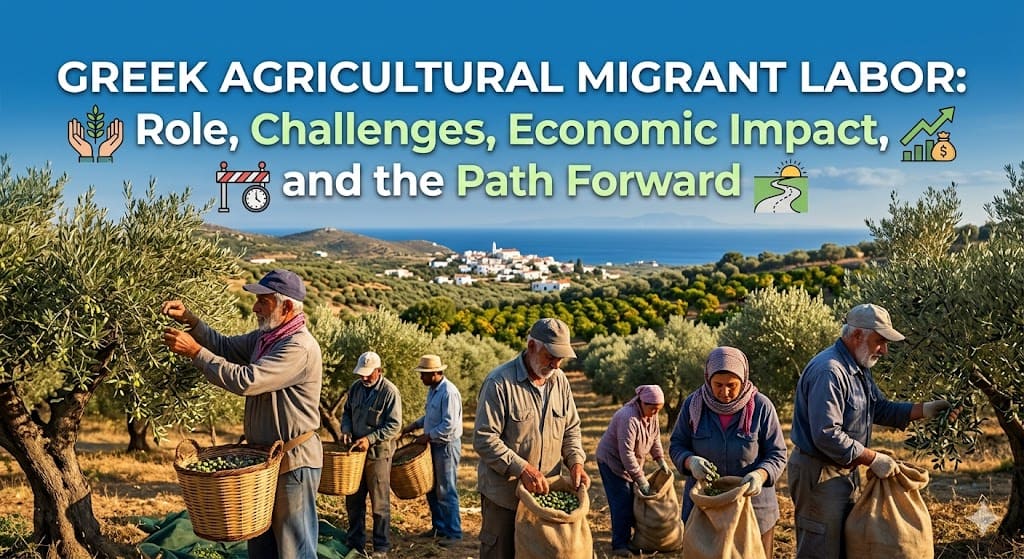
Greece is one of the world’s largest olive oil producers. Notably, olive harvesting is among the most labor-intensive agricultural activities in the country. Migrant workers — particularly from Albania and increasingly from Bulgaria, Romania, and other countries — have been central to the olive harvest workforce for decades.
🍅 Greenhouse Vegetables and Horticultural Crops
The greenhouse agriculture sector, particularly in Crete and the Peloponnese, produces tomatoes, cucumbers, peppers, and other vegetables for both domestic markets and export. These operations require year-round labor for planting, tending, harvesting, and packing. Consequently, they create a sustained demand for migrant workers in rural communities.
Working Conditions of Migrant Farm Workers in Greece
Any honest discussion of agricultural migrant workers in Greece must address the working conditions they face. Furthermore, the evidence, both from research and from documented incidents, is troubling. Therefore, this section examines the realities on the ground.
Labor Precarity and Wage Exploitation
Agricultural labor exploitation in Greece has been extensively documented by researchers, journalists, human rights organizations, and international bodies. The precarious status of migrant labor in Greece is one of the most consistently reported findings in academic studies of rural labor migration. Consequently, withholding of wages is a documented practice in labor-intensive farming regions.
The ethnic hierarchy of farm labor in regions like Manolada has been well documented. Albanian migrants, who arrived first and have greater language proficiency and legal status, typically hold more senior farm labor roles. Meanwhile, Bangladeshi migrants, who arrived later and often have less legal protection, work in the most physically demanding, least paid positions. Thus, the hierarchy is stark.
Housing and Living Conditions
The living conditions of seasonal migrant farm workers in some parts of Greece represent a serious humanitarian concern. In Nea Manolada, workers are forced to rent unused farmland and build makeshift shacks — called barangas — constructed out of salvaged plastic sheets, cardboard, and reeds. Notably, these structures are highly flammable.
In May 2025, a fire at a migrant camp in Nea Manolada left hundreds of migrant farm workers homeless. The blaze started from the open burning of waste and quickly spread to the migrants’ huts and a nearby greenhouse. According to local labor unions, there was no provision for assistance. Therefore, this fire was not an isolated incident — such fires have recurred multiple times over the years.
The Manolada Shooting and European Court of Human Rights Ruling
The most internationally prominent event in the history of Manolada migrant workers occurred in April 2013. Protests by Bangladeshi workers against delayed wages led to Greek farm employers shooting at them. Consequently, over 30 workers were injured.
The workers pursued legal action. In 2017, the European Court of Human Rights found that 42 Bangladeshi migrant workers had been subjected to forced labor and human trafficking while working in a strawberry farm in Manolada. The Court also found that Greece had failed in its obligations to prevent human trafficking, protect the migrant workers, conduct an effective investigation, and punish those responsible. Greece was ordered to pay more than $648,000 in damages to the 42 victims. Thus, this ruling was a landmark in European human rights law.
The Economic Contribution of Migrant Workers to Greek Agriculture
Despite the serious problems in working conditions documented above, the economic contribution of foreign workers to Greek agriculture is substantial. Moreover, it is essential to understanding the agricultural labor market in Greece. Therefore, this section examines the economic realities.
Migrant labor has enabled Greek farmers to undertake scale increases that would have been impossible with domestic labor alone. The expansion of labor-intensive export crops — strawberries, cotton, greenhouse vegetables, olives — has been premised on the availability of large numbers of workers willing to perform physically demanding tasks at wages that make Greek produce competitively priced in international markets.
The Greek agricultural labor market is, in practical terms, not functional without migrant workers. Removing this workforce without building a replacement supply would cause the collapse of significant portions of the Greek agricultural sector. Therefore, this economic dependence creates a paradox: the same sector that depends fundamentally on migrant labor has, in many documented cases, been among the most resistant to improvements in migrant wages and conditions.
Policy Landscape: Greece’s Agricultural Labor Migration Governance
The governance of agricultural labor migration in Greece has evolved significantly in recent years. However, significant challenges remain. Therefore, understanding the policy framework is essential.
The New Migration Code
Greece’s new Migration Code — Law 5038/2023, in force from March 2024 — represents the most significant reform of the legal framework governing labor migration in years. The code simplifies residence permit procedures, reduces documentary requirements, and extends permit duration. Moreover, it explicitly addresses the need to channel legal labor migration toward sectors with documented shortages, including agriculture.
The code’s provisions for regularizing 30,000 long-term undocumented migrants and for structured annual admission of 4,000 workers through bilateral agreements represent an attempt to shift Greek agricultural labor from informal, undocumented supply toward regulated, legal labor migration channels. However, the scale of these provisions is modest relative to the actual labor shortages. Thus, more needs to be done.
Bilateral Agreements and Seasonal Worker Programs
Greece has been actively developing bilateral agreements to create organized channels for seasonal agricultural workers from key sending countries. The bilateral agreement with Egypt, now supported by a digital implementation platform launched in June 2024, is designed to facilitate the employment of seasonal agricultural workers within a structured legal framework. Additionally, negotiations with India for a bilateral labor migration agreement are ongoing.
Integration Programs
Greece’s HELIOS integration program, which concluded in 2024 after supporting 45,688 beneficiaries, represents recognition that migrants already in Greece — including many working in agriculture — need systematic support for integration. The HELIOS+ program continues this work with additional monitoring. Moreover, the HELIOS JUNIOR program, launched in October 2024, extends support to approximately 2,000 formerly unaccompanied minors who have reached adulthood — many of whom have been working in agriculture.
Challenges Faced by Migrant Farm Workers in Greece
The challenges facing agricultural migrant workers in Greece are structural, systemic, and persistent. Moreover, they reflect not just individual employer behavior but the broader architecture of how agricultural labor markets are organized in Southern Europe. Therefore, systemic solutions are needed.
Documentation and Legal Status
Many agricultural migrant workers in Greece lack formal documentation or operate in legal gray areas — present with expired permits, pending applications, or no status at all. This lack of legal standing creates fundamental vulnerability. Thus, workers who cannot legally complain to authorities, change employers, or access state services are easy to exploit.
Wage Theft and Labor Rights Violations
Withholding wages, underpayment, and demanding that workers pay back part of their earnings for housing or food are documented practices in parts of the Greek agricultural sector. Workers with precarious legal status have limited ability to pursue wage claims through legal channels. Therefore, labor inspection capacity in rural areas is insufficient relative to the scale of the problem.
Housing and Living Standards
As documented most extensively in Manolada, housing conditions for many migrant farm workers in Greece are severely inadequate. The makeshift barangas of the strawberry fields — flammable, without clean water, crowded — represent the most extreme end of a spectrum of substandard housing. Consequently, these conditions violate basic human dignity and create serious safety risks.
Health and Safety
Agricultural work is inherently physically demanding and often involves exposure to pesticides, extreme heat, and injury risks. Migrant agricultural workers face these occupational hazards with additional disadvantages: limited access to healthcare, language barriers, and employment arrangements that may not include formal health and safety protections. Therefore, undocumented or informally employed workers are excluded from formal social insurance systems.

What Needs to Change: A Path Forward for Greek Agricultural Labor
Identifying the problems in Greek agricultural migrant labor is the beginning, not the end, of the discussion. Therefore, the question of how to build an agricultural labor system that is both economically functional and humane requires engagement with several interconnected policy, market, and social challenges.
Streamline Legal Labor Migration
The most direct way to reduce labor precarity is to expand legal, well-regulated pathways for migrant workers to enter and work in the sector. The bilateral agreements with Egypt and India, the single-application process of the new Migration Code, and the increase in annual admission quotas are steps in the right direction. However, scaling these up to match actual labor demand — which exceeds 300,000 positions across sectors — is essential.
Enforce Labor Rights in Rural Areas
Labor inspection in remote agricultural areas needs to be significantly strengthened. The rights of migrant agricultural workers in Greece exist on paper — the challenge is enforcement. Therefore, mobile labor inspection units with language capacity, relationships with migrant communities, and authority to act swiftly on wage theft and safety violations are needed.
Improve Housing Standards
A regulatory framework requiring farm employers who recruit migrant workers to provide or arrange adequate housing — clean water, fire safety, adequate space — would address one of the most persistent humanitarian failures in Greek agricultural labor. While this will increase production costs for farmers, the alternative — repeated fire deaths, continued human rights violations, and increasing reputational risk for Greek agricultural exports — is not sustainable.
Connect Integration Programs to Agricultural Communities
The HELIOS and HELIOS+ programs have demonstrated that structured integration support can be effective. Extending integration program reach to the rural agricultural communities where large numbers of migrants live and work — with language courses, legal information, healthcare access, and community building — is essential for both migrant wellbeing and rural economic development.
Build Long-Term Workforce Sustainability
The agricultural workforce sustainability challenge in Greece is not just about managing a current crisis — it is about building a labor system for the future. Therefore, this means investing in agricultural productivity improvements that reduce dependence on pure labor intensity; supporting migrant workers to develop skills and longer-term careers; and building rural communities that are genuinely inclusive of the migrant populations who are now integral members of them.
Frequently Asked Questions About Greek Agricultural Migrant Labor
📋 Understanding the Workforce
⚠️ Living and Working Conditions
🌾 Economic Significance
🏛️ Policy Responses
⚖️ Rights and Progress
📚 Related Guides from Agri Opportunities
↗️ Organic Agriculture in Pakistan ↗️ Regenerative Agriculture News ↗️ Computer Vision in Agriculture📚 External Resources & Further Reading
Add Agri Opportunities as a preferred source on Google to see latest blog listings first.