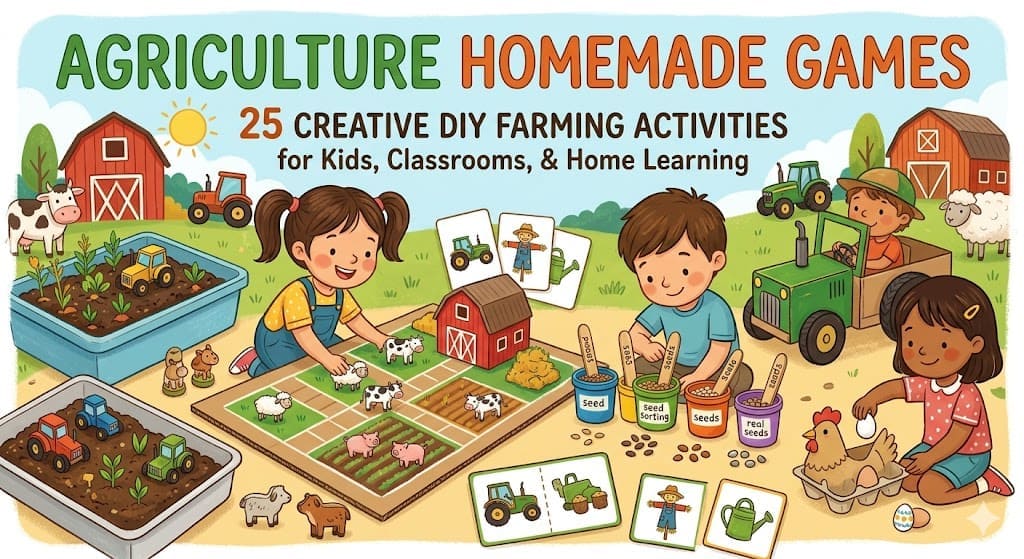
Agriculture Homemade Games – 25 Creative DIY Farming Activities for Kids, Classrooms, and Home Learning

Agriculture Homemade Games
25 Creative DIY Farming Activities for Kids, Classrooms, and Home Learning
Complete guide to agriculture homemade games: 25 creative DIY farming activities for kids, classrooms, and home learning. Includes farm animal matching, seed sorting, board games, and more.
Why Agriculture Homemade Games Matter
Agriculture homemade games are one of the most powerful and underused tools in education today. At a time when most children grow up far removed from farms and food production, agriculture games for kids bridge the gap between the dinner table and the field. Consequently, they make learning about farming hands-on, memorable, and genuinely fun. Moreover, these games create lasting connections to food systems. For instance, a child who plants a seed in a germination race will remember that experience far longer than a textbook lesson.
Whether you are a teacher designing farm-themed classroom activities, a parent looking for engaging DIY farm projects for the weekend, or a homeschool educator building an agriculture lesson plan, homemade agriculture games offer something that no screen or textbook can fully replace. Specifically, they provide the joy of learning by doing. Therefore, this guide covers 25 creative agriculture homemade games and activities — complete with instructions, learning objectives, and tips for teachers and parents. Additionally, all games use low-cost or recycled materials. As a result, these activities are accessible to everyone regardless of budget.
Benefits of Agriculture Learning Games
🎲 Learning Through Play
Research consistently shows that play-based learning produces deeper understanding and better long-term retention. When agriculture games embed agricultural concepts inside enjoyable activities, children absorb information naturally. Thus, the learning happens inside the play itself. Additionally, children willingly revisit game concepts. Therefore, repetition becomes enjoyable rather than tedious.
🖐️ Hands-On Activities Build Real Skills
Hands-on agriculture activities develop practical knowledge alongside cognitive skills. Problem solving, strategic thinking, and cooperation are all practiced in well-designed interactive farming challenges. Consequently, children gain both knowledge and skills simultaneously. Moreover, these skills transfer to other subjects. For example, the counting in harvest games directly supports math learning.
🌍 Connecting Children to Food and Nature
Children who understand farming systems grow into adults who make informed food choices. Moreover, they support sustainable agriculture and understand farming community challenges. Therefore, these games build food literacy for life. Furthermore, they foster environmental stewardship. As a result, children develop respect for the land and those who work it.
💰 Low Cost and Accessible
DIY agriculture games require very little expense. Most materials include recycled cardboard, saved seeds, and household craft supplies. As a result, they are ideal for resource-constrained schools and homeschool families. Thus, agricultural education can be accessible to everyone. Consequently, no child is excluded due to budget limitations.
Section 1: Farm Animal and Crop Identification Games
🎴 Game 1: Farm Animal Memory Game
Materials: Index cards, markers, scissors. First, create pairs of cards — animal names and pictures of cows, chickens, goats, sheep, pigs, horses. Then, shuffle and lay face-down. Players take turns flipping two cards to match names with pictures. Learning: Farm vocabulary, animal identification, memory development. Therefore, this game builds foundational farm knowledge. Additionally, it strengthens concentration skills.
🌾 Game 2: Crop Identification Activity Cards
Materials: Cardboard, printed crop pictures. First, create sets showing wheat, rice, corn, cotton, tomatoes, and carrots. Next, include cards describing climate needs and growing seasons. Then, use for matching, sorting, or classroom discussion. Learning: Crop identification, agricultural commodities, classification skills. Consequently, students learn global crop diversity. Moreover, they understand where food comes from.
🌱 Game 3: Seed Sorting Activity
Materials: Assorted seeds (beans, lentils, corn, sunflower), small bowls, magnifying glasses. First, children sort seeds by size, shape, and color. Then, discuss what each seed grows into. Learning: Botanical observation, classification, agricultural science, STEM education. Thus, this activity teaches plant biology naturally. Furthermore, it develops fine motor skills.
🎯 Game 4: Farm Bingo Game
Materials: Cardboard, markers, small tokens. First, create bingo cards with farm-related words: tractor, cow, wheat, irrigation, harvest, soil, barn, scarecrow. Then, the caller draws cards while players mark matches. Learning: Farm vocabulary, agricultural terminology, listening skills. Therefore, it is excellent for vocabulary development. Additionally, it works well for large groups.
🧩 Game 5: Agriculture Puzzle Games
Materials: Cardboard, printed farm images, scissors. First, print farm scenes showing planting, irrigating, or harvesting. Next, mount on cardboard and cut into puzzle pieces. Then, children assemble puzzles individually or in teams. Learning: Farm scene recognition, fine motor skills, agricultural education. Consequently, visual learners benefit greatly. Thus, multiple learning styles are accommodated.
Section 2: Planting and Growing Games
🏁 Game 6: The Germination Race
Materials: Small cups, potting soil, different seed types, water, sunny windowsill. First, plant the same quantity of seeds from different crops. Then, observe and record which germinates first. Next, graph results and discuss factors affecting germination. Learning: Plant biology, scientific observation, data recording. Thus, this is a true STEM activity. Moreover, it teaches patience and careful observation.
✏️ Game 7: Design Your Farm Game
Materials: Large paper, markers, rulers. First, give each student a paper representing a farm plot. Next, include constraints: at least two crop types, one water source, and biodiversity space. Then, students design layouts and explain choices. Learning: Farm planning, land use patterns, resource management. Consequently, students learn systems thinking. Additionally, they practice creative problem-solving.
💧 Game 8: Water the Crops — Irrigation Challenge
Materials: Small trays, measuring cups, crop models, tape. First, create a simulated farm with crop zones having different water needs. Then, players allocate limited water across zones. Finally, compare results and discuss trade-offs. Learning: Agricultural water management, resource allocation, decision-making. Therefore, it teaches real-world resource challenges. Furthermore, it introduces scarcity concepts.
🗑️ Game 9: Compost or Not? Sorting Game
Materials: Household items (apple core, plastic bag, newspaper, banana peel), labeled bins. First, children pick items and decide: compost or landfill? Then, discuss why organic matter decomposes. Learning: Composting, soil science, waste management, sustainable agriculture. Thus, environmental awareness is built. Moreover, children learn to reduce waste.
🌽 Game 10: Harvest Festival — Crop Counting Challenge
Materials: Dried beans or corn kernels, bags, number cards. First, set up crop collection stations with target yields. Then, players race to collect correct numbers from each station. Learning: Counting, number skills, harvest concepts, farm simulation. Consequently, math skills are practiced naturally. Additionally, it teaches accuracy and speed.
Section 3: Board Games and Strategy Games
🎲 Game 11: The Farming Season Game
Materials: Cardboard, markers, dice, tokens, event cards. First, design a board representing a farming year. Next, create event cards for good rain, drought, pest attacks, and bumper harvests. Then, players manage crop tokens through the seasons. Learning: Agricultural calendar, farm risk management, seasonal cycles. Therefore, strategic thinking is developed. Moreover, children learn about agricultural uncertainty.
📝 Game 12: Agricultural Word Builder
Materials: Letter tiles, agricultural vocabulary list. First, players build words like planting, irrigation, compost, harvest, and sustainability. Then, award points based on word length. Learning: Agricultural literacy, spelling, vocabulary development. Thus, language arts connect to agriculture. Additionally, it reinforces spelling skills.
🛒 Game 13: Farmer’s Market Simulation
Materials: Play money, product cards, price cards. First, create farm product cards with quantities. Next, assign some players as farmers and others as buyers. Then, negotiate prices and make selling decisions. Learning: Agricultural economics, market systems, negotiation, numeracy. Consequently, students learn real economic principles. Furthermore, they practice social skills.
🌍 Game 14: Soil, Climate, and Crop Matching
Materials: Soil cards, climate cards, crop cards. First, players match each crop with its ideal soil type and climate. Then, discuss why different crops suit different conditions. Learning: Crop-climate relationships, agricultural geography, soil science. Therefore, global agriculture patterns emerge. Additionally, it teaches geography concepts.
🔄 Game 15: From Seed to Supermarket
Materials: Cards for each stage: seed, planting, growing, harvesting, processing, transport, retail. First, students arrange themselves in the correct sequence. Then, connect stages with string. Learning: Food supply chains, systems thinking, food literacy. Thus, students understand where food comes from. Moreover, they learn about interdependence.
Section 4: Outdoor and Physical Games
🔍 Game 16: Farm Scavenger Hunt
Materials: Scavenger hunt list, pencils, small bags. First, create a list of farm-related items to find in a garden or park: specific leaves, soil types, seeds, insect evidence. Then, teams race to find all items. Learning: Observation skills, natural science, farm ecology. Consequently, outdoor learning is engaging. Additionally, it builds teamwork and cooperation.
🐝 Game 17: The Pollinator Relay Race
Materials: Cotton balls (pollen), bowls (flowers), relay course setup. First, each runner carries a cotton ball from one flower to another without using hands. Then, discuss how bees pollinate crops. Learning: Pollination, ecosystem services, farm biodiversity. Therefore, abstract concepts become physical experiences. Moreover, children learn about the importance of bees.
🌿 Game 18: Seed Bomb Making Activity
Materials: Clay, compost, seeds, water. First, mix into workable dough. Next, roll into small balls and allow to dry. Then, throw seed bombs into bare ground and observe germination. Learning: Planting, soil science, biodiversity, ecological restoration. Thus, environmental action is combined with learning. Furthermore, children see direct results of their efforts.
🏃 Game 19: The Farming Cycle Relay Race
Materials: Props for each farming stage: soil bag, seed packet, watering can, toy crops, harvest basket. First, each team member completes one stage of the farming cycle. Then, the first team to finish wins. Learning: Farming cycle sequence, agricultural calendar, teamwork. Consequently, the farming year becomes memorable. Additionally, it promotes physical activity.
Section 5: Creative and Art-Based Games
📦 Game 20: Build a Farm Diorama
Materials: Shoebox, craft supplies, paint, small figures. First, children design model farms inside shoeboxes. Next, include required elements: two crop fields, animal area, water source, compost area. Learning: Farm planning, spatial design, agricultural systems thinking. Therefore, creativity meets agricultural knowledge. Moreover, finished dioramas make excellent displays.
📖 Game 21: The Farmer’s Year Storytelling
Materials: Seasonal prompt cards, dice, writing materials. First, players draw seasonal cards with farming challenges. Then, create or continue stories about farmers navigating spring planting, summer drought, or fall harvest. Learning: Agricultural literacy, creative writing, problem-solving. Thus, literacy skills are developed naturally. Additionally, imagination is encouraged.
❓ Game 22: Agriculture Trivia Challenge
Materials: Question cards, timer, score sheet. First, write questions covering crops, farm animals, tools, and sustainability. Next, teams take turns answering. Example: What is composting? Which crop is Pakistan’s biggest export? Learning: Agricultural knowledge assessment, recall, teamwork. Consequently, friendly competition motivates learning. Furthermore, it reinforces previously learned material.
🐄 Game 23: Farm Animal Sound Matching
Materials: Audio recordings of farm animal sounds, picture cards. First, play an animal sound. Then, children identify which animal makes that sound. Next, extend by asking what each animal produces. Learning: Farm animal knowledge, listening skills, early childhood education. Therefore, this works well for young learners. Moreover, it engages auditory learners effectively.
⚖️ Game 24: Organic vs Conventional Debate
Materials: Information cards, role cards, discussion prompts. First, players draw roles as farmers, consumers, or policymakers. Then, debate proposed farming policies like banning chemical pesticides. Learning: Agricultural policy, critical thinking, perspective-taking. Thus, high school students engage deeply. Additionally, it develops public speaking skills.
🎲 Game 25: Farming Season Board Game — Advanced
Materials: Poster board, dice, tokens, event cards, weather cards, loan cards. First, design a complex farming game with financial elements. Then, players manage planting, investment, and risk across four seasons. Learning: Farm management, agricultural economics, agribusiness skills. Consequently, older students learn real farm business concepts. Furthermore, it teaches financial literacy.
Frequently Asked Questions About Agriculture Homemade Games
🎮 Understanding Agriculture Homemade Games
👧 Games for Different Ages
🏫 Classroom and Educational Use
🔬 STEM Education and Resources
Conclusion: Bringing Agriculture Alive Through Homemade Games
🎮 More Than Just Games
Agriculture homemade games are far more than a rainy-day activity or a classroom time-filler. Instead, they are a bridge — between children and the farms that feed them, between abstract curriculum content and living understanding, between the classroom and the countryside. Therefore, the 25 DIY agriculture games in this guide span the full spectrum of agricultural education. Moreover, they are accessible to any teacher or parent. Consequently, no special training is required to use them effectively.
🧠 Learning by Doing
What unites all of these educational farm games is a single, powerful idea: children learn best when they are active participants in their own learning. Specifically, when they hold real seeds in their hands and feel the difference between sandy and clay soil. When they run a pollinator relay race and feel how tirelessly bees must work. When they negotiate prices at a pretend farmer’s market and begin to understand the economic pressures real farmers face every season. Consequently, these games build genuine agricultural literacy. Furthermore, the learning lasts far longer than textbook study. Thus, hands-on experience is irreplaceable.
🛠️ Accessible to Everyone
The best part about agriculture homemade games is that they require nothing more than what most families and classrooms already have: cardboard, seeds, creativity, and the willingness to learn by doing. You do not need a farm to teach farming. Instead, you need curiosity, imagination, and the simple belief that understanding where food comes from is one of the most important things any child can learn. Therefore, these games democratize agricultural education. Moreover, they work in any setting — urban, suburban, or rural.
🌟 Start with One Game
Thus, start with one game. Watch what happens when a child’s eyes light up as their seed sprouts for the first time, or when they triumphantly complete their farm bingo card. That light — that moment of genuine connection to the living world of agriculture — is exactly what these games are designed to create. Consequently, the impact of these activities extends far beyond the classroom. Furthermore, children will carry these memories and this knowledge throughout their lives.
📚 Related Guides from Agri Opportunities
↗️ Agricultural Robotics News ↗️ Small Scale Agriculture Guide ↗️ Sustainable Agriculture Practices📚 External Resources & Further Reading
Add Agri Opportunities as a preferred source on Google to see latest blog listings first.