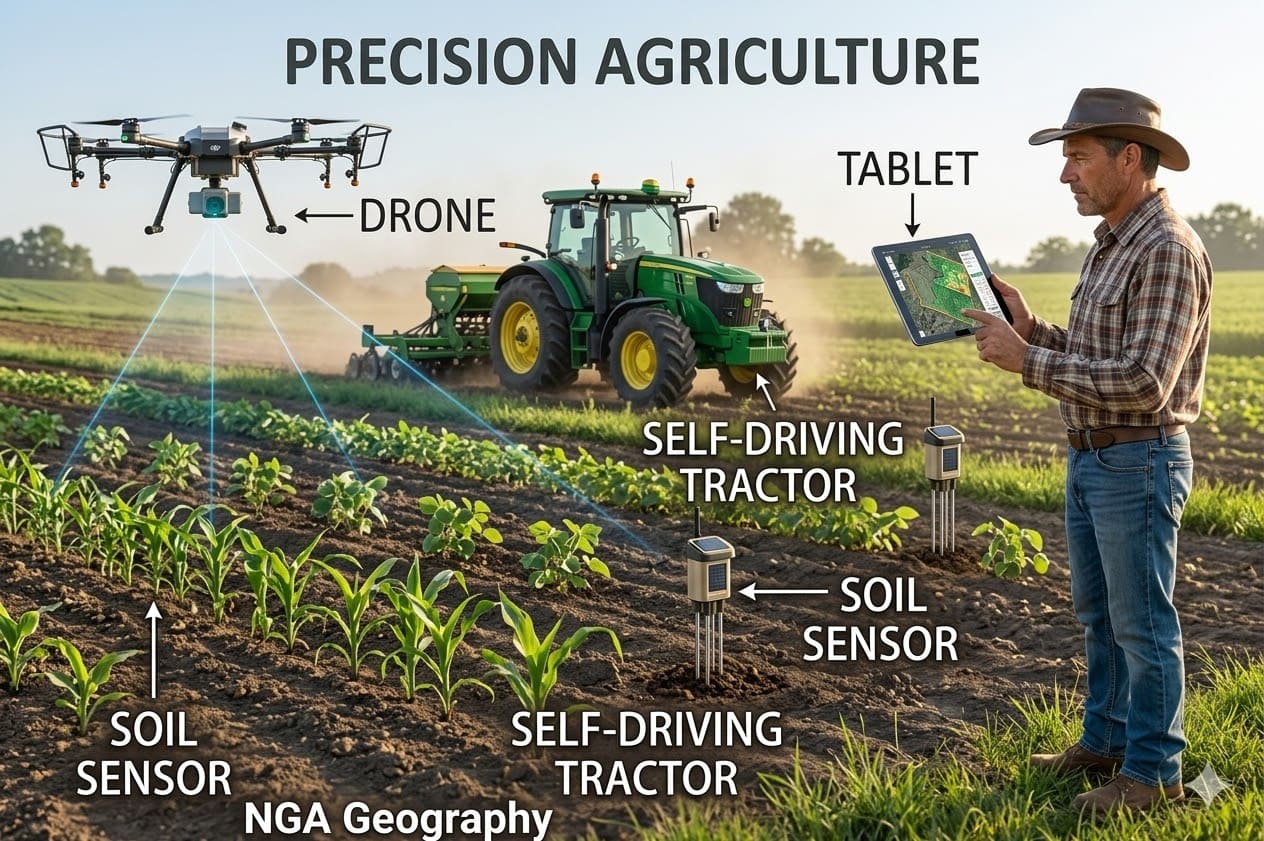
Precision Agriculture – Transforming Modern Farming

What is Precision Agriculture?
Precision agriculture, also known as smart farming, is a modern approach that leverages advanced technology to monitor, measure, and manage crops and soil efficiently. By using real-time data, farmers can make informed decisions that maximize yield, reduce resource waste, and minimize environmental impact.
At its core, precision agriculture rejects the old paradigm of treating an entire field uniformly and instead embraces variability. Every acre is different. Every square meter has its own history, chemistry, and potential.
Precision agriculture uses technology to observe, measure, and respond to that variability in real time.
The Formal Definition of Precision Agriculture
Precision agriculture integrates Global Positioning Systems (GPS), Geographic Information Systems (GIS), Internet of Things (IoT) sensors, drones, robotics, and Farm Management Information Systems (FMIS) to optimize crop production. Farmers apply inputs, water, fertilizer, pesticides, and seed, only where and when they are needed in precisely measured amounts.
This site-specific approach is often called Prescription Farming. Like a doctor’s prescription tailored to a single patient, precision agriculture writes prescriptions for every square meter of a field.
Why Precision Agriculture Matters Now
By 2050, the global population is expected to reach nearly 10 billion. To feed this population, food production must increase by 70%, but arable land, fresh water, and fossil fuels are shrinking. Climate change compounds the problem, with unpredictable weather, droughts, and pests threatening yields.
Traditional blanket applications of water and chemicals are no longer sustainable, economically or environmentally. Precision agriculture produces more with less, reduces chemical runoff, conserves water, lowers the carbon footprint, and maintains profitability in an era of thin margins.
How Precision Agriculture Works
Precision agriculture is an ecosystem. Each technology plays a role, forming a symphony of data and action.
1. GPS and GIS: The Cartographers of the Field
Before managing variability, farmers must map it. GPS provides precise coordinates—the “where.” Equipment with GPS knows its location to within inches. This enables Autosteer, guiding tractors with precision to eliminate overlap, saving thousands annually in chemicals.
GIS overlays soil type, elevation, historical yield, and satellite imagery. Farmers can see which zones underperform or overperform. Geofencing adds virtual boundaries so variable rate applications automatically adjust by zone.
2. Soil and Crop Sensors: The Nervous System
If GPS is the skeleton, sensors are the nervous system.
Soil Moisture Sensors measure water, temperature, and sometimes salinity in real time. Instead of irrigating on a schedule, farmers irrigate only when soil moisture drops below a threshold, reducing water use by 20–50% in arid regions while maintaining yields.
Crop sensors on tractors or drones measure reflected light. Healthy plants reflect near-infrared light differently than stressed plants. The Normalized Difference Vegetation Index (NDVI) quantifies this, creating color-coded maps to detect stress, disease, or nutrient deficiencies weeks before visible.
3. Drones and Aerial Imaging: The Eagle’s Eye
Drones equipped with multispectral cameras survey hundreds of acres in minutes, capturing visible, thermal, and near-infrared bands to map crop health, water stress, and pest pressure.
For specialty crops like vineyards, drones reveal variability at 1-centimeter resolution—enough to detect a single diseased vine. Drones are also used for precision spraying, reducing chemical use by up to 90% compared to broadcast spraying.
4. Variable Rate Technology (VRT): The Prescription Writer
VRT allows equipment to adjust inputs in real time based on prescription maps. A planter might sow 34,000 seeds per acre in high-yield zones and 26,000 in sandy areas. Sprayers target fungicide where needed and skip low-risk zones. This Prescription Farming reduces inputs, lowers costs, and increases yield.
5. Farm Management Software & Data Analytics: The Brain
Farm Management Software aggregates data from drones, sensors, machinery, and weather stations into a single dashboard. Predictive analytics and machine learning generate actionable insights, answering questions like:
- When should planting begin?
- Where will disease emerge?
- What is the optimal time to apply nitrogen based on forecasted rainfall?
Farmers can now make decisions with confidence rather than guesswork.
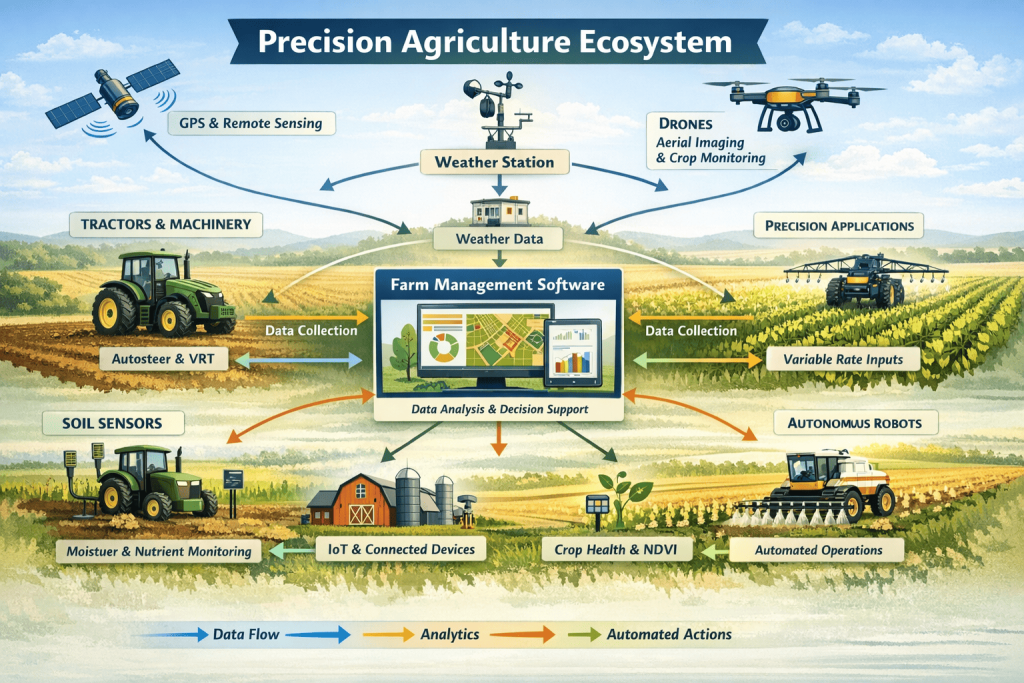
Key Technologies Summary
| Technology | Function | Related Entity / Keyword |
|---|---|---|
| GPS & GIS Systems | Field mapping, machinery guidance | Geofencing, Telematics |
| Soil & Crop Sensors | Monitor water, nutrients, crop health | IoT Agriculture, Soil Moisture Sensors |
| Drones & Aerial Imaging | Map crop health, detect pests | NDVI, Remote Sensing |
| Variable Rate Technology | Adjust inputs per zone | Prescription Farming, VRT |
| Farm Management Software | Aggregate and analyze data | FMIS, IoT Agriculture |
The Benefits of Precision Agriculture: Why Farmers Are Making the Leap
Precision agriculture adoption is driven by profitability, efficiency, and sustainability.
| Benefit | Impact |
|---|---|
| Increased crop yield | Yield monitoring identifies high-performing zones; replicates success across fields |
| Reduced costs | VRT and Autosteer reduce fertilizer, seed, water, and fuel waste |
| Environmental sustainability | Targeted chemical application reduces runoff; water conservation preserves aquifers |
| Enhanced risk management | Predictive analytics, drones, and FMIS mitigate disease, drought, and frost risk |
Increased Crop Yield
Yield monitoring enables real-time measurement during harvest. Patterns in yield maps reveal soil, drainage, or herbicide issues, which can then be addressed. Precision ag increases yields 5–15% depending on crop and region.
Reduced Costs
Variable rate fertilization reduces nitrogen use by 20–40% without sacrificing yield. Precision irrigation saves up to a third of water costs. Autosteer eliminates overlaps, lowering fuel and chemical waste.
Environmental Sustainability
Targeted inputs prevent runoff, reduce greenhouse gas emissions, and conserve water. Carbon credit markets now reward farmers for practices that sequester soil carbon, enabled by precision agriculture data.
Enhanced Risk Management
Early detection of disease and predictive analytics mitigate losses. FMIS provides documentation for insurance and compliance purposes.
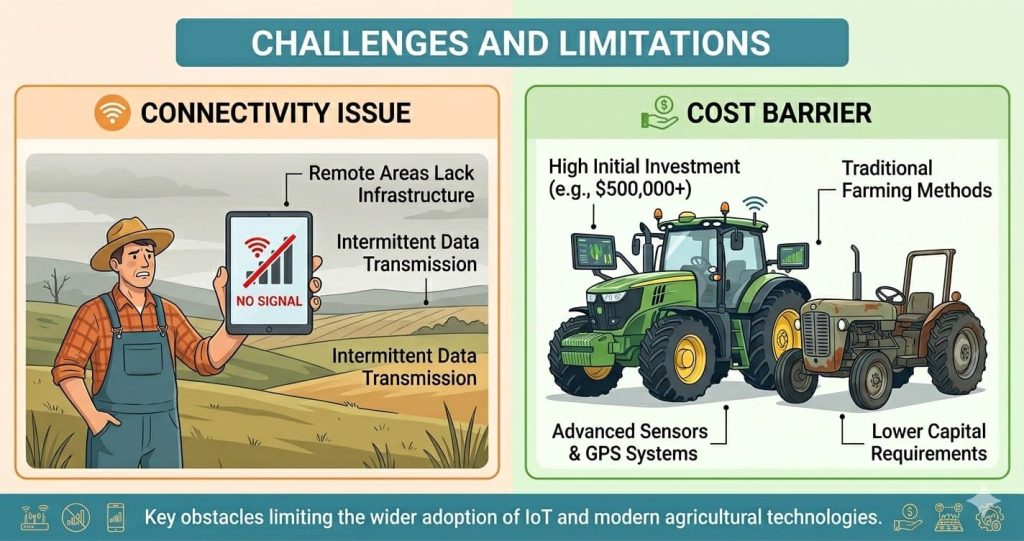
The Challenges: Why Precision Ag Isn’t Everywhere Yet
| Challenge | Detail |
|---|---|
| High costs | GPS tractors, drones, sensors, and software are expensive upfront |
| Technical skills | Farmers must interpret NDVI maps, calibrate sensors, and integrate software |
| Data privacy | Ownership of farm data is contentious between farmers, manufacturers, and insurers |
| Limited access for smallholders | Capital, infrastructure, and training gaps limit adoption |
Applications and Use
- Crop Monitoring & Management: NDVI and drones detect stress; prescription maps target interventions.
- Precision Irrigation: Soil moisture sensors with automated systems conserve water and optimize yields.
- Pest & Disease Control: Targeted fungicide application reduces chemical use by 50–90%.
- Soil Health & Fertility Management: Variable rate fertilization and cover crops build soil organic matter.
The Future of Precision Agriculture
1. AI and Machine Learning
Predictive models analyze yield history, weather, and soil maps to recommend planting, disease management, and input schedules. Computer vision enables “see and spray” systems, reducing herbicide use by 80–90%.
2. Autonomous Machinery
Robotic tractors and harvesters operate without human intervention, solving labor shortages and reducing harvest waste. Autosteer ensures accuracy.
3. IoT and Connected Farms
Sensors, machinery, and weather stations communicate continuously. Edge computing processes data locally, enabling real-time decision-making.
4. Climate-Smart Agriculture
Precision agriculture helps farmers adapt to climate change, stabilize yields, and participate in carbon markets.
5. Democratization of Precision Ag
Low-cost sensors, mobile apps, and shared equipment models make precision ag accessible to smallholders worldwide.
Conclusion: The Soil Is Speaking. Are We Listening?
Precision agriculture transforms farming from intuition to insight, uniformity to specificity, and waste to stewardship. GPS guidance, sensors, drones, VRT, and FMIS are already reshaping farms globally. The soil is speaking; the question is whether we are listening.
Call-to-Action: Explore precision agriculture solutions and Farm Management Software to optimize your farm operations today.
External Links:
- NDVI Crop Monitoring – NASA Earth Observatory
- ISPA – International Society of Precision Agriculture
Add Agri Opportunities as a preferred source on Google to see latest blog listings first.
Similar Posts
The Phosphorus Cycle Explained: Why This Nutrient Behaves Nothing Like Nitrogen
Phosphorus cycle explained: why phosphorus has no atmospheric phase, global reserves are finite, and how runoff causes eutrophication in lakes and rivers.
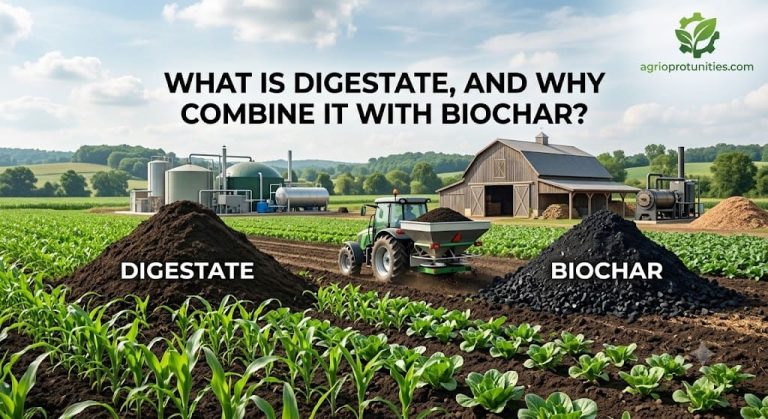
What Is Digestate, and Why Combine It With Biochar?
Digestate biochar co-application: what digestate is, why applying it alone creates problems, and how biochar reduces N₂O emissions by up to 80% while improving nitrogen retention.
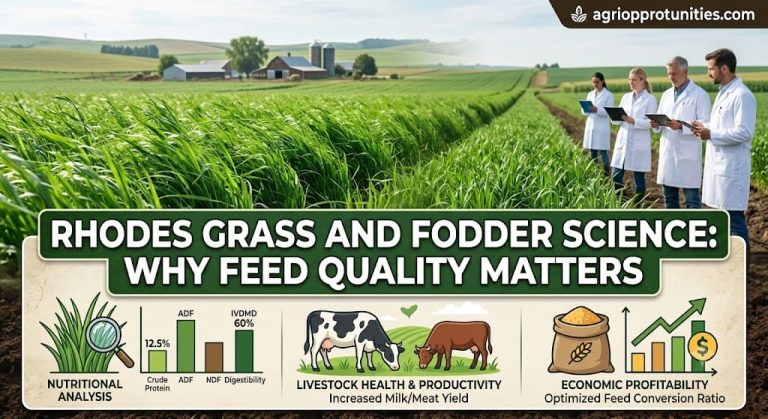
Rhodes Grass and Fodder Science: Why Feed Quality Matters
Rhodes grass nutritive value explained: why quality declines with maturity, NDF/ADF testing, fertilizer effects, and a genuine selenium toxicity risk.
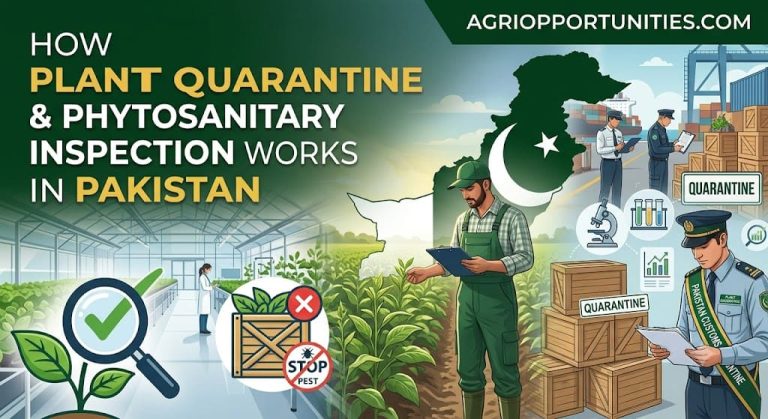
How Plant Quarantine and Phytosanitary Inspection Work in Pakistan
Plant quarantine Pakistan explained: import permits, pest risk analysis, phytosanitary certificates, and what plant inspectors actually do at ports of entry.
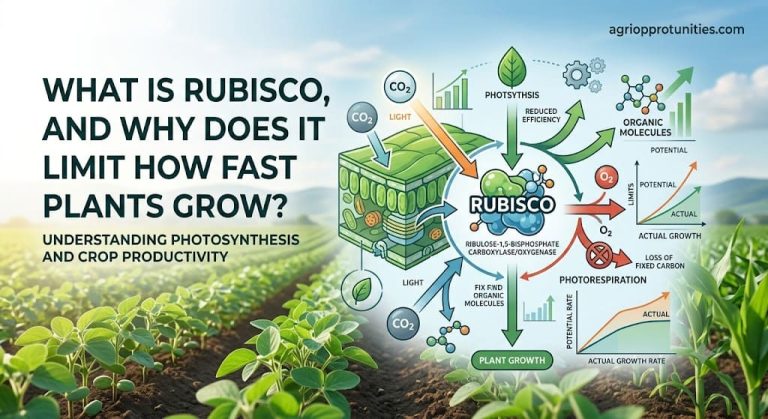
What Is Rubisco, and Why Does It Limit How Fast Plants Grow?
Rubisco explained: the world’s most abundant protein, its costly oxygen mistake, photorespiration, and how scientists are engineering crops to grow faster.
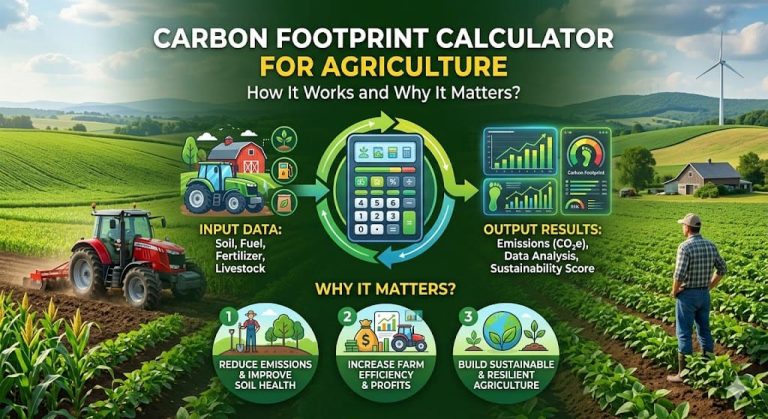
Carbon Footprint Calculator for Agriculture – How It Works and Why It Matters?
The carbon footprint calculator agriculture sector has developed over the past decade is not just a scientific instrument. Instead, it is a practical farm management tool that helps farmers, agribusiness investors, researchers, and policymakers understand the true climate impact of agricultural activities. This includes everything from the livestock in the barn to the tractor in the field to the fertilizer spread across the soil. Consequently, these tools are transforming how farms operate.
One Comment