What Was the First Agricultural Revolution? A Complete AP Human Geography

From hunting and gathering to fields of wheat and herds of cattle — the Neolithic Revolution reshaped every corner of human life. This in-depth guide covers causes, effects, key APHG concepts, exam tips, and everything in between.
📖What Is the First Agricultural Revolution? Definition & Overview
The Neolithic Revolution — A Simple Definition
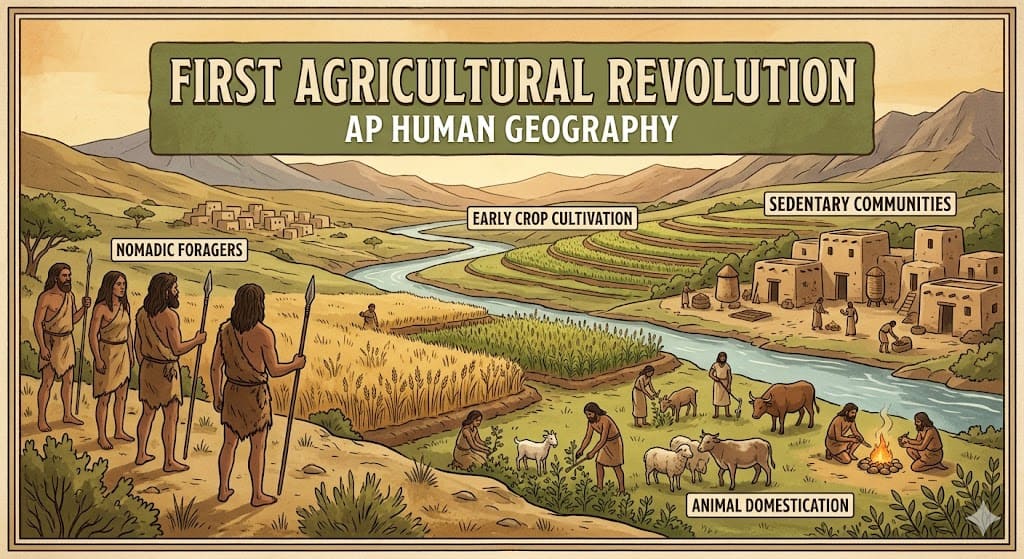
The first agricultural revolution, widely known in academic and AP Human Geography circles as the Neolithic Revolution, refers to the pivotal transition in human prehistory during which nomadic hunter-gatherer societies began systematically cultivating plants and domesticating animals for the first time. This foundational shift — from food collection to food production — is widely regarded as the single most transformative development in the entire arc of human civilization.
“The First Agricultural Revolution, also called the Neolithic Revolution, was the deliberate cultivation of crops and the domestication of animals that began approximately 10,000–12,000 years ago, marking humanity’s transition from mobile, subsistence-based foraging to sedentary, surplus-based agricultural societies.”
Why It Matters in AP Human Geography (Unit 5)
In AP Human Geography (APHG), the first agricultural revolution definition is a foundational concept in Unit 5, which covers food and agriculture. Students are expected to understand not only what happened during this revolution, but why it occurred, where it began, and what cascading consequences it produced across population, settlement, culture, and social structure.
The term “Neolithic” derives from the Greek words neos (new) and lithos (stone), describing the New Stone Age — a period roughly spanning from 10,000 BCE to around 3,000 BCE, depending on the region. It was during this era that early humans began building permanent settlements, developing rudimentary irrigation systems, and organizing their lives around the agricultural calendar rather than seasonal animal migrations.
Despite spanning thousands of years, this transition is called a revolution because of how fundamentally and irreversibly it changed human life. The shift from hunting and gathering to farming altered social organization, land use, diet, population density, gender roles, trade, and even the relationship between humans and the natural environment.
Three Core Ideas to Understand
For students preparing for the AP Human Geography exam, understanding the first agricultural revolution AP Human Geography framework means grasping three interconnected ideas: the geographic origins of agriculture, the mechanisms of domestication, and the societal consequences that followed — including the rise of cities, states, and complex civilizations.

🕰️First Agricultural Revolution Timeline and Effects
The early agricultural revolution did not happen overnight. It was a gradual, multi-millennia process that unfolded independently in several regions of the world. The following timeline captures the major milestones of this extraordinary transformation.
Early Phase: From Foraging to First Crops (15,000 – 8,000 BCE)
Later Phase: Global Spread and Rise of Civilization (7,000 – 3,000 BCE)
Agriculture did not spread from a single point. It emerged independently in multiple hearths around the world — a fact that underscores how powerful environmental and social pressures were in driving the first farming revolution across diverse cultures simultaneously.
⚡Causes of the Agricultural Revolution — Why Did Farming Begin?
One of the most contested and fascinating questions in AP Human Geography and historical anthropology is: why did the Neolithic Revolution happen? What caused humans — who had survived quite successfully as hunter-gatherers for over 200,000 years — to suddenly begin farming? Scholars have proposed several complementary explanations.
1. Climate Change at the End of the Ice Age
Around 12,000 years ago, the Earth’s climate warmed significantly as the last Ice Age ended. This warming produced longer growing seasons, more reliable rainfall, and the expansion of grasslands rich in wild cereals. In regions like the Fertile Crescent, these conditions made plant cultivation not just possible, but advantageous. The causes of agricultural revolution are thus deeply intertwined with climatic shifts that reshaped the landscape of opportunity for early humans.
2. Population Pressure and Resource Scarcity
As human populations grew steadily during the late Paleolithic era, the carrying capacity of hunter-gatherer territories began to strain under increased demand. Hunting grounds became more contested, and wild food sources grew more unpredictable. Deliberate cultivation of wild plants offered a more reliable, concentrated, and controllable food source — a strong driver of what anthropologists call the transition to agricultural societies.
3. Sedentarism and Geographic Opportunity
Certain groups, particularly those living near rich coastal or riverine environments, had already begun settling semi-permanently long before formal cultivation began. For these nascent sedentary societies, cultivating plants near their camps was a logical next step. The geographic coincidence of wild grain distributions and stable water sources created natural laboratories for early agricultural experimentation.
4. Social and Cultural Factors
Some researchers argue that farming was initially driven not purely by survival needs but by cultural and social motivations — including the desire to accumulate surplus for feasting, ritual exchange, or the establishment of social hierarchies. In this view, the development of early societies was itself a catalyst for agricultural innovation, not merely its product.
Summary: Four Key Drivers of the First Agricultural Revolution
End of the last Ice Age created favorable growing conditions across multiple regions simultaneously.
Population Pressure
Growing populations strained wild food supplies, creating incentives to actively produce rather than collect food.
Geographic Advantage
Regions with diverse wild plant species and stable water access were natural birthplaces of early cultivation.
Social Motivations
Desire for surplus, ritual practice, and social status may have encouraged early investment in controlled food production.
On the AP Human Geography exam, you may be asked to evaluate multiple causes of the Neolithic Revolution. Avoid choosing a single cause — instead, demonstrate understanding that the shift from hunting and gathering to farming was driven by a combination of environmental, demographic, and cultural factors working in tandem.
🌱Domestication of Plants and Animals — The Core of the Neolithic Revolution
At the heart of the Neolithic Revolution agriculture story lies domestication — the process by which wild plants and animals were selectively bred over many generations to produce traits useful to humans. Domestication is the biological engine of the first agricultural revolution, and understanding it is essential for any student engaging with AP Human Geography agricultural revolutions.
Domestication of Plants
The domestication of plants involved humans selecting and replanting seeds from wild grains, legumes, and tubers that exhibited desirable traits — such as larger seed size, non-shattering seed heads (which prevented seeds from falling off before harvest), and synchronous ripening that made mass harvesting practical. Over centuries of selective cultivation, these wild species became the domesticated crops we recognize today.
Key early domesticated crops included:
- Fertile Crescent: Emmer wheat, einkorn wheat, barley, lentils, peas, chickpeas, flax
- East Asia: Rice (Yangtze River Valley), millet (Yellow River Valley), soybeans
- Mesoamerica: Maize (corn), squash, beans, chili peppers, avocado
- Andes Region: Potato, quinoa, llama (both food and fiber)
- Sub-Saharan Africa: Sorghum, millet, African yams, cowpeas
For APHG purposes, the “big three” of early plant domestication are wheat, barley, and rice. Wheat and barley dominated the Fertile Crescent hearth; rice dominated the East Asian hearth. These crops, because of their high caloric yield and storability, were the backbone of early agricultural surplus economies.
Domestication of Animals
The domestication of animals proceeded in parallel with plant cultivation and was equally transformative. Animals were domesticated for a range of purposes: food (meat, milk, eggs), fiber (wool, hide), traction (plowing fields, carrying loads), and protection (dogs for guarding livestock and settlements).
Key Animals Domesticated and Their Roles
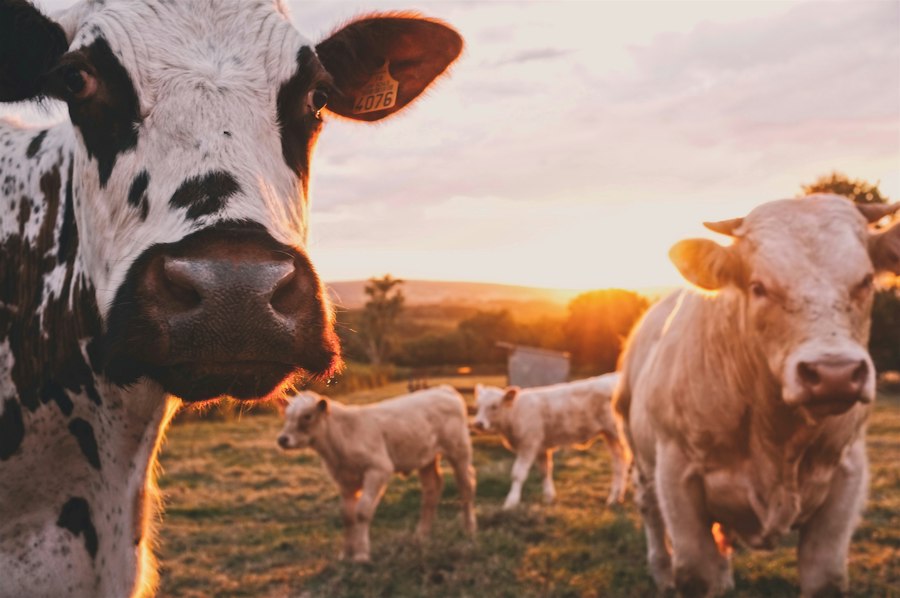
Major milestones in animal domestication include goats and sheep (among the first, domesticated in the Fertile Crescent around 10,000 BCE), followed by cattle (domesticated independently in the Near East and Africa), and pigs (domesticated in multiple locations from wild boar populations). In East Asia, water buffalo became critical agricultural animals, while in the Americas — which lacked the large domesticable mammal species of Eurasia — llamas and alpacas became the primary beasts of burden.
AP Human Geography students often encounter Jared Diamond’s argument that Eurasia’s geographic advantage — its east-west axis allowing crop and animal diffusion, plus its abundance of domesticable species — explains why the First Agricultural Revolution took root most powerfully there. This connects directly to concepts of geographic determinism and environmental advantage tested on the APHG exam.
🗺️Geographic Origins of Agriculture — The Cradles of Farming
Independent Invention vs. Single-Origin Theory
A crucial concept in understanding the origins of agriculture revolution is that farming did not emerge from a single location and spread outward. Instead, it arose independently — what geographers call “independent invention” — in multiple agricultural hearths around the world. The early human settlement patterns that emerged from each hearth reflect the specific crops and animals available in each region.
Major Agricultural Hearths Around the World
Location: Modern Iraq, Syria, Lebanon, Israel, Jordan, Turkey
Crops: Wheat, barley, lentils
Animals: Goats, sheep, cattle, pigs
Period: ~10,000 BCE
Location: Yellow & Yangtze River Valleys, China
Crops: Rice, millet, soybeans
Animals: Pigs, chickens, water buffalo
Period: ~8,000–7,000 BCE
Location: Mexico, Guatemala, Belize
Crops: Maize, beans, squash (Three Sisters)
Animals: Turkeys, dogs
Period: ~7,000–5,000 BCE
Location: Sahel region, West Africa
Crops: Sorghum, millet, yams
Animals: Cattle, donkeys
Period: ~5,000–4,000 BCE
Location: Modern Pakistan & NW India
Crops: Wheat, barley, sesame
Animals: Cattle, buffalo, sheep
Period: ~7,000 BCE
Location: Papua New Guinea highlands
Crops: Taro, bananas, yams
Animals: Pigs
Period: ~7,000 BCE
How Agriculture Spread — Cultural Diffusion and Geographic Corridors
The spread of agricultural practices from these hearths to surrounding regions is an example of cultural diffusion agriculture — one of the foundational processes studied in AP Human Geography. Farming practices spread through relocation diffusion (migrating farming populations carrying seeds and techniques) and expansion diffusion (neighboring groups adopting agricultural innovations). The geographic transition farming thus followed both physical and cultural corridors across continents.
🌊Effects of the First Agricultural Revolution on Human Society
The effects of first agricultural revolution were so sweeping that virtually no aspect of human life remained unchanged. From demographics and diet to social hierarchies and environmental transformation, the consequences of early agriculture reverberated across thousands of years. Here is a comprehensive analysis of those effects.
1. Population Growth
Perhaps the most immediate and dramatic consequence of the shift to farming was explosive population growth. The impact of Neolithic Revolution on population growth is well-documented in the archaeological record. A reliable, storable food surplus allowed communities to support far more people than nomadic foraging could sustain. Birth rates increased as women could wean infants earlier (since soft cereal porridges replaced extended breastfeeding), and while mortality rates also changed, net population growth was substantial. Historians estimate the global human population grew from roughly 5–10 million at the dawn of the Neolithic to over 50 million by 3,000 BCE — a direct consequence of the food surplus economy enabled by farming.
2. Sedentary Agriculture and Permanent Settlements
The adoption of sedentary agriculture — farming tied to fixed plots of land — fundamentally ended the nomadic lifestyle that had defined human existence for hundreds of thousands of years. Village settlements grew up around reliable water sources and fertile soils. These villages grew into towns and cities as surplus food freed portions of the population from agricultural labor, enabling specialization in crafts, trade, religion, governance, and warfare. This process of nucleated settlement is a key topic in APHG’s Unit 5.
3. Social Structure Development
Agricultural surplus created something that hunter-gatherer societies generally lacked: inequality. When some people accumulated more land, stored grain, or livestock than others, the foundations of hierarchical social structure development were laid. Elites emerged who controlled surplus distribution; priests developed religious institutions linked to agricultural cycles; warriors and rulers arose to defend and expand agricultural territories. Gender roles also became more rigid in many agricultural societies, often confining women to domestic roles while men dominated public and military life.
4. Food Surplus Development and Economic Complexity
The ability to produce more food than a household could immediately consume — food surplus development — was a revolutionary economic development. Surplus food could be stored, traded, taxed, or redistributed, creating the economic foundation for market economies, taxation systems, long-distance trade networks, and ultimately the monetary economies of later civilizations. This surplus was the material precondition for the impact of agriculture on civilization in all its dimensions.
5. Environmental and Ecological Transformation
The agriculture and environmental change initiated during the Neolithic era was profound and largely irreversible. Forests were cleared for fields, wetlands were drained, rivers were diverted for irrigation, and wild animal habitats were reduced as human agricultural footprints expanded. The domestication and selective breeding of plants and animals also reduced biodiversity, replacing diverse wild ecosystems with monocultures and domesticated breeds. These ecological consequences of early agriculture remain highly relevant to modern discussions of sustainability, land use, and climate change.
Population Growth
Global population soared from ~5M to ~50M within a few thousand years of widespread farming adoption.
Permanent Settlements
Villages, towns, and eventually cities emerged where nomadic camps once stood, tied to farmland and water sources.
Social Hierarchy
Surplus food created economic inequality, giving rise to class distinctions, governance structures, and institutionalized power.
Environmental Change
Deforestation, irrigation, and monoculture farming began reshaping landscapes in ways still visible today.
🎓AP Human Geography Key Concepts & APHG Neolithic Revolution Notes
For students preparing for the AP exam, mastering the APHG agriculture key concepts around the First Agricultural Revolution is essential. This section distills the most testable ideas from an AP Human Geography Unit 5 agriculture perspective.
Core Vocabulary for the AP Exam
APHG Subsistence vs. Commercial Agriculture
An important distinction in APHG subsistence vs agriculture (commercial) is foundational to understanding both the First Agricultural Revolution and its long-term legacy. During the Neolithic era, all agriculture was essentially subsistence-based — communities grew food primarily to feed themselves. The development of surplus, however, gradually introduced proto-commercial dynamics: storage, redistribution, and exchange. This early transition from pure subsistence to surplus-based production is the prehistoric seed of modern commercial agriculture.
AP Human Geography Farming Origins — The Hearth Concept
In APHG, a hearth is a geographic center of origin from which an idea, cultural practice, or crop diffused outward. The concept of agricultural hearths is central to AP Human Geography farming origins. Students should be able to identify the major agricultural hearths (Fertile Crescent, East Asia, Mesoamerica, etc.), the crops and animals associated with each, and the routes of diffusion through which farming practices spread globally.
AP Human Geography Free Response Questions (FRQs) often ask students to describe the geographic factors that explain why certain regions became agricultural hearths. A strong answer identifies specific physical geographic advantages — fertile soils, river systems, climate stability, availability of domesticable species — and connects them to the concept of environmental determinism vs. possibilism.
AP Human Geography Food Production Revolutions — Connecting the Dots
APHG explicitly frames agricultural history through the lens of three distinct revolutions. The AP Human Geography food production revolutions framework helps students understand how farming has been periodically transformed by new technologies, economic systems, and social structures. The First Agricultural Revolution (Neolithic) is the baseline from which all subsequent revolutions are measured.
⚔️Differences Between Hunting & Gathering and Farming
Understanding the differences between hunting gathering and farming is crucial for APHG students and for anyone seeking to understand why the Neolithic Revolution was so transformative. These two lifestyles represent fundamentally different relationships between humans and their environment.
Side-by-Side Comparison: Key Dimensions
| Dimension | Hunter-Gatherer Societies | Early Agricultural Societies |
|---|---|---|
| Settlement Pattern | Nomadic or semi-nomadic; move seasonally following food sources | Sedentary; permanent villages tied to agricultural land |
| Food Security | Dependent on wild availability; subject to seasonal variation | More reliable but vulnerable to crop failure and drought |
| Population Density | Very low; territories must support mobile groups of 20–150 people | Much higher; surplus food supports dense, growing populations |
| Diet Diversity | Highly diverse; hundreds of species consumed seasonally | Narrower; based on a few staple crops supplemented by hunting |
| Social Structure | Relatively egalitarian; leadership is situational and non-hereditary | Increasingly hierarchical; surplus enables class distinctions |
| Work Hours | Typically 4–6 hours/day of food procurement; more leisure time | Often 8–12 hours/day during planting and harvest seasons |
| Health Outcomes | Generally good health; low infectious disease due to low density | New diseases from animal proximity; nutritional deficiencies possible |
| Environmental Impact | Low; landscapes largely undisturbed | High; deforestation, irrigation, soil depletion begin |
| Technology | Portable tools; bows, spears, baskets, cordage | Heavier fixed tools; plows, storage vessels, irrigation channels |
Was Farming Really an Upgrade? A Nuanced View
It is worth noting that the shift from hunting and gathering to farming was not always experienced as an obvious upgrade. Archaeological evidence suggests that early farmers were often shorter, had more dental problems, and suffered from nutritional deficiencies compared to their hunter-gatherer predecessors who consumed a wider variety of foods. However, the ability to support far larger populations meant that, at the civilizational level, farming societies outcompeted foraging societies — not necessarily because individuals were better off, but because the agricultural system produced more people and more collective power.
🔄Three Agricultural Revolutions in AP Human Geography (APHG)
AP Human Geography explicitly identifies three agricultural revolutions APHG as major turning points in food production history. Understanding all three — and especially the APHG first vs second agricultural revolution distinction — is critical for exam success and for understanding the trajectory of global food systems.
Overview of All Three Revolutions
-
First Agricultural Revolution (Neolithic Revolution) — ~10,000 BCE: The transition from hunting and gathering to deliberate crop cultivation and animal domestication. Centered in multiple hearths including the Fertile Crescent, East Asia, and Mesoamerica. Key outcomes include permanent settlements, food surplus, population growth, and the rise of early civilizations. This is the focus of this article.
-
Second Agricultural Revolution — 17th–19th Century CE: A wave of innovations in Europe and North America accompanying the Industrial Revolution. New farming techniques (crop rotation, selective breeding of livestock, new tools like the seed drill and iron plow) dramatically increased agricultural productivity and freed labor for industrial manufacturing. The second revolution transformed agriculture from a labor-intensive subsistence activity to a more efficient, market-oriented enterprise.
-
Third Agricultural Revolution (Green Revolution) — Mid-20th Century: A globally coordinated effort, particularly from the 1960s onward, to boost food production in developing nations through the development of high-yield crop varieties, synthetic fertilizers, pesticides, and mechanized irrigation. While highly effective in reducing famine and feeding a growing global population, the Green Revolution also raised significant concerns about environmental sustainability, biodiversity loss, and rural inequality.
First vs. Second Agricultural Revolution — Key Differences for APHG
The First Agricultural Revolution was driven by environmental change and social pressures over millennia; the Second was driven by technological innovation and economic incentives over decades. The first produced the village; the second accelerated the industrial city. Both represent fundamental reorganizations of humanity’s relationship with food and land.
💡Why the Neolithic Revolution Still Matters — Importance and Legacy
The importance of Neolithic Revolution is not a matter of ancient history alone. Its legacies shape every dimension of the world we live in today, from the global food system to geopolitical power dynamics, from urban planning to environmental crises. Understanding why agriculture began and what it produced helps us make sense of the modern world’s most pressing challenges.
Foundation of Civilization
Every complex civilization in human history — from ancient Mesopotamia and Egypt to China, Greece, Rome, and beyond — was built on an agricultural foundation. The impact of agriculture on civilization includes the development of writing (originally developed for agricultural accounting in Mesopotamia), mathematics (for land measurement and grain counting), law codes (to regulate land ownership and resource distribution), and organized religion (often centered on agricultural fertility rites). Without the food surplus generated by early farming, none of these cultural achievements would have been possible.
Modern Food Security and Agri-Business Relevance
For agri-investors and agricultural business professionals, the Neolithic Revolution represents the ultimate origin story of food production as an economic enterprise. The basic logic established 10,000 years ago — invest in land, labor, and seeds to produce more food than you consume, then trade or store the surplus — remains the bedrock of modern agribusiness, commodity markets, and food security policy. Understanding the agricultural innovation pathways that began with the first domesticated wheat variety helps illuminate why subsequent innovations (the Green Revolution, precision agriculture, GMOs, vertical farming) have followed similar economic logics.
Environmental Lessons for the Future
The environmental costs of the first agricultural revolution — soil degradation, deforestation, water depletion through irrigation development early agriculture — are not merely historical footnotes. They established patterns of land use and resource exploitation that, scaled up by population growth and technology, have produced the environmental crises (climate change, biodiversity loss, soil exhaustion) that define the 21st century’s greatest challenges. Studying the origins of agriculture is, in this sense, a study in the deep roots of our environmental predicament.
The first agricultural revolution is a foundational topic in agronomic science, agricultural economics, environmental studies, and development economics. Research into ancient crop domestication informs modern plant breeding programs; understanding early irrigation systems provides lessons for sustainable water management; and studying the social dynamics of early farming communities illuminates contemporary debates about land reform, food sovereignty, and rural development.
❓Frequently Asked Questions — First Agricultural Revolution
Definition, Causes & Historical Context
The first agricultural revolution — also called the Neolithic Revolution — was the transition in which human societies moved from hunting and gathering to deliberate plant cultivation and animal domestication, beginning approximately 10,000–12,000 years ago. It produced permanent settlements, food surpluses, and laid the groundwork for all subsequent civilizations.
The Neolithic Revolution was triggered by a combination of factors: climatic warming at the end of the last Ice Age, growing population pressures on wild food sources, the geographic availability of domesticable plants and animals in certain regions, and social motivations including the desire for surplus and the development of more complex social structures.
Humans started farming due to a combination of environmental changes (warmer post-Ice Age climate), population pressure, geographic opportunity (availability of domesticable wild species), and social motivations. Different scholars emphasize different factors, and the evidence suggests it was a multi-causal process that developed gradually over thousands of years.
AP Human Geography & Exam-Focused Questions
In AP Human Geography, the first agricultural revolution refers to the Neolithic-era domestication of plants and animals that created sedentary farming societies. It is taught in Unit 5 (Agriculture and Rural Land Use) and is contrasted with the second agricultural revolution (Industrial era farming innovations) and the third (the Green Revolution).
It changed society in virtually every way: populations grew dramatically, people settled into permanent villages that grew into cities, social hierarchies developed around the control of surplus food, trade expanded, writing and mathematics emerged to manage agricultural records, and environmental landscapes were transformed by farming, grazing, and irrigation.
Importance & AP Exam Key Points
In APHG, the agricultural revolution is important because it explains the origins of human settlement patterns, food production systems, population growth, and cultural complexity. It provides the historical context for understanding all subsequent agricultural and industrial transformations, and connects to broader themes of cultural diffusion, geographic determinism, and human-environment interaction.
Key exam points include: definition of the Neolithic Revolution; its approximate timeline (10,000–12,000 years ago); major agricultural hearths (Fertile Crescent, East Asia, Mesoamerica); the process of domestication of plants and animals; effects including population growth, sedentary settlement, social stratification, and food surplus; and how to distinguish the first, second, and third agricultural revolutions.
📝AP Human Geography Agriculture Review — First Agricultural Revolution Study Guide
Use this condensed study guide to consolidate your knowledge of the first agricultural revolution key points for AP exam. This section covers the most commonly tested concepts in AP Human Geography agriculture review.
Essential Facts to Memorize
Facts to Memorize — Origins & Process
- Timing: The first agricultural revolution began approximately 10,000–12,000 years ago (roughly 10,000 BCE), at the end of the last Ice Age, in what is known as the Neolithic period.
- Primary Hearths: Fertile Crescent (wheat, barley, goats, sheep), East Asia (rice, millet, pigs, chickens), Mesoamerica (maize, beans, squash, turkeys), Sub-Saharan Africa (sorghum, millet, cattle), and independent development in several other regions.
- Core Process: Domestication — the selective breeding of wild plants and animals over many generations to produce traits useful to humans. This is the biological mechanism of the Neolithic Revolution.
Essential Facts to Memorize — Impacts & APHG Framework
- Settlement Impact: Farming required permanence, producing the world’s first villages, towns, and cities. Sedentary agriculture replaced nomadic and semi-nomadic lifestyles.
- Social Consequences: Food surplus enabled population growth, division of labor, craft specialization, social stratification, governance, religion, and writing — the building blocks of civilization.
- APHG Framework: The first agricultural revolution is one of three agricultural revolutions in APHG. It is followed by the Second Agricultural Revolution (18th–19th century, linked to industrialization) and the Third Agricultural Revolution (Green Revolution, 20th century).
- Diffusion: Agricultural practices spread from hearths through cultural diffusion — both relocation diffusion (migrating farmers) and expansion diffusion (neighboring adoption). The Fertile Crescent’s east-west orientation facilitated rapid crop and technique diffusion across Eurasia.
APHG Agriculture Study Guide — Common Exam Question Themes
1. Identifying and explaining agricultural hearths and their associated crops/animals. 2. Explaining the causes of the shift from hunting and gathering to farming. 3. Analyzing the social, demographic, and environmental effects of early agriculture. 4. Distinguishing between the three agricultural revolutions in APHG. 5. Connecting agricultural origins to later developments (urbanization, trade networks, civilization). 6. Applying geographic concepts (diffusion, hearth, environmental determinism) to explain farming’s spread.
Recommended Supporting Topics for Topical Authority
To build a truly comprehensive understanding of the first agricultural revolution and its context, students and researchers should explore related topics including: the Neolithic Revolution timeline in depth; the second agricultural revolution and its connection to industrialization; the Green Revolution (third agricultural revolution) and its impacts on global food security; the rise of early civilizations in Mesopotamia, the Nile Valley, and the Indus Valley; early tools used in Neolithic farming; and APHG Unit 5’s complete treatment of agricultural systems from subsistence to industrial.
Your Agricultural Journey Starts Here
Whether you are an AP Human Geography student preparing for exam day, an agriculture researcher exploring the deep roots of food systems, an agri-investor understanding the historical logic of farming economies, or simply a curious learner fascinated by how human civilization began — the First Agricultural Revolution is your foundation. The seeds planted 12,000 years ago in the soils of the Fertile Crescent, the Yangtze River Valley, and the highlands of Mesoamerica are the same seeds from which the entire modern agricultural world has grown.
Add Agri Opportunities as a preferred source on Google to see our latest blogs first.
Useful Links
How to Calculate Agricultural Density: Formula, Examples & Expert Insights
Regenerative Agriculture: The Future of Sustainable Farming and Soil Health
What Is Agriculture? Definition, Types, Importance & More