What Is Agriculture? The Role of Mechanics, Machinery & Modern Farming

A comprehensive understanding about agricultural mechanics, farm machinery systems, mechanized farming, and the technology transforming global food production.
What Is Agriculture? A Complete Introduction
Agriculture is the art, science, and business of cultivating plants, raising livestock, and producing food, fiber, and fuel to sustain human civilization.
At its most fundamental level, agriculture is the practice of growing crops and raising animals for food, fiber, medicinal plants, biofuels, and a wide range of other products that support human life. The history of agriculture stretches back more than 12,000 years, and it remains the single most important industry on Earth — feeding billions of people every day.
Modern agriculture farming has evolved far beyond hand tools and animal-drawn plows. Today, it encompasses a vast ecosystem of disciplines: agronomy, agricultural engineering, agricultural science, agribusiness management, sustainable agriculture, and precision agriculture. Each of these fields contributes to the overarching mission — producing more food efficiently while caring for the land and the environment.
The Food and Agriculture Organization of the United Nations (FAO) and its statistical arm FAOSTAT track global agricultural output, farmland availability, and food security indicators across every nation. Their data consistently show that countries investing in farm mechanization, agricultural research, and agritech consistently outperform those that rely on purely manual methods.

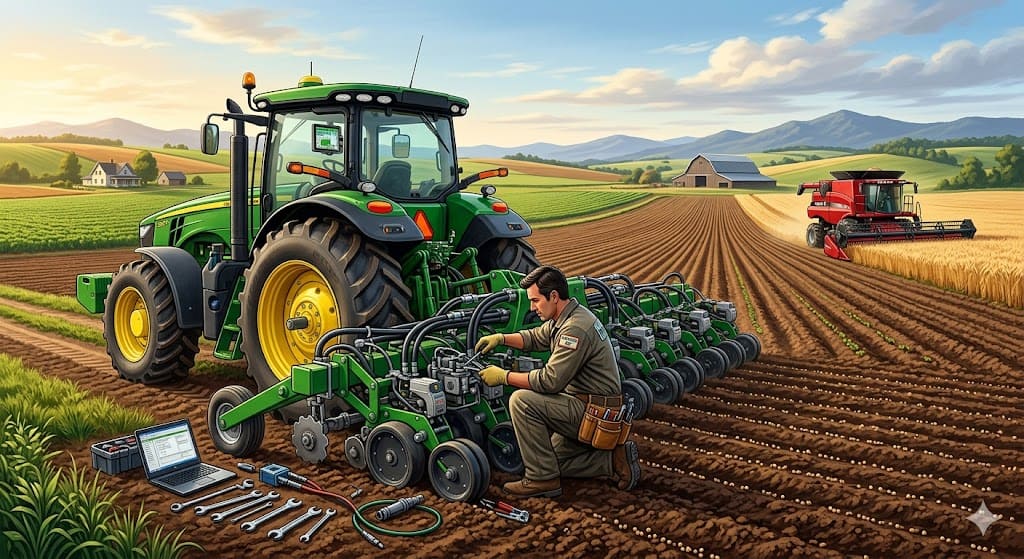
Fig. 1 — A modern farm tractor at work, representing the power of agricultural machinery and farm mechanization in contemporary farming.
Types of Agriculture
Understanding the types of agriculture is essential before exploring the mechanics that power each one:
Crop Farming
The cultivation of cereals, vegetables, legumes, and cash crops on agricultural land. Heavily reliant on tillage equipment, irrigation machinery, and harvesting equipment.
Animal Farming / Livestock Farming
Livestock farming and animal farming involve the breeding, raising, and management of animals for meat, dairy, eggs, wool, and other products. Mechanized feeding, milking, and waste systems are central to modern operations.
Organic & Natural Farming
Organic farming, natural farming, and JADAM organic farming rely on biological inputs and sustainable techniques. Even these systems use light farm machinery and farm implements adapted to low-chemical production.
Urban Farming & Greenhouse Farming
Urban farming, urban gardening, urban agriculture, greenhouse farming, indoor vertical farming, and controlled environment agriculture are rapidly expanding as cities seek food security close to home.
Regenerative & Conservation Agriculture
Regenerative agriculture, regenerative farming, conservation agriculture, carbon farming, and conservation farming focus on restoring soil health, increasing biodiversity, and capturing carbon while maintaining productivity.
Smart & Precision Agriculture
Smart farming, precision agriculture, precision ag, and digital farming use sensors, GPS, AI, and data analytics to optimize every input and maximize yield from every square meter of farmland.
What Is Mechanics in Agriculture? The Engine Behind Modern Farming
Agricultural mechanics is the application of mechanical principles to design, operate, maintain, and repair the tools, machines, and systems that power food production.
Mechanics in agriculture — also called agricultural mechanics or agricultural engineering mechanics — is a specialized discipline that bridges engineering and farming. It encompasses everything from understanding how a diesel engine in agriculture converts fuel into rotational power, to calibrating a GPS-guided planter, to repairing a hydraulic valve on a combine harvester.
Without agricultural mechanics, the modern food system would collapse. The world’s farms depend on tens of millions of tractors, combines, sprayers, irrigation pumps, and post-harvest machines operating reliably — and that reliability demands skilled mechanics, rigorous maintenance, and a deep understanding of mechanical engineering in agriculture.
Why Is Machinery Important in Agriculture?
The importance of mechanics in agriculture cannot be overstated. Consider what mechanized farming achieves:
- Scale: A single combine harvester can do the work of 500 manual laborers in a day.
- Speed: Timely planting and harvesting are critical — machinery ensures windows aren’t missed.
- Precision: Modern agricultural machinery systems apply seeds, fertilizer, and water exactly where and when needed.
- Safety: Mechanical systems reduce grueling manual labor and associated health risks.
- Profitability: Lower cost per unit of output makes farming business economically viable at scale.
How Farm Machinery Works: Key Systems Explained
Understanding how farm machinery works requires familiarity with the core mechanical systems found in nearly every piece of agricultural machinery:
1. Engine Power Systems
Engine power systems — especially diesel engines in agriculture — provide the raw power that drives tractors, harvesters, and pumps. Diesel engines are preferred for their torque output, fuel efficiency in farm machines, and durability under heavy field conditions. Understanding compression ratios, fuel injection systems, cooling circuits, and exhaust systems is foundational in agricultural mechanics.
2. Hydraulic Systems in Farming
Hydraulic systems in farming transmit power through pressurized fluid to lift implements, control steering, operate brakes, and actuate dozens of attachments. A modern tractor may have 10 or more hydraulic circuits managing everything from the three-point hitch to front-loader arms. Hydraulic system integrity is critical — leaks or failures can sideline a machine during peak season.
3. Power Transmission & Drivetrain
Transmissions, differentials, final drives, and the Power Take-Off (PTO) shaft transfer engine power to wheels and attached implements. The PTO drives many farm implements and attachments — mowers, balers, grain augers, and more — making it one of the most important interfaces in farm machinery and mechanics.
4. Electrical & Electronic Systems
Modern agricultural machinery is heavily computerized. Engine Control Units (ECUs), ISOBUS communication networks, yield monitors, and GPS-guided machinery systems all rely on robust electrical architecture. Faults in electrical systems are among the most complex issues in farm equipment maintenance.
5. Soil Preparation & Tillage Mechanisms
Soil preparation machinery and tillage equipment — disc ploughs, chisel plows, harrows, and rotavators — use rotating or ground-penetrating blades to break, turn, and condition soil. The disc plough is especially important in heavy soils, while minimum-till or no-till farming systems use specialized seed drills to reduce soil disturbance.
6. Machine Calibration in Farming
Machine calibration in farming is the process of setting and verifying machine parameters — seed rates, fertilizer doses, spray volumes, harvester threshing settings — to ensure accurate, consistent output. Poor calibration leads to wasted inputs and reduced crop quality, making it a critical skill in agricultural equipment mechanics.
Fig. 2 — A drone sprayer applying crop protection products with pinpoint accuracy, exemplifying precision farming technology and smart agriculture systems.
Fig. 3 — A combine harvester using mechanical harvesting systems to efficiently gather grain crops at scale.
Types of Agricultural Machinery and Their Uses
The breadth of farm machinery and equipment used in modern agriculture is enormous. Here is a comprehensive overview of types of farm machinery and their applications:
| Category | Key Equipment | Primary Function |
|---|---|---|
| Tractors & Prime Movers | Farm tractors, John Deere farm tractors, Claas tractors, Mahindra tractors, LS tractors, new Holland tractors, electric farm tractor | Power source for pulling, pushing, and driving implements; foundation of mechanized farming systems |
| Tillage Equipment | Disc plough, moldboard plow, chisel plow, harrow, rotavator, subsoiler | Soil preparation and seedbed creation; fundamental to tillage equipment operations |
| Planting Machinery | Seed drill, air seeder, transplanter, precision planter, no-till drill | Accurate seed placement; critical for no-till farming and precision planting systems |
| Crop Protection Equipment | Agriculture sprayer, farm sprayer, pesticide sprayer, power sprayer for agriculture, crop sprayer, field sprayer | Application of pesticides, herbicides, fungicides, and fertilizers across crops |
| Drone Technology | Drone sprayer, DJI agriculture drone, DJI Agras T40, XAG drone, XAG P100, agri drone | Aerial crop monitoring, precision spraying, mapping; central to drone farming |
| Harvesting Equipment | Combine harvester, forage harvester, cotton picker, sugarcane harvester, thresher | Mechanical harvesting systems that cut, thresh, and clean grain or other crops |
| Irrigation Machinery | Center pivot, drip system, garden drip system, farm irrigation systems, agricultural irrigation systems, irrigation pumps and systems | Efficient water delivery; essential for agricultural water management |
| Post-Harvest Machinery | Grain dryer, storage silo, conveyor, sorter, packaging line | Post-harvest machinery reduces losses and maintains commodity quality |
| Tractor Implements & Attachments | Farm implements, tractor implements, front loaders, bale handlers, farm gates, balers | Extend tractor capability; farm implements and attachments define what a tractor can do |
| Soil Amendment Equipment | Agricultural lime spreader, ag lime spreader, agricultural gypsum applicator, fertilizer spreader | Soil pH management and nutrient correction; key input in sustainable crop production |
Farm Mechanization: Evolution, Benefits, and Sustainable Futures
Evolution of Farm Machinery — A Timeline
Pre-1800s — Hand Tools & Animal Power
Early farming relied on wooden plows, hand-harvesting, and draft animals. The history of agricultural mechanization begins with simple levers, irrigation channels, and iron-tipped tools.
1800s — Industrial Revolution & Steam Power
Steam-powered threshers and traction engines marked the first great leap in farm mechanization. The mechanical reaper, invented by Cyrus McCormick in 1831, transformed grain harvesting forever.
Early 1900s — Tractor Technology Revolution
The internal combustion tractor replaced draft animals across farms. Tractor technology evolution accelerated rapidly, and companies like John Deere, Case International, and Ford became synonymous with farm tractors.
Mid-1900s — Green Revolution & Combine Harvesters
High-yielding crop varieties combined with mechanized farming systems and commercial fertilizer application drove the Green Revolution, vastly increasing global food output.
1990s–2000s — GPS & Precision Agriculture Emerges
GPS-guided machinery, yield mapping, and variable-rate technology introduced the era of precision agriculture and precision farming technology, allowing machine calibration in farming at unprecedented accuracy.
2010s–Present — Smart, Digital & Autonomous Farming
Smart agriculture, smart farming technologies, digital agriculture, farm automation, agricultural robotics, the John Deere autonomous tractor, and Agriculture 4.0 define today’s cutting edge. Platforms like Topcon Agriculture and Heartland Ag Systems provide integrated digital farm management solutions.
Benefits of Agricultural Mechanization for Farmers
The agricultural mechanization benefits for farmers span economics, productivity, labor welfare, and sustainability:
Higher Productivity
How farm machinery improves agricultural productivity is straightforward: machines work faster, more consistently, and around the clock if needed. A single tractor with modern implements can cultivate hundreds of acres per day.
Reduced Labor Costs
Farm mechanization reduces dependence on expensive or scarce manual labor, lowering the cost of production and improving margins for farming businesses and agri business investors.
Sustainable Practices
Sustainable farm mechanization, including no-till farming, precision ag, and conservation agriculture, reduces chemical inputs, fuel consumption, and soil erosion — supporting sustainable agriculture practices and 7 practices of sustainable agriculture.
Precision & Input Efficiency
Precision farming technology and smart farming systems ensure that seeds, fertilizers, and crop protection chemicals are applied only where needed, reducing waste and environmental impact.
Better Farm Management
Digital tools and agriculture apps integrated with farm machinery provide real-time data for improved farm management, agricultural finance decisions, and supply chain coordination.
Food Security
Mechanized production systems, monitored by bodies like the Food and Agriculture Organization and the United States Department of Agriculture (USDA), are the backbone of global food security and sustainable food production.
Modern Agriculture Technology: From Smart Farming to Agricultural Robotics
Smart agriculture and Agriculture 4.0 represent the most profound transformation in farming since the invention of the tractor. Powered by the Internet of Things (IoT), artificial intelligence, big data, and autonomous systems, smart farming technologies are rewriting the rules of farm equipment operation and crop management.
Precision Agriculture Technology
Precision agriculture technology and precision farming use data-driven approaches to manage variability within fields. Rather than treating an entire field uniformly, precision systems analyze soil, crop, and weather data to tailor inputs at a sub-meter level. Key tools include:
- GPS-guided machinery — tractors and farm implements guided by satellite positioning to centimeter accuracy
- Variable Rate Technology (VRT) — automatically adjusts seed, fertilizer, and spray rates based on soil maps
- Remote sensing & drone farming — aerial imagery from agri drone systems identifies crop stress, disease, and nutrient deficiency early
- Topcon Agriculture platforms and similar ag systems integrate machine data, field maps, and farm records
Drone Sprayers & Aerial Precision
The drone sprayer is one of the most transformative developments in recent agricultural mechanics. Systems like the DJI agriculture drone, the DJI Agras T40, and the XAG P100 from XAG drone can spray crops with remarkable efficiency, reducing chemical use by 30–50% compared to conventional ground sprayers. DJI Agriculture and XAG are two of the leading companies driving drone farming globally.
Agricultural Robotics & Automation
Agricultural robotics and farm automation are moving from research labs to real fields. Robotics in modern farming includes autonomous weeding robots, robotic fruit pickers, automated greenhouse systems, and — most ambitiously — fully autonomous tractors. The John Deere autonomous tractor is a landmark example of what the evolution of farm machinery looks like in the 2020s, capable of operating 24/7 without a driver using computer vision and AI.
Smart Farming Technologies & Digital Agriculture
Digital farming and smart farming systems connect every element of the farm through sensors, cloud computing, and mobile agriculture apps. Farmers can monitor soil moisture, control farm irrigation systems, track agricultural commodity prices today, manage agricultural finance, and even apply for a USDA grant — all from a smartphone.
Organizations like Heartland Ag, Pattison Ag, Basf Agricultural Solutions, and scores of agtech companies are investing billions into innovation in agriculture, from biotechnology in agriculture and cellular agriculture to sustainable food production systems and climate smart agriculture.
Agriculture 4.0: The Digital Revolution on the Farm
Agriculture 4.0 — the fusion of physical machinery with digital intelligence — is defined by:
- IoT sensors embedded in soil, crops, livestock, and equipment
- Big data analytics for farm management and yield prediction
- Artificial intelligence powering autonomous decisions in real time
- Blockchain for traceability of agricultural products and ag products from farm to fork
- Digital agriculture platforms connecting farmers, markets, financiers, and agricultural services globally
Farm Equipment Maintenance: Keeping Machinery Running at Peak Performance
A well-maintained machine is a profitable machine. Farm equipment maintenance is not just a cost — it is the foundation of operational reliability and long-term ROI.
Agricultural machinery maintenance encompasses a wide range of activities — from daily pre-operation checks to annual overhauls and specialized repair and maintenance workshops. Proactive maintenance is always cheaper than reactive breakdown repair, especially during planting or harvest seasons when downtime is catastrophically costly.
Farm Equipment Maintenance and Repair Basics
Daily Checks
Before every shift, operators should inspect engine oil, coolant, hydraulic fluid, tire pressures, belts, and filters. Visual inspection of farm implements and attachments for damage or wear prevents breakdowns in the field.
Seasonal Servicing
At the start and end of each growing season, all major agricultural machinery should receive a comprehensive service: oil and filter changes, fuel system cleaning, bearing greasing, electrical system checks, and hydraulic fluid analysis.
Spare Parts Management
Maintaining an inventory of critical spare parts for farm equipment — belts, filters, seals, fuses, and wear items — minimizes downtime. Agri parts suppliers and agri shop networks can supply both OEM and aftermarket components.
Agricultural Mechanics Tools and Equipment
The agricultural mechanics tools and equipment found in a well-equipped workshop include: hydraulic press, torque wrenches, multimeters, diagnostic scan tools (for ECU-based systems), welding equipment, hydraulic hose crimpers, and precision measuring instruments.
Winter Storage & Off-Season Care
Proper storage of farm machinery during off-seasons — draining fuel, lubricating pivot points, applying rust protection, and storing in agricultural buildings and farm buildings — extends equipment life significantly.
Fuel Efficiency Monitoring
Tracking fuel efficiency in farm machines across seasons identifies engines that are losing efficiency due to worn injectors, blocked filters, or calibration drift — enabling early intervention before costly failures occur.
Basics of Farm Machinery Operation — A Beginner’s Introduction
For those new to farm machinery basics for students or anyone seeking a simple guide to agricultural mechanics, the foundational concepts are:
Understanding these easy agricultural mechanics concepts empowers farm operators to perform basic troubleshooting, recognize early warning signs of mechanical trouble, and communicate effectively with specialized technicians. This introduction to farm mechanization and beginner explanation of agricultural equipment serves as a foundation for more advanced study in agricultural science and agricultural engineering.
Agribusiness, Agricultural Finance & Investment Opportunities
The global agriculture industry represents one of the largest and most stable investment sectors on Earth. Agribusiness, agribusiness management, and agri business management are growing disciplines as private capital flows into food and fiber production in search of resilient returns.
Whether you are a farming business owner looking to upgrade your farm machinery for sale fleet, an investor exploring agricultural land acquisition, or a student pursuing a BSc Agriculture or B.Sc Agriculture degree, understanding the financial landscape of farming is essential.
Agricultural Finance & Credit
The National Bank for Agriculture and Rural Development (NABARD), the Farm Credit System, ag credit institutions, agri finance providers, and rural finance programs help farmers and agribusiness operators access capital for equipment upgrades, land acquisition, and farm irrigation systems installation.
Government Support & Grants
The US Department of Agriculture (USDA), accessible via the USDA website, offers USDA grants, including the USDA greenhouse grant 2022 program, to support sustainable agriculture, smart farming, and infrastructure development. The Farmers Home Administration also provides rural development financing. Farmers can apply for agricultural grants through official government portals.
Agricultural Commodity Markets
Understanding agricultural commodities and agricultural commodity prices today is critical for farm business planning. Price movements in grains, oilseeds, livestock, and ag products directly impact farm revenues and the economics of farm mechanization decisions.
Farm Equipment Market
The market for farm equipment for sale, new tractors for sale, repossessed farm tractors for sale, second hand farm machinery for sale, and tractor implements for sale is substantial. Platforms like the American Farm Company and international agri expo events connect buyers with farm equipment suppliers globally.
Community Supported Agriculture & Cooperative Models
Community supported agriculture (CSA) and CSA farm models create direct connections between farmers and consumers, reducing dependence on commodity markets and providing predictable farm income. Combined with agribusiness principles and the efficiency of farm mechanization, these models represent a resilient and community-oriented approach to food production.
Agriculture Investment & AgTech Companies
Investment in agtech companies, digital agriculture startups, smart farming system providers, and precision agriculture technology firms has surged. Farm Africa, Ag World, and multinational corporations are funding everything from agricultural robotics to biotechnology in agriculture and cellular agriculture — creating new ag solutions that will define the next generation of food production.
Agricultural Mechanics Careers & Education Pathways
The demand for skilled professionals in agricultural mechanics careers and agricultural engineering careers is growing worldwide. As farms adopt more complex agricultural machinery systems, the need for qualified mechanics, engineers, and technicians has never been higher.
Career Paths in Agricultural Mechanics
Agricultural Equipment Mechanic
Diagnose, repair, and maintain farm machinery and equipment for dealerships, farms, or independent workshops. Expertise in diesel engines, hydraulics, electronics, and machine calibration in farming is essential.
Agricultural Engineer
Design and improve agricultural machinery systems, irrigation systems and machinery, precision equipment, and sustainable production systems. Typically requires a degree in agricultural engineering or mechanical engineering with agricultural specialization.
Precision Agriculture Technologist
Specialize in precision farming technology, GPS systems, drone operation, data analytics, and smart farming technologies. A rapidly growing field as digital agriculture expands.
AgTech & Digital Farm Consultant
Advise farms on adopting smart agriculture system platforms, agriculture apps, and data management tools. Blend agricultural knowledge with IT skills and business acumen.
Agricultural Extension Officer
Work with the agriculture department, department of agriculture and rural development, or NGOs like Farm Africa to provide agricultural extension services — transferring technology and knowledge to farmers on the ground.
Agribusiness Manager
Oversee the business side of farming operations: supply chains, agri finance, marketing of agricultural products, and strategic planning. A BSc Agriculture combined with business training opens doors in this field.
Educational Resources
Students pursuing agricultural mechanics, agronomy, or agricultural science have access to extensive resources. Agriculture research centers, agriculture projects for students, agriculture information portals, and agriculture websites maintained by universities and government bodies provide rich material. The agriculture Victoria department, the FAO organization, and the US Department of Agriculture all publish freely accessible research and educational content. The ag communications field also offers career opportunities for those who want to bridge technical farming knowledge with public education and media.
Sustainable Agriculture & Climate-Smart Farming Practices
Sustainable agriculture, sustainable farming, regenerative agriculture, agroecology and sustainable food systems, and climate smart agriculture are not merely trends — they are existential necessities for a planet feeding 10 billion people by 2050.
Key approaches include:
- Regenerative farming practices — composting, cover cropping, rotational grazing, and minimal tillage to build soil organic matter
- Sustainable farming practices — integrated pest management, biological controls, and reduced synthetic chemical use
- Climate resilient agriculture — drought-tolerant varieties, agricultural water management, and farm irrigation systems designed to function under variable rainfall
- Carbon farming — sequestering carbon in soil and biomass to generate carbon credits while improving land productivity
- Organic agriculture — certified production without synthetic pesticides or fertilizers, catering to premium markets for organic farming products
- Agronomy for sustainable development — applying agronomic science to optimize yields while minimizing environmental footprints
Mechanization plays a central role in sustainable systems. Electric farm tractors and hybrid power systems are reducing on-farm emissions. Precision ag technology cuts unnecessary chemical applications. No-till farming — enabled by specialized farm machinery — preserves soil structure and reduces erosion. Even small scale farming can benefit from appropriate agricultural equipment designed for small farm tractors and compact operations.
Initiatives from the Food and Agriculture Organization of the United Nations, the United States Department of Agriculture, and agriculture and rural development departments worldwide are financing the transition to green agriculture and climate smart agriculture practices, creating new opportunities across the agriculture industry.
Frequently Asked Questions About Agricultural Mechanics
Below you’ll find clear answers to the most common questions about agricultural mechanics, farm machinery, mechanization, tools, and career pathways — organized by topic for easy navigation.
Understanding Agricultural Mechanics
What Is Mechanics in Agriculture?
Mechanics in agriculture refers to the application of mechanical principles — engine power, hydraulics, power transmission, and materials science — to design, operate, repair, and maintain the machines and systems used in farming. It is the technical backbone of farm mechanization and one of the most practically important disciplines in modern agricultural science.
In simple terms, agricultural mechanics answers the question: how do the machines that grow our food actually work — and how do we keep them running? From calibrating a seed drill to troubleshooting a hydraulic leak on a combine, it covers the full lifecycle of farm machinery and equipment.
What Is Farm Mechanization?
Farm mechanization is the process of replacing human and animal power with machines in agricultural production. It encompasses the adoption of tractors and machinery, harvesting equipment, irrigation systems, post-harvest machinery, and digital tools to increase efficiency and productivity across all types of agriculture.
Mechanization is not a single event — it is a continuum. It begins with a simple hand-tool replaced by a motor-driven implement and progresses to fully autonomous smart farming systems guided by AI and satellite data. The introduction to farm mechanization is therefore both a historical story and an ongoing technological revolution.
Farm Machinery & Equipment
Why Is Machinery Important in Agriculture?
The importance of machinery in agriculture comes down to scale, speed, and precision. Machinery in agriculture dramatically increases the volume of work that can be completed in a given time — a combine harvester covers in hours what hundreds of manual workers could not finish in days. Without farm machinery, it would simply be impossible to feed the world’s growing population from the available agricultural land.
Agricultural machinery also reduces per-unit labor costs, improves the timeliness of critical operations like planting and harvesting, and enables precision farming approaches that optimize every input — reducing waste and improving both profitability and environmental outcomes.
What Are Examples of Machinery Used in Agriculture?
Common examples of machinery used in agriculture span every stage of the production cycle:
- Soil preparation: Disc ploughs, chisel plows, rotavators, and subsoilers — key tillage equipment for seedbed creation
- Planting: Seed drills, air seeders, precision planters, and no-till drills for accurate seed placement
- Crop protection: Agriculture sprayers, pesticide sprayers, drone sprayers (including the DJI Agras T40 and XAG P100), and field sprayers
- Harvesting: Combine harvesters, forage harvesters, cotton pickers, and threshers — the heart of mechanical harvesting systems
- Irrigation: Center pivots, drip systems, and irrigation pumps and systems for agricultural water management
- Post-harvest: Grain dryers, storage silos, conveyors, and sorting lines — critical post-harvest machinery
Tractors and implements form the most versatile combination, as a single tractor can operate dozens of interchangeable farm implements and attachments.
How Do Tractors Help Agriculture?
How tractors are used in agriculture spans virtually every farm operation. At their core, farm tractors are mobile power stations — they provide mechanical force for pulling implements, hydraulic power for lifting and operating attachments, and PTO (Power Take-Off) drive for equipment like mowers, balers, and grain augers.
Modern tractors from brands like John Deere, Claas, Mahindra, and New Holland also serve as mobile computing platforms, running precision guidance software, yield mapping systems, and integrated farm management applications. The emergence of the John Deere autonomous tractor signals that even the driver may eventually become optional, pushing the frontier of farm automation further than ever before.
How Agricultural Mechanization Works
How Does Agricultural Mechanization Work?
Agricultural mechanization works by substituting mechanical power — drawn from internal combustion engines, electric motors, or hydraulic systems in farming — for human and animal effort. Mechanized farming systems integrate machines at every stage of production: soil preparation, planting, crop care, harvesting, and post-harvest handling.
Each machine in the system relies on a chain of engine power systems, transmission components, and precision controls. Machine calibration in farming ensures that outputs — seed rates, spray volumes, harvester settings — match the agronomic requirements of each field. Farm automation and smart farming take this further, adding autonomous decision-making powered by sensors, IoT connectivity, and AI algorithms.
How Does Farm Machinery Improve Agricultural Productivity?
How farm machinery improves agricultural productivity is best understood through four mechanisms: speed (machines complete tasks in a fraction of the time required manually), scale (a single operator can manage vastly more land), precision (inputs are applied at the right rate in the right place), and consistency (machines perform reliably regardless of fatigue or skill variation).
Together, these factors translate into higher yields per hectare, lower cost of production, reduced input waste, and improved product quality — all of which are central to profitable farming business operations and the goals of sustainable agriculture.
Tools, Maintenance & Repair
What Tools Are Used in Agricultural Mechanics?
Agricultural mechanics tools and equipment cover a wide range, from basic hand tools to sophisticated diagnostic instruments. A well-equipped repair and maintenance workshop typically includes:
- Hydraulic press and hose crimper — for hydraulic system repair
- Torque wrenches and precision gauges — for critical fastener and clearance checks
- Digital multimeters and ECU diagnostic scanners — for electrical and electronic fault diagnosis
- Welding and fabrication equipment — for structural repairs to farm implements
- Grease guns and lubrication systems — for routine preventive maintenance
- Fuel system tools — injector testers, bleeding kits, and fuel analyzers
Workshop facilities also maintain stocks of spare parts for farm equipment — belts, filters, seals, bearings, and electrical components — sourced from agri parts suppliers and agri shop networks to minimize downtime during breakdowns.
What Are the Basics of Farm Equipment Maintenance?
Farm equipment maintenance and repair basics begin with one principle: prevention is always cheaper than cure. Daily pre-operation checks — engine oil, coolant, hydraulic fluid, tire pressure, belts, and visible damage — catch problems before they become failures. Scheduled servicing at manufacturer-recommended intervals keeps agricultural machinery operating at peak fuel efficiency and reliability.
Seasonal tasks include full fluid changes, filter replacements, bearing inspections, and electrical system reviews. Proper off-season storage in agricultural buildings and farm buildings — with rust protection, drained fuel systems, and lubricated pivot points — significantly extends the working life of farm machinery and equipment.
Careers in Agricultural Mechanics
What Careers Are Available in Agricultural Mechanics?
Agricultural mechanics careers are diverse and in high demand. The most common pathways include:
- Agricultural Equipment Mechanic — diagnose, repair, and service farm machinery at dealerships, farms, or independent workshops
- Agricultural Engineer — design and develop agricultural machinery systems, irrigation infrastructure, and precision equipment
- Precision Agriculture Technologist — operate and interpret GPS-guided machinery, drones, and data analytics platforms
- AgTech & Digital Farm Consultant — advise on smart agriculture system adoption and digital farming integration
- Agricultural Extension Officer — deliver agricultural extension services, linking technology to farmers through the agriculture department or development agencies
- Agribusiness Manager — lead the business, finance, and supply chain functions of agricultural enterprises
Agricultural engineering careers typically offer strong earning potential, excellent job security, and the satisfaction of contributing directly to global food production. Entry pathways range from vocational training and apprenticeships to a full BSc Agriculture or agricultural engineering degree program.
Ready to Go Deeper Into Agricultural Mechanics?
Explore our detailed guides on tractor technology, irrigation systems, precision farming, harvesting machines, and agricultural engineering careers. Whether you’re a student, a farmer, or an agribusiness investor — we have the resources you need.
Add Agri Opportunities as a preferred source on Google to see our latest blogs first.
Useful Links
How to Calculate Agricultural Density: Formula, Examples & Expert Insights
What Was the First Agricultural Revolution? A Complete AP Human Geography
What Is Agriculture? Definition, Types, Importance & More