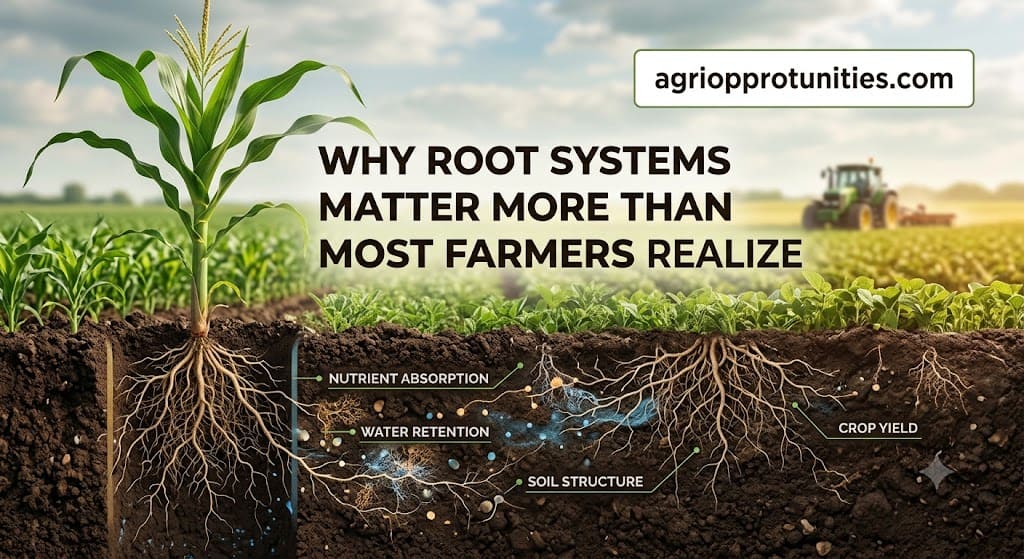
Why Root Systems Matter More Than Most Farmers Realize

W hen people picture what makes a crop resilient to drought or poor soil, they usually think about the visible parts — leaves, stems, the plant’s above-ground appearance. The part actually doing most of the real work in a stressful season is hidden underground, and it rarely gets the attention it deserves. I want to walk through why root system architecture, the specific arrangement and shape of a plant’s root network, has become one of the most actively studied traits in modern crop breeding.

What “Root System Architecture” Actually Means
<Root system architecture (RSA) describes the overall spatial arrangement of a plant’s roots, including their length, branching patterns, growth angles, and distribution throughout the soil. RSA is not static. It changes as the plant develops and responds to environmental conditions, including soil properties, water availability, and nutrient status.
Why This Matters So Much for a Plant That Can’t Move
Plants are sessile, meaning they cannot move to seek better growing conditions as animals can. Their roots anchor them in the soil while absorbing water and nutrients. By shaping root architecture, plants can improve their access to these essential resources. For agricultural researchers and breeders, understanding RSA offers a valuable way to develop crops that use soil resources more efficiently and maintain or improve yields under different growing conditions.
The Key Root Traits Scientists Actually Measure
Rather than treating “root system” as one single characteristic, researchers break it down into several specific, measurable traits, each contributing differently to a plant’s performance.
Root Length Density
Measures the total length of roots packed into a given volume of soil, serving as a useful indicator of how extensively lateral roots have expanded outward. Water uptake is positively correlated with root length density up to a certain critical threshold.
Root Growth Angle
A steeper, more downward growth angle allows a root system to reach deeper soil moisture that remains available long after the topsoil has dried out, while a shallower angle limits a plant to surface moisture.
Root Diameter & Xylem Vessel Size
Increased metaxylem vessel diameter helps reduce hydraulic resistance as water moves upward through the plant, helping maintain proper leaf water status even under drought pressure.
Root Hairs
These microscopic extensions from root cells substantially increase the total surface area available for absorbing both water and dissolved nutrients, playing an outsized role in nutrient uptake efficiency.
Deep Rooting: One of the Clearest Drought Strategies
Among all the root traits studied, deep rooting has emerged as one of the most consistently valuable strategies for drought avoidance specifically. Multiple studies have found that greater root distribution at depth is directly associated with enhanced water uptake under drought conditions, translating into measurably reduced yield loss across different crop varieties.
A Concrete Example From Rice Breeding
Research on a specific rice gene, qSOR1, found that enhancing its functional activity produced more vertically-oriented rooting, and this trait directly improved rice yield specifically under drought stress conditions — a genuinely direct demonstration of how a single, identifiable gene can meaningfully shift a crop’s real-world drought performance through root architecture alone.
A Genuinely Counterintuitive Finding: More Roots Isn’t Always Better
It would be reasonable to assume that a bigger, denser root system is always an advantage under drought stress. Research has found this assumption doesn’t hold up under prolonged drought conditions specifically.
The Carbon Cost Problem
Maintaining root tissue carries substantial respiratory costs, meaning a larger root system requires significantly more of the plant’s carbon resources just for basic maintenance. Under extended drought, roots concentrated in already-dry topsoil provide only limited water uptake benefit, while continuing to consume carbon resources at the same rate — representing what researchers describe as a genuinely low return on the plant’s carbon investment.
Why This Complicates Simple Breeding Goals
This finding is a good example of a pattern that’s shown up repeatedly throughout this science-explainer series: the “obvious” intervention (more roots, more nitrogen, more carbon amendment) isn’t automatically better once you account for the full cost-benefit picture, and breeding programs increasingly need to target the right balance of root traits for specific conditions, rather than simply maximizing root quantity across the board.
Root Traits Matter for Nutrient Uptake Too, Not Just Water
Beyond drought resilience, root system architecture plays a genuinely central role in how efficiently a plant acquires phosphorus and nitrogen — connecting directly back to the nitrogen and phosphorus cycle pieces earlier in this series. In soils where nutrients are unevenly distributed, a plant’s root plasticity (its ability to adjust its architecture in response to where nutrients actually are) can significantly improve nutrient acquisition.
A Concrete Example From Sorghum
Research comparing two sorghum cultivars under phosphorus stress found one variety accumulated 43 to 64 percent more phosphorus in its shoots than the other across different stress conditions, despite no major physiological differences between the two otherwise — a striking demonstration of how much root architecture alone can influence a plant’s actual nutrient acquisition outcome.
Root Traits Also Affect a Plant’s Physical Stability
Beyond water and nutrient uptake, root architecture influences a crop’s resistance to lodging — the agricultural term for when a plant’s stem bends or breaks and the whole plant falls over, often due to wind, heavy rain, or its own top-heavy growth. Research on maize specifically found that local auxin production (tying back to the plant hormones piece earlier in this series) regulates the angle of brace roots, directly affecting the plant’s overall lodging resistance in the field.
The Technology Making This Research Possible
Root research has historically lagged behind above-ground crop trait research for a genuinely practical reason: roots are hard to see and measure without destroying them or the surrounding soil. That’s changed substantially in recent years.
High-Throughput Imaging
The development of high-throughput 2D and 3D imaging technology has allowed researchers to characterize root traits at a scale and speed that simply wasn’t possible before, without needing to physically excavate and destroy every plant being studied.
Genomic Tools and Gene Editing
Combined with high-throughput genotyping platforms and gene-editing technologies, researchers have made real progress identifying the specific molecular and genetic regulatory networks underlying root traits. In maize specifically, researchers identified 19 significant genetic loci associated with root number, with 12 of those loci showing consistent effects under both moderate and severe drought stress — genuinely useful, specific targets for molecular breeding programs aiming to improve drought resilience.
Why This Knowledge Hasn’t Fully Reached Commercial Breeding Yet
Despite this real scientific progress, researchers studying this field are candid about a persistent gap: despite identifying many functionally significant root traits, a genuine knowledge gap remains in actually integrating these traits into predictive breeding frameworks that plant breeders can use reliably and at scale.
Why Roots Have Been Harder to Breed For Than Leaf Traits
Water uptake and root phenotypic traits, despite being among the most important factors determining a plant’s actual water-use efficiency, have historically been underaddressed by breeders. This is largely because of the high variability root systems show in response to their specific environment, combined with the genuine practical difficulty of monitoring root systems in situ without disturbing them — a difficulty above-ground traits like leaf size or flowering time simply don’t share.
Where This Research Is Actively Heading
Current research priorities in this space explicitly include genetic mapping and functional validation of root-related genes, root traits connected to biological nitrogen fixation, genomics-assisted selection and CRISPR-based editing of root traits (tying directly back to the CRISPR piece earlier in this series), high-throughput phenotyping combined with AI and machine learning for modeling root architecture, and — perhaps most practically important — case studies specifically translating root trait research into real, field-ready breeding programs and commercial cultivars.
Why This Matters for Students Considering This Research Area
Root system architecture research sits at a genuinely important and still-developing intersection of plant physiology, genetics, and imaging technology. Given the clearly identified gap between promising root trait discoveries and their actual integration into commercial breeding programs, this is an area where meaningful, high-impact research contributions remain very much available — particularly for students comfortable combining genetic analysis with the newer high-throughput phenotyping tools that are finally making root research tractable at scale.
For current research and graduate opportunities in plant root biology and drought-resilient breeding, browse live agriculture scholarship listings on Agri Opportunities.
Frequently Asked Questions
What is root system architecture?
Root system architecture refers to the overall spatial arrangement of a plant’s root system, including root length, branching pattern, growth angle, and density, all of which determine how effectively a plant can access water and nutrients in the soil.
Why does root growth angle matter for drought tolerance?
A steeper, more downward root growth angle allows roots to reach deeper soil moisture that remains available even after the topsoil has dried out during a drought, while a shallower angle limits access to that deeper water reserve.
Is it always better for a crop to grow more roots under drought stress?
No. Research has found that excessive root development under prolonged drought can actually work against the plant, since maintaining a large root system consumes significant carbon resources through respiration, and roots concentrated in already-dry topsoil provide limited water uptake benefit relative to their ongoing carbon cost.
Can breeders actually select for better root traits?
Yes, increasingly so. Advances in high-throughput root imaging, genotyping platforms, and gene-editing tools have allowed researchers to identify specific genetic loci controlling root traits like root number, angle, and depth, enabling molecular breeding programs to target these traits directly rather than relying on visible above-ground characteristics alone.
Add Agri Opportunities as a preferred source on Google to see latest blog listings first.


Can you help me ?