Why Rice Paddies Produce So Much Methane


A soil scientist’s explanation of how flooded rice soil becomes a methane factory, and the water management strategies that can cut emissions dramatically.
Rice feeds more people on this planet than almost any other single crop, and it also happens to be one of agriculture’s biggest methane sources. Roughly 10 to 12 percent of global methane emissions trace back to rice cultivation, and unlike the nitrous oxide sources covered elsewhere in this series, the mechanism here has almost nothing to do with fertilizer. It’s about water, and about what happens to organic matter when you keep soil flooded for months at a time.

The Basic Mechanism: Flooding Creates a Methane Factory
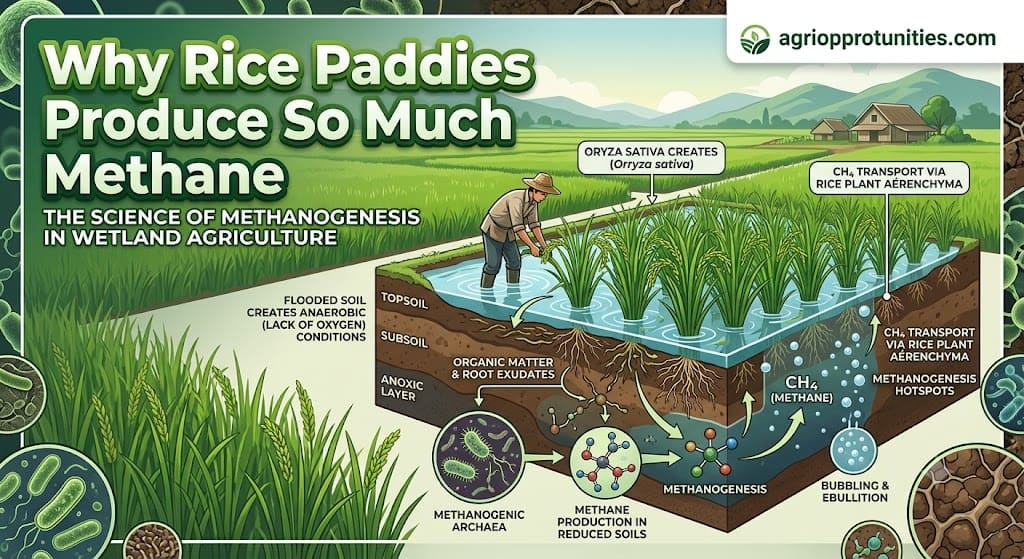
Rice is traditionally grown in continuously flooded fields, and that standing water does something specific to the soil beneath it: it cuts off the oxygen supply almost entirely, creating strictly anaerobic conditions throughout most of the growing season.
Under those oxygen-free conditions, specific microorganisms called methanogenic archaea — methanogens, for short — break down organic carbon in the soil as their energy source, and methane is the metabolic byproduct of that breakdown process. Soils richer in organic matter, whether from crop residue or added amendments, simply give methanogens more fuel to work with, producing more methane in the process.
How Methane Actually Escapes the Soil
Once methane forms below the flooded soil surface, it doesn’t all leave the same way. Understanding the different escape routes matters because they respond differently to management changes.
Through the Rice Plant
Rice plants have aerenchyma tissue that channels methane up through the plant and releases it into the atmosphere — the dominant escape pathway.
Through Bubbling (Ebullition)
Methane bubbles physically form in the waterlogged soil and rise up through the standing water, similar to bubbles rising in a swamp.
Through Diffusion
A small share moves through slow diffusion directly through the soil and water layer without the plant or bubble pathways.
A Built-In Buffer: Methanotrophs Near the Roots
Interestingly, the same aerenchyma tissue that channels oxygen down to rice roots creates small aerobic pockets in the surrounding rhizosphere. This matters because it allows methanotrophic bacteria — organisms that consume methane rather than produce it — to partially oxidize some methane right at the root zone before it ever reaches the atmosphere.
This is a genuinely elegant natural buffering system, though it only partially offsets total methane production rather than eliminating it, since the bulk of the field remains deeply anaerobic throughout the flooded growing season.
The Single Biggest Lever: Water Management
Given that flooding itself is the root cause, it should come as no surprise that changing how a rice field is irrigated is the single most powerful tool for reducing methane emissions. This is a genuinely different management lever than anything covered elsewhere in this series, since it’s about oxygen exposure timing rather than fertilizer chemistry.
- Alternate Wetting and Drying (AWD) — Periodically drains and re-floods the field. Research consistently shows AWD reduces methane emissions by roughly 22 to 64 percent across various studies, and one specific meta-analysis found methane emissions decreased by 31 to 62 percent under this practice.
- Precision Aerobic Irrigation — A more refined approach achieving a 56.64 percent reduction in cumulative methane emissions, a 33.23 percent cut in irrigation water use, and a 13.06 percent yield increase simultaneously.
- Controlled Drip Irrigation — An even more aggressive departure from flooding, showing reductions in methane emissions exceeding 90 percent compared to flood irrigation in controlled research settings.

⚠️ The Trade-Off This Series Keeps Running Into: Methane Down, Nitrous Oxide Up
If this pattern sounds familiar, it should — it’s structurally similar to the ammonia-versus-nitrous-oxide trade-off covered earlier in this series. Drying out rice soil to suppress methane creates exactly the oxygen-rich conditions that favor nitrification, and the subsequent re-flooding cycles create denitrification conditions too, meaning nitrous oxide production can actually increase even as methane drops.
The numbers here are genuinely striking. A synthesis of 11 recent meta-analyses found that water management practices reducing methane by 31 to 62 percent simultaneously increased nitrous oxide emissions by 37 to 445 percent. Since nitrous oxide is nearly 300 times more potent than carbon dioxide per unit of mass, as covered in the second piece of this series, this trade-off needs to be evaluated on a full greenhouse-gas-equivalent basis, not just by looking at methane numbers in isolation.
Why the Net Effect Can Still Be Positive: Despite this trade-off, most research still finds a net climate benefit from AWD and similar practices, because methane’s shorter atmospheric lifetime combined with the sheer scale of the baseline methane reduction generally outweighs the nitrous oxide increase in total warming impact — though the exact balance depends on the specific timing and intensity of the drainage events used.
Managing Rice Straw: Another Major Lever
Beyond water management, what happens to rice straw after harvest significantly shapes methane output in the following season. Incorporating fresh rice straw directly into flooded soil gives methanogens abundant fresh organic carbon to work with, increasing methane production considerably.
🔥 A Genuinely Impressive Biochar Result
Rather than incorporating raw straw, converting it into biochar first — tying directly back to the biochar piece earlier in this series — has shown remarkable results. A two-year field experiment in eastern China found that adding rice straw biochar to paddy soil reduced methane emissions by up to 86 percent while simultaneously increasing yield by more than 13 percent. This approach also avoids the alternative of straw burning, a still-common practice in many rice-growing regions that itself generates significant methane and carbon dioxide emissions.
🧪 Fertilizer Management Matters Too
Changing fertilizer application regimes in rice systems has been shown to lower methane emissions by as much as 50 percent in some studies, working through a different mechanism than the nitrogen cycle dynamics covered earlier in this series — here, fertilizer choice and timing interact with the soil’s redox chemistry and organic carbon availability that methanogens depend on, rather than primarily driving nitrification and denitrification pathways.
Soil Chemistry Also Shapes the Outcome
Beyond water and organic inputs, a soil’s inherent chemistry plays a real role. Soils higher in iron content can actually suppress methane production, because iron compounds serve as an alternative electron acceptor that outcompetes methanogens for the same microbial “fuel” — a genuinely useful natural buffering mechanism in iron-rich paddy soils.
A Useful Side Benefit: Reduced Cadmium Uptake
Interestingly, the choice between continuous flooding and alternate water management doesn’t only affect greenhouse gases. Flooded, anaerobic conditions also favor sulfate-reducing bacteria that convert soluble cadmium into an insoluble, less bioavailable form, reducing the amount of this heavy metal contaminant that ends up in rice grain. This creates a genuinely complicated trade-off for farmers and researchers to weigh: water management approaches that cut methane emissions can sometimes increase cadmium accumulation risk in rice, meaning the “best” irrigation strategy depends on which environmental and food-safety priority matters more for a specific region’s soil conditions.
Why This Matters for Students Considering This Research Area
Rice paddy methane research sits at a genuinely rich intersection of microbiology, water management engineering, and food security policy, given how central rice is to global caloric intake and how large its methane footprint remains. Unlike the nitrogen-focused research covered elsewhere in this series, this field rewards deep familiarity with microbial ecology under fluctuating oxygen conditions, alongside genuine practical knowledge of irrigation infrastructure and farmer adoption constraints in rice-growing regions.
For current research and graduate opportunities in rice systems and greenhouse gas mitigation, browse live agriculture scholarship listings on Agri Opportunities.
Frequently Asked Questions
What percentage of global methane emissions come from rice cultivation?
Rice cultivation is responsible for roughly 10 to 12 percent of global methane emissions, making it one of agriculture’s largest single sources of this greenhouse gas.
What organisms actually produce methane in rice paddies?
Methane in rice paddies is produced by methanogenic archaea, microorganisms that break down organic carbon under the strictly oxygen-free conditions created by flooding, using that organic matter as their energy source.
How does alternate wetting and drying reduce methane emissions?
Alternate wetting and drying periodically drains and re-floods rice fields rather than keeping them continuously flooded, introducing oxygen into the soil during dry periods that suppresses methane-producing methanogens and favors methane-consuming methanotrophs instead, reducing methane emissions by roughly 22 to 64 percent in various studies.
Does reducing methane in rice paddies create other problems?
Yes. Multiple meta-analyses have found that water management practices reducing methane emissions by 31 to 62 percent simultaneously increase nitrous oxide emissions by 37 to 445 percent, since drying the soil shifts conditions to favor nitrification and denitrification instead of methane-producing anaerobic decomposition.
Add Agri Opportunities as a preferred source on Google to see latest blog listings first.