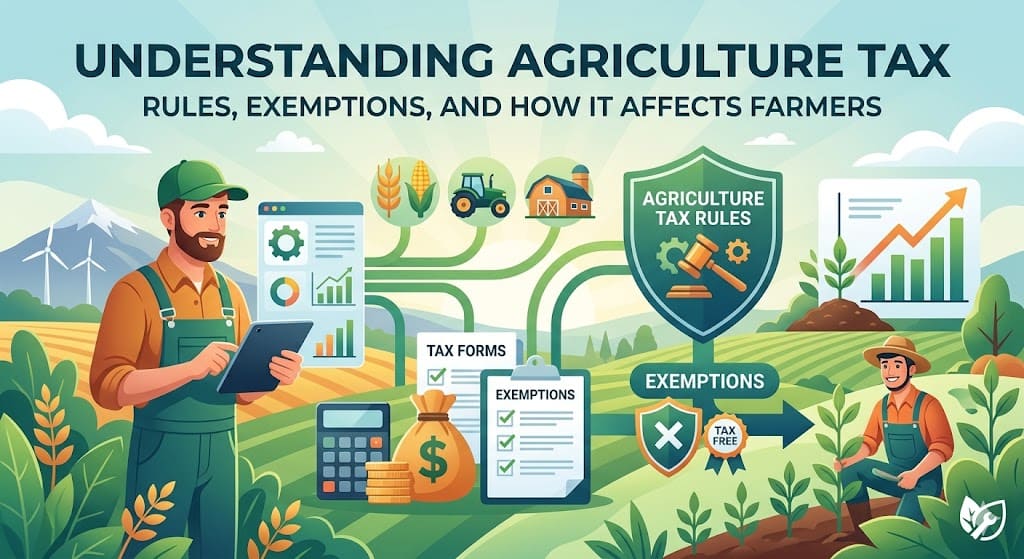
What Is Agriculture Tax? Rules, Exemptions, and How It Affects Farmers

What Is Agriculture Tax?
Rules, Exemptions, and How It Affects Farmers
Complete guide to agricultural taxation: learn how agricultural income tax works, farming tax deductions, exemptions, reliefs, and how tax policy affects farmers worldwide.

Taxation and the Farmer: A Relationship That Shapes the Entire Industry
Of all the complexities a farmer navigates — weather, markets, input costs, labor, land — taxation is among the least visible yet most consequential. Agriculture tax affects how farming businesses are structured, how land is valued and transferred, what investments are financially viable, and ultimately whether farming as an occupation remains economically sustainable. Therefore, understanding agricultural taxation is essential for every farmer and agribusiness operator. Moreover, tax planning can significantly impact farm profitability.
However, agricultural taxation is widely misunderstood. Many people assume farmers pay no tax at all. Others assume farming businesses are taxed the same as any other commercial enterprise. The reality, in nearly every country in the world, lies somewhere between these positions — shaped by agricultural tax policy decisions that reflect the economic, social, and food security priorities of each nation. Consequently, this guide explains what agriculture tax is, how agricultural income tax works, what exemptions and deductions typically apply, and why agricultural taxation matters to farmers and economies worldwide. Thus, readers will gain a comprehensive understanding of this critical topic.
What Is Agriculture Tax?
Agriculture tax — also referred to as agricultural tax or farming tax — is the system of taxation applied to income, land, and economic activity derived from agricultural operations. Specifically, it encompasses how farm revenue is assessed, what rates apply, which exemptions or deductions are available, and how compliance is administered by government authorities. Therefore, understanding this system is fundamental to farm business management. Furthermore, tax rules vary significantly between countries.
At its most fundamental level, the question of what is agriculture tax is a question about how governments treat farming income within their broader public finance and fiscal policy frameworks. The answer varies significantly by country — reflecting differences in agricultural economics, rural development priorities, food security policy, and the historical relationship between governments and farming communities. Consequently, farmers must understand the specific rules in their jurisdiction. Additionally, tax laws frequently change, requiring ongoing attention.
In some countries, agricultural income is entirely exempt from income tax as a matter of national food policy. In others, farming businesses are taxed similarly to any commercial enterprise, though with sector-specific deductions and allowances. In many, a hybrid approach applies — with small subsistence farmers largely outside the formal tax system, commercial agribusinesses fully subject to corporate taxation, and a range of middle-ground treatments for medium-scale farming operations. Thus, the agricultural tax system relevant to a specific farm operation requires careful study. For this reason, professional advice is often valuable.
Why Agricultural Taxation Matters
The importance of agricultural taxation extends well beyond the individual farmer’s tax return. Agricultural tax policy shapes the structure of the farming sector, the incentives for agricultural investment, the viability of rural communities, and the capacity of governments to fund agricultural support programs. Therefore, everyone in the agricultural sector should understand these dynamics. Moreover, tax policy directly influences farming decisions at every level.
🌾 Food Security & Tax Policy
Governments that exempt or reduce tax on agricultural income do so primarily to protect food security — ensuring that farming remains economically attractive. The Food and Agriculture Organization recognizes agricultural taxation as a component of broader food security policy. Consequently, tax policy directly affects food production levels. Additionally, tax incentives can encourage sustainable farming practices.
🏘️ Rural Development & Economic Equity
Agricultural tax policy intersects deeply with rural development goals. In many countries, farming is the primary livelihood of rural populations. Tax law that is burdensome for farming realities can undermine rural economic stability. Therefore, fiscal policy that supports farmers contributes to more equitable rural development. For this reason, tax reform is often a rural development priority.
💼 Investment & Agribusiness Growth
For agribusiness investors and agricultural finance institutions, the agricultural tax system is a key factor in investment decisions. Favorable tax treatment reduces investment risk and encourages capital allocation toward agricultural development. Thus, tax policy influences agricultural modernization. Furthermore, predictable tax rules attract long-term investment.
🏛️ Government Revenue & Agricultural Subsidies
From a public finance perspective, agricultural taxation balances revenue collection with support provision. Governments that forgo tax revenue often compensate by directing agricultural subsidies toward the farming sector. Consequently, the fiscal relationship between farmers and governments is two-directional. Moreover, this balance affects overall agricultural policy effectiveness.
Is Agricultural Income Taxable?
The question of whether agricultural income is taxable — and if so, how — is answered differently in different tax systems around the world. Therefore, farmers must understand the specific rules in their country. Additionally, tax treaties and international agreements can affect cross-border farming operations.
Agricultural Income Tax in the United States
In the United States, agricultural income is fully subject to federal and state income tax. However, the agricultural tax system provides a wide range of deductions, credits, and favorable treatment provisions that significantly reduce the effective tax burden for most farming operations. The USDA and IRS administer the primary frameworks for farm tax regulations. US agriculture taxation allows farmers to deduct a broad range of farming business expenses — including seeds, fertilizer, pesticides, farm machinery depreciation, farm buildings, and leased agricultural land. Additionally, self-employment tax applies to most farm operators, but income averaging provisions allow farmers to spread taxable farm income across multiple years. Thus, the effective tax rate on farming income is often much lower than the nominal rate.
Agricultural Income Tax in India
In India, agricultural income is exempt from central government income tax under the Income Tax Act — one of the most significant agricultural tax exemptions in any major economy. Agricultural income in India includes income from farming land, income from farm buildings used for agricultural purposes, and income from commercial products of agricultural origin. However, agricultural income is used for rate purposes in calculating tax on non-agricultural income — a mechanism known as partial integration. State governments levy agricultural land tax, with systems varying by state. Consequently, the overall tax burden on Indian farmers depends significantly on state-level policies.
Agricultural Tax in Pakistan
Agricultural tax in Pakistan is constitutionally a provincial subject, meaning each province administers its own agricultural income tax system. Agricultural income tax in Pakistan applies to income above specified thresholds, with rates and exemptions varying by province. The taxation of farming businesses in Pakistan has been an area of ongoing fiscal policy reform, with debates around extending agricultural income tax collection as part of public finance modernization efforts. Therefore, farmers in Pakistan must consult their provincial tax authorities for specific guidance.
Agricultural Tax in the United Kingdom
In the United Kingdom, farm businesses are subject to income tax or corporation tax on farming profits. However, the UK agricultural tax system provides significant reliefs — most notably Agricultural Property Relief (APR), which can provide up to 100 percent relief from inheritance tax on qualifying agricultural property. Therefore, APR is one of the most important tax benefits for farming families managing intergenerational land transfers. Farmers can also access capital allowances for agricultural machinery and benefit from favorable treatment of farm diversification income. Thus, the UK system strongly supports family farm succession.

How Agricultural Tax Is Calculated
How is agricultural tax calculated? The calculation approach depends on the tax system in question. However, most agricultural income tax frameworks follow one of several models. Therefore, understanding these models is essential for effective tax planning. Moreover, different models have different compliance requirements.
Profit-Based Taxation
In profit-based agricultural tax systems — used in the United States, UK, and most developed economies — taxable farm income is calculated as total agricultural revenue minus allowable farming business expenses. This approach requires detailed farm accounting records covering all income sources and all deductible expenses. Consequently, the profit-based approach is the most equitable from an agricultural economics perspective, as it taxes actual farm profitability rather than gross revenue. However, it requires sophisticated farm accounting capabilities. Nevertheless, many farmers find the accuracy worth the effort.
Area-Based or Presumptive Taxation
Area-based agricultural tax systems calculate tax liability based on the area of agricultural land farmed — often multiplied by a standard presumptive yield per hectare — rather than actual farm profits. This approach is simpler to administer and less demanding of farm accounting records. However, it can be inequitable when actual farm productivity varies significantly from the standard presumptive figures used. Thus, many developing countries use presumptive approaches for smaller farms while applying profit-based taxation to larger commercial operations. For this reason, hybrid systems are common.
Land Value Taxation
Agricultural land tax — based on the value of farmland rather than farm income — is another approach used in some fiscal policy frameworks. Land value taxation can encourage productive use of agricultural land by creating a carrying cost for underutilized farmland. However, it can also create cash flow challenges for farmers whose land values are high relative to their current income. Therefore, this approach is particularly challenging in peri-urban areas experiencing development pressure. Consequently, land value taxes are often accompanied by relief provisions for working farmers.
Agricultural Tax Exemptions and Benefits
What tax benefits do farmers receive? Most agricultural tax systems incorporate substantial exemptions, deductions, and reliefs designed to support farm viability, encourage agricultural investment, and reflect the unique economic characteristics of farming as a business. Consequently, farmers who understand these benefits can significantly reduce their tax burden. Furthermore, these benefits often reward sustainable practices.
💰 Income Tax Exemptions
Several countries exempt agricultural income entirely or partially from income tax — recognizing that food production is a strategic national priority. These agricultural tax exemptions represent a significant fiscal policy choice, reflecting food security and rural development priorities. Therefore, farmers in these jurisdictions have lower tax burdens.
📋 Farm Business Expense Deductions
Almost every agricultural income tax system allows farming tax deductions for legitimate business expenses. Deductible expenses typically include seeds, fertilizer, pesticides, farm machinery depreciation, fuel, farm buildings, irrigation systems, wages, insurance, land lease costs, and professional fees. Thus, farmers can offset many costs against their taxable income.
⚙️ Depreciation & Capital Allowances
Farm machinery, agricultural machinery, tractor implements, farm equipment, and farm buildings typically qualify for depreciation deductions. Smart farming technologies, digital agriculture tools, drone farming equipment, and precision agriculture hardware may also qualify for capital allowances in many tax jurisdictions. Consequently, technology investments become more affordable.
📊 Income Averaging
Because farming income is inherently volatile, many agricultural tax systems offer income averaging provisions. These allow farmers to spread income across multiple years for tax purposes, preventing the distortion of applying progressive tax rates to high-income years that reflect lumpy agricultural revenue. Therefore, farmers in volatile commodity markets benefit greatly.
🏞️ Agricultural Property Reliefs
Inheritance tax reliefs and capital gains tax exemptions on agricultural land support intergenerational farm transfer. These agricultural land taxation reliefs ensure that family farms can pass between generations without triggering tax liabilities that would force the sale of farmland. Thus, they preserve family farming as a way of life.
💵 Agricultural Subsidies Treatment
The taxation of agricultural subsidies — payments from USDA grant programs, conservation agriculture initiatives, and agri finance support schemes — varies by jurisdiction. Understanding how government payments interact with farm tax regulations is an important component of agriculture tax planning. Consequently, farmers receiving subsidies must carefully track their tax treatment.
Agricultural Tax Compliance: What Farmers Need to Do
Agricultural tax compliance refers to the practical obligations that farming businesses must fulfill to meet their tax law responsibilities. Good tax compliance is both a legal requirement and a financial management tool — proper farm accounting and record-keeping not only satisfies tax authorities but also provides the information needed for effective agriculture tax planning. Therefore, farmers should prioritize these practices. Moreover, digital tools make compliance easier than ever before.
Farm Accounting Records
Accurate farm accounting records are the foundation of agricultural tax compliance. Farmers should maintain complete records of all farm income — including crop sales, livestock sales, agribusiness service revenue, and government payments — and all farming business expenses, supported by invoices, receipts, and bank statements. Records should be kept for the minimum period required by the relevant tax authority — typically five to seven years in most jurisdictions. Agriculture apps and digital agriculture tools increasingly support farm accounting, making compliance more accessible for farmers without dedicated accounting staff. Consequently, record-keeping has become less burdensome.
Agricultural Tax Assessment and Filing
The agricultural tax assessment process varies by jurisdiction. In self-assessment systems (common in the United States and UK), farmers calculate their own taxable farm income, prepare farm profit reporting statements, and submit returns to the relevant authority. In assessment-based systems, tax authorities may assess farm tax liability based on land area, standard income assumptions, or audited accounts. Consequently, meeting filing deadlines, maintaining required records, and accurately reporting all taxable farm income are the core obligations of agricultural tax compliance. Therefore, farmers should calendar all important tax deadlines.
Tax Incentives for Agriculture and Investment Planning
Agriculture tax planning — the proactive management of farming business activities to optimize tax outcomes within the law — is a legitimate and important component of agricultural financial management. Tax incentives for agriculture, including equipment depreciation allowances, income averaging provisions, agricultural subsidies treatment, and capital gains reliefs, create planning opportunities that reduce the overall tax burden on farming operations. For larger agribusiness operations, the interaction between agricultural tax systems, agri finance structures, and agricultural economics creates sophisticated planning considerations. Therefore, agricultural finance advisors and farm business tax professionals play an important role. Additionally, tax planning should be an ongoing process, not just a year-end activity.
Agriculture Tax Policy: The Bigger Picture
Agricultural tax policy sits at the intersection of fiscal policy, agricultural economics, food security strategy, and rural development objectives. Getting the balance right — between raising public finance revenue and supporting the agricultural sector — is one of the ongoing challenges of government in every country that depends on farming for food security. Therefore, understanding policy trends is valuable for farmers and agribusinesses. Moreover, policy changes can create both opportunities and challenges.
The Economic Impact of Agricultural Tax Policy
The economic impact of agricultural tax policy is felt across the entire food system. Tax systems that impose excessive burdens on farming — through high agricultural income tax rates, punitive agricultural land taxation, or poorly designed compliance requirements — reduce farming profitability, discourage agricultural investment, and can accelerate the exit of farmers from the sector. Conversely, agricultural tax systems that provide appropriate relief, recognize the economic realities of farming, and encourage long-term investment contribute to a more productive and resilient agricultural sector. Thus, tax policy has direct effects on food production. Furthermore, tax policy affects land values and rural economic vitality.
Agricultural Taxation and Sustainable Farming
An increasingly important dimension of agricultural tax policy is its relationship to sustainable farming practices and climate smart agriculture objectives. Several countries are developing or extending tax incentives specifically for regenerative agriculture, carbon farming, no till farming, organic agriculture, and other environmentally beneficial farming practices. These fiscal policy tools — sometimes called eco-fiscal reforms — use the tax system to align private farming decisions with public environmental goals. The Food and Agriculture Organization supports the development of agricultural tax frameworks that promote agroecology and sustainable food systems. Consequently, sustainable farmers may soon have access to new tax benefits.
Agricultural Tax and Agritech Investment
The treatment of investment in smart farming technologies — precision agriculture equipment, digital agriculture tools, drone farming systems, agricultural GIS tools, and smart agriculture system infrastructure — under agricultural tax systems has important implications for agritech adoption. Tax systems that allow rapid depreciation of precision ag and agritech investments encourage farmers and agribusiness operators to adopt productivity-enhancing technologies faster. Consequently, tax policy influences the pace of agricultural modernization. Therefore, pro-technology tax policies can accelerate the adoption of efficiency-enhancing tools.
Frequently Asked Questions About Agriculture Tax
📖 Understanding Agriculture Tax
📊 Calculation and Deductions
✅ Tax Benefits for Farmers
🏛️ Tax Policy and Reduction Strategies
Conclusion: Tax Is Not Just a Burden — It Is Part of Farm Business Strategy
💰 Tax as a Strategic Tool
Agriculture tax is often approached with apprehension — as an external obligation to be minimized and met. However, farmers and agribusiness operators who understand the agricultural tax system properly recognize it as an integral component of farm business strategy, not simply a compliance exercise. Therefore, proactive tax planning should be part of every farm’s financial management. Moreover, tax knowledge can create competitive advantages.
📋 The Reality of Agricultural Taxation
The reality of agricultural taxation is that most tax systems — when understood and navigated effectively — are not hostile to farming. Most recognize the strategic importance of agricultural income for food security. Most provide farming tax deductions that substantially reduce effective tax rates on farm profits. Most offer relief on agricultural land transfers that protects family farming across generations. Moreover, most are evolving to provide additional tax incentives for sustainable farming practices, precision agriculture investment, and climate smart agriculture participation. Consequently, farmers who invest in understanding these systems gain significant advantages. For this reason, tax education should be a priority for farming organizations.
🌾 What This Means for Farmers
What this means in practice is that farmers who invest in farm accounting, engage competent agricultural financial management support, and take an active approach to agriculture tax planning are generally in a strong position. They understand their taxable farm income accurately. They capture all legitimate farming tax deductions. They time capital investments to maximize depreciation benefits. And they access the full range of agricultural tax exemptions, reliefs, and incentives available in their jurisdiction. Thus, tax planning becomes a competitive advantage rather than a burden. Furthermore, these farmers are better prepared for tax audits and inquiries.
🌍 The Relationship Between Farming and Society
The agricultural tax system also reflects something important about the relationship between farming and society. Governments that provide agricultural tax relief are making a statement about the value of food production, rural development, and the farming way of life. They are recognizing, through fiscal policy, that agriculture is not just another business — it is the foundation of the food security and rural economic health that entire societies depend on. For farmers at every scale — from small scale farming operations to large commercial agribusiness enterprises — understanding agriculture tax is not optional. It is a core competency of modern farm management. And for those who master it, it is a genuine competitive advantage. Therefore, every farmer should invest time in learning their local tax rules and seeking professional advice when needed.
📚 Related Guides from Agri Opportunities
↗️ How Is Urbanization Affecting Agriculture? ↗️ Carbon Footprint Calculator for Agriculture ↗️ Computer Vision in Agriculture📚 External Resources & Further Reading
Add Agri Opportunities as a preferred source on Google to see latest blog listings first.