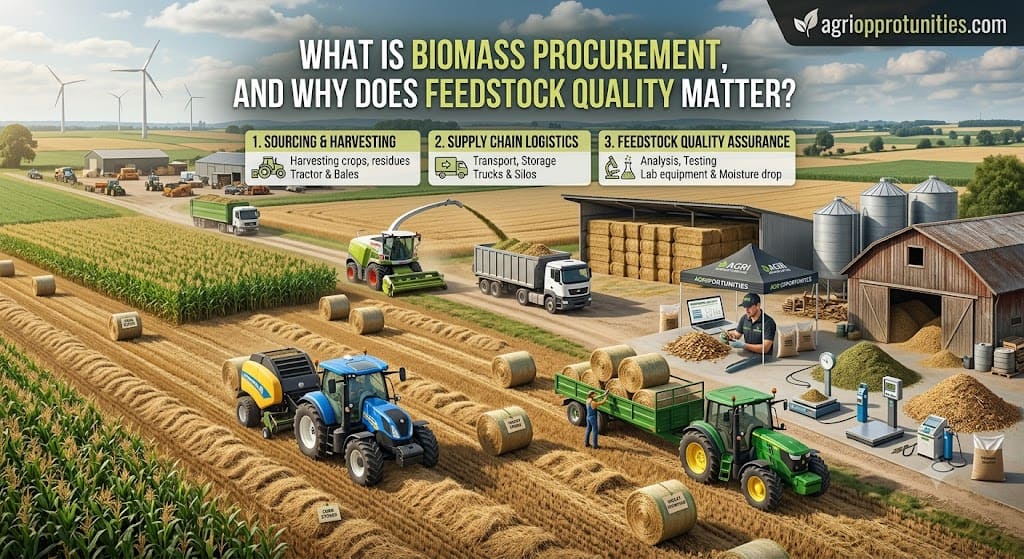
What Is Biomass Procurement, and Why Does Feedstock Quality Matter?

What Is Biomass Procurement, and Why Does Feedstock Quality Matter?
How agricultural residues are sourced as industrial fuel — and why moisture, ash, and calorific value determine everything downstream
Behind many of Pakistan’s textile mills, sugar refineries, and increasingly, power generation facilities, sits a genuinely important but rarely discussed function: sourcing agricultural residue at industrial scale to fuel boilers and processing operations. I want to walk through what biomass procurement actually involves, and why the quality of the feedstock being procured matters so much more than most people assume.

What Biomass Procurement Actually Involves
At its core, biomass procurement means sourcing agricultural or forestry residues — crop stalks, husks, straw, wood waste, or similar organic material — at sufficient volume and reliable, consistent quality to supply an industrial facility that burns or converts that material, typically for boiler fuel, captive power generation, or increasingly, conversion into biochar or other value-added products.
Why This Is Genuinely Different From Buying a Standard Commodity
Unlike procuring a standardized agricultural commodity like wheat or cotton, biomass feedstock is genuinely variable — its physical and chemical properties differ significantly depending on the specific crop residue, the region it was grown in, how it was harvested and stored, and how long it sat before delivery. This variability is exactly why biomass procurement requires genuine technical evaluation, not simply negotiating volume and price the way a standard commodity purchase might.
The Core Quality Parameters That Matter
Industry standards and researchers evaluate biomass feedstock using two main approaches. Proximate analysis measures moisture, volatile matter, ash content, and fixed carbon, while elemental analysis measures carbon, hydrogen, nitrogen, oxygen, chlorine, and sulfur content.
Moisture Content: The Single Most Consequential Variable
Fresh biomass often contains a high proportion of water. Fresh wood, for example, can contain about 50% water by weight, compared with roughly 5% for bituminous coal. This moisture lowers fuel quality in several ways. Combustion systems must first evaporate the water before the biomass can burn efficiently, reducing its effective calorific value. High moisture also lowers the maximum combustion temperature, increases the time the fuel must remain in the combustion chamber, and can cause incomplete combustion. As a result, the system produces more flue gas and higher emissions for each unit of energy generated.
Why Procurement Teams Actively Manage Moisture Before Delivery
Given how directly moisture undermines combustion efficiency, biomass procurement operations often specify maximum acceptable moisture thresholds in supply agreements, and some feedstocks are pre-dried before delivery or before further processing specifically to limit moisture’s negative effect on downstream combustion or conversion performance.
Ash Content: A Highly Variable, Crop-Dependent Parameter
Ash content refers to the incombustible mineral residue remaining after complete combustion, and it’s always measured on a dry basis. This parameter matters both for the fuel’s overall energy value (since ash-forming substances contribute no combustion energy) and for determining whether a specific biomass type is even suitable for a particular combustion system.
Why Ash Content Varies So Dramatically by Crop Residue Type
This is a genuinely important, easy-to-underestimate detail: ash content varies enormously depending on the specific biomass source. Research measuring orchard and agricultural residues found ash content relatively low on average, around 3 to 5 percent on a dry matter basis, for most residue types — except for grapevine prunings specifically, which showed a dramatically higher ash content around 18 percent. This kind of crop-specific variation means a procurement team genuinely needs to evaluate each specific residue type on its own terms, rather than assuming all agricultural biomass behaves similarly.
Calorific Value: The Actual Energy Content
Calorific value — the actual energy released per unit of fuel, typically expressed in megajoules per kilogram — is the parameter that most directly determines a feedstock’s economic value as fuel. Research across common plant-based biomass types found calorific values typically clustering in a range of roughly 15 to 21 MJ/kg, though this varies by specific species and residue type.
How Moisture and Calorific Value Interact
Calorific value is directly, inversely tied to moisture content — net calorific value for wood, for example, decreases steadily as total moisture rises, reaching zero at around 88 percent moisture. Air-dried wood, with moisture typically between 12 and 20 percent, yields a calorific value in the range of roughly 13 to 16 MJ/kg — a genuinely useful illustration of exactly how much moisture management directly translates into real fuel value, not just a secondary quality concern.

Volatile Matter and Fixed Carbon: What They Tell You About Combustion Behavior
Beyond moisture and ash, volatile matter — the gases released during the initial stages of combustion — plays a genuinely important role in fuel ignition and flame stability. Research characterizing common biomass feedstocks found volatile matter content varying considerably by species, with eucalyptus showing particularly high volatile matter (around 74 percent) and rice husk somewhat lower (around 64 percent).
Why Too Much Volatile Matter Can Also Be a Problem
It’s worth understanding that volatile matter isn’t simply “more is better.” An excessive amount of volatile matter can actually lead to inefficient combustion if some portion escapes the combustion chamber without fully reacting — meaning combustion system design and feedstock volatile matter content need to be reasonably well matched, rather than assuming higher volatile matter is always a straightforward advantage.
How This Connects to Biochar and Value-Added Biomass Use
Feedstock quality assessment matters just as much when biomass is destined for conversion into biochar rather than direct combustion — a connection worth drawing directly to the biochar and digestate content covered elsewhere on this site. Research on biochar production found that converting raw biomass into biochar through pyrolysis generally increases calorific value substantially compared to the original feedstock — one study found woody biochar showing calorific values 28 to 29 percent higher than the equivalent raw feedstock — meaning feedstock quality assessment isn’t just relevant to direct-burn applications, but shapes the eventual value of biochar-based soil amendments too.
Why Standardization Matters: The Role of ISO Standards
Given how much feedstock quality can vary, the biomass energy industry has developed formal international standards — including ISO 17225 for solid biofuel classification, alongside specific test method standards for moisture (ISO 18134), calorific value (ISO 18125), ash content (ISO 18122), and elemental composition (ISO 16948 and ISO 16994) — providing a genuinely standardized basis for comparing and specifying feedstock quality across different suppliers and facilities, rather than relying on inconsistent, facility-specific testing approaches.
Why This Standardization Genuinely Helps a Procurement Function
Standardized testing protocols mean a procurement specialist can meaningfully compare feedstock quality across different suppliers, regions, and residue types using a common, internationally recognized methodology — essential for negotiating supply contracts with clear, enforceable quality specifications rather than vague, subjective quality expectations that are difficult to verify or dispute.
Practical Considerations for Biomass Procurement Operations
Building Supply Consistency Across a Genuinely Variable Input
Given how much agricultural residue characteristics vary by crop, season, and region, a well-run biomass procurement operation typically diversifies its supplier base across multiple residue types and geographic sources, both to secure adequate volume and to blend feedstocks strategically to achieve a more consistent overall quality profile than any single source could reliably provide alone.
Storage and Handling: Protecting Quality After Procurement
Since moisture content is so central to feedstock value, proper storage — protecting biomass from rain exposure and ensuring adequate ventilation to prevent moisture reabsorption — represents a genuinely important, ongoing responsibility for procurement and logistics teams, not simply a one-time quality check performed at the point of purchase.
Why This Matters for a Career in Biomass Procurement
Given how directly feedstock quality determines both a facility’s combustion efficiency and its equipment’s operational lifespan (poor-quality, high-ash, or high-moisture feedstock accelerates wear on boiler and handling equipment), a genuinely strong biomass procurement specialist needs real technical fluency in the parameters covered throughout this piece — not simply commercial negotiation skill. This makes biomass procurement a genuinely distinct, technically demanding specialization within the broader agribusiness supply chain career track covered elsewhere on this site, rewarding candidates who can combine commercial sourcing skill with genuine feedstock quality literacy.
For current openings in biomass procurement and agribusiness supply chain roles in Pakistan, browse live agriculture job listings on Agri Opportunities.
Frequently Asked Questions
What is biomass procurement?
Biomass procurement is the process of sourcing agricultural or forestry residues, such as crop stalks, husks, or wood waste, at sufficient volume and consistent quality to supply an industrial facility that burns or processes that material for energy or other conversion purposes.
Why does moisture content matter so much in biomass fuel?
High moisture content lowers a biomass fuel’s effective calorific value because energy must first be spent evaporating the water before combustion can occur, and it also reduces maximum combustion temperature, increases the necessary residence time in a combustion chamber, and can lead to incomplete combustion and higher emissions.
What is ash content and why does it vary so much between biomass types?
Ash content is the incombustible mineral residue remaining after complete combustion, and it varies significantly by biomass type, with fuelwood typically around 1 percent ash while some agricultural residues, such as grapevine prunings, can reach as high as 18 percent ash on a dry matter basis.
What is proximate analysis in the context of biomass quality?
Proximate analysis refers to the standard set of tests measuring moisture, volatile matter, ash content, and fixed carbon in a biomass sample, together providing the core data needed to assess a feedstock’s energy viability and combustion behavior.
Add Agri Opportunities as a preferred source on Google to see latest blog listings first.



https://www.facebook.com/share/1CJabEaKCe/
I am interested to play my role as biomass procurement specialist.
Regards
Tajammal Hussain tahir
Agri professional
Bio energy developer.
Contact:03076943031