Carbon Farming 101: What Farmers Need to Know Before Chasing Carbon Credits


A soil scientist’s honest breakdown of how carbon credits actually work, what they really pay, and the red flags worth watching for.
This is a part of soil science series, the carbon credits sit at the intersection of everything covered so far — nitrogen cycling, nitrous oxide, biochar, cover crops, dryland soils, and the carbon-nitrate balance that determines how soil actually behaves. Carbon farming promises to turn all of that underlying science into a genuine income stream. That promise is real, but it comes with more fine print than most marketing materials let on, and I want to walk through it honestly rather than as a sales pitch.

What a Carbon Credit Actually Is
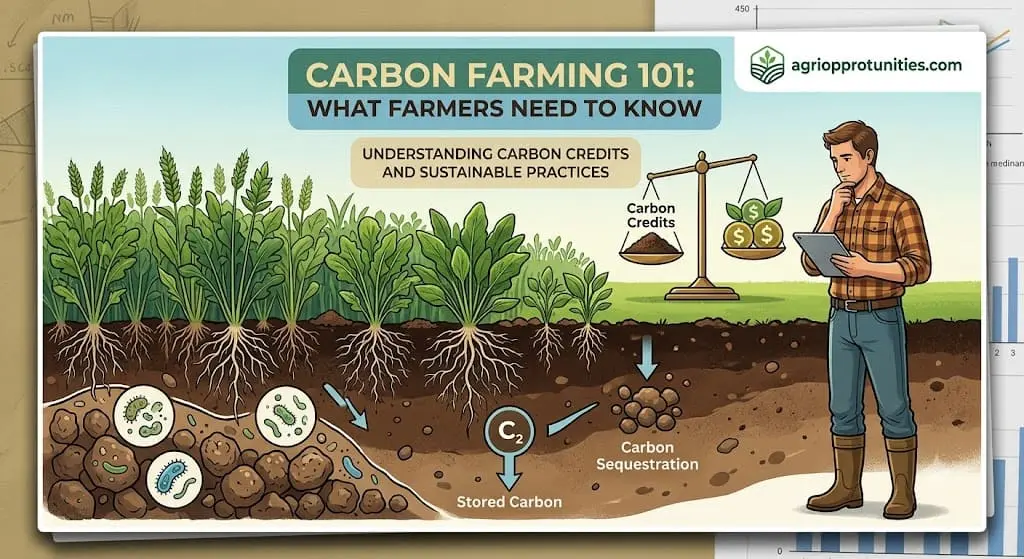
A carbon credit represents one tonne of carbon dioxide equivalent (tCO₂e) either reduced or removed from the atmosphere. In soil carbon farming specifically, this usually means demonstrating that a given practice — cover cropping, reduced tillage, better nitrogen management — has measurably increased how much carbon is stored in the soil, or reduced how much greenhouse gas the field emits.
A company or organization then purchases that credit, usually to offset its own emissions elsewhere, and the farmer gets paid for generating it. In principle, it’s a clean way to compensate farmers for a genuine public good — carbon storage that benefits everyone, not just the farm itself.
How the Verification Process Actually Works
Getting from “I planted cover crops” to “I have a sellable carbon credit” requires a formal process called MRV: Measurement, Reporting, and Verification. This typically involves soil sampling, satellite or remote sensing monitoring, and detailed digital record-keeping of practices, inputs, and yields.
This process exists specifically to ensure credits represent real, additional, and permanent carbon changes rather than just a farmer’s claim. Well-known certification bodies overseeing this process include Verra, Gold Standard, and Climate Action Reserve, alongside various country-specific certification programs.
What Farmers Should Prepare Before Enrolling
Practical guidance for prospective participants consistently recommends gathering three to five years of historical data on crops, yields, fertilizer use, and farming practices before applying to a program. This baseline data is essential for demonstrating genuine change from prior practice, which leads directly into the single most contentious concept in this entire market.
Additionality: The Concept That Excludes Many Genuine Early Adopters
Additionality is the requirement that a farmer’s practices must be new or expanded beyond what they were already doing, or beyond regional norms, to generate a legitimate credit. The logic makes sense in theory: a credit is supposed to represent an emissions reduction that wouldn’t have happened anyway.
In practice, this creates a genuinely uncomfortable outcome. Research estimates that 40 to 60 percent of farmers enrolled in carbon programs were already implementing qualifying practices, or planning to adopt them, regardless of any carbon payment — meaning a substantial share of issued credits may not represent genuine additional climate benefit at all.
The “Gravy on Top” Problem
This dynamic has earned its own nickname in industry discussion: the “gravy on top” problem, describing situations where farmers effectively get paid for practices they would have adopted anyway. It represents a real challenge to overall market integrity, and it’s part of why farmers who’ve been practicing sustainable methods for many years sometimes struggle, somewhat unfairly, to qualify for new carbon programs — their genuine long-term commitment actually works against them under strict additionality rules.
Permanence: What Happens If You Change Your Mind Later
Soil carbon storage isn’t necessarily permanent. Carbon accumulated through practices like no-till farming or cover cropping can be released back into the atmosphere if a farmer later reverses course — plowing a field that had been under no-till management, for instance.
Research tracking long-term conservation programs found reversal rates of 15 to 25 percent within ten years of practice discontinuation, a meaningful risk that carbon credit programs have to account for structurally.
How Contracts Handle This Risk
Most carbon credit contracts require genuinely long commitments, commonly five to ten years, with financial penalties attached to reversal. This creates real practical risk for tenant farmers on shorter leases, who may face financial and legal exposure for land-use decisions beyond their long-term control. Emerging regulatory frameworks, including the EU’s Carbon Removal Certification system, are pushing toward even stricter permanence requirements, with some standards now requiring guarantees as long as 40 years.
The Measurement Problem: Soil Carbon Is Genuinely Hard to Track Accurately
Beyond the policy questions around additionality and permanence, there’s a genuinely difficult scientific challenge underneath all of this. Natural soil carbon variability can exceed 30 percent even within a single field, driven by everything covered throughout this series — soil texture, moisture history, organic matter distribution, and localized microbial activity.
Detecting a real, statistically confident change against that much natural background variability requires a lot of sampling. Current guidance suggests 50 to 100 soil samples per field are needed for 95 percent confidence in detecting genuine carbon changes — a genuinely significant cost, particularly for smallholder farmers who can’t easily absorb intensive sampling expenses.
Where Technology Is Helping
Emerging tools — satellite monitoring, IoT soil sensors, and AI-powered modeling — are actively working to reduce these measurement costs and improve accuracy without requiring quite as much expensive direct sampling. This remains a genuinely active area of technical development rather than a fully solved problem, and it’s worth watching closely if you’re considering enrolling a farm in a carbon program in the near future.
A Trade-Off This Entire Series Has Been Building Toward: Carbon Practices Can Increase N₂O
Here’s where this final piece connects directly back to nearly everything covered earlier in this series. Some carbon-sequestering practices can actually increase nitrous oxide emissions — the same gas with a global warming potential 298 times greater than carbon dioxide, discussed in detail in the second piece of this series.
This is precisely why comprehensive lifecycle assessments matter so much, and why current verification protocols are frequently criticized for omitting them. A carbon farming practice that stores measurable soil carbon while simultaneously increasing nitrous oxide emissions could, in the worst case, deliver a net negative climate outcome dressed up as a positive one on paper.
Why This Matters Given Everything Covered in This Series
Recall the cover crop findings from earlier in this series: some studies found significant nitrous oxide increases alongside genuine soil carbon gains. Recall the DOC:NO₃⁻ stoichiometry piece: carbon-rich amendments interact with nitrate levels in ways that can either suppress or fail to suppress nitrous oxide depending on the specific balance present. A genuinely rigorous carbon credit program needs to account for these interactions, not just measure soil carbon in isolation.
What the Money Actually Looks Like
It’s worth being concrete about realistic earnings rather than vague promises of “additional income.” Carbon farming practices like cover cropping or no-till typically store about one ton of carbon for every five to ten acres of land.
With carbon credit prices around 29 to 32 dollars per ton in some established markets like California’s, that works out to roughly 4 dollars per acre before accounting for program fees — a genuinely modest figure on its own. Some ecosystem service programs and government initiatives pay considerably more, and combining multiple qualifying revenue streams can improve the overall picture.
Typical Credit Yields by Land Type
Most arable farms earn between 0.3 and 1.5 carbon credits per hectare per year, while managed grasslands can reach up to 2 credits per hectare, depending on baseline soil carbon levels and management intensity. Adding specific practices like off-season “service crops” (clover or rye, which keep living roots feeding the soil year-round) can add a further 1 to 2 credits per hectare on top of a base program.
Realistically, this means carbon income is meaningful as a supplementary revenue stream, but rarely transformational on its own — current broad estimates suggest carbon credit participation can boost overall farm income by up to roughly 15 percent, which matters, but shouldn’t be the sole reason to fundamentally restructure a farming operation.

Red Flags Worth Watching For Before Signing Anything
Given how much genuine complexity and legitimate uncertainty exists in this market, it’s also unfortunately attracted its share of low-quality or outright misleading programs. A few specific warning signs are worth knowing.
📋 Vague or Missing Standards
Be cautious of programs claiming “top quality” credits without a clear, transparent link to recognized frameworks like the Core Carbon Principles set by the Integrity Council for the Voluntary Carbon Market, or without clear detail on additionality, baseline calculations, and safeguards.
📈 Numbers That Look Too Good
If a program’s projected payments don’t include any risk or uncertainty deductions, or offers no credible explanation of how it handles permanence risk, ask directly about their buffer pool (a reserve of credits held back to cover future reversals), their reversal policy, and their quality assurance and quality control procedures.
📄 Unclear or Restrictive Contracts
Read contract terms carefully around commitment length, penalties for early exit, and whether you’re permitted to combine this program with other government or ecosystem service payments on the same land — some programs explicitly prohibit stacking payments for the same practice on the same acreage, while others allow it.
Practical Advice Before You Enroll a Farm
Given everything above, a few concrete steps make sense before committing to any carbon program.
- Start Gathering Baseline Data Now — Since three to five years of historical practice and yield data strengthens both your additionality case and your negotiating position, start documenting your current practices even before you’ve chosen a specific program to enroll with.
- Verify the Certifier, Not Just the Program — Confirm the program is working with an established, recognized certifier like Verra, Gold Standard, or Climate Action Reserve, and look specifically for transparent, published methodology documents rather than taking marketing claims at face value.
- Ask About the N₂O Question Directly — Given everything covered throughout this series, ask any prospective carbon program directly whether their measurement protocol accounts for nitrous oxide alongside soil carbon changes. A program that only measures carbon while ignoring potential nitrous oxide trade-offs is measuring an incomplete picture of your farm’s actual climate impact.
- Understand Your Specific Permanence Obligation — Know exactly how many years you’re committing to, and what financial exposure you’d face if circumstances (a change in land tenancy, a shift in crop rotation needs, an unexpected drought forcing a practice change) required you to discontinue the qualifying practice before the contract term ends.
Closing Out This Series
Over the course of this series, we’ve moved from the basic nitrogen cycle through nitrous oxide’s outsized climate impact, the frustrating ammonia trade-off, biochar’s genuine but conditional promise, the complicated evidence around cover crops, the distinct rhythm of dryland soils, the technical but genuinely useful DOC:NO₃⁻ stoichiometry concept, and now the commercial reality of carbon credits. If there’s one thread running through all of it, it’s this: soil greenhouse gas science rewards specificity and skepticism of simple, universal answers, whether you’re a student choosing a research direction or a farmer choosing which practice, product, or program to adopt.
For current research and graduate opportunities in soil science, greenhouse gas research, and climate-smart agriculture, browse live agriculture scholarship listings on Agri Opportunities.
Frequently Asked Questions
What is ‘additionality’ in carbon farming, and why does it matter?
Additionality means a farmer must adopt new or expanded practices beyond what they would have done anyway to qualify for carbon credits, which means farmers who have already been practicing sustainable methods for years often struggle to qualify, since the credit is meant to represent an emissions reduction that wouldn’t have happened otherwise.
How much does a soil carbon credit actually pay a farmer?
Based on recent market data, carbon farming practices typically store about one ton of carbon per five to ten acres, and with carbon credit prices around 29 to 32 dollars per ton in some markets, this can translate to roughly 4 dollars per acre before fees, though specific programs and ecosystem service payments can pay considerably more.
What is ‘permanence’ risk in soil carbon credits?
Permanence risk refers to the possibility that carbon stored in soil through a practice like no-till farming or cover cropping can be released back into the atmosphere if that practice is discontinued, such as if a field is later plowed, which is why most contracts require long-term commitments with penalties for reversal.
Why is measuring soil carbon changes so difficult and expensive?
Natural soil carbon variability can exceed 30 percent even within a single field, meaning verification programs often need 50 to 100 soil samples per field to detect real carbon changes with reasonable statistical confidence, making accurate measurement a genuinely significant cost, especially for smallholder farmers.
Add Agri Opportunities as a preferred source on Google to see our latest blogs first.