What Are PFAS “Forever Chemicals,” and How Do They Reach Farmland?

How PFAS chemicals move from wastewater into biosolid fertilizer and onto farmland, and why they don’t break down once they’re there.
Most people carry measurable levels of PFAS—often called “forever chemicals”—in their blood. Surprisingly, some of that exposure can begin on ordinary farmland, where biosolids used as fertilizer introduce these persistent compounds into the soil. In this article, I’ll explain what PFAS are, how they reach agricultural land, and what researchers and regulators are doing to address this growing environmental challenge.

What PFAS Are
PFAS (per- and polyfluoroalkyl substances) are a family of about 15,000 synthetic chemicals. Manufacturers have used them for decades because they resist heat, water, oil, and stains, making them useful in a wide range of consumer and industrial products.
Where PFAS Show Up in Everyday Life
PFAS are found in non-stick cookware, food packaging, stain-resistant carpets and clothing, firefighting foams, and many industrial processes. After decades of widespread use, they have become common throughout modern supply chains and everyday environments.
Why They’re Called “Forever Chemicals”
The nickname reflects their chemistry rather than marketing. PFAS contain exceptionally strong carbon-fluorine bonds—among the strongest in organic chemistry—which makes them highly resistant to natural breakdown.
What This Persistence Means
Because PFAS degrade extremely slowly, they can remain in soil, water, and living organisms for many years. They also move readily through soil into groundwater, making contamination difficult to contain and earning recognition as pollutants of global concern.
The Main Pathway Onto Farmland: Biosolids
Many people outside agriculture and environmental policy are unfamiliar with this pathway. Biosolids are fertilizer products made from treated municipal sewage sludge—the solid material left behind after wastewater treatment.
Why Farmers Use Biosolids
Biosolids provide nutrients at a lower cost than many commercial fertilizers. As fertilizer prices have increased, they have become an attractive option for farmers working within tight budgets.
How PFAS Ends Up in Biosolids
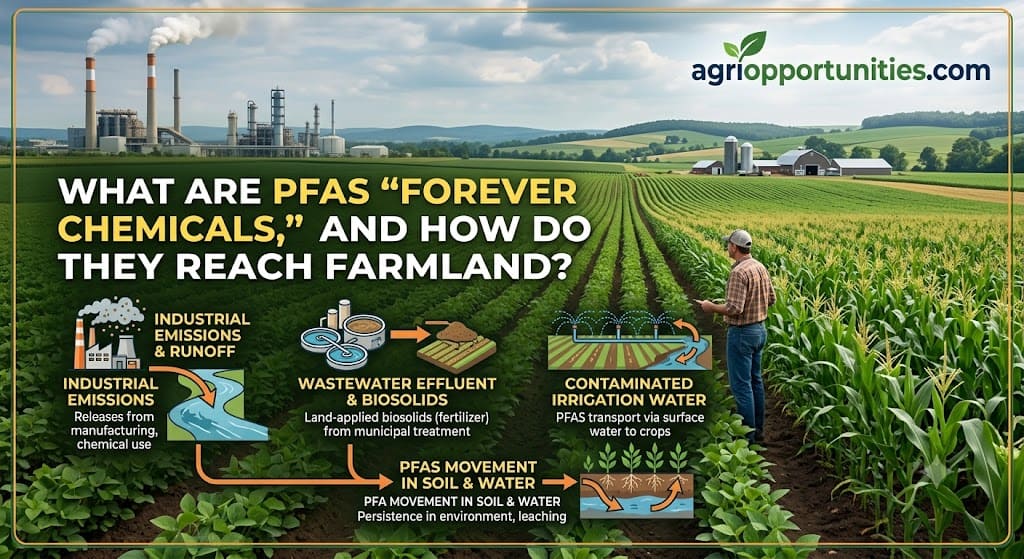
PFAS enters wastewater through industrial discharges, household products, and legacy contamination from decades of manufacturing and firefighting foam use. Wastewater treatment plants cannot effectively remove these chemicals, so they accumulate in the remaining solids. When those biosolids are applied to farmland, PFAS enters agricultural soils.
The Scale of the Problem
In 2023, farmers across 41 US states applied more than 1 million dry metric tons of biosolids to agricultural land. That enormous volume reached millions of acres, often without comprehensive PFAS testing before application.
Documented Contamination Cases
This isn’t a hypothetical risk. In 2025, the Waterkeeper Alliance collected water samples near ten biosolid application sites across the United States and detected elevated PFAS levels downstream from most of them. New Hampshire’s environmental agency detected PFAS in most sludge samples it tested and confirmed that the chemicals leached into nearby groundwater. Maine, one of the earliest states to use biosolids extensively, documented widespread PFAS contamination and has since restricted the practice in parts of the state.

How Contamination Spreads
Once PFAS reaches farmland, it doesn’t stay where biosolids were applied. Rainfall, groundwater movement, and crop uptake can spread these chemicals beyond the original application site.
Groundwater and Drinking Water
PFAS can move through soil into groundwater beneath nearby fields and eventually reach wells used for drinking water or irrigation. This mobility creates long-term risks for farm families and surrounding communities.
Long-Term Soil Persistence
PFAS can remain in soil for decades after application. Crops grown on fields treated years—or even decades—earlier may still absorb these chemicals. Their persistence also makes it difficult to trace contamination back to fertilizer decisions made many years before.
Uptake Into Crops and Forage
Researchers are still investigating how much PFAS different crops and forage plants absorb from contaminated soil. Uptake varies with crop species, soil chemistry, and the specific PFAS compounds present, making this one of the fastest-evolving areas of agricultural and environmental research.
The Real Cost to Affected Farmers
PFAS contamination affects more than the environment and public health—it can also devastate farm businesses. Some farmers have stopped producing food on contaminated fields, while others have sold land that no longer meets food safety standards. These losses can erase years or even generations of investment and threaten a family’s livelihood.
How Regulators Are Responding
The growing number of contamination cases has also prompted a stronger policy response. During 2025 and 2026, legislators and environmental agencies introduced new proposals to expand PFAS monitoring, fund research, and strengthen oversight of biosolids used in agriculture.
State-Level Action
At least ten US states are considering roughly two dozen policies focused on PFAS cleanup and research funding, including Michigan, Minnesota, New Jersey, New York, and Massachusetts. In Pennsylvania, the Department of Environmental Protection has proposed updated permits that would require wastewater treatment facilities to monitor PFOS and PFOA in biosolids intended for land application. These requirements would give farmers better information about the materials they apply and strengthen oversight of biosolid use.
Federal Risk Assessment
The EPA’s own draft risk assessment for these two legacy PFAS compounds in sewage sludge found significant risks specifically for farm families, a notably direct acknowledgment from the federal regulator most responsible for overseeing this issue nationally.
A Real Policy Dilemma
Biosolids provide a low-cost way to recycle nutrients from wastewater back into agricultural soils, making them an important fertilizer source for many farmers. However, tighter PFAS restrictions create a difficult policy question that regulators and farm groups continue to debate: if biosolids can no longer be applied safely to farmland, where should this enormous volume of treated sewage sludge go instead?
What This Means for Farmers Right Now
Given how recently this issue has escalated in both scientific documentation and regulatory attention, farmers currently using or considering biosolid fertilizer are in a genuinely uncertain position. Testing requirements vary significantly by state, historical application records are often incomplete or unavailable, and the science on crop-specific PFAS uptake is still actively developing rather than fully settled.
Why This Matters for Students Considering This Research Area
PFAS contamination in agricultural systems sits at a genuinely urgent, rapidly evolving intersection of environmental chemistry, soil science, and public policy. Given how recently this issue has moved from a niche environmental concern to active state and federal legislative response, this represents a genuinely growing research area with real, immediate practical stakes — particularly for students interested in soil remediation, environmental risk assessment, or agricultural policy specifically.
For current research and graduate opportunities in environmental soil science and contaminant research, browse live agriculture scholarship listings on Agri Opportunities.
Frequently Asked Questions
What does PFAS stand for and why are they called forever chemicals?
PFAS stands for per- and polyfluoroalkyl substances, a class of roughly 15,000 known human-made chemicals. They’re called forever chemicals because their chemical structure makes them extremely resistant to breaking down, meaning they persist in the environment and in human and animal bodies indefinitely.
How do PFAS chemicals actually get onto farmland?
PFAS most commonly reach farmland through biosolids, a fertilizer made from treated sewage sludge. Since standard wastewater treatment cannot remove PFAS, chemicals present in wastewater from homes, businesses, and factories become concentrated in the leftover solid waste, which is then applied to fields as a low-cost fertilizer.
How much biosolid fertilizer is applied to US farmland?
According to the EPA, more than 1 million dry metric tons of biosolids were applied to agricultural land across 41 US states in 2023 alone, making this a widespread and ongoing pathway for PFAS to enter farmland nationally.
Can PFAS contamination be removed from farmland once it’s there?
Not easily. PFAS can persist in soil for decades, allowing crops to absorb them long after biosolid application. In severe cases, farmers have abandoned food production on contaminated fields or sold the affected land instead of attempting costly remediation.
Add Agri Opportunities as a preferred source on Google to see latest blog listings first.