GHG and Soil Emissions Research Opportunities: PhD, Postdoc, and Funding Guide

Where to find funded PhD and postdoc positions in greenhouse gas and soil emissions research, and how to build a genuinely competitive application.
If the science covered throughout this site’s greenhouse gas explainer series has genuinely interested you, the natural next question is practical: where do you actually find funded positions to study this yourself? This guide walks through the major research groups actively hiring in this space, a specific fellowship program built exactly for this field, and what makes an application genuinely competitive for this particular research area.

Why This Field Is Genuinely Well-Funded Right Now
Agricultural greenhouse gas research sits at the intersection of climate policy, food security, and soil science, and that combination has translated into real, sustained funding across multiple countries. Given how much of this series has covered nitrous oxide, methane, and soil carbon dynamics, it’s worth knowing this isn’t a niche academic corner — it’s an area with genuine institutional backing and career pathways.
Major Active Research Groups Worth Following Directly
Rather than relying purely on generic job board searches, following specific active research groups tends to surface opportunities earlier, since many positions get filled through direct outreach before ever reaching a public job board.
- DTU Sustain (Denmark) — The Technical University of Denmark’s DTU Sustain has recently offered multiple PhD scholarships and postdoctoral positions specifically focused on methane mitigation from manure storage, including work on biofilter systems and numerical modeling of microbial methane oxidation. These positions are funded through Denmark’s Ministry of Green Transition, and candidates with modeling software experience (such as COMSOL) are specifically noted as advantaged for certain roles.
- Aarhus University’s Department of Agroecology (Denmark) — Aarhus has advertised postdoctoral positions in agricultural micrometeorology and greenhouse gas emissions, working with advanced sensor setups for direct field-based gas measurement. Typical eligibility includes a PhD in environmental science, agriculture, engineering, meteorology, agroecology, or biology, alongside documented scholarly experience specifically in greenhouse gas measurement or micrometeorology.
- University of Western Australia — UWA has run fully funded PhD positions embedded within the Zero Net Emissions Agriculture Cooperative Research Centre, focused specifically on emissions reduction and farm-level transformation, bringing together researchers, institutions, and industry stakeholders around Australia’s net-zero agricultural goals.
- North Carolina State University — NC State’s Soil Science Program has offered fully funded PhD positions specifically focused on AI-enabled modeling of agricultural nitrogen cycling and greenhouse gas emissions — a genuinely good example of this field’s increasing overlap with computational and data science skills, not just traditional wet-lab or field methodology.
- The European Commission’s Joint Research Centre — The JRC has advertised postdoctoral positions specifically focused on deciphering, predicting, and reducing greenhouse gas emissions from soils, with particular focus on nitrous oxide from croplands receiving different manure and synthetic nitrogen treatments — directly relevant to the ammonia-nitrous oxide trade-off and DOC:NO₃⁻ stoichiometry concepts covered elsewhere on this site.
🎓 A Fellowship Program Worth Knowing About Specifically: CLIFF-GRADS
This is genuinely one of the most useful, specific opportunities for students from countries like Pakistan to know about, and it doesn’t get nearly enough visibility relative to how well-suited it is for exactly this audience.
What CLIFF-GRADS Actually Offers: The CLIFF-GRADS Programme offers PhD students specifically from developing countries a funded four to six month international research stay focused on greenhouse gas measurement, modeling, mitigation, and carbon storage in agricultural systems. Selected students receive a 14,000 US dollar grant to fund a genuine, hands-on international research placement at a host institution actively working in climate-smart agriculture.
Why This Fits Pakistani PhD Students Particularly Well: Unlike a full-degree scholarship, CLIFF-GRADS is specifically designed to strengthen scientific capacity for researchers already enrolled in a PhD program back home — meaning it works as a genuine complement to, rather than a replacement for, indigenous PhD funding through programs like the HEC scholarships covered elsewhere on this site. If you’re already pursuing a PhD at a Pakistani university on a topic touching food security, climate mitigation, or greenhouse gas emissions, this represents a realistic, well-matched opportunity to gain international research experience and host-institution mentorship without needing to secure an entirely separate, multi-year funded placement abroad.
Where to Actually Search for These Positions
Dedicated Academic Job Aggregators
Platforms like FindAPhD and Nature Careers consistently list greenhouse gas and soil emissions positions across many countries simultaneously, making them a genuinely efficient starting point compared to checking dozens of individual university career pages one at a time.
Following Specific Research Groups Directly
Given how specialized this field is, the specific professors and research groups actively publishing in nitrous oxide, methane, or soil carbon research (several of whom are referenced throughout the greenhouse gas explainer series on this site) are worth following directly through their institutional pages and recent publication records, using the same direct-outreach approach covered in the research assistantship guide elsewhere on this site.
What Makes an Application Genuinely Competitive for This Field
Given how technical this research area is, a few things consistently strengthen an application beyond the generic advice covered in the general statement of purpose guide on this site.
Demonstrate Genuine Mechanistic Understanding
Since this field rewards precise, mechanism-level knowledge — the difference between nitrification and denitrification, the DOC:NO₃⁻ balance, the ammonia-nitrous oxide trade-off — your application materials should demonstrate you understand these distinctions specifically, not just that you’re broadly interested in “climate change and agriculture.”
Highlight Any Instrumentation Experience
Given how central specific measurement technology is to this field — gas chromatography, static and dynamic chambers, Picarro analyzers, eddy covariance systems — any hands-on experience with these tools deserves explicit, specific mention in your application rather than being buried in a general lab-skills list.
Connect Your Interest to a Specific Regional Problem
As covered in the Fulbright guide elsewhere on this site, reviewers respond well to applicants who connect their research interest to a concrete, specific regional challenge rather than a generic global statement. For Pakistani or South Asian applicants specifically, framing your interest around nitrogen use efficiency in heavily subsidized fertilizer systems, or emissions from South Asia’s dominant flood-irrigated and rice-paddy systems, gives your application a genuine, differentiated edge.
Career Paths Beyond the PhD Itself
It’s worth knowing that this research area feeds into genuinely diverse career outcomes beyond a straight academic track:
- National greenhouse gas inventory work for government agencies
- Agri-tech product development focused on precision fertilizer and emissions monitoring technology
- International development and policy roles at organizations focused on climate-smart agriculture
All draw directly on the same core expertise developed through a GHG-focused PhD or postdoc.
For current PhD and postdoc positions in greenhouse gas and soil emissions research specifically, browse live agriculture scholarship listings on Agri Opportunities.
Frequently Asked Questions
What is the CLIFF-GRADS programme?
CLIFF-GRADS is a fellowship offering PhD students from developing countries a funded four to six month international research stay focused on greenhouse gas measurement, modelling, mitigation, and carbon storage in agricultural systems, providing a 14,000 US dollar grant alongside hands-on training at a host institution.
Which universities are active in agricultural greenhouse gas research?
Several universities and research institutions conduct research on agricultural greenhouse gas emissions, soil nitrogen cycling, and mitigation strategies. Examples include Aarhus University and DTU in Denmark, Teagasc and the University of Galway in Ireland, the University of Western Australia, and North Carolina State University in the United States. Their research strengths vary, so explore individual departments, research groups, and current projects to identify opportunities that match your interests.
Do I need prior greenhouse gas measurement experience to apply for these positions?
Requirements depend on the position and project. Some PhD programmes welcome candidates with backgrounds in soil science, agronomy, environmental science, or related fields, even if they have limited direct greenhouse gas measurement experience. Others require practical skills in techniques such as static chamber sampling, gas chromatography, or greenhouse gas analysers. Postdoctoral positions generally expect more directly relevant research experience, although the specific requirements vary. Review each advertisement carefully and highlight transferable field, laboratory, and data-analysis skills in your application.
Where can I search for greenhouse gas research positions beyond university websites?
Academic job platforms such as FindAPhD and Nature Careers can help you identify doctoral, postdoctoral, and other research opportunities across countries and institutions. You can also monitor university vacancy pages, research institute websites, funding agency announcements, and the websites of research groups working on soil emissions, nitrogen cycling, and agricultural climate mitigation. Set up keyword alerts for terms such as “agricultural greenhouse gas emissions,” “soil nitrous oxide,” “methane mitigation,” and “nitrogen cycling” to broaden your search.
Find funded PhD positions, postdoctoral roles, and research fellowships in greenhouse gas and soil emissions science — browse live agriculture scholarship listings on Agri Opportunities.
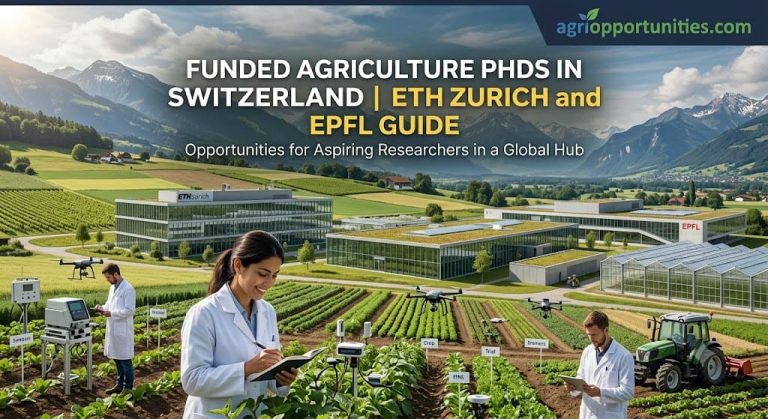
Switzerland runs the same broad employment-based PhD model as Denmark and Sweden, covered elsewhere on this site, but with a few genuinely distinctive details worth understanding before you apply — including some of the highest doctoral compensation in Europe, paired with famously high living costs. This guide focuses on Switzerland’s two federal institutes of technology, ETH Zurich and EPFL, the two most prominent destinations for agriculture-adjacent PhD research in the country.
PhD as Genuine, Well-Paid Employment
As with the Nordic systems covered elsewhere on this site, Swiss PhD students are not typically “scholarship students” in the traditional sense — they’re full-time university employees, commonly referred to as scientific or doctoral assistants, hired on contracts with salaries defined by national scales.
What This Actually Pays
As of 2026, EPFL’s basic starting salary for a doctoral assistant is 55,225 Swiss francs gross per year. More broadly across ETH and EPFL, doctoral stipends range from roughly 50,000 to 62,000 francs annually — genuinely well above typical European PhD compensation, including comparison points like Germany’s DFG-funded positions, which sit closer to 45,000 to 55,000 euros.
The Living Cost Reality Check
It’s worth being honest that this higher pay reflects genuinely higher costs, not just better funding. Zurich and Geneva rank among the most expensive cities globally for cost of living, placing in the same tier as Hong Kong, Singapore, and New York — meaning the higher salary needs to be weighed against a correspondingly higher cost base rather than treated as pure additional purchasing power.
Tuition Is Almost an Afterthought
Given the employment-based structure, tuition fees are genuinely minimal — often just a few hundred Swiss francs per semester, with ETH Zurich specifically citing fees around 809 CHF per semester. Your salary is effectively your entire funding package, rather than needing to separately cover significant tuition costs on top of living expenses.
How PhD Admission Actually Works
How PhD Admission Actually Works
You Generally Need a Doctoral Program Behind You First
At EPFL, admission to a doctoral programme and employment as a doctoral assistant are related but distinct processes. Applicants must satisfy the relevant programme’s admission requirements, while hiring depends on the position, funding arrangements, and applicable university procedures. Do not assume that doctoral admission automatically guarantees a funded position or that admission without immediate funding provides a fixed period of eligibility for later employment. Check the current requirements with the relevant doctoral programme and research group before applying.
Finding a Supervisor Is an Important Early Step
In Switzerland, the PhD application process varies by institution and programme. Some positions are advertised against specific funded projects, while other routes involve applying to a doctoral programme and identifying a suitable research group. In either case, research alignment matters: review the professor’s recent publications, understand the group’s current projects, and explain how your background fits the research objectives. Directly contacting a potential supervisor can be useful when the programme permits or encourages it, but always follow the instructions in the official vacancy or admissions announcement. Finding a suitable opportunity may take time, so start early and tailor each application rather than relying on generic outreach.
A Concrete Example: ETH Zurich’s Agricultural Economics PhD
ETH Zurich has advertised doctoral opportunities in agricultural economics and policy, including work associated with Professor Robert Finger’s Agricultural Economics and Policy Group. One previously advertised opportunity was linked to the ACHIEVE project, a Swiss research initiative examining pathways toward net-zero emissions in sectors where decarbonisation presents particular challenges, including agriculture. However, a previous vacancy should not be described as currently open unless its status and application deadline have been verified on ETH Zurich’s official recruitment website.
What Made This Position Attractive
The advertised opportunity combined doctoral research in agricultural economics and policy with the potential to contribute to research on Switzerland’s climate transition. The position’s employment conditions, including salary and social benefits, should be checked against the original vacancy announcement. For applicants interested in agricultural policy, climate mitigation, and evidence-based decision-making, projects of this kind can offer an opportunity to connect academic research with practical policy questions.
What the Application Actually Required
Applicants needed to submit a cover letter, CV, academic transcripts, and contact details for two referees, all combined into a single PDF document, through ETH Zurich’s online application portal. The position was open to both recent master’s graduates and students still completing their degree in agricultural economics or a related discipline.
A Language Detail Worth Noting
Some Swiss positions, including certain policy-facing roles, may favor or require proficiency in one of Switzerland’s major working languages (German or French) alongside English, which can meaningfully narrow the international applicant pool for those specific roles — worth checking carefully on each individual posting rather than assuming English alone is always sufficient, even at internationally-oriented institutions like ETH and EPFL.
Where to Actually Search for Swiss PhD Positions
Direct University Job Portals
Swiss universities frequently advertise doctoral vacancies through their own recruitment websites. In addition to ETH Zurich and EPFL, applicants can check the career portals of the universities of Zurich, Geneva, Lausanne, Bern, Basel, and Fribourg. Platforms such as Academic Positions and FindAPhD can provide additional leads, but always consult the university’s official vacancy announcement for eligibility requirements, funding details, and application deadlines.
Structured Graduate Schools
Structured doctoral programmes offer another route into Swiss research. The Life Science Zurich Graduate School, a joint initiative involving ETH Zurich and the University of Zurich, brings together doctoral programmes and research groups across a range of life science disciplines. Its research areas may be relevant to applicants interested in plant biology, microbiology, biotechnology, and other agriculture-adjacent fields. However, the number of available positions and their funding arrangements vary by programme and recruitment round, so check the graduate school’s current announcements rather than relying on historical vacancy figures.
Swiss Government Excellence Scholarships
Switzerland’s Federal Commission for Scholarships for Foreign Students administers the Swiss Government Excellence Scholarships, which support eligible international researchers and, depending on the award category, doctoral candidates or researchers undertaking a research stay. Eligibility, participating countries, eligible disciplines, award duration, and application procedures vary by scholarship type and country. Many research-based applications require support from a Swiss academic host, so identifying a suitable professor and confirming the relevant requirements are important early steps. Consult the official scholarship information for the current rules applicable to your nationality and proposed research.
What Makes ETH and EPFL Genuinely Distinctive as a Career Investment
ETH Zurich and EPFL offer strong research environments, international academic networks, and connections with industry. These features can benefit graduates pursuing academic or industry careers, including opportunities in food science, biotechnology, environmental research, and agricultural innovation. Both institutions also have links with major companies, including Nestlé, although the relevance of those connections depends on the research group and field of study. Career outcomes vary considerably by discipline, individual experience, and the wider academic job market, so applicants should not assume that attending either university guarantees a tenure-track position or a particular employment outcome after graduation.
Practical Tips for a Competitive Application
Start supervisor outreach well in advance, since securing a professor’s genuine commitment can take several months of sustained contact, and treat this relationship-building as the actual gating step in your application timeline rather than an afterthought. Confirm language requirements explicitly for any specific posting rather than assuming English alone suffices, particularly for policy-facing or applied research roles. And budget realistically for Swiss living costs specifically — the higher salary figures covered in this guide need to be weighed honestly against Zurich and Geneva’s position among the most expensive cities in the world, rather than treated as straightforwardly superior to lower-paying positions in more affordable countries.
For currently open PhD positions in Switzerland and across Europe, browse live agriculture scholarship listings on Agri Opportunities.
Frequently Asked Questions
How much does a PhD student at ETH Zurich or EPFL actually earn?
As of 2026, EPFL’s basic starting salary for a doctoral assistant is 55,225 Swiss francs gross per year, while ETH and EPFL doctoral stipends more broadly range from roughly 50,000 to 62,000 francs annually, well above typical European PhD compensation.
Do I need to find a supervisor before applying for a PhD in Switzerland?
Yes, in most cases. At EPFL specifically, you must be admitted by a doctoral program before you can be hired as a doctoral assistant, and finding a professor willing to supervise your specific research area is typically the first practical step.
How much does PhD tuition cost in Switzerland?
Tuition fees are very low, often only a few hundred Swiss francs per semester, since most PhD students are treated as full-time university employees rather than fee-paying students, meaning your salary functions as your primary source of funding.
What is the Swiss Government Excellence Scholarship?
It’s a national-level award, run by the Federal Commission for Scholarships for Foreign Students, available to postgraduate researchers from over 180 countries, funding either a full PhD of usually up to three years or a research stay during a PhD already underway elsewhere.
Add Agri Opportunities as a preferred source on Google to see latest guide listings first.