Agribusiness Supply Chain and Value Chain Careers in Pakistan: A Complete Guide

From commodity logistics to agritech platforms — the complete guide to agribusiness supply chain careers in Pakistan
Agribusiness Supply Chain and Value Chain Careers in Pakistan: A Complete Guide
Between the farm gate and the consumer’s plate sits a genuinely complex chain of logistics, processing, storage, and commercial coordination — and this “middle” of Pakistan’s agricultural economy has become a genuinely distinct, fast-growing career category in its own right. This guide covers the roles that keep agricultural commodities moving efficiently from farmer to final buyer, spanning traditional agribusiness logistics through to newer agritech-driven value chain platforms.

What “Agribusiness Supply Chain” Actually Means in Practice
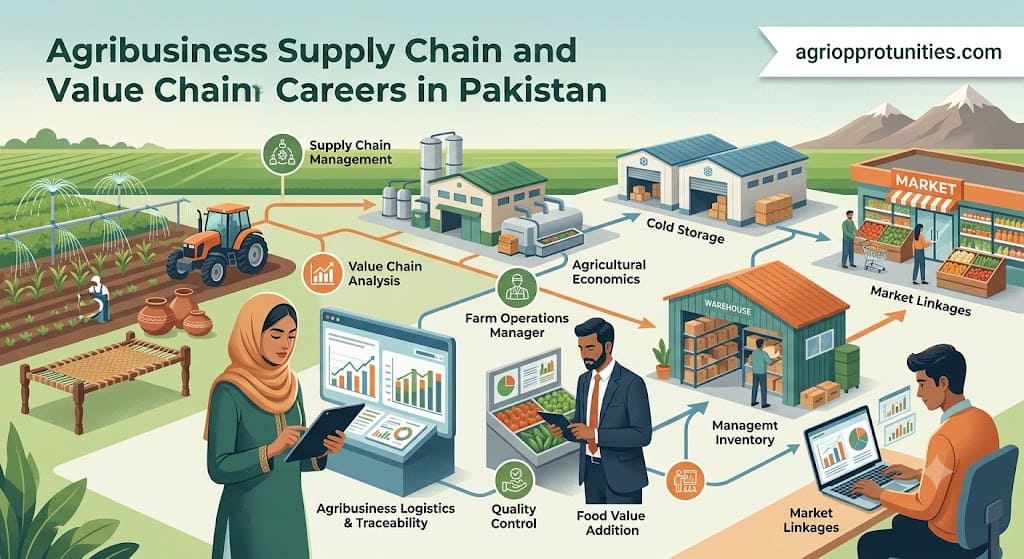
It’s worth being concrete about what this career category actually covers, since “supply chain” can sound abstract without a real example. A representative Manager Supply Chain role at a major Pakistani agribusiness company is explicitly responsible for managing crop movement, transportation, logistics coordination, warehouse interfaces, processing partnerships, and operational execution between procurement points, storage facilities, and customer destinations — ensuring efficient movement of commodities while maintaining service quality, cost efficiency, and operational reliability throughout.
The Core Functions Broken Down
Within this broad remit, the actual day-to-day responsibilities typically include executing supply chain plans against defined targets, managing transportation activities and the transporters and logistics providers who physically move commodities, coordinating directly with warehouses and silos to ensure storage capacity and timing align with harvest and procurement schedules, supporting relationships with processing partners who convert raw commodities into finished or semi-finished products, and continuously working to improve turnaround times while reducing transportation costs.
Warehouse and Storage Roles
Sitting within this broader supply chain function, warehouse-specific roles focus on the physical storage and handling of commodities — grain, cotton, or other agricultural products — between the point of procurement and their eventual movement to a processor or buyer. A Warehouse Incharge role typically manages the day-to-day operations of a specific storage facility, overseeing inventory accuracy, quality preservation during storage (particularly important for perishable or moisture-sensitive commodities like grain), and coordinating outbound movement in line with the broader supply chain plan.
Processing-Facing Roles: Flour and Rice
A distinct set of roles exists specifically at the interface between raw commodity supply and food processing operations. Officer-level positions focused on flour processing and rice processing typically coordinate the relationship between an agribusiness company’s commodity supply chain and the actual processing mills that convert wheat into flour or paddy into milled rice, monitoring processing yield, quality specifications, and delivery timing to ensure the finished product meets both quality standards and commercial delivery commitments.
Why These Roles Sit Between Two Worlds
These positions genuinely require understanding both sides of the process: the agricultural commodity side (crop quality, moisture content, storage condition affecting processing yield) and the processing and commercial side (milling efficiency, product specifications, customer delivery requirements) — making them a genuinely useful entry point for candidates with an agriculture background who want to build toward broader agribusiness or food industry management roles over time.

The Newer Category: Agritech Value Chain Platforms
Beyond traditional agribusiness logistics, a genuinely newer category of role has emerged through Pakistan’s growing agritech sector — companies building digital platforms that connect farmers directly to input suppliers, buyers, and financing, often bypassing some of the traditional middlemen layers in the conventional supply chain.
The Value Chain Executive Role
A Value Chain Executive at a company like this typically manages relationships and operations across multiple stages of a specific commodity’s journey from farmer to end buyer, often within a defined geographic cluster spanning several districts. The role’s core objective is genuinely distinct from a traditional logistics role: rather than simply moving product efficiently, it’s explicitly focused on improving overall value chain efficiency, reducing waste at each transfer point, and ultimately increasing the price farmers receive by shortening or improving the chain between them and the final buyer.
The Agri-Content Executive: A Genuinely Different Kind of Role
Interestingly, some agritech companies operating value chain platforms also hire for content and digital communication roles specifically focused on agriculture — an Agri-Content Executive role, for instance, combines genuine agricultural subject knowledge with content creation and digital communication skill, producing farmer-facing educational and product content for a company’s app or digital platform. This represents a genuinely distinct entry point for candidates who have an agriculture background but are drawn toward the digital and communication side of the industry rather than field-based sales or logistics work.
Contract Farming: A Distinct Value Chain Model
A meaningfully different model within this broader career category is contract farming, where a company agrees in advance to purchase a farmer’s crop under specified terms — often providing inputs, technical support, or financing in exchange for a guaranteed supply commitment at harvest. A Head of Contract Farming role oversees this entire arrangement structure: negotiating and administering the underlying agreements with growers, monitoring crop progress against expected yield and quality throughout the season, and ensuring both the farmer’s and company’s contractual obligations are actually met by harvest time.
Why Contract Farming Roles Require a Genuinely Broad Skill Set
This role sits at a genuinely demanding intersection of agronomy (understanding crop progress and realistic yield expectations), commercial negotiation (structuring agreements that work for both farmer and company), and risk management (since crop failure, price volatility, or farmer non-compliance all represent genuine business risk the role needs to actively manage) — making it one of the more senior, broadly-skilled positions within the agribusiness value chain career track rather than an entry-level role.
How Career Progression Typically Works in This Sector
Entry into agribusiness supply chain and value chain roles commonly starts through more junior executive or officer-level positions — a Supply Chain Executive handling day-to-day logistics coordination, or a Value Chain Executive managing a smaller geographic cluster — before progressing toward Manager-level roles with broader responsibility across a wider region or a full commodity category. Given how much these roles depend on genuine operational judgment and relationship management rather than purely technical agricultural knowledge, demonstrated problem-solving ability in ambiguous, fast-moving logistics situations tends to matter more for career progression here than in more purely technical agronomic roles.
What Salary Data Actually Shows
Broader agriculture-sector salary benchmarking in Pakistan places general roles somewhere between PKR 25,000 and 80,000 per month depending on specific role and experience level. Supply chain and processing management roles at larger, well-capitalized agribusiness companies — particularly those backed by significant institutional investment, as is increasingly common in Pakistan’s agritech space — tend to sit toward the higher end of this broader range, reflecting the genuine operational complexity and cross-functional responsibility these positions carry compared to more narrowly defined field or sales roles.
Building a Strong Foundation for Career Growth
These roles require you to coordinate across logistics, warehousing, processing, and commercial operations, so developing a broad understanding of the entire agricultural supply chain is often more valuable than specializing too early. As you progress into senior supply chain and value chain roles, employers increasingly expect you to understand how these functions work together rather than focusing on a single area.
Choosing a Specialized Career Path
If you’re interested in agritech value chains rather than traditional agribusiness logistics, research the companies building digital agriculture platforms in Pakistan. These employers often look for candidates with strong digital skills and experience using data-driven decision-making alongside agricultural knowledge. If contract farming management appeals to you, expect to build experience first in agronomy, field operations, or commercial negotiation. Most companies treat contract farming as a senior, high-responsibility role rather than an entry-level position.
For current openings across agribusiness supply chain, processing, and value chain roles in Pakistan, browse live agriculture job listings on Agri Opportunities.
Frequently Asked Questions
What does an agribusiness supply chain role actually involve in Pakistan?
It typically involves managing the movement of agricultural commodities from procurement points through storage facilities to processing partners and final customers, coordinating transportation, warehouse and silo operations, and processor relationships while balancing service quality, cost efficiency, and operational reliability.
What is a Value Chain Executive role in Pakistani agritech companies?
A Value Chain Executive typically manages relationships and operations across multiple stages of a specific commodity’s journey from farmer to end buyer, often within a defined geographic cluster, working to improve efficiency, reduce waste, and increase the price farmers ultimately receive.
What is contract farming, and what does a role managing it involve?
Contract farming is an arrangement where a company agrees in advance to purchase a farmer’s crop under specified terms, often providing inputs, technical support, or financing in exchange, and a role managing this involves negotiating and administering these agreements, monitoring crop progress, and ensuring both farmer and company obligations are met.
What salary range applies to agribusiness supply chain roles in Pakistan?
General agriculture-sector salary data in Pakistan spans roughly PKR 25,000 to 80,000 per month depending on role and experience level, though supply chain and processing management roles at larger, well-capitalized agribusiness companies often sit toward the higher end of this range given their operational complexity and responsibility.
Add Agri Opportunities as a preferred source on Google to see latest blog listings first.