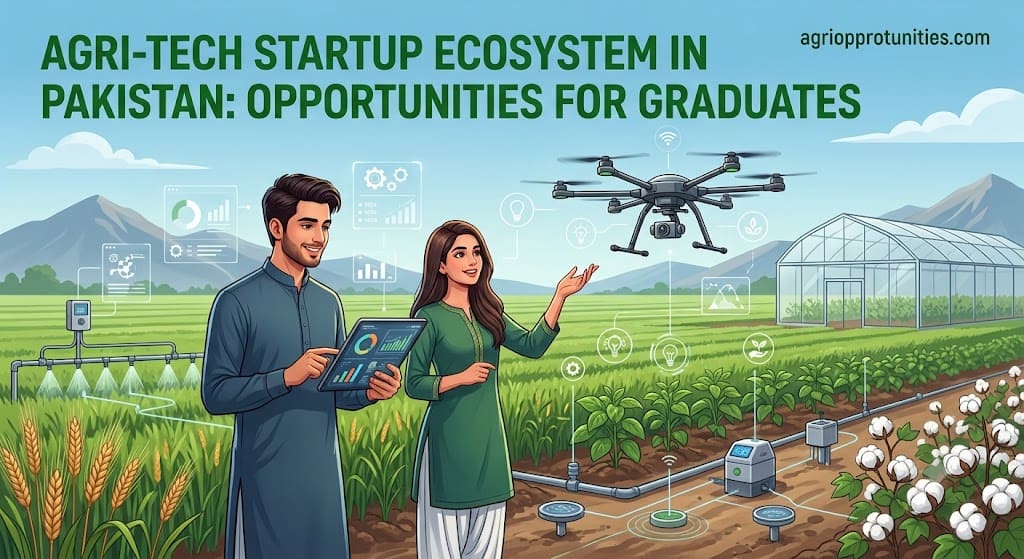
Agri-Tech Startup Ecosystem in Pakistan: Opportunities for Graduates


Pakistan has 125+ agritech startups tackling a 40-50% yield gap. Here’s who’s building what, and how graduates can get in.
Pakistan’s agriculture sector has a problem that also happens to be an enormous opportunity: despite agriculture making up roughly 22 percent of the economy and employing around a third of the country’s workforce, yields run an estimated 40 to 50 percent below the global average. That gap — inefficiency this large, in a sector this central to the economy — is exactly the kind of problem a growing wave of Pakistani agritech founders have set out to solve. For agriculture and technology graduates alike, this ecosystem represents a genuinely new category of career that didn’t meaningfully exist a decade ago, and it’s worth understanding who’s building what, who’s funding it, and where the actual job opportunities sit.
The Scale of the Ecosystem
As of early 2026, Pakistan is home to approximately 125 agritech startups, spanning crop data and remote sensing, supply chain and marketplace platforms, livestock trading, and agricultural e-commerce. Of these, around 22 have secured formal funding, with one having reached Series A+ stage — modest by global standards, but reflecting real, sustained momentum, with an average of roughly 9 new agritech companies launching in Pakistan every year over the past decade. Interestingly, a notable share of these founders have academic backgrounds from institutions like Cornell University, INSEAD, and MIT, bringing international training back into a distinctly local problem space.
Who’s Building What: The Major Players
Farmdar
Remote sensing and AI to generate actionable crop and farm data. Helps farmers and corporate agribusiness clients lower costs and increase yield.
Tazah Technologies
B2B agriculture marketplace tackling the 30-40% produce waste between harvest and retail. Raised $2M pre-seed from Global Founders Capital.
Ricult
Single mobile app for farmers to procure inputs, market produce, access credit, and connect with agronomic service providers.
Sawie
Machine learning, data analytics, and AI applications for agriculture. Focused on precision farming and data-driven decision support.
InFarmer
Smart, satellite, and precision farming powered by AI. Helps farmers make data-driven decisions for better yields.
BKK
App-based livestock trading marketplace for buying and selling cattle, buffaloes, goats, and sheep online.
Where Traditional Companies and Startups Are Meeting
It’s worth noting this ecosystem isn’t purely startup-driven. Established players like Cargill Pakistan and Engro Fertilizers are actively integrating digital tools and precision farming techniques into their existing operations, working to help farmers make more data-driven decisions even outside a pure startup context. This creates a genuinely broader set of employers for graduates interested in agritech skills, beyond the startup sector alone — a large agribusiness corporation increasingly needs the same data analytics and precision agriculture skill set a startup does.
Incubators and Institutional Support
NIC Faisalabad
Agritech-focused incubator. Home to UAF and Pakistan’s agricultural research hub.
NIC Karachi
Supported Farmdar, Crop2X, and other agritech ventures with mentorship and funding access.
Digital Dera
“Smart village” project in Pakpattan. Reached 2,000+ farmers with agritech solutions.
💼 What Career Opportunities Look Like for Graduates
How to Actually Break In
- Identify which problem area interests you — crop data, supply chain, marketplace, or livestock trading.
- Follow the National Incubation Centers in Karachi and Faisalabad — their cohort announcements signal which ventures are hiring.
- Don’t undersell agriculture expertise — the ability to validate real field conditions is a differentiated skill.
For current openings across Pakistani agriculture and agritech roles, browse live agriculture job listings on Agri Opportunities.
Frequently Asked Questions
How many agritech startups exist in Pakistan?
As of early 2026, Pakistan has around 125 agritech startups, with roughly 22 of them having received formal funding, and an average of about 9 new companies launching in this space each year over the past decade.
Why is there so much room for agritech growth in Pakistan?
Pakistan’s agricultural yields run an estimated 40 to 50 percent below the global average despite agriculture representing roughly 22 percent of the economy and employing around a third of the workforce, reflecting a significant efficiency gap that technology can help close.
What kind of roles do Pakistani agritech startups hire for?
Beyond software engineers and data scientists, Pakistani agritech startups hire for agronomy and field operations, supply chain and logistics, business development with farmers and buyers, and quality control roles, since most ventures need genuine on-ground agricultural expertise alongside technical skill.
Where do Pakistani agritech startups get support to grow?
Government-backed and university-affiliated incubators such as the National Incubation Center in Karachi and Faisalabad provide funding, mentorship, and cohort-based support specifically for agritech ventures.
Add Agri Opportunities as a preferred source on Google to see our latest career guides and job listings first.