How Pesticide Field Trials Actually Work

How pesticide registration works in Pakistan — from Ordinance 1971 through the NAFSA restructuring
How Pesticide Registration and Regulation Works in Pakistan
Before a pesticide reaches dealers and farmers in Pakistan, it must pass through a detailed regulatory process that includes technical review, laboratory testing, and multi-season field trials. In recent years, however, the institutions responsible for overseeing this system have undergone significant changes, creating uncertainty around how the registration process will operate going forward. This guide explains how Pakistan’s pesticide registration system is designed to work and highlights the recent regulatory transition.

The Legal Framework Governing Pesticides
Pakistan regulates pesticides under the Agricultural Pesticides Ordinance, 1971 and the Agricultural Pesticides Rules, 1973. For decades, the Department of Plant Protection (DPP), operating under the Ministry of National Food Security and Research, administered this framework. Since these laws came into force, authorities have registered more than 7,500 pesticide products for commercial use.
How the Regulatory System Evolved
Before 1971, the federal government imported pesticides and distributed them through the provinces. The Agricultural Pesticides Ordinance introduced a formal registration system and shifted the government’s role from supplier to regulator. In 1980, the government ended pesticide subsidies and opened the market to the private sector. A further reform in 1992 introduced two additional registration routes—the Generic Scheme (Form-16) and the Registered Abroad Scheme (Form-17)—alongside the original trade-name registration pathway.
The Registration Process for New Trade-Name Products
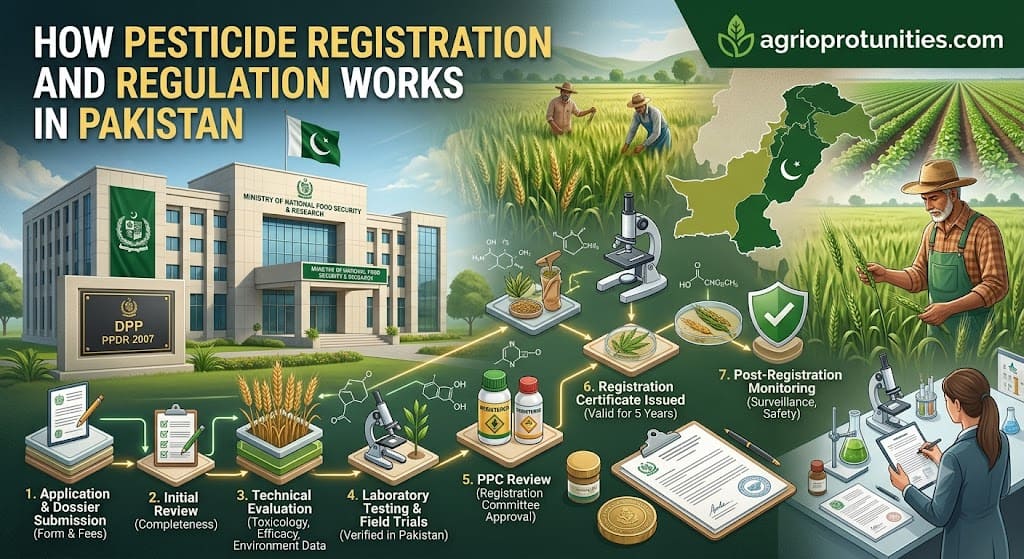
A company registering a new pesticide under its own trade name follows a structured approval process consisting of several technical and regulatory stages.
Step 1: Application and Laboratory Testing
The manufacturer submits Form-1, pays the required registration fee, and provides product samples. The Federal Pesticide Testing and Reference Laboratory (FPTRL) analyzes the samples before forwarding successful applications for field evaluation.
Step 2: Multi-Season Field Trials
Federal or provincial research institutes evaluate the product over two crop seasons, with at least two independent research institutes conducting the trials. Testing the product across multiple locations and seasons helps confirm that it performs consistently under different farming conditions rather than succeeding in a single favorable trial.
Step 3: Technical Review and Approval
After successful field trials, the Provincial Standardization Committee reviews the results and forwards its recommendations to the Department of Plant Protection. The Agricultural Pesticides Technical Advisory Sub-Committee then conducts a technical evaluation before the Agricultural Pesticides Technical Advisory Committee makes the final registration decision.
Step 4: Registration Certificate
After completing the technical review and approval process, the Department of Plant Protection issues a registration certificate, typically valid for three years unless it specifies a shorter period. Companies must renew the registration before it expires, allowing regulators to periodically review products instead of granting permanent approval.
Fast-Track Registration for Existing Products
To simplify the registration of products already established in the market, the Department of Plant Protection introduced a Fast-Track Registration System through SRO 1017(I)/2014. This pathway applies to products registered under the Generic (Form-16) and Registered Abroad (Form-17) schemes.
Requirements for Fast-Track Registration
Applicants under the Form-16 scheme must submit a completed application form, an original authorization letter from the manufacturer, a company profile that meets the official checklist, and the prescribed registration fee (historically Rs. 60,000, payable through the National Bank of Pakistan or the State Bank of Pakistan). Form-17 applications require a similar set of documents. Because these products have already demonstrated their safety and efficacy, regulators can process them much faster than entirely new trade-name registrations.

Quality Control After Registration
Registering a pesticide is only the first step. Provincial authorities continue to monitor products after they reach the market to ensure manufacturers and dealers comply with quality and registration standards.
The Provincial Inspection Network
Provincial Agriculture Departments oversee pesticide quality through a network of federally notified inspectors and laboratories operating under the Agricultural Pesticides Ordinance. Together, they maintain nine pesticide laboratories and employ more than 645 inspectors who regularly visit distributors and retailers, collect product samples, and verify that registered pesticides meet quality standards.
What Happens When a Sample Fails
Inspectors collect pesticide samples directly from dealer stock and split each sample into two portions. They leave one portion with the vendor and send the other to the Federal Pesticide Testing and Reference Laboratory in Karachi for independent analysis. If the provincial laboratory declares a sample substandard or unfit, authorities register a First Information Report (FIR) against the responsible party, and the case proceeds to court. These penalties make pesticide quality control a legal enforcement process rather than a simple administrative review.
A Major Institutional Change: The Creation of NAFSA
Pakistan’s pesticide regulatory system is currently undergoing a significant transition. In 2025, a presidential ordinance established the National Agri-Trade and Food Safety Authority (NAFSA) to replace the Department of Plant Protection and the Animal Quarantine Department with a single federal authority. As the transition continues, questions remain about how and when NAFSA will fully assume these responsibilities.
NAFSA’s Intended Role
Under its founding ordinance, NAFSA is responsible for enforcing sanitary and phytosanitary (SPS) standards, regulating agricultural and food businesses, conducting inspections and quarantine services, issuing quality, health, and SPS certifications, implementing biosecurity measures, and coordinating Pakistan’s representation in international agricultural trade. The authority is also expected to assume the pesticide regulatory functions previously handled by the Department of Plant Protection.
Why This Restructuring Has Been Controversial
However, the ordinance has drawn significant constitutional objections. The 18th Constitutional Amendment explicitly devolved food safety, agriculture, and livestock to Pakistan’s provinces. As a result, critics argue that the federal government cannot legislate in these areas without provincial consent. They also point out that each province already operates its own food safety authority, including the Punjab Food Authority, Sindh Food Authority, and equivalent agencies in Khyber Pakhtunkhwa and Balochistan.
International Compliance Concerns
In addition to these constitutional questions, the restructuring has raised technical concerns about Pakistan’s international obligations. Under the International Plant Protection Convention (IPPC), each country must designate a clearly recognized government body as its National Plant Protection Organization. However, reports have described a transitional “hybrid” arrangement in which the Department of Plant Protection is being phased out under the NAFSA ordinance while continuing to perform some pesticide registration functions. Consequently, industry groups have warned that this overlap could create uncertainty for exporters and pesticide registrants until the transition is fully completed.
What This Means for Applicants and Industry Professionals
For anyone working in—or planning to enter—Pakistan’s pesticide regulatory sector, this ongoing transition makes it especially important to verify current procedures before submitting an application. Although the core registration process is expected to remain largely unchanged, the responsible offices, committees, and points of contact may continue to evolve as NAFSA assumes its new responsibilities. Therefore, applicants should confirm the latest requirements directly with NAFSA or the Ministry of National Food Security and Research before beginning the registration process.
A Genuinely Positive Development: Biopesticide Registration
Amid this broader institutional uncertainty, one specific, genuinely constructive regulatory development is worth highlighting. Historically, Pakistan’s pesticide regulatory system — like most of South Asia — only considered registration pathways for chemical pesticides, which meant biopesticides and biocontrol products couldn’t be properly commercialized despite their genuine potential as safer, more environmentally sustainable pest management tools.
How This Gap Is Being Addressed
Starting in 2018, CABI, in collaboration with the Pakistan Agricultural Research Council (PARC) and with support from USDA and USAID, led a project specifically aimed at demonstrating the efficacy of an indigenous biocontrol product and facilitating biopesticide registration in Pakistan more broadly. This multi-year collaborative effort culminated in a formal biopesticide registration guidance document, approved through Pakistan’s relevant technical committee in November 2023, and further approved through a Cabinet Committee on Legislative Committee meeting in January 2024 — a genuinely meaningful, multi-year regulatory achievement opening a new commercial pathway for a category of product that connects directly to the biopesticide and plant growth-promoting organism testing challenges discussed in our companion piece on how pesticide field trials work.
Why This Matters for a Career in Regulatory Affairs
Given how genuinely complex and currently unsettled this regulatory landscape is, professionals working in pesticide regulatory affairs in Pakistan right now need real comfort navigating institutional ambiguity and staying current with a genuinely moving target, rather than working from a single, fixed rulebook. This is exactly the kind of environment where deep, specific institutional knowledge — knowing precisely which committee, office, or transitional arrangement actually governs a given application at a given moment — becomes a genuinely valuable, differentiated professional skill.
For current openings in pesticide regulatory affairs and crop protection compliance roles in Pakistan, browse live agriculture job listings on Agri Opportunities.
Frequently Asked Questions
What law governs pesticide registration in Pakistan?
Pesticide registration in Pakistan has historically been governed by the Agricultural Pesticides Ordinance 1971, read with the Agricultural Pesticides Rules 1973, which established the registration process, quality control system, and enforcement structure administered for decades by the Department of Plant Protection.
How long does field trial testing take for a new pesticide product in Pakistan?
Under the standard Form-1 (trade name) registration process, efficacy trials must be conducted at federal or provincial research institutes for two full crop seasons, carried out by at least two separate research institutes, before a product can proceed toward final approval.
What is NAFSA and how does it relate to pesticide regulation?
The National Agri-Trade and Food Safety Authority (NAFSA) is a statutory body created by presidential ordinance in 2025, intended to replace the Department of Plant Protection and Animal Quarantine Department and consolidate food safety and agricultural trade regulation, though its establishment has been contested on constitutional and provincial-autonomy grounds.
Are biopesticides regulated the same way as chemical pesticides in Pakistan?
Historically, no. Pakistan’s pesticide regulatory system was designed only for chemical pesticides, which limited the commercialization of biopesticides, though a dedicated biopesticide registration guidance document was developed through a multi-year collaboration between CABI, PARC, and USDA and formally approved in 2023 and 2024.