How Pesticide Field Trials Actually Work

What Good Experimental Practice (GEP) Actually Is
Pesticide field trials follow a formal framework known as Good Experimental Practice (GEP). GEP establishes standards for designing, conducting, evaluating, and reporting efficacy trials. These standards help researchers generate reliable, scientifically sound results that can be compared across locations, seasons, and testing organizations.
Why GEP Is Different from GLP
Pesticide field trials and laboratory studies follow different quality frameworks. Good Laboratory Practice (GLP) focuses on the quality, consistency, and integrity of non-clinical studies submitted to regulatory authorities. Good Experimental Practice (GEP), by contrast, addresses the conduct of reliable pesticide field trials under variable agricultural conditions, including differences in weather, soil properties, and pest pressure. Each framework serves a distinct purpose, and the applicable regulatory requirements determine which standards a study must meet.
What GEP Requires
GEP sets expectations for staff qualifications, equipment, facilities, trial protocols, operating procedures, and reporting. Testing organizations must demonstrate that they have the trained personnel, suitable equipment, and necessary resources to conduct scientifically reliable field trials in accordance with applicable standards and regulatory requirements.
Matching Real-World Conditions: Good Agricultural Practice (GAP)
Pesticide efficacy trials should evaluate products under conditions that reflect their intended agricultural use. Good Agricultural Practice (GAP) helps define these conditions, including the application rate, timing, method, target crop, and target pest. Researchers must consider the relevant use patterns and regulatory requirements in the country where they intend to register the product.
Why GAP Matters
Testing a pesticide under unrealistic conditions can produce results with limited practical value for farmers and regulators. Following the relevant GAP conditions helps researchers generate efficacy data that better reflects expected field performance. Researchers must also use appropriate experimental controls and account for local environmental conditions when interpreting the results.
Designing Reliable Field Trials Through Randomization
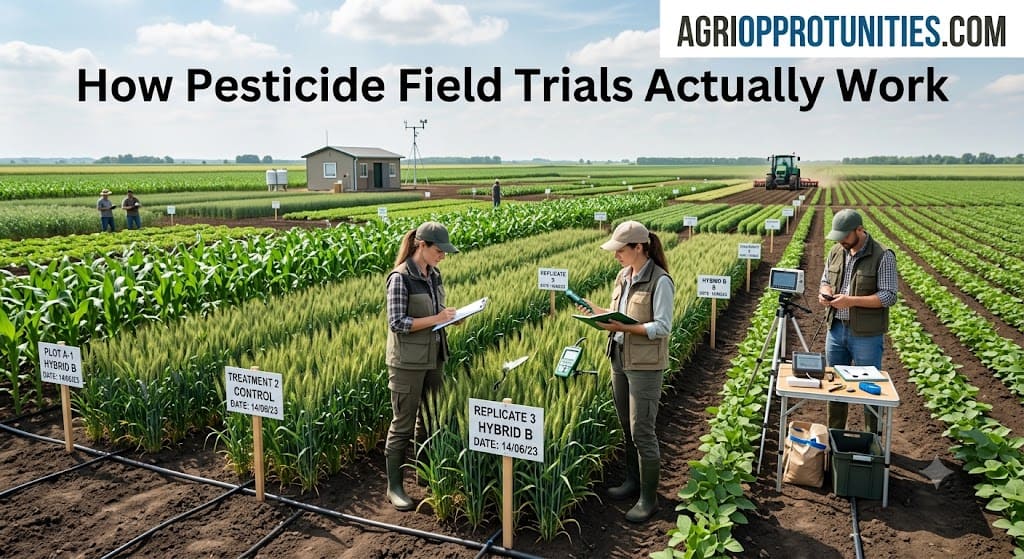
After establishing the application conditions, researchers design the trial to produce statistically reliable results. One widely used approach is the randomized complete block design (RCBD). This design divides the experimental area into blocks and randomly assigns treatments within each block. Researchers typically replicate each treatment to strengthen comparisons and improve the reliability of their findings.
Why Randomization Matters
Soil fertility, drainage, pest distribution, and microclimate can vary considerably within a single field. Without proper randomization and blocking, these differences can distort treatment comparisons, making a pesticide appear more or less effective than it actually is. Randomly assigning treatments within blocks helps researchers account for field variability and distinguish genuine treatment effects from background variation.
What a Typical Trial Plot Looks Like
Plot dimensions depend on the crop, target pest, application equipment, and trial protocol. In some cereal crop trials, individual plots may measure approximately 2.5 × 7 meters. Researchers use calibrated sprayers and carefully controlled application settings to deliver consistent treatments. Spray volumes may be around 200 liters per hectare, depending on the crop, product, equipment, and protocol. Researchers should report the actual spray volume, operating pressure, and other relevant application parameters for each trial rather than treating these values as universal standards.
Testing Different Application Rates and Formulations
Researchers may evaluate a pesticide at the recommended label rate alongside reduced rates, such as half the recommended rate, when the study protocol and regulatory requirements allow it. They may also compare formulations or test adjuvants, which can improve spray retention, coverage, or other aspects of application performance. These comparisons help researchers assess how consistently a product controls the target pest under different application strategies. However, reduced-rate treatments are experimental comparisons and should not be interpreted as recommendations for commercial use unless the relevant evidence and regulatory approval support them.

How Efficacy Is Actually Measured
Depending on the specific product and pest target, efficacy measurement varies considerably. For herbicides, this typically involves population monitoring of the target weed to determine the exact right timing for application, alongside detection of any herbicide resistance in the local weed population. For insecticides, efficacy trials assess activity against the target pest across contact, systemic, ingestion, ovicidal (egg-killing), and larvicidal modes of action, depending on the product’s intended mechanism.
Yield as the Ultimate Measure
For many trials, particularly those testing fungicides against yield-limiting diseases, the ultimate efficacy measure is simply the resulting crop yield itself, commonly measured in decitonnes per hectare. Following data collection, researchers apply a formal statistical mean separation test (commonly the Student-Newman-Keuls test) at a defined significance level, typically 5 percent, to confirm whether observed yield differences between treatments are genuinely statistically meaningful rather than random variation.
Checking for Crop Safety, Not Just Pest Control
Trials also explicitly assess selectivity — confirming a product controls its target pest or disease without causing unacceptable damage to the crop itself, or to non-target, beneficial species nearby. A product that kills the target pest but also damages the crop, or harms beneficial insects like pollinators, would fail this selectivity assessment even if its raw pest-control efficacy looked strong.
Beyond Efficacy: Residue Trials
Efficacy trials answer “does the product work?” A genuinely separate category of trial, the GLP residue study, answers a different question entirely: how much pesticide residue actually remains on or in the harvested crop after treatment, and does this fall within a safe limit?
Why Residue Trials Need the Stricter GLP Standard
Unlike efficacy trials, which benefit from GEP’s flexibility to accommodate variable field conditions, residue studies specifically use the stricter Good Laboratory Practice standard, since these results feed directly into regulatory maximum residue limit (MRL) determinations — the legal thresholds distinguishing safe consumption from potential health risk. This regulatory consequence justifies the tighter methodological control GLP requires.
What Residue Trials Actually Test
These studies commonly include harvest and decline studies (tracking exactly how residue levels decrease over time after application, both in open field and protected/greenhouse conditions), food processing studies (examining how residues change when a raw commodity is processed into a food product), and terrestrial field soil dissipation studies (tracking how the product breaks down in soil after application) — a genuinely comprehensive picture of the pesticide’s fate well beyond the harvest date itself.
Testing Beyond the Target Crop: Non-Target and Environmental Fate Studies
A comprehensive pesticide development program extends well beyond how a product performs on the intended crop and pest. Non-target organism testing assesses whether a product harms beneficial insects, soil organisms, or nearby wildlife not meant to be affected. Environmental fate studies track how the compound moves and breaks down in the broader environment — directly connecting to themes covered elsewhere on this site around how agricultural chemicals interact with soil and water systems. Operator exposure studies specifically assess the safety risk to the person actually applying the product, a genuinely important but sometimes overlooked dimension of the overall safety picture.
A Growing, Distinct Category: Testing Biological and Microbial Products
As biopesticides and plant growth-promoting microorganisms (connecting to the soil microbiome content covered elsewhere on this site) become a larger share of the crop protection market, a genuinely important methodological gap has emerged. Products marketed as soil improvers or plant biostimulants in some jurisdictions aren’t always strictly required to demonstrate proven minimum efficacy under field conditions the way registered pesticides are — manufacturers in these categories often only need to show the product doesn’t pose unacceptable safety risk, without necessarily proving it actually works as claimed.
Why This Regulatory Gap Matters
Uniform field trial guidelines comparable to the well-established EPPO (European and Mediterranean Plant Protection Organisation) standards used for conventional pesticides don’t yet fully exist for these biological products, representing a genuine, actively developing area where researchers are working to propose better standardized testing frameworks — a useful thing to know if you’re considering research specifically in the growing biopesticide and biostimulant testing space.
Why This Matters for a Career in Crop Protection R&D or Trialing
Understanding this full trial process properly is directly relevant if you’re considering a career in crop protection field trial management, R&D, or regulatory affairs — roles covered in more general terms elsewhere on this site, but which depend entirely on genuine technical fluency in exactly the design principles, testing categories, and regulatory distinctions covered in this piece. A trialing manager who genuinely understands why GEP differs from GLP, why randomized block design matters statistically, and why efficacy and residue testing serve entirely different regulatory purposes is positioned to do this work with real credibility, rather than simply executing a protocol handed down without understanding its underlying logic.
For current openings in crop protection field trials, R&D, and regulatory roles, browse live agriculture job listings on Agri Opportunities.
Pesticide field trials follow a rigorous, scientifically structured process — from GEP guidelines to randomized block design. Understanding this process is essential for anyone considering a career in crop protection R&D, regulatory affairs, or field trial management.
Explore careers in crop protection R&D and field trials →Frequently Asked Questions
What is Good Experimental Practice (GEP) in pesticide trials?
GEP is a set of guidelines governing the organization, design, conduct, interpretation, and reporting of pesticide efficacy trials, ensuring results are reliable and comparable across different locations and testing organizations, distinct from the stricter, less flexible Good Laboratory Practice standard.
What is the difference between an efficacy trial and a residue trial?
An efficacy trial measures how well a pesticide actually controls the target pest, disease, or weed under real field conditions, while a residue trial measures how much pesticide residue remains on or in the harvested crop, which is used to establish safe maximum residue limits.
Why do pesticide trials use a randomized complete block design?
Randomized complete block design assigns treatments randomly within grouped blocks of plots to account for natural variation across a field, such as soil differences or drainage patterns, allowing researchers to statistically distinguish a genuine treatment effect from ordinary field-level variability.
What does Good Agricultural Practice (GAP) mean in the context of a pesticide trial?
GAP refers to applying a pesticide exactly as it would be used in real farming conditions in a specific country, at the rate and timing intended for the eventual product label, ensuring trial results genuinely reflect how the product will actually perform once registered and sold.
Add Agri Opportunities as a preferred source on Google to see latest blog listings first.