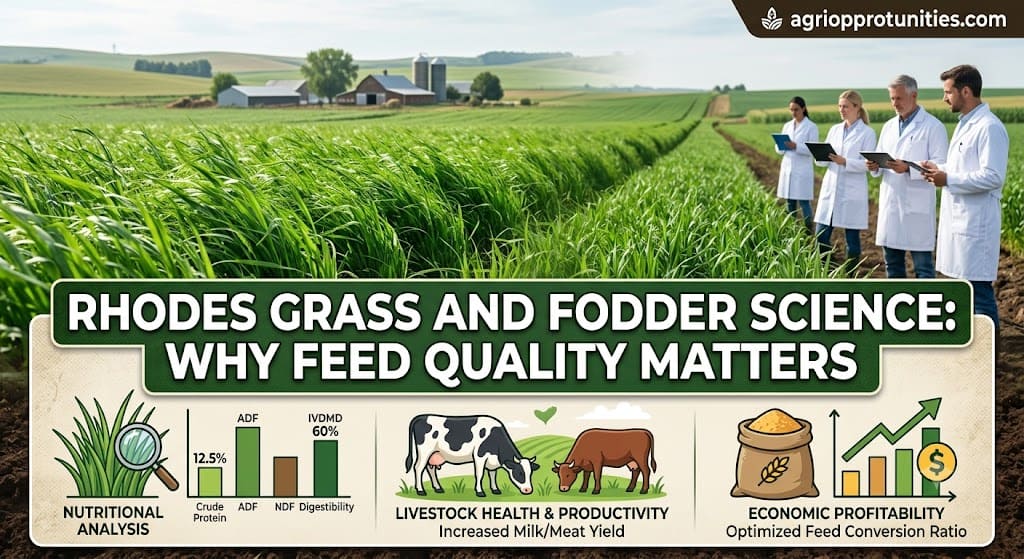
Rhodes Grass and Fodder Science: Why Feed Quality Matters

Rhodes Grass and Fodder Science: Why Feed Quality Matters
The measurable science behind fodder quality — crude protein, digestibility, maturity timing, and a genuine toxicity risk worth knowing about
Rhodes Grass and Fodder Science: Why Feed Quality Matters
Rhodes grass is grown on more than 100,000 acres across Sindh, Punjab, and parts of Balochistan, and it’s become a genuinely significant export commodity to Gulf livestock markets. But “good fodder” isn’t a vague quality judgment — it’s measurable, and the science behind what actually makes one batch of Rhodes grass more nutritionally valuable than another is genuinely interesting. I want to use Rhodes grass as a case study for understanding fodder science more broadly, since the same principles apply across most forage crops.

What Makes Rhodes Grass Agronomically Attractive in the First Place
Rhodes grass (Chloris gayana) is a summer-growing, stoloniferous perennial grass, meaning it spreads through above-ground runners rather than relying purely on seed propagation. It’s genuinely well-suited to Pakistan’s growing conditions: adapted to a wide range of soils from infertile sands to fertile clays, drought-tolerant, and capable of producing as many as eight harvests through the summer months under proper management — a genuinely productive multicut forage crop by almost any measure.
The Core Quality Parameters: What Actually Gets Measured
Fodder quality assessment centers on a specific set of measurable parameters, each telling you something distinct about how valuable a given batch of forage actually is to the animal eating it.
Crude Protein
Crude protein content is the most commonly cited fodder quality figure, and it directly determines how much of an animal’s protein requirement a given fodder can supply without needing supplementary feed. Research on Rhodes grass in Sindh found crude protein content varying considerably by harvest timing, with the highest values recorded during the third harvest compared to the first — a pattern directly connected to plant maturity, covered in detail below.
Neutral Detergent Fiber (NDF) and Acid Detergent Fiber (ADF)
These two related but distinct measurements capture different components of a plant’s structural fiber. NDF measures total cell wall content — cellulose, hemicellulose, and lignin combined — while ADF measures specifically the less digestible portion, cellulose and lignin, excluding hemicellulose. Research studying fodder grasses in Central Punjab found both NDF and ADF strongly negatively correlated with digestibility (correlation coefficients of -0.91 and -0.84 respectively), meaning higher fiber content reliably predicts lower forage quality.
In Vitro Digestibility
This measurement estimates how much of the forage an animal can actually break down and absorb, typically assessed through in vitro dry matter digestibility (IVDMD) or in vitro organic matter digestibility (IVOMD) testing. The same Punjab research found digestibility strongly positively correlated with crude protein (correlation coefficients around +0.83 for both measures) — meaning protein content and digestibility tend to move together, both declining as a plant matures and its fiber content builds up.
The Central Science: Why Maturity Timing Matters So Much
This is genuinely the most important concept in fodder science, and it’s directly actionable for anyone managing forage harvest timing. Rhodes grass’s nutritional quality declines steeply as the plant matures — crude protein drops to around 9 to 10 percent after 10 weeks of regrowth, and can fall below 8 percent after 15 weeks, at which point the grass becomes genuinely protein-deficient for ruminant animals.
Why This Decline Happens
As a grass plant ages, it invests increasingly in structural tissue — cellulose and lignin supporting stem and leaf structure — at the expense of the more digestible, protein-rich cellular content that dominates in younger growth. This is precisely why crude fiber content moves in the opposite direction from crude protein as a fertilizer or harvest-timing variable changes, reflecting greater deposition of structural carbohydrates under nutrient stress or extended growth periods.
A Genuine Trade-Off Between Yield and Quality
Here’s the practical tension this creates for anyone managing a fodder operation: total biomass yield generally increases with each successive harvest and with plant age, but nutritional quality moves in the opposite direction. Research on Rhodes grass in Sindh documented exactly this pattern — fresh matter and dry matter yield increased steadily from the first to third harvest, while crude protein content per unit area also increased in absolute terms, but at a declining rate relative to total biomass, since a larger share of that additional biomass was structural, lower-quality tissue rather than protein-rich early growth.

Why Farmers’ Traditional Harvest Judgment Often Matches the Lab Data
This is a genuinely interesting research finding worth highlighting specifically. A study connecting ethnobotanical knowledge — farmers’ traditional rankings of fodder grass quality based on experience — with formal laboratory nutritional analysis in Central Punjab found a strong, statistically significant correlation between farmers’ traditional preferences and the actual lab-measured values for crude protein, NDF, ADF, and ADL. In other words, generations of farmer experience choosing which grass to feed livestock, and when to harvest it, genuinely tracks the underlying nutritional science quite closely — a good reminder that traditional agricultural knowledge and formal laboratory science aren’t in tension here; they’re measuring the same underlying reality through different methods.
How Fertilizer Management Shapes This Same Trade-Off
Beyond harvest timing, fertilizer application rate represents a second major lever affecting Rhodes grass quality, and research testing varying fertilizer levels found a similarly nuanced picture rather than a simple “more fertilizer, better quality” relationship.
What the Research Actually Found
As fertilizer application increased across tested treatment levels, crude protein content rose from 6.3 to 11.9 percent, and metabolizable energy improved from 8.7 to 10.0 megajoules per kilogram of dry matter. But the same increased fertilizer application also increased fiber fractions (both ADF and NDF), reflecting greater structural plant development under higher-input conditions. The research concluded that a moderately high fertilizer application rate, rather than the maximum tested level, provided the best overall balance between forage yield and nutritional quality — a genuinely useful, concrete finding for anyone managing fertilizer decisions on a fodder operation, since simply maximizing fertilizer input doesn’t straightforwardly maximize forage value.
A Genuine Safety Concern Worth Knowing: Selenium Accumulation
Here’s a detail that doesn’t get nearly enough attention in casual coverage of Rhodes grass, and it’s genuinely important for anyone managing livestock feeding programs. Rhodes grass is a known selenium accumulator — meaning when grown on selenium-rich soils, it can concentrate this trace element to levels that cause serious illness or death in grazing livestock.
How Serious This Risk Actually Is
Acute selenium toxicity in cattle occurs at around 3 milligrams of selenium per kilogram of body weight, and death can follow within days of intoxication, with no established treatment available once acute poisoning occurs. This is a genuinely serious risk, not a theoretical concern — though it’s worth noting that seleniferous plants tend to have a bitter taste and strong odor, meaning animals typically avoid them unless other forage options are genuinely scarce, which somewhat limits real-world exposure risk in practice.
Why This Matters for Sourcing and Quality Control
Given this risk, anyone involved in fodder procurement, quality assurance, or export certification for Rhodes grass genuinely benefits from understanding regional soil selenium levels in sourcing areas, rather than treating this purely as an obscure agronomic footnote — it’s a genuine food safety and animal health consideration that connects the fodder supply chain directly back to underlying soil chemistry.
Why Intake, Not Just Digestibility, Also Matters
It’s worth knowing a further nuance that pure digestibility measurements alone can miss: research comparing Rhodes grass hay intake against other tropical forage species found animals actually consumed around 20 percent less Rhodes grass hay than comparable alternatives, even when the measured digestibility of the two hays was similar. This finding led to a specific practical recommendation — allowing for 30 to 50 percent feed refusal (offering more than the animal is expected to actually eat) so livestock can selectively consume the most digestible portions of the offered fodder, rather than being forced to eat lower-quality material alongside the good portions.
Why Rhodes Grass Has Become a Genuine Export Commodity
Beyond domestic livestock feeding, Rhodes grass hay has become a meaningful Pakistani agricultural export, particularly to Gulf Cooperation Council markets including the UAE, Saudi Arabia, and Oman, where demand for high-quality, consistent forage for dairy and camel operations runs strong. Export-oriented Rhodes grass suppliers specifically market attributes like fine texture, moisture control, and consistent quality — directly reflecting the underlying nutritional science covered throughout this piece, since these commercial quality claims are ultimately proxies for the same crude protein, fiber, and digestibility parameters that determine genuine feed value.
Why This Matters for a Career in Fodder and Forage Science
Understanding the genuine underlying science — why maturity timing drives quality decline, how fertilizer creates a real yield-quality trade-off, why selenium accumulation represents a genuine safety consideration, and why intake behavior matters alongside pure digestibility — is exactly what separates a genuinely credible fodder quality professional from someone simply repeating commercial marketing claims about a product. Given Pakistan’s genuine export growth potential in this specific commodity, this represents a technically rich, genuinely valuable specialization within the broader agribusiness supply chain career track covered elsewhere on this site.
For current openings in fodder science, forage quality, and livestock feed supply chain roles in Pakistan, browse live agriculture job listings on Agri Opportunities.
Frequently Asked Questions
Why does Rhodes grass lose nutritional quality as it matures?
As Rhodes grass matures, crude protein content declines steeply, dropping to around 9 to 10 percent after 10 weeks of regrowth and below 8 percent after 15 weeks, at which point it becomes protein-deficient for ruminant livestock, while fiber content simultaneously increases as the plant builds more structural tissue.
What do NDF and ADF actually measure in fodder quality testing?
Neutral detergent fiber (NDF) measures total plant cell wall content including cellulose, hemicellulose, and lignin, while acid detergent fiber (ADF) measures the less digestible portion, cellulose and lignin specifically, and both are strongly negatively correlated with digestibility, meaning higher fiber values indicate lower quality forage.
Is Rhodes grass ever toxic to livestock?
Rhodes grass is a known selenium accumulator, meaning when grown on selenium-rich soils, it can concentrate enough selenium to cause serious illness or death in cattle, with acute toxicity occurring at around 3 milligrams of selenium per kilogram of body weight.
Does fertilizer application affect Rhodes grass quality?
Yes. Research shows moderately high fertilizer application improves crude protein and metabolizable energy in Rhodes grass, but also increases fiber fractions, meaning fertilizer management involves a genuine trade-off between yield, protein content, and fiber levels rather than a simple more-is-better relationship.