The Nitrogen Cycle Explained: How Fertilizer Becomes Greenhouse Gas

A simple, first-person explanation for students and non-scientists, showing exactly how fertilizer applied to a field ends up as air pollution, water pollution, or greenhouse gas.
I still remember standing at the edge of a fertilized field early in my research career, watching a farmer broadcast urea by hand across freshly irrigated soil, and thinking about a number that had stuck with me from a lecture a few years earlier: less than half of that nitrogen would ever end up inside a wheat plant. The rest — more than half of what he’d just paid for and spread across his land — would disappear somewhere else. Nitrogen doesn’t literally vanish, of course. It just goes somewhere we don’t want it to go. Understanding exactly where it goes, and why, is one of the most useful things a young agriculture student can learn, because it explains a huge share of what’s actually wrong with modern farming’s relationship with the atmosphere.

Start With a Simple Question: Why Do We Even Add Nitrogen?
Nitrogen is one of the most important nutrients a plant needs. It’s a building block of chlorophyll, the pigment that lets plants turn sunlight into energy, and it’s a core ingredient in the amino acids that build every protein in the plant, including the proteins that eventually end up in the grain, fruit, or vegetable we harvest. Plants can’t grow properly without enough of it. The problem is that the atmosphere around us is actually about 78 percent nitrogen gas, yet plants can’t use that atmospheric nitrogen directly — it’s locked in a chemically stable form (N₂) that plant roots simply can’t absorb. So farmers add nitrogen in a form plants can use: synthetic fertilizer, manure, or compost.
The Journey Fertilizer Nitrogen Actually Takes
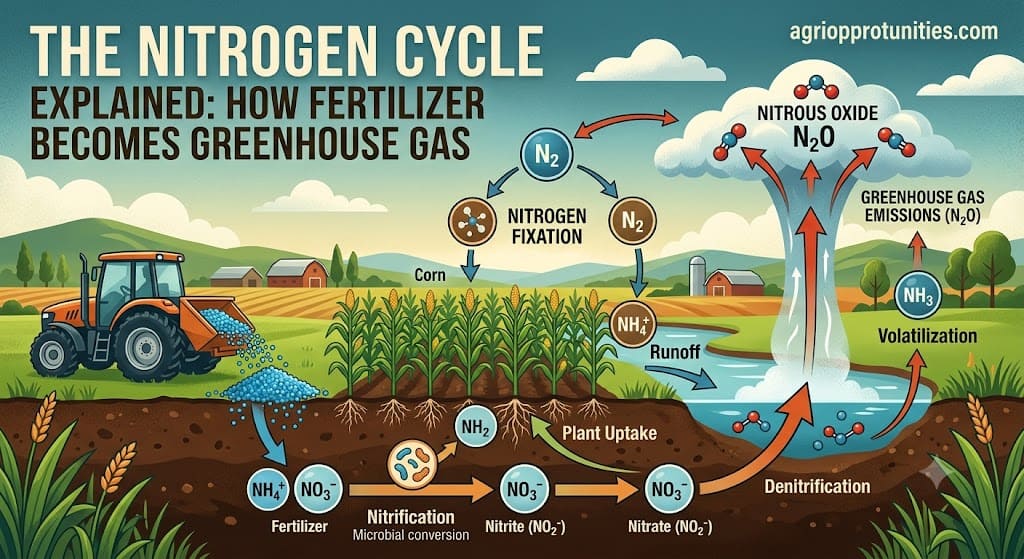
Here’s where it gets interesting, and where most simple explanations stop too early. Once nitrogen fertilizer hits the soil, it doesn’t sit there waiting patiently for the plant to absorb it. It immediately becomes part of a much larger, constantly moving system — what we call the nitrogen cycle — and it can take several different paths, only one of which ends with “plant grows bigger.”
Path One: The Plant Actually Uses It
Ideally, nitrogen in the soil gets converted by microorganisms into a form called nitrate, which plant roots can take up directly, transport upward, and incorporate into new leaves, stems, and grain. This is the outcome every farmer is paying for.
The Good OutcomePath Two: It Washes Away
Nitrate is highly soluble in water. When it rains, or when a field is flood-irrigated, nitrate dissolves easily and moves downward past the root zone, eventually reaching groundwater, or runs off into canals, rivers, and larger water bodies.
Leaching & RunoffPath Three: It Evaporates Into the Air
When nitrogen fertilizer, especially urea, reaches the soil surface and remains exposed rather than properly incorporated, a portion converts into ammonia gas and simply evaporates into the atmosphere before it ever has a chance to reach the roots.
Ammonia VolatilizationPath Four: Soil Bacteria Transform It
In waterlogged or oxygen-poor soil conditions, specific soil bacteria carry out denitrification, converting nitrate step by step into nitrogen gases — including nitrous oxide (N₂O), a gas that traps roughly 300 times more heat than carbon dioxide.
Denitrification → N₂O
Why the Numbers Are Actually Worse Than People Assume
Let’s be blunt about the scale of this. Some research puts global nitrogen use efficiency even lower than the 40-46 percent range, with certain studies suggesting as little as 20 percent of applied nitrogen ends up in our food, meaning as much as 80 percent leaves the system entirely in some assessments. And the trend line is genuinely troubling: nitrogen use efficiency has declined by roughly 22 percent globally since 1961, even as total nitrogen fertilizer use has quadrupled over the same period, because farming has intensified faster than our ability to apply nitrogen precisely has improved.
🌍 Regional Variation Matters
The picture isn’t uniform everywhere. In many developing regions, including large parts of South Asia, farmers lose an estimated 40 to 68 percent of applied nitrogen fertilizer from the field—a genuinely enormous share. Less precise application methods, limited access to soil testing, and fertilizer decisions based more on habit or rough estimates than actual crop demand all contribute to these losses. China’s nitrogen use efficiency has fallen from around 61 percent to 50 percent, while India’s has dropped from about 50 percent to 42 percent, largely because farmers apply more fertilizer than crops can absorb. Meanwhile, countries like France have improved nitrogen use efficiency from around 40 percent to 58 percent through precision agriculture and stronger regulatory frameworks. These examples show that we can improve nitrogen efficiency, but doing so requires deliberate investment in better application practices.
There’s one more twist worth knowing, because it complicates any simple “just use less fertilizer” advice: in parts of sub-Saharan Africa, the opposite problem exists. Soils there are so nutrient-depleted, and farmers have such limited access to fertilizer, that as much as 80 percent of the little fertilizer they apply actually reaches the crops. That sounds like high efficiency, but it reflects a troubling reality: the soil genuinely lacks nutrients. This is a good reminder that nitrogen use efficiency numbers need context. A high number isn’t automatically good news, and a low number doesn’t automatically mean farmers simply use too much fertilizer.
Why This Matters Beyond the Environment
It’s tempting to frame all of this purely as an environmental problem, but for a working farmer, it’s also a very direct financial issue. Every kilogram of nitrogen fertilizer that leaches into groundwater, escapes as ammonia, or turns into nitrous oxide represents money spent without producing any yield. Improving nitrogen use efficiency isn’t just good environmental practice—it makes economic sense for the farmer paying for the fertilizer.
What Can Actually Be Done About It
The encouraging part of this story, and the reason I find this area of research genuinely hopeful rather than just alarming, is that meaningful improvement doesn’t require exotic or unaffordable technology. Research consistently shows that nitrogen losses can be reduced by roughly 15 to 30 percent through practical, achievable agronomic changes:
- Split fertilizer application — applying in smaller, timed doses to match the crop’s actual growth-stage demand rather than one large upfront application.
- Canopy sensors or visual indicators — judging a crop’s real-time nitrogen need rather than applying a fixed, standard dose regardless of conditions.
- Maintaining proper plant population density — so nitrogen isn’t wasted on under-planted fields.
- Incorporating fertilizer into the soil — rather than leaving it exposed on the surface where it can volatilize.
- Combining synthetic fertilizer with legume-based intercropping or organic amendments — improving the soil’s own capacity to hold and cycle nitrogen more efficiently.
Where This Series Goes Next
This piece has explored the nitrogen cycle as a whole—the complete journey nitrogen takes once it enters the soil. In the next piece in this series, I’ll focus on one particularly important step in that journey: nitrous oxide. We’ll look at why it forms, why this gas has such a powerful greenhouse effect despite its relatively small quantity, and what farmers and researchers are doing to reduce emissions without sacrificing the yields needed to feed a growing population.
For current research and graduate opportunities in soil science and nitrogen management, browse live agriculture scholarship listings on Agri Opportunities.
Frequently Asked Questions
What percentage of fertilizer nitrogen actually reaches the crop?
Globally, nitrogen use efficiency averages somewhere between 40 and 46 percent, meaning roughly half or more of the nitrogen applied as fertilizer is lost to the environment rather than taken up by the crop, though this varies significantly by country and farming system.
Where does the lost nitrogen actually go?
Lost nitrogen leaves the field through several pathways: it can wash away with rainwater as leaching or runoff, evaporate into the air as ammonia gas, or be converted by soil bacteria into nitrogen gases including nitrous oxide, a potent greenhouse gas.
Why is nitrogen use efficiency lower in developing countries?
Nitrogen use efficiency tends to be lower where fertilizer is applied without precise timing, placement, or dosage guidance, often due to limited access to soil testing, extension advice, or precision application tools, leading to over-application relative to what the crop can actually use.
Can farmers improve nitrogen use efficiency without reducing yield?
Yes. Research shows improved agronomic practices such as split fertilizer application, correct timing relative to crop uptake stages, and precision tools like canopy sensors can reduce nitrogen losses by 15 to 30 percent without sacrificing yield.
Add Agri Opportunities as a preferred source on Google to see our latest blogs listings first.
Similar Posts
Regenerative Agriculture: The Future of Sustainable Farming and Soil Health
For decades, conventional agriculture has prioritized yield above all else, maximizing output through synthetic fertilizers, heavy tilling, and monoculture planting. While this approach fed billions, it came at a steep cost: degraded soil health, depleted aquifers, collapsed biodiversity, and a spiraling dependency on chemical inputs. Today, farmers, researchers, agri-investors, and policymakers are turning toward a…
How Do Cover Crops and Organic Amendments Affect Soil Emissions?
Cover crops greenhouse gas emissions: what the science says about nitrous oxide, methane, and soil carbon. An evidence-based guide with practical takeaways.
What Is CRISPR, and How Is It Actually Used in Crop Breeding?
CRISPR crop breeding explained: how gene editing works, how it differs from GMOs, and real examples of CRISPR being used in agriculture.
Agriculture Universities in China – Faculty Email List for CSC Scholarship 2026-2027
This guide to agriculture universities in China for CSC Scholarship 2026 will help you find the right professor, craft a compelling email, and secure your admission. It begins with a single, well-written email to the right professor.
Agricultural Robotics: Benefits, Applications, Types, and Future Trends
What is agricultural robotics? Agricultural robotics refers to the design, development, and deployment of robotic systems that perform tasks within farming and food production environments. Unlike traditional machinery that requires constant human operation, agricultural robots are intelligent systems that combine robotics, artificial intelligence, sensors, GPS, machine learning, and automation to carry out complex tasks with minimal human intervention.
What Are PFAS “Forever Chemicals,” and How Do They Reach Farmland?
PFAS forever chemicals explained: how these persistent compounds reach farmland through biosolids, why they don’t break down, and what’s being done about contamination.