The Soil and Crop Microbiome Explained

A soil scientist’s plain-language explanation of the rhizosphere, plant growth-promoting bacteria, and mycorrhizal fungi shaping crop health.
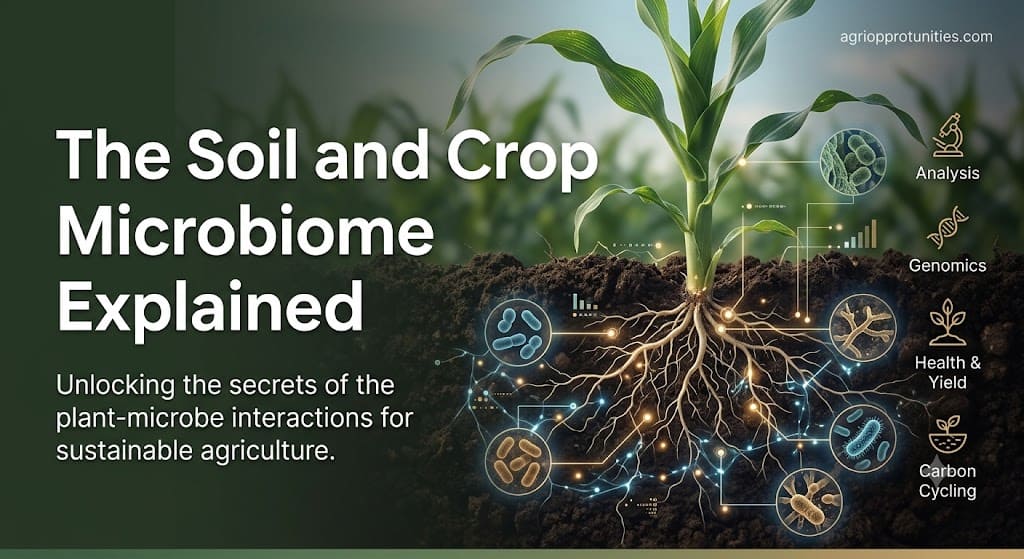
Every healthy crop you’ve ever seen growing in a field owes a huge, mostly invisible debt to a community of microorganisms most farmers never think about directly. This is the soil and crop microbiome — the bacteria, fungi, archaea, and other microbes living in and around a plant’s roots — and it does far more heavy lifting than most people realize. I want to walk through what this community actually is, what it does for a plant, and why researchers increasingly describe it as almost a second genome for the plants it lives alongside.

Starting With a Key Term: The Rhizosphere
The rhizosphere is the narrow zone of soil immediately surrounding a plant’s roots — not the roots themselves, and not the broader “bulk soil” further away, but the specific thin boundary layer where root and soil interact directly.
This zone is genuinely special. Research consistently finds it contains greater microbial species richness than either the plant’s internal tissues (the endosphere) or its above-ground surface (the phyllosphere), making it the single richest microbial habitat associated with any plant.
Why the Rhizosphere Is So Microbially Rich
Plant roots aren’t passive in creating this environment — they actively shape it. Roots secrete a wide variety of compounds directly into the surrounding soil, including organic acids, amino acids, fatty acids, sugars, and vitamins, effectively creating a nutrient-rich zone that draws in and sustains a much denser microbial population than the surrounding soil.
The Plant Actively Recruits Specific Microbes
This isn’t a random process either. Research on rice, for instance, has found that as the plant grows, its roots specifically recruit certain bacteria, including genera like Nitrospira, which help modulate the nitrogen cycle in ways that benefit the plant directly. In other words, plants aren’t just tolerating whatever microbes happen to be nearby — they’re actively shaping which organisms thrive around their roots.
Meet the Key Functional Groups
The rhizosphere microbiome isn’t one uniform community — it’s made up of several distinct functional groups, each contributing something different to plant health and productivity.
Nitrogen-Fixing Rhizobia
These bacteria form symbiotic relationships with legume crops specifically, converting atmospheric nitrogen gas into a form the plant can use — directly connecting to the nitrogen cycle piece earlier in this series, but through a biological pathway rather than industrial fertilizer production. Soybean, one of the world’s most widely cultivated legumes, depends heavily on this relationship, with its unique rhizomicrobiome shaped substantially by its symbiosis with nitrogen-fixing bacteria.
Phosphate-Solubilizing Bacteria
As covered in the phosphorus cycle piece earlier in this series, a large share of soil phosphorus is chemically locked away in forms plants can’t directly access. Phosphate-solubilizing bacteria help release that trapped phosphorus, making it available for root uptake without requiring additional fertilizer input.
Plant Growth-Promoting Rhizobacteria (PGPR)
This is a broad and genuinely important functional category, covering bacteria that benefit plants both directly and indirectly. Direct benefits include improved nutrient uptake and the production of plant growth hormones like auxin, while indirect benefits include suppressing disease-causing pathogens and helping plants withstand environmental stress.
Arbuscular Mycorrhizal Fungi (AMF)
These fungi form a genuinely remarkable partnership with plant roots, extending a vast network of fine fungal threads far beyond what the root itself could reach, dramatically expanding the plant’s effective ability to absorb water and nutrients, particularly phosphorus, from a much larger soil volume than the root system alone could access.
How PGPR Actually Help Plants: The Specific Mechanisms
It’s worth being concrete about exactly how these beneficial bacteria produce their effects, since “helps the plant grow” can sound vague without the underlying mechanism.
Hormone Production
Many PGPR species produce indole-3-acetic acid, a plant growth hormone (auxin) that directly stimulates root development and growth, giving the plant a stronger, more extensive root system to work with.
Stress-Related Enzyme Production
Certain PGPR produce an enzyme called 1-aminocyclopropane-1-carboxylate deaminase, which helps plants manage the physiological stress response triggered by drought, salinity, or other environmental pressures, effectively helping the plant cope better under difficult growing conditions.
Exopolysaccharide and Volatile Compound Production
Some beneficial bacteria produce exopolysaccharides and volatile organic compounds that further help plants tolerate abiotic stress, adding another layer to the microbiome’s stress-buffering role beyond nutrient supply alone.
Nitrogen Fixation and Phosphate Solubilization
As covered above, these two functions — pulling nitrogen from the atmosphere and unlocking soil-bound phosphorus — represent some of the most economically valuable services the microbiome provides, directly reducing a crop’s dependence on purchased fertilizer.
The Disease Suppression Role
Beyond nutrition and stress tolerance, the microbiome plays a genuinely important role in plant defense. When a plant faces disease pressure, it can actively recruit PGPR into the rhizosphere specifically to help suppress the invading pathogens — a form of biological defense that operates alongside, or sometimes instead of, chemical pest and disease control.
Specific bacterial genera like Bacillus are particularly well studied for this disease-suppression role, and combined with growth-promoting genera like Azospirillum, which specifically enhances root growth, these microbial partnerships support genuinely more resilient and productive cropping systems, particularly in crops like soybean grown across tropical regions.
Why Researchers Call This a “Second Genome”
This is a genuinely useful way to think about the concept, and it’s not just a catchy phrase. The full microbiome associated with a plant — spanning its rhizosphere (root zone), phyllosphere (above-ground surface), and endosphere (internal tissues) — plays such an extensive role in the plant’s health and growth that researchers describe it as functioning almost like an extension of the plant’s own genetic toolkit, providing capabilities the plant’s own genome alone doesn’t encode.
How the Microbiome Actually Assembles Around a Plant
An interesting and still actively studied question in this field is exactly how a plant ends up with the specific microbial community it has. Research suggests plants assemble their microbiomes from the surrounding soil through a multistep process, with the rhizosphere playing a central role in shaping which microbes ultimately establish themselves in a stable, ongoing community around the roots.
The Plant’s Own Genotype Matters
Research has found that a plant’s own genotype, alongside the specific soil’s physical and chemical properties, shapes which particular rhizosphere microbiome ends up forming — meaning different crop varieties, even grown in identical soil, can end up hosting meaningfully different microbial communities.
Can Farmers Deliberately Improve the Microbiome?
Given how much value this invisible community provides, a genuinely active area of agricultural research and product development focuses on deliberately inoculating crops with specific beneficial microbes, rather than relying entirely on whatever community happens to establish naturally.
Seed Coinoculation
One documented approach involves coinoculating soybean seeds with two complementary microbial species together — in one study, Priestia megaterium and Bradyrhizobium elkanii — which increased the efficiency of phosphorus fertilization and meaningfully reshaped the resulting rhizosphere bacterial community under real field conditions.
Synthetic Microbial Communities
A newer, more sophisticated approach involves building synthetic communities of multiple beneficial strains together, rather than a single inoculant species. Research using six Pseudomonas strains specifically screened from garlic rhizosphere microbiome successfully promoted plant growth, illustrating how deliberately combining multiple complementary microbial strains can outperform any single strain used alone.
Organic Amendments as an Indirect Tool
Beyond direct inoculation, research comparing different organic amendments has found they meaningfully affect rhizosphere microbial communities and broader soil properties, even in challenging continuous-cropping systems like watermelon grown repeatedly on the same land — connecting directly back to the organic amendments piece earlier in this series, since amendment choice shapes not just nutrient availability but the living microbial community responding to it.
Why Conventional Farming Practices Can Damage This System
It’s worth being honest about a genuine tension here. Research has found that overuse of chemical fertilizers combined with monoculture farming has deteriorated soil health and negatively affected the soil microbiome — meaning some of the very practices used to boost short-term yield can undermine the long-term microbial foundation that supports yield sustainably over time.
This connects directly to themes covered throughout this series: heavy reliance on synthetic nitrogen (covered in the first piece), disruption of natural soil carbon and nitrogen balances (covered in the DOC:NO₃⁻ stoichiometry piece), and reduced organic matter inputs can all combine to weaken the microbial community a healthy, resilient cropping system actually depends on.
An Emerging Frontier: Microbiomes in Environmental Remediation
Beyond conventional crop production, researchers are also studying how rhizosphere microbiome assembly can help address contaminated land. One study found rhizosphere microbiome assembly drives metal sequestration in a specific plant species during tailings phytoremediation — meaning the same microbial partnerships that help a crop absorb nutrients can, in the right plant-microbe combination, also help immobilize and manage toxic metal contamination in degraded soil.
How Climate Change Is Already Shifting These Communities
Given everything covered in the dryland farming piece earlier in this series, it’s worth noting that soil microbial communities themselves are actively responding to changing environmental conditions. Research tracking bacterial diversity and composition in wild blueberry soils found that warming treatments shift the temporal dynamics of these microbial communities — a reminder that the microbiome isn’t a fixed, static system, but one actively responding and adapting to the same climate pressures affecting the crops it supports.
Why This Matters for Students Considering This Research Area
The soil and crop microbiome sits at a genuinely exciting, rapidly expanding intersection of microbiology, plant science, and sustainable agriculture. Given the well-documented damage conventional high-input farming has done to these microbial communities, and the genuine promise shown by targeted inoculation and organic amendment strategies, this is an area where meaningful new research continues to emerge rapidly, rewarding students comfortable working across genomics, field trial design, and practical agronomy together.
For current research and graduate opportunities in soil microbiology and sustainable crop production, browse live agriculture scholarship listings on Agri Opportunities.
Frequently Asked Questions
What is the rhizosphere?
The rhizosphere is the narrow zone of soil directly surrounding a plant’s roots, where root secretions create a nutrient-rich environment that supports a much denser and more active microbial community than the surrounding bulk soil.
What are plant growth-promoting rhizobacteria (PGPR)?
PGPR are rhizosphere bacteria that benefit plant growth directly, by improving nutrient uptake and producing growth hormones like auxin, or indirectly, by suppressing disease-causing pathogens and helping plants tolerate environmental stress.
Why is the crop microbiome sometimes called a plant’s second genome?
The term reflects how extensively the microbiome associated with a plant’s roots, surface, and internal tissues influences the plant’s nutrition, stress tolerance, and disease resistance, functioning almost like an extension of the plant’s own genetic toolkit.
Does using more chemical fertilizer harm the soil microbiome?
Research indicates that overuse of chemical fertilizers combined with monoculture farming has deteriorated soil health and negatively affected the soil microbiome, which is part of why sustainable practices increasingly aim to preserve or actively restore beneficial microbial communities.
Find funded graduate opportunities in soil microbiology, plant-microbe interactions, and sustainable crop production — browse live agriculture scholarship listings on Agri Opportunities.
Add Agri Opportunities as a preferred source on Google to see latest blog listings first.