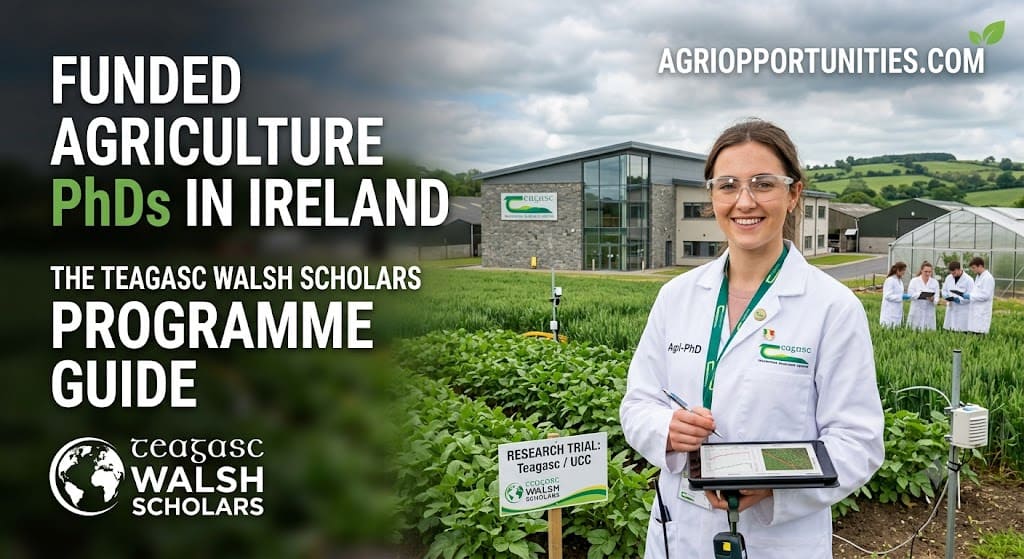
Funded Agriculture PhDs in Ireland: The Teagasc Walsh Scholars Programme Guide

Everything you need to know about Ireland’s primary funding route for agriculture PhDs, and how to actually apply.
If you’re researching funded agriculture PhD opportunities in Ireland, nearly every path eventually leads back to one name: Teagasc, Ireland’s Agriculture and Food Development Authority, and specifically its Walsh Scholars Programme. This is genuinely the primary route to a fully funded agriculture PhD in the country, and understanding exactly how it works will save you considerable time compared to searching individual university pages one by one.

What the Walsh Scholars Programme Actually Is
Named in honor of Dr. Tom Walsh, Teagasc’s first Director, this is a long-established, fully funded training programme for graduates undertaking PhD and Research Masters study across agriculture, food, environment, climate, and rural development. Scholars are based at Teagasc’s national research centres and partner universities, working within multidisciplinary teams on research with genuine national and international relevance.
Joint Supervision Is the Programme’s Core Structure
Unlike a standard university PhD, Walsh Scholars receive joint supervision from Teagasc researchers and academic staff at Irish and international universities together, combining Teagasc’s applied research infrastructure with a university’s formal degree-granting structure and academic training framework.
What It Actually Pays
Scholarships provide a stipend of 25,000 euros per year, with tuition fees covered up to 6,000 euros annually, subject to the specific terms of each individual project. Some individual projects, particularly those co-funded through other bodies like the VistaMilk SFI Research Centre, have offered similar or slightly adjusted figures, along with additional funding for international travel and professional development on top of the base stipend.
Who Actually Funds This Programme
The Walsh Scholars Programme draws funding from Teagasc directly alongside a range of national and European funders, including Research Ireland, the Department of Agriculture, Food and the Marine (DAFM), and Horizon Europe. This diversified funding base is part of why the programme has sustained such a consistently large intake year after year, rather than depending on a single funding source that could dry up unpredictably.
The Scale of the 2026 Intake
For 2026 specifically, the programme advertised 20 fully funded postgraduate opportunities, including 18 PhD and two Research Masters positions, spanning sustainable agriculture and food systems, climate and environmental science, grassland and livestock systems, crop production, soil and nutrient management, food innovation, rural development, and farmer wellbeing — a genuinely broad range covering nearly every subfield relevant to agriculture graduates.
Where Scholars Are Actually Based
Given how this project-based structure works, individual Walsh Scholars positions get hosted across a range of Teagasc research centres and university partners depending on the specific project. Common partner institutions include University College Dublin, the South East Technological University (SETU) in Waterford, the University of Limerick, and Teagasc’s own research centres, including Moorepark in County Cork and Oak Park in County Carlow.
An Example Project Worth Knowing About
One recent Walsh Scholars project, run jointly between Teagasc Moorepark and the University of Limerick, focused on “Next Gen Milking” — using advanced analytics and machine learning to optimize cow-level milking management for efficiency, cow comfort, and milk quality. This is a good illustration of how Walsh Scholars projects increasingly blend traditional agricultural science with modern data science and engineering skills, a pattern worth keeping in mind if your own background leans toward the more technical or computational side of agriculture.
The Application Process, Step by Step
Unlike a single general scholarship application, Walsh Scholars opportunities are advertised as individual, specific projects, each with its own listing, supervision team, and application instructions.
- Step One: Review the Current Opportunities List — Teagasc publishes all currently open Walsh Scholars projects centrally on its own website, with full details on each project’s research focus, named supervisors, training supports, and funding terms.
- Step Two: Select a Project That Genuinely Matches Your Background — Since these are individually defined research projects rather than a general PhD admission, your application should demonstrate a clear, specific fit with the exact project you’re applying to — echoing the advice in the general statement of purpose guide elsewhere on this site, generic enthusiasm for “Irish agriculture” won’t stand out the way a targeted connection to a specific project’s research question will.
- Step Three: Follow That Specific Project’s Application Instructions Exactly — Each project listing specifies its own required documents and submission method — some use a standard CV-and-cover-letter format, others (as seen in one recent UCD-affiliated project) use an online Google Form application requiring a CV with named referees and a short research or personal statement. Late submissions are not considered, and application requirements genuinely vary project to project, so read each listing’s specific instructions carefully rather than assuming a standard format applies across the whole programme.
Deadlines Vary by Project, Not by a Single Programme-Wide Date
This is a genuinely important detail that trips up first-time applicants: while a broader wave of new opportunities is typically announced early in the calendar year (with closing dates commonly falling around mid-March for a September start), individual project listings continue to open throughout the year with their own specific deadlines, some closing in July for later intakes. Always check the specific closing date on your target project’s own listing rather than assuming a single fixed programme-wide deadline.
Eligibility Requirements
Requirements vary by specific project, but common baseline expectations include a first or upper second-class honours degree in a relevant discipline, with a master’s degree considered an advantage though not always mandatory. Some more quantitative projects specifically value statistical or modelling software experience, while others prioritize field research experience or specific technical qualifications relevant to that project’s exact focus.
International Applicants Are Explicitly Welcome
Applicants from all nationalities are welcome, and there is no application fee. Non-EU applicants do need to separately confirm Irish student visa requirements, which is worth reviewing early in your planning process rather than after securing a project offer.
What Scholars Actually Receive Beyond the Stipend
Beyond the direct funding, Walsh Scholars gain access to supervision from internationally recognized researchers, state-of-the-art laboratories and research facilities, opportunities for global collaboration and conference participation, professional development in communication and leadership, and a structured, cohort-based research community — genuinely comprehensive support beyond the base financial package.
Why This Programme Is Worth Prioritizing If You’re Considering Ireland
Given Teagasc’s own explicit framing — building a strong pipeline of research talent as essential to the future of Ireland’s agri-food sector — the Walsh Scholars Programme isn’t a minor funding scheme; it’s the central, deliberately sustained pathway through which Ireland trains its next generation of agricultural researchers, and its consistent, multi-funder backing makes it a genuinely more stable long-term opportunity than many smaller, single-project scholarships elsewhere.
Practical Tips for a Competitive Application
Apply early, since the programme itself explicitly advises applying ahead of deadlines to avoid system delays and competition pressure near the closing date. Make sure your motivation letter and CV clearly match your specific background to your chosen project’s stated research focus, rather than submitting a generic agriculture-interest statement across multiple applications. Strong grades and any relevant research experience meaningfully strengthen your profile, and given how competitive and internationally recognized this programme has become, a well-written, project-specific motivation letter is often described as the deciding factor in close selection decisions.
For currently open PhD and research positions in Ireland and across Europe, browse live agriculture scholarship listings on Agri Opportunities.
Frequently Asked Questions
What is the Teagasc Walsh Scholars Programme?
The Walsh Scholars Programme is Teagasc’s long-established postgraduate scholarship scheme, offering fully funded PhD and Research Masters positions in agriculture, food, environment, climate, and rural development, with scholars jointly supervised by Teagasc researchers and academic staff at partner universities.
How much does a Teagasc Walsh Scholarship pay?
Walsh Scholarships provide a stipend of 25,000 euros per year, with tuition fees covered up to 6,000 euros annually, subject to specific programme terms and conditions for each project.
Can international students apply for Walsh Scholarships?
Yes. Applicants from all nationalities are welcome, though non-EU applicants must separately meet Irish student visa requirements, which are worth reviewing before applying to ensure eligibility.
How do I actually apply for a Walsh Scholars Programme PhD position?
Applications are project-based rather than a single general application. You need to review the specific list of currently advertised research opportunities on the Teagasc website, select a project matching your background, and follow the exact application instructions provided in that individual project’s listing.
Find Teagasc Walsh Scholars positions, PhD funding, and research roles in agriculture and food science — browse live agriculture scholarship listings on Agri Opportunities.