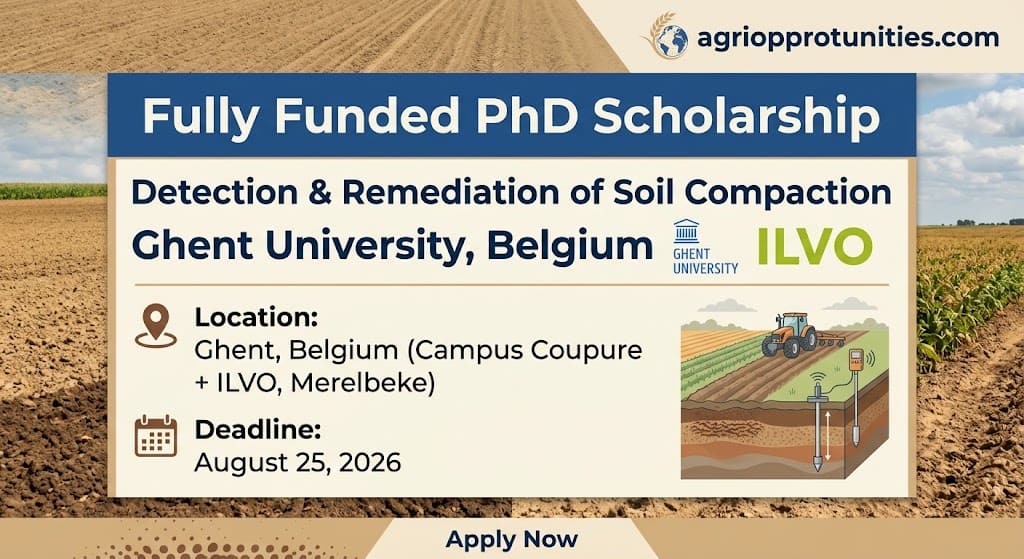
Fully Funded PhD Scholarship: Detection & Remediation of Soil Compaction – Ghent University, Belgium

Quick Overview
Ghent University is offering a fully funded doctoral fellowship focusing on the detection and remediation of soil compaction. This interdisciplinary project combines remote sensing, proximal sensing, field measurements, and machine learning to develop innovative methods for mapping soil compaction and evaluating remediation techniques. The position is part of a consortium including ILVO, Viaverda, and the Belgian Soil Service.
Experience Level: MSc in Bioscience/Agricultural Engineering, Soil Science, Geography, Geology, or related field
Best Fit: Soil Science, Agricultural Engineering, or Geography graduates with interest in remote sensing
Deadline: August 25, 2026
Key Details
| Position | Doctoral Fellow |
| Project | Detection & Remediation of Soil Compaction |
| University | Ghent University |
| Location | Ghent, Belgium (Campus Coupure + ILVO, Merelbeke) |
| Qualification | MSc in Bioscience/Agricultural Engineering, Soil Science, Geography, Geology, or related discipline |
| Experience | Basic knowledge of soil physics required |
| Funding | Full-time doctoral fellowship (100% net salary of AAP member) |
| Duration | 12 months (extendable to 48 months after positive evaluation) |
| Start Date | October 1, 2026 |
| Deadline | August 25, 2026 |
| Apply Via | wim.cornelis@ugent.be |
| Contact | Prof. Wim Cornelis – wim.cornelis@ugent.be / Dr. Tommy D’hose – Tommy.Dhose@ilvo.vlaanderen.be |
Research Context
Climate change is increasingly leading to periods of extreme drought and intense rainfall. Soil compaction exacerbates the impact of both: it reduces infiltration and water storage during heavy rainfall while decreasing the availability and accessibility of water for crops during drought.
This project will develop innovative methods to accurately map soil compaction at the field scale by integrating remote sensing and proximal sensing. This information is essential for selecting and implementing the most appropriate remediation measures.
Key Responsibilities
- Develop and validate innovative methods for mapping soil compaction combining remote sensing, proximal sensing, and field measurements
- Develop and optimize machine-learning models for detection and quantification of soil compaction
- Conduct field experiments on arable and horticultural farms and collect, analyze, and interpret soil and crop data
- Evaluate innovative techniques for remediating soil compaction under practical farming conditions
- Translate research findings into user-friendly decision support tools for farmers, growers, and agricultural advisors
- Publish research results in international peer-reviewed scientific journals
- Actively participate in workshops, project meetings, and consultations with stakeholders
Who Should Apply
This position is best for candidates with a background in soil science, agricultural engineering, or related fields.
Required:
- MSc in Bioscience or Agricultural Engineering, Soil Science, Geography, Geology, or related discipline
- Basic knowledge of soil physics
- Strong interest in agriculture/horticulture and soils
- Excellent written and spoken English
- Motivation to pursue a PhD
- Ability to work independently and collaboratively
Desirable:
- Experience with Python, MATLAB, or other computational tools
- Interest/experience in remote sensing, proximal sensing, or machine learning
- Willingness to undertake a short research stay abroad
What They Offer
| Benefit | Details |
|---|---|
| Funding | Full-time doctoral fellowship |
| Duration | 12 months (extendable to 48 months) |
| Start Date | October 1, 2026 |
| Location | Ghent, Belgium |
| Salary | 100% of net salary of AAP member (tax-free under conditions) |
| Holiday Leave | 36 days + annual bridge days |
| Benefits | Bicycle allowance, eco vouchers, training opportunities |
Application Tips
- Highlight soil science background – Core requirement.
- Show computational skills – Python, MATLAB experience is desirable.
- Demonstrate remote sensing interest – Key research focus.
- Apply before deadline – August 25, 2026.
- Email subject line – “Application PhD DEREBO”.
How to Apply
Submit your application via email to wim.cornelis@ugent.be with the subject line “Application PhD DEREBO.”
Required documents:
- CV
- Copy of master’s diploma (if available)
- Academic transcripts
- Motivation letter
Frequently Asked Questions
- What is the qualification requirement? MSc in Bioscience/Agricultural Engineering, Soil Science, Geography, Geology, or related discipline.
- Is IELTS/TOEFL required? The vacancy requires excellent English but does not specify an IELTS/TOEFL score.
- Can international applicants apply? Yes, the vacancy does not state a nationality restriction.
- What is the duration? 12 months, extendable to 48 months after positive evaluation.
- What is the deadline? August 25, 2026.

Good luck