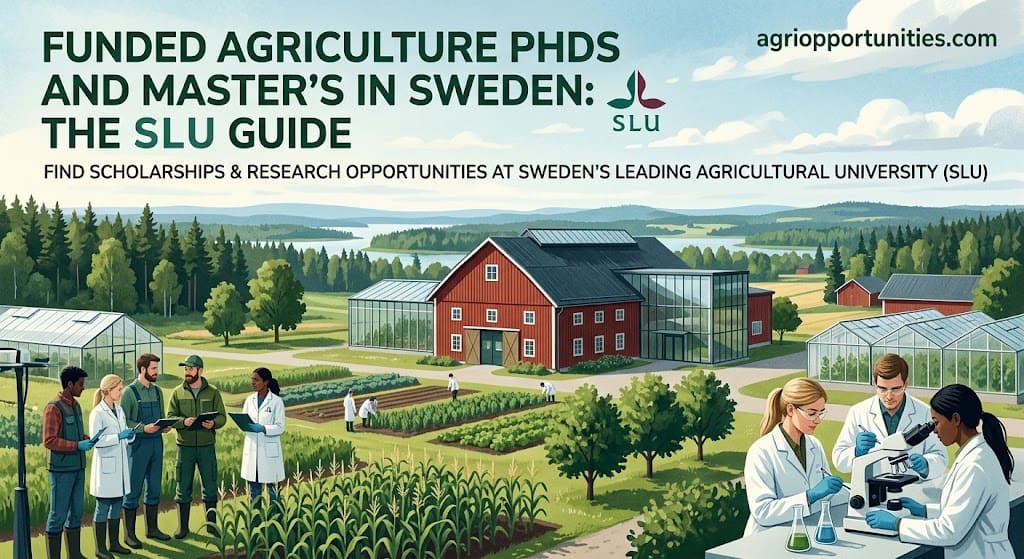
Funded Agriculture PhDs and Master’s in Sweden: The SLU Guide

How Sweden’s PhD-as-employment model works, what SLU actually pays, and how to apply as an international student.
The Swedish University of Agricultural Sciences, universally known as SLU, is Sweden’s dedicated institution for agriculture, forestry, veterinary medicine, and related environmental sciences, and it follows the same distinctive PhD-as-employment model used across Swedish higher education generally. This guide walks through exactly how that system works, what it pays, and how international students actually navigate the application process.

PhD as a Genuine Salaried Job, Not a Stipend
Like Denmark, covered elsewhere on this site, Sweden treats PhD candidates as university employees rather than students receiving a stipend. Doctoral students hold formal employment contracts offering a monthly salary sufficient to meet living costs, employee benefits including pension contributions and healthcare, and paid vacation and parental leave.
What SLU Actually Pays
As of 2026, doctoral students at SLU enter a structured salary ladder starting at 33,000 Swedish kronor per month, with salary increasing progressively each year of the programme according to a fixed, pre-determined salary progression set through local collective agreements — meaning your pay isn’t subject to individual negotiation, but follows a known, transparent schedule you can plan around from the outset.
Tuition Is Genuinely Free, Regardless of Nationality
Because PhD candidates are classified as employees, tuition is free for all doctoral students at SLU regardless of nationality, unlike many other countries where international students pay significantly higher PhD fees than domestic ones. It’s worth being honest, though, that living costs in Sweden remain genuinely high, so the monthly salary needs to be weighed against that reality when planning your finances.
Where SLU Is Actually Located
The Swedish University of Agricultural Sciences (SLU) operates three main campuses in Uppsala, Alnarp, and Umeå, along with research stations, experimental parks, and educational facilities across Sweden. Each campus has distinct research strengths. Alnarp focuses on landscape architecture, horticulture, plant production, agriculture, and forestry suited to southern Sweden’s growing conditions. Uppsala and Umeå contribute expertise across the university’s broader agriculture, forestry, and veterinary science programs.
The Scale of the University
SLU enrolls more than 4,000 students and over 700 doctoral researchers. Research and doctoral education account for approximately 70 percent of the university’s total turnover, highlighting its strong research focus. The university also produces around 1,600 scientific articles annually, with many publications ranking among the most cited in their respective fields.
How PhD Positions Are Actually Posted and Filled
SLU advertises PhD positions throughout the year rather than following a single annual admissions cycle. Each vacancy typically relates to a specific funded research project and identifies the relevant research group or supervisor. Applicants should therefore monitor new openings regularly and apply according to each position’s deadline.
A Genuinely Wide Range of Research Opportunities
Recent SLU vacancies have covered a broad range of subjects, including agricultural and food economics, technology adoption and smallholder farmer welfare in Ghana and Vietnam, AI-driven digital phenotyping and genomics, forest tree genomics, cyanobacterial toxins under climate change, microbial approaches to PFAS remediation, and environmental organic chemistry related to antimicrobial resistance. These examples demonstrate how SLU connects traditional agricultural research with emerging biotechnology and environmental science.
The Step-by-Step Application Process
Step One: Find a Specific Position
Start by checking SLU’s official vacancies page and relevant academic job portals. Because the university advertises PhD positions throughout the year, check regularly or set up alerts through platforms such as PhDportal and other academic job aggregators. Do not assume that all positions follow the same application deadline.
Step Two: Contact the Prospective Supervisor
Before applying, review the project’s research objectives and identify the relevant supervisor or research group. Contact the supervisor if the vacancy invites enquiries or if you need clarification about the project. A focused email explaining your research interests and relevant experience can help you assess your fit for the position and clarify any uncertainties before submitting your application.
Step Three: Prepare Your Application Documents
Review the vacancy announcement carefully and prepare every document the employer requests. For example, a recent PhD vacancy in environmental economics at SLU Uppsala asked applicants to submit PDF documents, including a cover letter describing their motivation, research interests, and relevant skills; degree certificates and academic transcripts; a master’s thesis or equivalent independent project worth at least 15 credits; and proof of English proficiency equivalent to the Swedish upper-secondary qualification English 6 (Engelska 6).
Step Four: Check the Subject-Specific Requirements
Each PhD vacancy sets its own eligibility criteria, so a relevant degree alone may not qualify you. For example, the environmental economics position required at least 90 higher education credits in economics, including an independent project worth at least 30 advanced-level credits. Check the required subject background, degree level, research experience, language proficiency, and other conditions before applying.
Step Five: Submit Your Application and Complete the Selection Process
Submit your application through SLU’s online recruitment system before the deadline. If you make the shortlist, the university will invite you for an interview before announcing the final selection results.
Master’s Applicants: A Different Process and Timeline
If you’re applying for a master’s degree rather than a PhD, you’ll follow a different process. Instead of applying for individual research positions throughout the year, you submit your application during Sweden’s centralized university admissions cycle. International students can generally apply to SLU from 16 October to 15 January for the following academic year through Sweden’s university admissions system. Check the current admissions calendar for the exact dates and deadlines for your chosen programme.
Funding at the Master’s Level
Citizens of EU/EEA countries and Switzerland generally do not pay tuition fees. Fee-paying international students can explore SLU-specific scholarships, the Swedish Institute’s scholarship programmes for eligible applicants, and external funding opportunities. However, SLU offers a limited number of scholarships relative to demand, so investigate eligibility requirements and alternative funding sources early in the application process.
Beyond SLU-Specific Funding: The Swedish Institute Scholarship
The Swedish Institute, a Swedish government agency, offers scholarship programmes for international students from eligible countries. These scholarships operate separately from individual universities’ funding schemes. Check the Swedish Institute’s official website for current eligibility criteria, participating countries, eligible programmes, and application deadlines, regardless of which Swedish university you plan to attend.
Practical Tips for a Competitive SLU Application
Given SLU’s rolling PhD posting structure, set up regular monitoring of the university’s own careers page and academic job aggregators rather than checking sporadically, since a strong-fit position posted today might close before you’d otherwise notice it during a less frequent search routine. Reach out to your target supervisor before formally applying, following the same research-first approach — reading their recent publications and referencing specific, genuine points of connection — covered in the general statement of purpose and research assistantship guides elsewhere on this site. And given how specific eligibility requirements can get buried in individual posting fine print (as the 90-credit economics example above illustrates), read the full position description carefully rather than assuming a general “relevant degree” qualifies you automatically.
For currently open PhD and master’s positions in Sweden and across Europe, browse live agriculture scholarship listings on Agri Opportunities.
Frequently Asked Questions
How much does a PhD student at SLU actually get paid?
As of 2026, doctoral students at SLU enter a structured salary ladder starting at 33,000 Swedish kronor per month, with salary increasing progressively each year as the student advances through the programme.
Where are SLU’s main campuses located?
SLU’s three main campuses are located in Uppsala, Alnarp, and Umeå, with additional research stations and educational facilities throughout Sweden, and each campus has a somewhat different research focus, with Alnarp specializing in landscape architecture, horticulture, and southern Swedish agriculture.
Is PhD tuition free in Sweden?
Yes, PhD tuition is free at SLU and other Swedish universities regardless of nationality, since doctoral students are considered university employees rather than fee-paying students, though living costs in Sweden remain genuinely high.
What documents are typically required for an SLU PhD application?
Common requirements include a cover letter describing your motivation and research interests, copies of degree certificates and transcripts, your master’s thesis or an equivalent independent project, and documentation confirming you meet SLU’s English language requirements.
- • Funded Agriculture PhDs in Denmark: Aarhus and DTU Guide
- • GHG and Soil Emissions Research Opportunities: PhD, Postdoc, and Funding Guide
- • How to Write a Winning Statement of Purpose for Agriculture Graduate Programs
- • Fulbright Scholarship Guide for Agriculture Students
Add Agri Opportunities as a preferred source on Google to see latest guide listings first.

I must thank you for the efforts you’ve put in writing this site. I am hoping to view the same high-grade content by you later on as well. In truth, your creative writing abilities has encouraged me to get my own site now 😉
Share me for the next PhD call through email. I am very interested to study my PhD in Sweden.