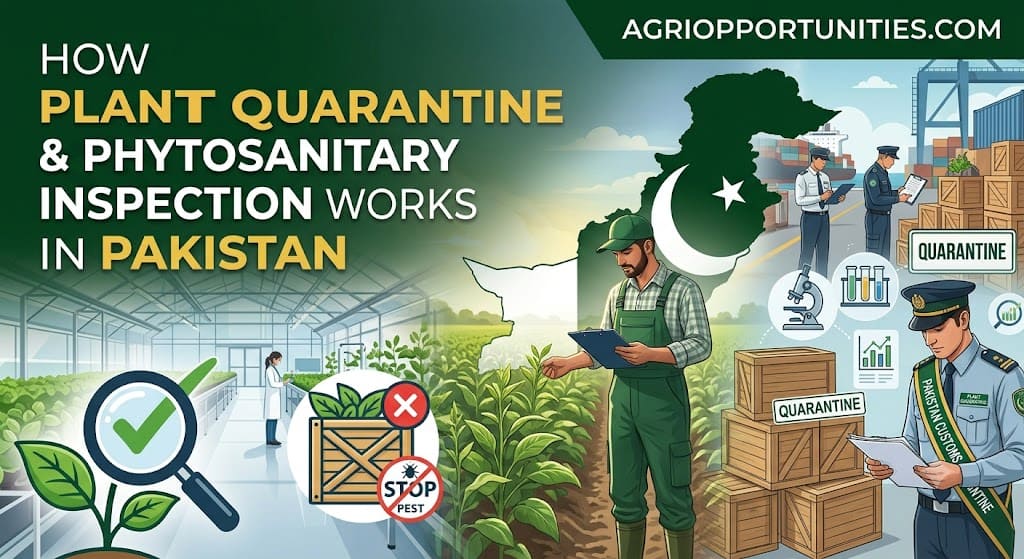
How Plant Quarantine and Phytosanitary Inspection Work in Pakistan

How Plant Quarantine and Phytosanitary Inspection Works in Pakistan
Import permits, pest risk analysis, phytosanitary certificates, and the role of plant inspectors at Pakistan’s ports of entry
How Plant Quarantine and Phytosanitary Inspection Works in Pakistan
Every sack of imported seed, every container of pulses, and every consignment of fresh produce entering Pakistan passes through a structured plant quarantine and inspection system designed to prevent harmful pests and diseases from crossing the country’s borders. A single infested shipment can introduce an invasive pest or plant pathogen capable of causing severe economic losses across an entire crop sector. This guide explains how Pakistan’s plant quarantine system works and what plant inspectors actually do to protect the country’s agriculture.

The Legal Foundation
Plant quarantine in Pakistan is regulated under the Pakistan Plant Quarantine Act, 1976, together with the Pakistan Plant Quarantine Rules, 1967. Pakistan has been a signatory of the International Plant Protection Convention (IPPC) since 1954, and the Department of Plant Protection (DPP) has historically functioned as the country’s National Plant Protection Organization (NPPO) under both the IPPC and the WTO’s Sanitary and Phytosanitary (SPS) Agreement — the international framework governing how countries manage pest and disease risk in agricultural trade.
Pakistan may require special phytosanitary treatments for certain commodities that pose a high risk of introducing pests or diseases. Depending on the identified risk and applicable import conditions, these treatments may include fumigation, cold treatment, heat treatment, irradiation, or vapour heat treatment. Commodities that may face such requirements include beans, chickpeas, other pulses, crude drugs and medicinal herbs, lucerne, oats, sunflower and canola seeds intended for oil extraction, cotton, raw jute, and sorghum. The specific requirements vary by commodity, country of origin, and regulated pest, so importers should confirm the applicable conditions before shipment.
Seed-Specific Requirements: A More Rigorous Path
Seed imports follow their own regulatory procedures, and the applicable requirements depend on factors such as the species, variety, country of origin, and approval status in Pakistan. Importers should distinguish between varieties already approved for import or cultivation and new varieties that may require additional evaluation or authorization.
The Core Concept: Pest Risk Analysis
Before Pakistan allows the import of any new plant or plant product, authorities carry out a Pest Risk Analysis (PRA). This formal assessment identifies the phytosanitary risks associated with a specific commodity and evaluates the measures needed to manage those risks throughout the import pathway.
What Comes Out of a PRA?
Based on the findings, authorities develop import conditions for a specific commodity from a specific country of origin and communicate them through an Import Permit. As a result, import requirements vary not only by commodity but also by exporting country. For example, the same crop imported from two different countries may face entirely different phytosanitary requirements because each country presents a different pest profile.
The Import Permit: Granting Market Access
An Import Permit formally confirms that Pakistan has granted market access to a specific commodity from a particular country under defined phytosanitary conditions. Authorized importers apply for the permit using the prescribed Form-I and must meet the requirements of the Plant Quarantine Act, the Plant Quarantine Rules, and the Ministry of Commerce’s Import Policy Order.
An Important Time Limit
An Import Permit remains valid for a maximum of three months. During that period, the exporter must ship the commodity and obtain a valid Phytosanitary Certificate from the exporting country’s plant protection authority. If the shipment does not take place before the permit expires, the importer must apply for a new permit covering another three-month period. For importers and logistics managers, missing this deadline can result in additional paperwork and delays.
The Phytosanitary Certificate: The Exporting Country’s Responsibility
While Pakistan issues the Import Permit, the exporting country’s National Plant Protection Organization (NPPO) issues the Phytosanitary Certificate. This certificate confirms that inspectors examined the consignment, found it free from the quarantine pests specified by Pakistan, and verified that it complies with all stated import requirements.
What a Phytosanitary Certificate Contains
A properly issued certificate records the shipper’s and consignee’s details, provides a complete description of the shipment—including package numbers and shipping marks—and includes an official declaration that inspectors examined the consignment and found it free from the quarantine pests identified by the importing country. If the shipment underwent a phytosanitary treatment, the certificate also specifies the treatment method, chemical used, concentration, duration, and temperature. An authorized government official then signs and stamps the document.
What Happens When a Shipment Arrives
When a consignment reaches a designated port of entry in Pakistan, plant quarantine officials hold it for inspection and verify that it meets every condition listed in its Import Permit. This stage represents the core of a Plant Inspector’s day-to-day work.
Document Verification
Inspectors begin by reviewing all required documents for accuracy and consistency. These typically include the Import Permit, Phytosanitary Certificate, certificate of origin, treatment certificate (where applicable), bill of lading, commercial invoice, letter of credit, and anchorage permit. They then compare the shipment itself with the accompanying documents to confirm that the cargo matches its declared identity and specifications.
Physical Inspection
Next, inspectors examine the shipment itself. Depending on the type of cargo, they may inspect ship holds, shipping containers, baggage, mail parcels, warehouses, dry ports, and other designated entry or exit points. This broad inspection network helps prevent quarantine pests from entering the country through any potential pathway, not just commercial cargo.
The Four Possible Outcomes
Following inspection, a Plant Quarantine Inspector reaches one of several conclusions about a given consignment: it can be released as a compliant shipment, free of risk; it can be treated if it carries a manageable, non-quarantine risk that becomes compliant after treatment; or it can be destroyed or returned if it carries a non-manageable quarantine risk that cannot be resolved through treatment. Once a shipment passes inspection and any necessary treatment, the DPP issues a Plant Protection Release Order (PPRO), notifying Pakistan Customs that the consignment can be released.

Special Treatments for High-Risk Commodities
Certain commodities carrying particularly high phytosanitary risk require special treatments before entry — fumigation, cold treatment, heat treatment, irradiation, or vapour heat treatment, depending on the specific pest risk involved. Commodities historically subject to these special treatment requirements include beans, chickpeas, pulses, crude drugs and medicinal herbs, lucerne, oats, sunflower and canola seed for oil extraction, cotton, raw jute, and sorghum, among others — a genuinely broad range of agricultural commodities reflecting how many different import pathways carry meaningful pest risk.
Seed-Specific Requirements: A More Rigorous Path
Seeds carry their own distinct import procedure, and the specific requirements depend on whether the variety is already approved or genuinely new to Pakistan.
Approved Varieties
Seeds of already-approved varieties are subject to seed purity and germination testing — connecting directly to the seed certification and DUS/VCU testing content covered elsewhere on this site, since a variety only reaches “approved” status after passing through that formal variety registration process in the first place.
New Varieties
For genuinely new varieties not yet approved in Pakistan, additional requirements apply, including a mandatory two years of adaptability trials before the variety can even be considered for approval — a genuinely serious barrier to entry for new seed varieties, ensuring imported genetics are actually validated under Pakistani growing conditions before being allowed into broader circulation.
Export Inspection: The Other Direction
Plant quarantine work isn’t only about protecting Pakistan from incoming risks — it also facilitates Pakistani agricultural exports, since importing countries require their own phytosanitary assurance before accepting Pakistani plant material. Export inspection involves sampling and detailed laboratory testing specifically for seeds and planting material intended for propagation, while plant material intended for direct consumption typically undergoes visual examination using hand lenses and washing tests instead — a genuinely different, generally less intensive inspection standard reflecting the lower propagation-related risk of consumption-only produce.
The Digital Modernization of This System
More recently, Pakistan has moved this process onto Pakistan’s Single Window (PSW) digital trade platform, allowing traders and customs agents to electronically submit Import Permit and Export Certificate (Phytosanitary Certificate) applications, perform document and inspection calling, and track approval or rejection status online — removing the need to physically visit a DPP office to manually submit paperwork, and giving traders clearer visibility into exactly where their application stands in the process.
An Important Institutional Note: The NAFSA Transition
As covered in more detail in our companion piece on pesticide registration in Pakistan, the Department of Plant Protection’s functions — including the plant quarantine and inspection responsibilities described throughout this piece — are in the process of being absorbed into the newly created National Agri-Trade and Food Safety Authority (NAFSA), established by presidential ordinance in 2025. This transition has been genuinely contested on constitutional and provincial-autonomy grounds, and reports describe DPP operating in a “hybrid status” during the changeover, with its core inspection functions reportedly continuing in practice even as the formal institutional structure shifts. Anyone entering this field right now should confirm the current operational authority directly, since the underlying inspection procedures described here are likely to remain broadly similar, but the specific office and reporting structure is a genuinely moving target during this period.
Why This Matters for a Career in Plant Quarantine and Inspection
A career as a Plant Inspector combines genuine technical knowledge — pest identification, understanding of quarantine treatment protocols, familiarity with international phytosanitary standards — with real regulatory and documentation rigor, since a single missed detail in reviewing an Import Permit or Phytosanitary Certificate carries genuine consequences for Pakistan’s broader biosecurity. Given how directly this work protects the country’s agricultural sector from introduced pests and diseases, and how it simultaneously facilitates Pakistan’s own agricultural export trade, this represents a genuinely important, technically demanding public-sector specialization distinct from the regulatory affairs and quality control roles covered elsewhere on this site.
For current openings in plant quarantine, inspection, and regulatory affairs roles in Pakistan, browse live agriculture job listings on Agri Opportunities.
Pakistan’s plant quarantine system protects the country’s agriculture from imported pests and diseases — from Pest Risk Analysis to phytosanitary inspection at ports of entry. A career as a Plant Inspector combines technical pest knowledge with regulatory rigor.
Explore plant quarantine and inspection jobs in Pakistan →Frequently Asked Questions
What law governs plant quarantine in Pakistan?
Plant quarantine in Pakistan is regulated under the Pakistan Plant Quarantine Act, 1976, and the Pakistan Plant Quarantine Rules, 1967, with the national plant protection function historically carried out by the Department of Plant Protection under the International Plant Protection Convention, which Pakistan has been a signatory to since 1954.
What is a Pest Risk Analysis?
A Pest Risk Analysis (PRA) is an assessment conducted for every plant or plant material import to evaluate the potential phytosanitary risks associated with that specific commodity, and to determine what management options or treatments are needed to mitigate those risks before an Import Permit is granted.
What is the difference between an Import Permit and a Phytosanitary Certificate?
An Import Permit is issued by Pakistan’s plant protection authority to notify an exporting country that market access has been granted for a specific commodity, while a Phytosanitary Certificate is issued by the exporting country’s own plant protection authority to certify that a specific consignment is pest-free and meets Pakistan’s import conditions.
What does a Plant Inspector actually do at a port of entry?
A Plant Inspector examines arriving consignments against their Import Permit and Phytosanitary Certificate, verifies the shipment matches its accompanying documents, checks for quarantine pests, and decides whether to release, treat, destroy, or return the consignment based on the inspection outcome.
Add Agri Opportunities as a preferred source on Google to see latest blog listings first.