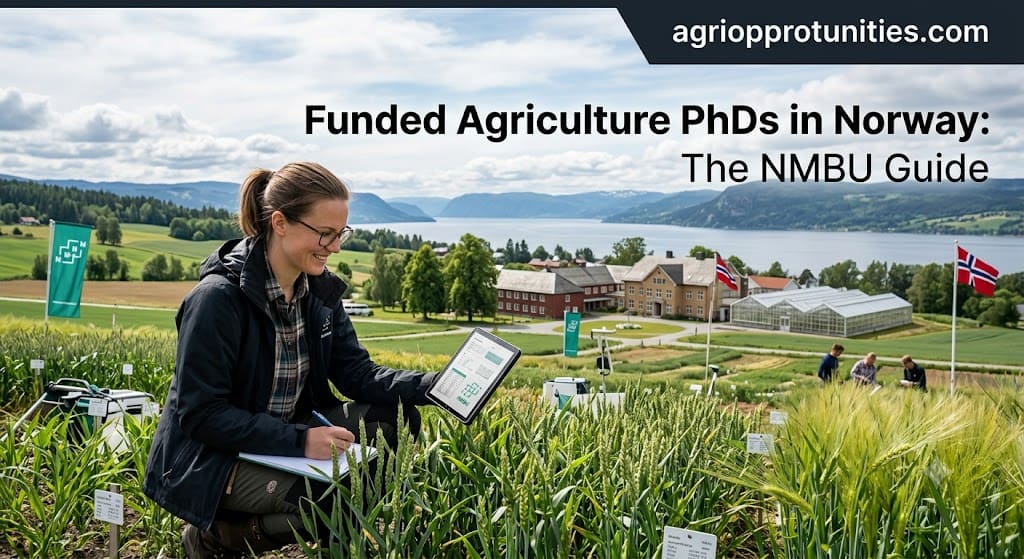
Funded Agriculture PhDs in Norway: The NMBU Guide

The Norwegian University of Life Sciences, universally known as NMBU, traces its roots back to 1859 as the Norwegian Agricultural Postgraduate College, becoming a full university only in 2005. Today it remains Norway’s dedicated centre for life sciences, agriculture, veterinary medicine, and environmental research, and it follows the same broad Scandinavian PhD-as-employment model covered elsewhere on this site for Denmark and Sweden — but with its own specific rules, application sequence, and documentation requirements that are genuinely worth understanding in detail before you invest time in an application.

The Foundational Rule: Full Funding Must Be Documented Before Admission
If you’re considering a PhD in Norway, understand this first: you must secure full funding before the university can admit you. NMBU, NTNU, and other Norwegian universities all follow this rule. Without documented funding for the entire PhD period, you cannot enroll in a doctoral programme.
Why Norway Treats PhD Candidates Differently
Norwegian universities usually hire PhD candidates as employees rather than enrolling them as traditional students. As a result, your employment status affects your visa, taxes, social benefits, and the university office that handles your application.
The Two Main Ways to Meet the Funding Requirement
Path One: Apply for an Advertised Research Fellow Position
Most applicants do not apply for PhD admission directly. Instead, they apply for an advertised research fellow position funded by the university or an external research project. At NMBU, your application for a research fellow position also serves as your PhD admission application, combining both steps into a single process.
Path Two: Bring External Funding and Apply for Admission Separately
You can also qualify with external funding. Eligible sources include a research position at another institution that provides sufficient time for doctoral research, an Industrial PhD or Public Sector PhD funded by your employer, or a scholarship from a charitable organization. If you choose this route, submit a separate PhD admission application to the relevant faculty using the required form within three months of your project start date. Regardless of the funding source, you must document financial support for the entire PhD period, including research and operational costs—not just your living expenses.
- Research Fellow Position — Apply for an advertised position, which combines the job application and PhD admission process.
- External Funding — Secure funding through an Industrial PhD, Public Sector PhD, another employer, or a charitable organization, then submit a separate admission application.
Residency Requirements for Externally Funded Candidates
If you hold a position outside NMBU, the university may require you to affiliate with an NMBU research environment and spend part of your PhD on campus. Each faculty sets its own residency rules, so check the requirements before planning a fully remote or externally based PhD.
What a PhD Fellowship Position Actually Involves
PhD fellowship positions at NMBU are normally granted for three years, though the position can extend up to four years when it includes additional career-enhancing tasks alongside the core doctoral research — commonly teaching duties or departmental administrative responsibilities that broaden a candidate’s professional experience beyond pure research alone. As with the broader Scandinavian model, this is genuine temporary employment: a formal employment contract, a workplace at one of the university’s faculties, salary, and standard Norwegian employee benefits including pension contributions and access to the country’s well-regarded welfare system.
Academic Admission Requirements
To be admitted to an NMBU PhD programme, you need relevant education equivalent to a five-year Norwegian master’s degree — this can include a standard master’s degree, a degree in veterinary medicine (cand.med.vet.), or another qualification the specific faculty formally recognizes as equivalent after evaluation. Beyond the degree itself, you need a strong academic background genuinely relevant to your intended PhD programme, along with a weighted average grade for the final two years of your master’s degree equivalent to a B or higher on NMBU’s own grading scale.
Discipline-Specific Requirements Can Go Further
Individual programmes layer additional, more specific requirements on top of these general rules. For the Life and Food Sciences PhD programme specifically, applicants must document an independent master’s-level project worth at least 30 ECTS credits, alongside an average grade of C or better across bachelor’s-level subjects included in their qualifying degree. Candidates who don’t meet these specific thresholds aren’t automatically excluded — they may still be admitted following an individual assessment by the faculty’s own research committee, so a technical shortfall against the stated requirements isn’t necessarily a disqualifying detail if your broader application is strong.
Documentation of Foreign Qualifications
If your previous education was completed outside Norway, as will be the case for essentially every Pakistani applicant, you can contact NOKUT — the Norwegian Agency for Quality Assurance in Education — to have your qualifications formally assessed and recognized. Alternatively, the faculty itself may complete an equivalent assessment directly as part of reviewing your application, meaning a formal NOKUT assessment isn’t always a strict prerequisite before you submit your materials.
NMBU’s Structure: Seven Faculties, Eight PhD Programmes
NMBU has seven faculties—six at Campus Ås and one, the Faculty of Veterinary Medicine, split between Campus Ås and Campus Adamstuen. It offers eight PhD programmes, each operating under the university’s general PhD regulations as well as faculty-specific rules.
Campus Ås: A Working Agricultural Campus
Campus Ås is home to Norway’s largest interdisciplinary life sciences community and offers a unique environment for agriculture research. The campus includes Ås Farm, where researchers and students conduct livestock research and practical teaching alongside laboratories, historical buildings, and green spaces. For agriculture PhD candidates, this means direct access to working farm facilities as part of everyday research and training.
The Genuine Breadth of Current Research Topics
Recent PhD vacancies illustrate the breadth of research opportunities at NMBU:
- Aquaculture — Developing bioelectrochemical systems for wastewater treatment and single-cell protein production through the PROWAQ initiative.
- Animal Welfare & AI — Using AI-based monitoring systems to improve dairy cow and calf welfare, including research on cow–calf separation.
- Precision Agriculture — Designing robotics and drone-based sensing technologies for next-generation farming.
- Agricultural Economics — Studying how Nordic agricultural cooperatives such as TINE, Nortura, and Felleskjøpet respond to climate change and geopolitical challenges.
- Climate Economics — Investigating emissions inequality and behavioral responses to climate risk through the TRANSPLAN research centre.
- Nature-Based Solutions — Developing urban flood adaptation strategies for the Oslofjord region.
The Coursework Requirement Alongside Your Research
After admission, you must submit your PhD education plan for approval as soon as possible, and no later than six months after enrollment. The plan must include at least 30 credits of coursework, including a compulsory five-credit course in research ethics. Apart from this ethics course, you can tailor the remaining coursework to your research area and academic background. You may also complete supervised independent study if no suitable formal course is available.
Exceptions Worth Knowing: The Quota Scheme and NORHED Programme
Most NMBU PhD candidates work as university employees throughout their studies. However, candidates funded through the Quota Scheme, the NORHED programme, and certain other schemes follow a different model. Instead of working as employees, they pay a semester registration fee and complete their PhD as students. If you’re looking for a non-employment PhD route in Norway, these programmes are worth exploring because they follow different funding and admission rules.
How to Actually Find Available Positions
NMBU advertises PhD fellowship positions throughout the year rather than through a single annual admission cycle. Check the university’s vacancies page regularly, as new opportunities open on a rolling basis. Because NMBU’s research spans fields such as aquaculture, precision agriculture, agricultural economics, and climate adaptation, search vacancies within your target faculty as well as general academic job portals to avoid missing relevant positions.
Practical Steps Before You Apply
Get in touch with your target research group and identify a potential supervisor as early in the process as genuinely possible — Norwegian universities generally expect your main supervisor to already be confirmed and ready by the time you formally apply for the programme, and most programmes expect you to have at least two academic supervisors lined up in total. If you’re applying to a position embedded within a larger, already-funded research project, your main supervisor will typically already be part of that project’s core team, somewhat simplifying this step compared to identifying an entirely independent supervisor from scratch.
Prepare Your Project Description Early
Your application will usually include a research proposal, either in complete or preliminary form. If the university accepts a preliminary proposal, you must submit the final version within six months of admission. If your project requires approval from an ethics committee or another regulatory authority, include that approval with your application whenever possible.
For currently open PhD positions in Norway and across Europe, browse live agriculture scholarship listings on Agri Opportunities.
Frequently Asked Questions
Can I apply for a PhD at NMBU without securing funding first?
No. Funding for the entire PhD education must be documented before admission, and it is not possible to apply for the PhD education without being able to secure and document full funding for the whole period, which is why most applicants first apply for an advertised research fellow position rather than applying for admission independently.
How does applying for a research fellow position work at NMBU?
An application for a research fellow position at NMBU also functions as an application for admission to a PhD programme, meaning you submit your academic documentation alongside the position application itself rather than as two separate processes.
What academic background do I need to be admitted to an NMBU PhD programme?
You need relevant education equivalent to a five-year Norwegian master’s degree, a strong academic record with a weighted average equivalent to a B or higher over the final two years, and, for many programmes, an independent master’s-level project worth at least 30 ECTS credits.
How long does a PhD fellowship position at NMBU typically last?
PhD fellowship positions are normally granted for three years, though the position may extend up to four years when it includes other career-enhancing tasks alongside the core research work.
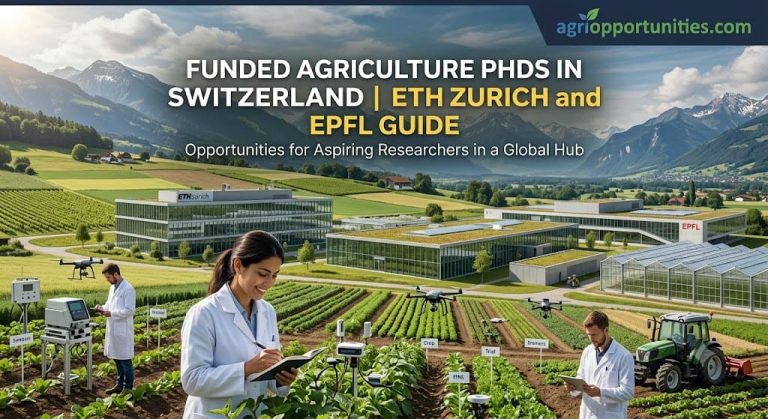
Switzerland runs the same broad employment-based PhD model as Denmark and Sweden, covered elsewhere on this site, but with a few genuinely distinctive details worth understanding before you apply — including some of the highest doctoral compensation in Europe, paired with famously high living costs. This guide focuses on Switzerland’s two federal institutes of technology, ETH Zurich and EPFL, the two most prominent destinations for agriculture-adjacent PhD research in the country.
PhD as Genuine, Well-Paid Employment
As with the Nordic systems covered elsewhere on this site, Swiss PhD students are not typically “scholarship students” in the traditional sense — they’re full-time university employees, commonly referred to as scientific or doctoral assistants, hired on contracts with salaries defined by national scales.
What This Actually Pays
As of 2026, EPFL’s basic starting salary for a doctoral assistant is 55,225 Swiss francs gross per year. More broadly across ETH and EPFL, doctoral stipends range from roughly 50,000 to 62,000 francs annually — genuinely well above typical European PhD compensation, including comparison points like Germany’s DFG-funded positions, which sit closer to 45,000 to 55,000 euros.
The Living Cost Reality Check
It’s worth being honest that this higher pay reflects genuinely higher costs, not just better funding. Zurich and Geneva rank among the most expensive cities globally for cost of living, placing in the same tier as Hong Kong, Singapore, and New York — meaning the higher salary needs to be weighed against a correspondingly higher cost base rather than treated as pure additional purchasing power.
Tuition Is Almost an Afterthought
Given the employment-based structure, tuition fees are genuinely minimal — often just a few hundred Swiss francs per semester, with ETH Zurich specifically citing fees around 809 CHF per semester. Your salary is effectively your entire funding package, rather than needing to separately cover significant tuition costs on top of living expenses.
How PhD Admission Actually Works
You Generally Need a Doctoral Program Behind You First
At EPFL specifically, you must be admitted by a doctoral program before you can be hired as a doctoral assistant. In some cases, a doctoral program may admit a candidate even without a corresponding funded position immediately available — in that situation, the candidate remains eligible for hiring for up to one year while funding is sought, and can pursue individual scholarships and external funding in parallel.
Finding a Supervisor Is the Real First Step
As with Germany’s traditional PhD model covered elsewhere on this site, Swiss admissions tend to be based on genuine fit and research alignment between you and a specific supervisor, rather than a standardized, purely metrics-based admissions process. Direct outreach to a professor whose research matches your interests — following the same approach recommended in the general research assistantship guide elsewhere on this site — is typically the practical starting point, sometimes taking several months of sustained outreach before securing a supervisor’s commitment.
A Concrete, Currently Open Example: ETH Zurich’s Agricultural Economics PhD
To make this genuinely concrete rather than abstract, it’s worth looking at an actual recent ETH Zurich posting closely matching this site’s focus. ETH Zurich advertised a four-year doctoral position in Agricultural Economics and Policy, working under Professor Robert Finger within the Agricultural Economics and Policy Group, as part of the ACHIEVE project — a major national Swiss research initiative focused on pathways to net-zero for Switzerland’s hardest-to-abate emissions sectors, including agriculture.
What Made This Position Attractive
The role offered a full ETH Zurich doctoral salary, social benefits, and direct involvement in a genuinely consequential national climate policy project — connecting real agricultural economics research to Switzerland’s actual net-zero transition planning, rather than purely theoretical academic work disconnected from policy application.
What the Application Required
According to the vacancy details, applicants had to submit a cover letter, CV, academic transcripts, and contact information for two referees as a single PDF through ETH Zurich’s online application portal. The position targeted candidates with a master’s degree in agricultural economics or a related field and may also have accepted applicants who were completing their degree, subject to the stated eligibility requirements.
A Language Detail Worth Noting
Language requirements vary across Swiss doctoral positions. Many research groups at ETH Zurich and EPFL operate primarily in English, but roles involving local stakeholders, policy engagement, or public administration may require or favor proficiency in German or French. Check the language requirements listed in each vacancy rather than assuming that English alone will be sufficient—or that another national language is always necessary.
Where to Actually Search for Swiss PhD Positions
Direct University Job Portals
ETH Zurich, EPFL, and other Swiss universities including Zurich, Geneva, Lausanne, Bern, Basel, and Fribourg regularly advertise PhD openings directly on their own job portals, alongside general academic job boards like Academic Positions and FindAPhD.
Structured Graduate Schools
Beyond individually advertised positions, structured graduate schools offer another entry route — the Life Science Zurich Graduate School, a joint programme between ETH Zurich and the University of Zurich, offers over 100 fully funded PhD positions across roughly 500 research groups in the life sciences broadly, a genuinely large and relevant pool for agriculture-adjacent research interests.
Swiss Government Excellence Scholarships
Switzerland’s Federal Commission for Scholarships for Foreign Students administers the Swiss Government Excellence Scholarships, which support eligible international researchers through several funding routes. Depending on the applicant’s country of origin and scholarship category, opportunities may include doctoral scholarships or research stays at Swiss institutions. Eligibility, funding duration, and supported disciplines vary, so applicants should consult the official guidance for their country and intended academic year. Some routes require an academic host in Switzerland and a formal confirmation of support from a professor, making early contact with a suitable supervisor an important step in the application process.
What Makes ETH and EPFL Genuinely Distinctive as a Career Investment
Beyond the funding mechanics, it’s worth knowing that ETH and EPFL graduates report notably strong academic placement outcomes, with some tracking suggesting a meaningful probability of landing a tenure-track position at a top-100 global university within five years of graduation — among the stronger placement outcomes for any doctoral programme outside a small handful of the most prestigious US and UK institutions. Both universities also maintain well-established industry connections with major companies including Nestlé, relevant for agriculture and food science graduates specifically considering an industry rather than purely academic career path.
Practical Tips for a Competitive Application
Start supervisor outreach well in advance, since securing a professor’s genuine commitment can take several months of sustained contact, and treat this relationship-building as the actual gating step in your application timeline rather than an afterthought. Confirm language requirements explicitly for any specific posting rather than assuming English alone suffices, particularly for policy-facing or applied research roles. And budget realistically for Swiss living costs specifically — the higher salary figures covered in this guide need to be weighed honestly against Zurich and Geneva’s position among the most expensive cities in the world, rather than treated as straightforwardly superior to lower-paying positions in more affordable countries.
For currently open PhD positions in Switzerland and across Europe, browse live agriculture scholarship listings on Agri Opportunities.
Frequently Asked Questions
How much does a PhD student at ETH Zurich or EPFL actually earn?
As of 2026, EPFL’s basic starting salary for a doctoral assistant is 55,225 Swiss francs gross per year, while ETH and EPFL doctoral stipends more broadly range from roughly 50,000 to 62,000 francs annually, well above typical European PhD compensation.
Do I need to find a supervisor before applying for a PhD in Switzerland?
Yes, in most cases. At EPFL specifically, you must be admitted by a doctoral program before you can be hired as a doctoral assistant, and finding a professor willing to supervise your specific research area is typically the first practical step.
How much does PhD tuition cost in Switzerland?
Tuition fees are very low, often only a few hundred Swiss francs per semester, since most PhD students are treated as full-time university employees rather than fee-paying students, meaning your salary functions as your primary source of funding.
What is the Swiss Government Excellence Scholarship?
It’s a national-level award, run by the Federal Commission for Scholarships for Foreign Students, available to postgraduate researchers from over 180 countries, funding either a full PhD of usually up to three years or a research stay during a PhD already underway elsewhere.
Add Agri Opportunities as a preferred source on Google to see latest guide listings first.





Nil