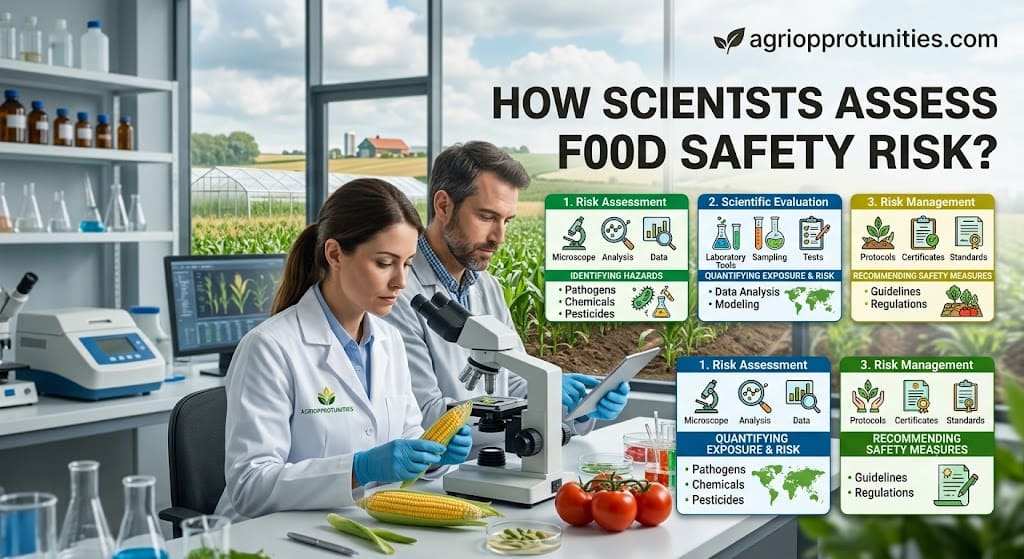
How Scientists Assess Food Safety Risk

A food scientist’s explanation of quantitative microbial risk assessment, using Salmonella in poultry as a real-world case study.
When health authorities decide how strictly to regulate Salmonella levels in chicken, or which specific point in a supply chain deserves the most inspection attention, that decision isn’t based on guesswork or general caution alone. It’s built on a genuinely structured, mathematically rigorous framework called quantitative microbial risk assessment, or QMRA. I want to walk through how this framework actually works, using Salmonella contamination in poultry — one of the most extensively studied applications of this methodology — as a detailed, concrete case study.

What QMRA Actually Is
Quantitative microbial risk assessment has become the central framework for evaluating foodborne microbial hazards, integrating microbiological data, exposure assessment, dose-response modelling, and probabilistic simulation into a single, structured analytical process. Rather than simply asking “is this pathogen present,” QMRA asks a more precise and genuinely more useful question: given everything we know about how much pathogen is present, how it behaves along the supply chain, and how people actually handle and consume the product, what is the realistic probability of someone actually getting sick?
Why This Structured Approach Matters
Microbial risk assessment provides a systematic way to integrate and evaluate information from diverse sources concerning a pathogen’s origin and fate along the food chain, giving decision-makers genuine scientific insight for managing food supply safety, rather than relying on intuition or worst-case assumptions alone.
The Four Core Methodological Building Blocks
Research reviewing three decades of QMRA literature has identified probabilistic exposure assessment, Monte Carlo simulation, predictive microbiology, and dose-response modelling as the methodological core of this entire field. It’s worth understanding each piece individually.
Predictive Microbiology
Models how a pathogen’s population actually behaves under different conditions — growing, surviving, or dying off depending on temperature, time, and the specific food matrix involved, at each stage from farm to consumer’s plate.
Exposure Assessment
Estimates how much of the pathogen a person is actually likely to be exposed to by the time they consume the product, accounting for everything that happened to the pathogen population along the way.
Dose-Response Modelling
Translates a given level of exposure into an actual probability of illness, based on established relationships between how much of a pathogen someone consumes and their likelihood of getting sick.
Monte Carlo Simulation
Runs thousands of randomized scenario combinations to produce a realistic probability distribution of risk rather than a single, falsely precise number, accounting for real-world variability.
Why Salmonella Specifically Requires Such Careful Modelling
Salmonella isn’t a single, uniform threat — it’s represented by over 2,600 distinct serotypes, and these serotypes differ meaningfully in their actual capacity to cause illness even at similar consumption doses.
A Small Number of Serotypes Cause Most Illness
Outbreak surveillance data backs this up directly: the top three most common serotypes identified through the CDC’s FoodNet surveillance system — Enteritidis, Typhimurium, and Newport — are collectively responsible for roughly 40 percent of all reported salmonellosis cases between 1996 and 2022, despite representing a small fraction of the 2,600-plus known serotypes overall.
Why This Reshapes Modern Risk Assessment
This finding has genuinely shifted how researchers approach the problem. Rather than treating all Salmonella detections as equally risky, recent modelling work has incorporated genomically determined differences in Salmonella virulence directly into risk assessment models, refining hazard characterization to account for which specific serotype is actually present. This more refined approach is currently informing proposed regulatory changes to meat and poultry policy in the United States — a genuinely direct example of this kind of research shaping real policy decisions.
An Important, Counterintuitive Implication
Research applying this more refined risk modelling to raw chicken parts found that most of the actual salmonellosis risk is concentrated in a relatively small number of products carrying high levels of the most virulent serotypes — meaning targeted interventions focused on that specific subset of high-risk product could meaningfully reduce public health risk more efficiently than broader, less targeted measures applied uniformly across all product.
Following the Full Farm-to-Fork Chain
A comprehensive systematic review of poultry meat QMRA research, screening over 4,000 studies down to 43 that met rigorous inclusion criteria, mapped out exactly where along the supply chain risk actually concentrates.
Where Most Research Attention Has Gone
Among the studies reviewed, the large majority focused on thermotolerant Campylobacter (61 percent) and Salmonella (32 percent), with a smaller share addressing Listeria monocytogenes and Clostridium perfringens — reflecting where the genuine public health burden and research funding have historically concentrated.
The Consumer Stage Is the Real Weak Point
Perhaps the most practically important finding from this review: consumer behavior, not earlier stages like processing or retail handling, was identified as the central concern across the collected research. In plain terms, by the time a product reaches a consumer’s kitchen, a huge share of the remaining risk depends on how that specific person handles, stores, and cooks the food — a genuinely important finding since it means food safety interventions focused purely on industrial processing, however important, may miss where a large share of the actual remaining risk sits.
📋 Case Study: From Risk Model to Real Policy
Baseline: Salmonella prevalence of 54.02%, mean initial levels of 45.90 MPN/g, and a baseline risk of 0.455 per package.
Interventions tested: Reducing initial prevalence and levels, cutting cross-contamination rates (hands: 0.759%, cutting boards: 0.098%), maintaining consistent 4°C transportation, and capping storage at 7°C.
This became the basis for a revised HACCP plan with specific, risk-justified critical limits — a direct example of QMRA translating into an implementable food safety management plan.
How This Connects to HACCP Systems
HACCP is the food safety management framework most food manufacturers already use, identifying critical control points throughout production where hazards need active monitoring. QMRA modelling increasingly integrates directly with HACCP systems, providing the quantitative, risk-based justification for exactly where critical limits should be set, rather than relying on more generic, one-size-fits-all industry standards.
Why This Field Matters More as Global Poultry Production Grows
The stakes here are genuinely significant and growing. Global poultry meat production increased from 83 million to 103 million metric tons between 2012 and 2023, and poultry now accounts for nearly 40 percent of total global meat production. Foodborne disease overall affects nearly one in ten people worldwide each year, making the continued refinement of risk assessment methodology a genuinely consequential public health priority, not a narrow academic exercise.
Where the Field Is Heading: Genomics and Machine Learning
Current research is actively working to integrate newer technologies into this established framework. Machine learning-based predictive modelling of foodborne pathogens and antimicrobial resistance, increasingly using genomic and other “omics” data, represents a genuinely active development frontier.
A Surprisingly Early-Stage Integration
Despite frequent discussion of machine learning’s potential in this space, recent review research found that a direct search for work combining food safety, machine learning, and QMRA together leads to a near dead end — meaning most current applications remain limited primarily to genome sequence analysis informing risk models, like the Salmonella virulence work described earlier, rather than a fully realized machine-learning-driven risk assessment framework. This is a genuinely useful, honest finding for anyone considering this as a research direction: the opportunity for meaningful new contribution here remains wide open rather than already crowded.
A Related, Practical Application: Detecting Specific Emerging Threats
Beyond the broader modelling framework, QMRA research depends entirely on accurate underlying microbiological detection methods. Recent research has developed and validated quantitative methods for enumerating a specific, increasingly dominant Salmonella serovar, Infantis, directly from environmental poultry feces — relevant given that this serovar has emerged as the dominant Salmonella type in European Union broiler production, representing up to 90 percent of Salmonella isolates from broiler chickens in some countries and roughly 40 percent of human cases, and carrying particular concern given its association with multidrug-resistant strains that can spread silently through flocks without visible symptoms.
Why This Matters for Students Considering This Research Area
Food safety risk assessment sits at a genuinely rich, quantitatively rigorous intersection of microbiology, statistics, epidemiology, and public policy. Given the honestly acknowledged gap between machine learning’s discussed potential and its actual current application in this field, alongside the ongoing shift toward serotype- and genomically-informed risk models, this represents a genuinely active area for meaningful new graduate research contribution, particularly for students comfortable combining quantitative modelling skills with practical microbiological detection methodology.
For current research and graduate opportunities in food safety science and microbial risk assessment, browse live agriculture scholarship listings on Agri Opportunities.
Frequently Asked Questions
What is quantitative microbial risk assessment?
Quantitative microbial risk assessment (QMRA) is a structured framework that integrates microbiological data, exposure assessment, dose-response modelling, and probabilistic simulation to estimate the actual public health risk posed by a foodborne pathogen.
Why does Salmonella serotype matter in food safety risk assessment?
Salmonella includes over 2,600 distinct serotypes that differ meaningfully in their capacity to cause illness, and just three serotypes, Enteritidis, Typhimurium, and Newport, are collectively responsible for about 40 percent of all reported salmonellosis cases, meaning risk assessments increasingly account for which specific serotype is present rather than treating all Salmonella as equally dangerous.
What is the biggest point of risk in the poultry supply chain according to food safety research?
A systematic review of 43 quantitative microbial risk assessment studies on poultry meat found that contamination and consumer behavior at the consumer preparation stage, not earlier stages like processing or retail, was identified as the main area of concern.
Can risk assessment models actually reduce real-world foodborne illness?
Yes. A case study applying quantitative microbial risk assessment to a poultry supply chain in Taiwan found that implementing risk-based critical limits reduced Salmonella risk per package by 99.78 percent, demonstrating that this kind of modelling can translate directly into concrete, measurable food safety improvements.
Add Agri Opportunities as a preferred source on Google to see latest blog listings first.