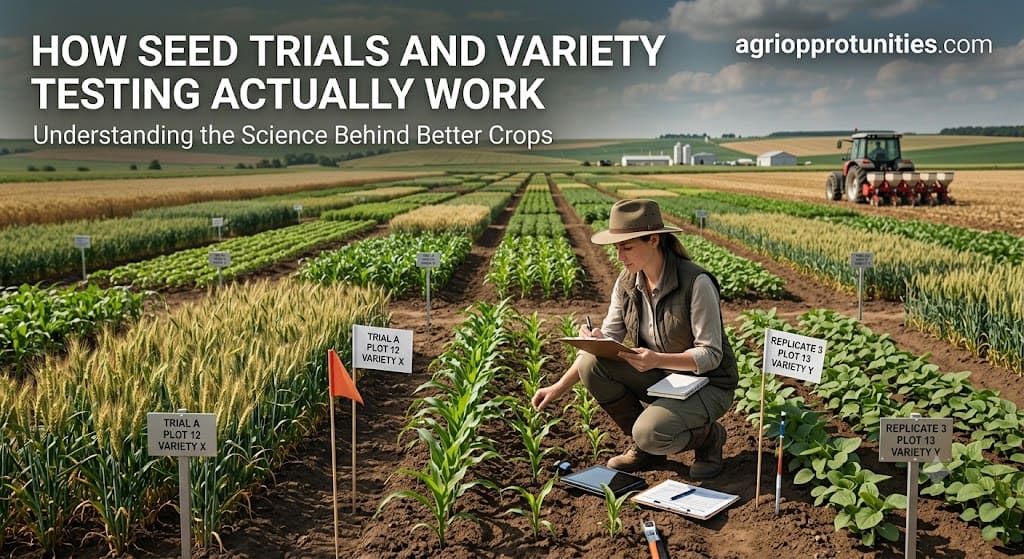
How Seed Trials and Variety Testing Actually Work

Every new crop variety must pass DUS testing (Distinctness, Uniformity, Stability) and VCU testing (Value for Cultivation and Use) before reaching farmers.
One test confirms genetic identity. The other confirms real-world agronomic performance.
How Seed Trials and Variety Testing Work
Before farmers can buy a new crop variety—whether a hybrid maize line or an improved wheat cultivar—plant breeders test it for several years across multiple locations using internationally recognized standards. This rigorous process ensures that new varieties meet legal requirements and deliver reliable field performance before they reach the market.

The Two Tests Every New Variety Must Pass
Before companies can legally market a new crop variety or protect it under intellectual property law, they typically evaluate it through two separate tests. Each serves a different purpose.
DUS Testing: Is This Variety Different?
DUS stands for Distinctness, Uniformity, and Stability. Rather than measuring field performance, this test establishes a variety’s identity. Distinctness confirms that the variety differs from existing ones. Uniformity verifies that individual plants share consistent characteristics. Stability confirms that those characteristics remain unchanged after repeated propagation over successive generations.
Why DUS Testing Matters
DUS testing forms the basis for granting Plant Breeder’s Rights, allowing breeders to collect royalties from the sale of protected seed or planting material. Many countries also require DUS testing for official Variety Listing (or National Listing), making it a legal prerequisite for commercial marketing. This requirement connects directly to the seed regulatory framework discussed in our companion article on seed industry careers in Pakistan.
VCU Testing: Does This Variety Perform Well?
Value for Cultivation and Use (VCU) testing measures how well a variety performs under real farming conditions. Researchers compare new varieties with established ones for traits such as grain yield, disease resistance, pest tolerance, and other agronomic characteristics. Unlike DUS testing, which focuses on identity, VCU testing evaluates field performance through multi-year, multi-location trials.
Why Variety Testing Uses Multiple Locations
Testing a variety in a single field cannot show how it will perform under different growing conditions. Instead, plant breeders evaluate varieties across multiple locations to account for genotype-by-environment interaction—the well-established principle that a variety’s performance depends on the soil, climate, and management practices where it grows.
What This Means in Practice
A variety that performs exceptionally under one region’s soil and rainfall conditions may perform only moderately—or even poorly—in another. To capture this variation, breeders test varieties across a geographically representative set of locations that reflects the variety’s intended target population of environments. A single trial site simply cannot predict how a variety will perform across a wider production region.
Sub-Region Stratification in Large Testing Programs
When breeding programs cover large geographic areas, researchers often divide the target environment into distinct sub-regions or zones. They then analyze variety performance separately within each sub-region while accounting for the relationships among them. This approach helps breeders identify where each variety performs best instead of relying on a single national or regional average.
How Many Replicates Does a Trial Need?
Because field trials require considerable land, labor, and resources, researchers have studied how many replicate plots are needed to produce reliable results without adding unnecessary cost.
A Surprising Research Finding
Studies applying quantitative genetics to multi-location trial data found that one or two replicates per location can provide sufficient selection accuracy when trials already span multiple environments. For example, analyses of several years of oat registration trials showed that using just two replicates reduced the total number of field plots by 33% to 50% without changing the genotype rankings used for selection.
Why This Improves Trial Efficiency
This finding highlights an important principle: much of a trial’s statistical power comes from testing varieties across multiple locations rather than repeatedly testing them within a single field. As a result, well-designed multi-location trial networks can reduce costs while maintaining reliable selection decisions.

The Statistical Design Behind a Trial: Randomized Blocks and Beyond
Individual VCU trial designs are generally fully replicated, most commonly using the randomized complete block design covered in our companion piece on pesticide field trials, though more sophisticated alpha-designs are also used in some testing programs to further improve statistical efficiency across larger numbers of varieties being compared simultaneously.
Why This Matters Across an Entire Testing Network
Modern variety testing analysis relies on linear mixed models, treating location and year effects as random variables rather than fixed ones, allowing researchers to make genuinely robust predictions about how a variety will perform not just at the specific test sites used, but across the entire broader target population of environments the variety is ultimately intended for — a meaningfully more sophisticated statistical approach than simply averaging raw yield numbers across trial sites.
How This Process Fits Into the Broader Crop Improvement Pipeline
Once a candidate variety successfully passes both DUS and VCU testing and meets the requirements for official registration, it’s officially approved for commercialization and listed in a variety register. From there, the actual seed multiplication chain begins: breeder’s seed is used to produce foundation seed, which is then multiplied further into certified seed that eventually reaches farmers — connecting directly to the certified seed system discussed in our companion piece on seed industry careers in Pakistan.
Hybrid-Specific Complexity
Hybrid varieties add another layer of complexity to this process. Instead of simply multiplying a single variety, seed producers must maintain separate parent lines and cross them under carefully controlled conditions. For three-way and double-cross hybrids, they also produce intermediate hybrid generations before generating the final commercial hybrid seed for sale.
How Participatory Trials Complement Formal Replicated Testing
In addition to formal, statistically replicated trials at research stations, many breeding programs conduct participatory trials on working farms. These on-farm evaluations capture valuable information that controlled research trials may miss because a variety’s performance depends not only on its genetics but also on local climate, management practices, and farm conditions. By combining farmers’ observations with data from replicated research trials, breeders gain a more complete and realistic understanding of how a variety is likely to perform under commercial farming conditions.
Managing the Data Challenge of Modern Variety Testing
As breeding programs evaluate more traits across more locations and multiple growing seasons, managing the resulting data becomes a major task. To handle this complexity, many programs now use dedicated data management platforms that standardize data collection, improve data quality, and integrate results from multi-location trials. These systems also support advanced analyses, allowing researchers to combine phenotype data with genomic and other multi-omics datasets instead of relying solely on yield comparisons.
Why This Matters for a Career in Seed Trialing and Variety Testing
Understanding the genuine statistical and biological rigor behind this process — DUS versus VCU testing, genotype-by-environment interaction, replication efficiency, and the growing role of formal data management platforms — is exactly what separates a genuinely credible seed trials professional from someone simply following a fixed field protocol without understanding its underlying logic. Given how central rigorous variety testing is to introducing genuinely improved crop varieties, this represents a technically demanding, genuinely important specialization within the broader seed industry career track covered elsewhere on this site.
For current openings in seed trials, variety testing, and plant breeding roles, browse live agriculture job listings on Agri Opportunities.
Ready to build a career in seed trialing, variety testing, or plant breeding? From DUS and VCU testing to multi-location trial design — this is a technically demanding, genuinely important specialization in agriculture.
Explore seed trials and plant breeding jobs in Pakistan →Frequently Asked Questions
What is DUS testing in seed variety development?
DUS testing evaluates whether a new crop variety is Distinct from existing varieties, Uniform across individual plants of that variety, and Stable, meaning its essential characteristics remain unchanged after repeated propagation, and it is required for both plant breeder’s rights protection and official variety registration in most countries.
What is VCU testing and how is it different from DUS testing?
VCU, or Value for Cultivation and Use testing, evaluates whether a new variety performs as well as or better than existing varieties on practical agronomic characteristics like yield, disease resistance, and quality, typically conducted through multi-year, multi-location field trials, as distinct from DUS testing which focuses on a variety’s genetic identity rather than its performance.
Why are crop variety trials conducted at multiple locations rather than just one?
Multi-location trials are necessary because a variety’s performance genuinely differs across different environments, soils, and climates, a phenomenon called genotype-by-environment interaction, meaning testing at a single site cannot reliably predict how a variety will perform across the diverse range of conditions it might eventually be grown in.
How many replicates does a crop variety trial actually need?
Research suggests that when trials are conducted across multiple locations, as few as one or two replicates per location can be sufficient without meaningfully reducing selection accuracy, since the multi-location structure itself already provides much of the statistical power that additional within-site replication would otherwise need to supply.
Add Agri Opportunities as a preferred source on Google to see our latest blogs first.





My Name is Nehal khan i am Done my M.sc Program in plant Breeding and Genetics from MNS university of Agricultural Multan.