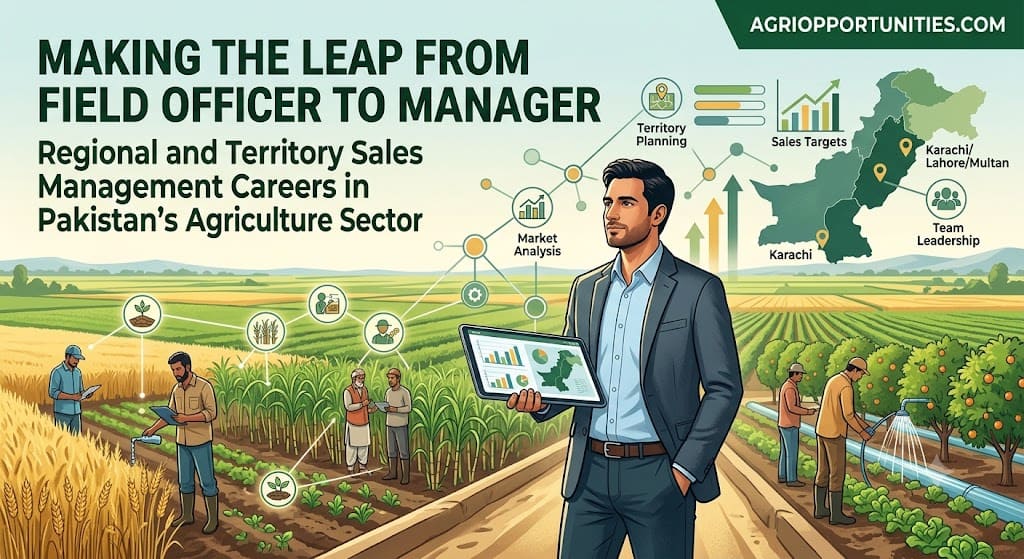
Regional and Territory Sales Management Careers in Pakistan: Making the Leap From Field Officer to Manager

The complete guide to moving from field officer to territory, area, and regional sales management — what actually changes, what you’re measured on, and how to prepare
Regional and Territory Sales Management Careers in Pakistan: Making the Leap From Field Officer to Manager
Landing your first field officer or sales officer role in Pakistan’s agriculture sector is an important career milestone. Moving into territory, area, or regional management, however, marks a very different stage of your professional growth. It’s not simply the same job with a higher salary or a larger territory—it requires a fundamental shift in responsibilities, decision-making, and leadership. This guide explains what changes as you move into management, how companies evaluate candidates for these roles, and how you can prepare for the transition.

The Core Shift: From Doing the Work to Managing the Work
This is the most important mindset shift to understand before moving into management. As a field officer, you’re primarily responsible for your own sales performance, customer relationships, and dealer network. As a territory or area manager, however, you’re accountable for your team’s performance. Your role shifts from selling products yourself to coaching, monitoring, and supporting the people responsible for sales across your territory.
Why Many High Performers Struggle After Promotion
One of the most common career challenges in agricultural sales is assuming that excellent salespeople automatically become excellent managers. In reality, the two roles demand different skill sets. Strong field officers succeed through technical knowledge, customer relationships, and personal selling ability. Effective managers, on the other hand, develop people, delegate responsibilities, solve operational problems, and drive results through their teams rather than through their own direct sales efforts.
What a Territory or Area Manager Actually Does
Current sales job postings across Pakistan, including those in agriculture, show that territory and area managers handle responsibilities that go well beyond a field officer’s role. Both positions support product distribution and sales growth, but managers oversee broader operations and take responsibility for results across their assigned territories.
Leading and Developing the Sales Team
Territory and area managers lead, train, and mentor sales teams. They accompany field staff on customer visits, coach them during field activities, review performance, and provide on-the-job training to strengthen technical knowledge and selling skills.
Managing the Distributor and Dealer Network
Managers also oversee distributor and dealer networks across their territories. They build business relationships, maintain product availability, coordinate order fulfillment, monitor outstanding payments, and resolve claims and service issues to strengthen long-term commercial partnerships.
Owning Territory-Wide KPIs
Field officers typically focus on individual sales targets and customer relationships, while territory and area managers monitor performance across the entire territory. Companies evaluate managers using broader key performance indicators (KPIs), including sales achievement, market share growth, distribution reach, outlet coverage, collection performance, resource utilization, and route efficiency.
Business Planning
Territory and area managers develop and implement business plans to achieve regional sales objectives. They forecast demand, allocate resources, set territory priorities, and coordinate with marketing, finance, supply chain, and other departments to improve sales performance and meet broader commercial goals.
The KPIs Managers Are Measured On
Performance at the management level goes well beyond individual sales figures. Companies evaluate managers using a combination of commercial, operational, and team performance indicators that reflect the overall health of the territory.
Sales and Growth Metrics
Key commercial KPIs typically include sales target achievement, net sales growth, market share, and organic growth. These measures assess not only whether targets were achieved but also whether the business expanded through sustainable customer acquisition and stronger market penetration rather than short-term gains.
Distribution and Coverage Metrics
Managers are also accountable for distribution quality and market coverage. Companies commonly monitor numeric distribution, weighted distribution, outlet coverage, and product availability to evaluate how effectively their products reach dealers and retailers throughout the territory. Strong sales concentrated in only a few locations rarely compensate for weak market coverage across the rest of the region.
Operational and Compliance Metrics
In addition to commercial performance, managers ensure their teams follow company policies, maintain quality standards, and comply with relevant regulatory requirements. They also monitor operational KPIs such as collection efficiency, claims resolution, inventory movement, and route-to-market effectiveness. Compared with a field officer, a manager carries much broader operational accountability across the entire territory.
Team Development Metrics
As managers move into more senior roles, people development becomes an increasingly important performance measure. Companies often evaluate managers on succession planning, coaching effectiveness, employee retention, and the growth of their team members’ technical and commercial skills. In other words, strong managers don’t just deliver results themselves—they build teams that continue performing well even as employees develop, earn promotions, or move into new roles.

What Experience Companies Typically Look For
Most employers expect candidates to have at least two to four years of successful field sales experience before promoting them to a territory or area manager role. However, the exact requirement depends on the company and the scope of the position. Smaller territories may offer opportunities to high-performing field officers earlier in their careers, whereas regional management roles covering an entire province usually require more extensive experience, a consistent record of delivering results, and clear evidence of leadership—not just strong individual sales performance.
Educational Qualifications at the Management Level
Most employers accept candidates with a bachelor’s or master’s degree in Agriculture, Sales, Marketing, Business Administration, or a related discipline. Compared with entry-level field positions, however, academic qualifications carry less weight at this stage of your career. Companies place greater emphasis on proven field experience, consistent sales performance, and the ability to lead people, manage territories, and build strong distributor relationships—skills that are developed primarily through practical experience rather than classroom learning.
How to Prepare for the Transition into Management
Start Leading Before You Receive the Title
If you’re currently working as a field officer or sales officer, look for opportunities to mentor new colleagues, share best practices, or help teammates solve field challenges. By taking on informal leadership responsibilities early, you build credible coaching and leadership experience that you can highlight during promotion discussions or management interviews. Strong sales results may earn you attention, but demonstrated leadership often earns you the promotion.
Build Genuine Comfort With Data and Reporting
Since management roles are measured across multiple KPIs simultaneously rather than a single sales figure, developing comfort with tracking, interpreting, and reporting on multiple performance metrics — not just closing individual sales — is a genuinely valuable skill to build deliberately before you’re expected to manage an entire territory’s performance dashboard.
Understand the Full Distributor Relationship, Not Just the Sales Transaction
Since managing distributor and dealer relationships (stock availability, order fulfillment, collections, claims) is such a central part of this role, actively learning this broader commercial relationship — beyond simply closing a sale — while still in a field-level position genuinely prepares you for the fuller scope of a management role ahead of actually stepping into it.
Practical Advice for Making This Career Move
Seek explicit feedback from your current manager about your readiness for this kind of transition, since coaching and people-leadership potential aren’t always visible purely through sales performance metrics, and a direct conversation can surface specific development areas worth addressing before you formally pursue a promotion or apply externally for a management-level role. When applying for these positions, frame your application around team and territory-level thinking rather than purely personal sales achievement, even if your actual track record so far is individual — demonstrating that you already think about business planning, distributor relationships, and coaching, even informally, signals genuine management readiness to a hiring panel far more effectively than sales numbers alone.
For current openings in territory, area, and regional sales management roles across Pakistan’s agriculture sector, browse live agriculture job listings on Agri Opportunities.
Ready to Make the Leap to Sales Management?
The transition from field officer to territory or area manager is a genuine career shift — from personal execution to team leadership, coaching, and strategic planning. Build your coaching skills, develop your data fluency, and prepare for a role that rewards leadership as much as sales performance.
Explore sales management and leadership roles in Pakistan →Frequently Asked Questions
What actually changes when moving from a field sales officer role to a territory manager role?
The core shift is from personally executing sales activity to managing a team of field staff who execute it, meaning success is measured through team performance, coaching, and KPI delivery across the whole territory rather than through personal sales activity alone.
What are common KPIs used to measure territory and area sales managers?
Common KPIs include overall sales target achievement, distributor and dealer network performance, distribution and market coverage metrics, timely collections and claims management, and team coaching and development outcomes such as staff retention and skill progression.
How many years of experience are typically needed before moving into a management-level sales role?
Based on current postings, most companies expect at least 2 to 4 years of relevant field sales experience before considering a candidate for a territory or area manager role, though this varies by company and the specific scope of the position.
Does a management-level sales role in agriculture require a specific degree?
Most postings accept a Bachelor’s or Master’s degree in a Sales, Marketing, Agriculture, or Business-related field, with demonstrated field sales experience and a track record of hitting targets generally weighted more heavily than the specific degree title.
Add Agri Opportunities as a preferred source on Google to see latest guide listings first.