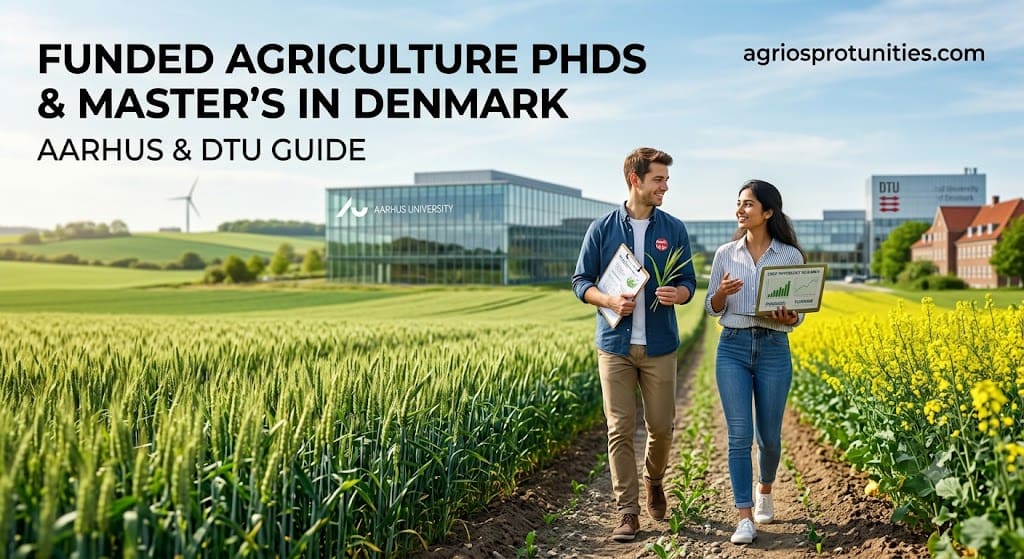
Funded Agriculture PhDs and Master’s in Denmark: Aarhus and DTU Guide

Funded Agriculture PhDs and Master’s in Denmark: Aarhus and DTU
How Danish PhD funding actually works, why it’s structured as employment rather than a scholarship, and how to apply at Aarhus and DTU.

Denmark has one of Europe’s most distinctive university funding systems, and understanding it early will save you a lot of confusion. The key point is simple: a Danish PhD is a paid job, not a scholarship. Master’s funding follows a completely different model. This guide explains both systems, using Aarhus University and the Technical University of Denmark (DTU) as examples because both universities host strong agriculture and environmental science research programs.

The Single Most Important Thing to Understand: PhD as Employment
Danish universities hire PhD candidates as PhD fellows under formal employment contracts. Instead of receiving a scholarship or stipend, they earn a monthly salary and receive the same employee benefits as other university staff.
Why This Changes How You Should Search
This employment model changes how you apply. Rather than applying for a PhD program in general, you apply for a specific advertised PhD position linked to a defined research project and supervisor. Universities list these openings through individual departments, much like any other academic job vacancy.
How Danish PhD Positions Are Actually Structured and Funded
Individual PhD positions are commonly funded through specific national and international grant sources rather than a single blanket university scholarship fund. A recent, genuinely representative example: DTU Sustain advertised PhD positions specifically embedded within projects funded by the Danish Ministry of Green Transition, focused on methane mitigation technology for agricultural manure storage.
Fully Funded Regardless of the Funding Source
Whether funding comes from a university budget, a research grant, or an external project, DTU and Aarhus employ PhD candidates and postdoctoral researchers under Danish academic employment agreements. That means these positions include a salary and employee benefits, so successful applicants do not need to secure separate funding after admission.
How to Find and Apply for a PhD Position
At Aarhus University
Aarhus organizes its PhD education through five graduate schools, each with its own website listing available positions, programmes, deadlines, and admission requirements. Start by identifying the graduate school that matches your research interests, then search for an advertised project that fits your academic background. Because each graduate school sets its own requirements, reviewing the relevant guidelines before applying is essential.
At DTU
DTU accepts all PhD applications through its online application portal and does not accept paper applications. If you are not already a DTU student, create a self-registered account with your personal email address. Use the same email address for every DTU application to keep your records consistent.
Application Limits for Master’s Programmes
For master’s admissions, DTU currently lets applicants rank up to four programme choices in a single admission round. Beginning with the Autumn 2026 intake, applicants may select a maximum of two priorities, so plan your applications accordingly.
Master’s Funding Works Differently: The Danish State Scholarship
Master’s students do not receive funding through the PhD employment model. Instead, eligible applicants compete for the Danish State Scholarship, a government-funded programme for international students.
No Separate Scholarship Application
When you apply to an eligible master’s programme at Aarhus University, the university automatically considers you for a Danish State Scholarship. You do not need to submit a separate scholarship application or additional documents.
Who Is Eligible?
The scholarship targets students from outside the EU/EEA and Switzerland. Because EU/EEA and Swiss students do not pay Danish tuition fees, they generally do not qualify. Aarhus awards scholarships primarily on academic merit, and competition is strong because the number of awards is limited.
What the Scholarship Covers
Benefits vary by faculty. Some scholarships cover full tuition, while others—including those offered by Aarhus BSS and the Faculty of Arts—also provide a monthly living allowance. Even with a full tuition waiver, you must still show sufficient financial resources to meet Danish student visa requirements.
A Timing Detail Worth Knowing
If you don’t receive a scholarship with your admission offer, don’t assume you’ve missed your chance. Aarhus continues awarding scholarships throughout the admission cycle, and you may still receive funding before the acceptance deadline. If your enrollment depends on financial support, wait until the final decision deadline before declining your admission offer.
What Tuition Actually Costs If You’re Not Awarded a Scholarship
For context on what’s actually at stake financially, DTU’s current tuition fee for paying (non-EU/EEA) students is 7,500 euros per semester, totaling 30,000 euros for a two-year master’s programme — figures worth keeping in mind when weighing how significant a scholarship award, even a partial one, genuinely is to your overall budget.
Where Agriculture-Relevant Research Actually Concentrates
For applicants interested in agricultural and environmental research, it helps to understand the research strengths of these two universities. Aarhus University’s Department of Agroecology and related environmental science units conduct research in areas such as plant–microbe interactions, climate-smart agriculture, and greenhouse gas emissions. These fields can offer opportunities for PhD and postdoctoral research, depending on current projects and vacancies. DTU Sustain focuses on environmental and resource technologies, including aspects of sustainable production, pollution control, and environmental biotechnology. Applicants interested in agricultural sustainability may find relevant projects in areas such as methane mitigation and biofilter development, depending on the research group’s current priorities.
Practical Tips for a Competitive Application
Danish PhD positions are often advertised as salaried research jobs linked to specific projects. Treat each application as a targeted job application: review the advertised project’s objectives, read the named supervisor’s recent publications, and explain how your research experience and technical skills align with the project’s questions and methods. As discussed in the research assistantship guide elsewhere on this site, a tailored application is generally more effective than a generic academic CV and motivation letter.
For master’s applicants considering Danish government scholarships, check the eligibility and selection criteria for the specific university, programme, and scholarship route. Some awards consider academic performance alongside the strength of the admission application, but requirements vary. Present your academic record, relevant research experience, and programme-specific motivation clearly, and do not assume that all scholarships use the same selection process or exclude separate scholarship statements.
For currently open PhD and master’s opportunities in Denmark and across Europe, browse live agriculture scholarship listings on Agri Opportunities.
Frequently Asked Questions
Is a PhD in Denmark a scholarship or a job?
In Denmark, PhD positions are structured as paid employment rather than a traditional scholarship. Candidates are hired as PhD fellows under Danish academic employment agreements, receiving a genuine monthly salary and full employee benefits rather than a stipend.
Do I apply to a general Denmark PhD program or to a specific project?
You apply to a specific advertised PhD position tied to a named project and supervisor, not a general programme. Each Danish university’s individual graduate schools post specific openings with their own deadlines and requirements.
How does the Danish State Scholarship work for master’s students?
When you apply for admission to an eligible master’s programme at a Danish university like Aarhus, you are automatically assessed for a Danish State Scholarship without needing to submit a separate scholarship application, with awards including a tuition fee waiver and, for some faculties, a monthly living grant.
Are EU and non-EU applicants treated the same for Danish scholarships?
No. Danish State Scholarships for master’s students are specifically designed for non-EU/EEA applicants who are liable to pay tuition fees, since EU/EEA and Swiss students already study in Denmark without tuition fees and are generally not eligible for these particular scholarships.
Switzerland runs the same broad employment-based PhD model as Denmark and Sweden, covered elsewhere on this site, but with a few genuinely distinctive details worth understanding before you apply — including some of the highest doctoral compensation in Europe, paired with famously high living costs. This guide focuses on Switzerland’s two federal institutes of technology, ETH Zurich and EPFL, the two most prominent destinations for agriculture-adjacent PhD research in the country.
PhD as Genuine, Well-Paid Employment
As with the Nordic systems covered elsewhere on this site, Swiss PhD students are not typically “scholarship students” in the traditional sense — they’re full-time university employees, commonly referred to as scientific or doctoral assistants, hired on contracts with salaries defined by national scales.
What This Actually Pays
As of 2026, EPFL lists a gross annual starting salary of approximately 55,225 Swiss francs for doctoral assistants. Salaries at EPFL and ETH Zurich vary by institution, employment category, and year of doctoral study, so applicants should check the latest official salary scales rather than rely on a single range. Swiss doctoral positions can offer competitive compensation compared with many European PhD opportunities, although direct comparisons with German positions require care because salary scales, employment percentages, benefits, and taxation differ.
The Living Cost Reality Check
Higher doctoral salaries in Switzerland must be considered alongside the country’s high living costs. Zurich and Lausanne, as well as Geneva, can be expensive places to live, particularly when it comes to rent, health insurance, and everyday expenses. Your actual purchasing power will depend on your salary, housing arrangements, personal spending, and tax situation. Before accepting an offer, estimate your likely monthly expenses rather than judging the package by its gross annual salary alone.
Tuition Is Almost an Afterthought
Swiss doctoral positions are commonly structured as paid employment, allowing doctoral researchers to earn a salary while completing their research. However, employment does not automatically eliminate tuition or semester fees. Charges differ between institutions and may depend on the student’s circumstances. ETH Zurich has also changed its tuition-fee structure for certain international students, so applicants should verify the current doctoral fees directly with their university. When assessing an offer, consider both the employment package and any tuition, semester, or administrative fees you will need to pay.
How PhD Admission Actually Works
You Generally Need a Doctoral Program Behind You First
At EPFL, doctoral admission and employment as a doctoral assistant are related but distinct processes. Applicants must meet the relevant doctoral programme’s admission requirements, and doctoral employment depends on the applicable hiring and funding arrangements. The precise sequence can vary by programme and position, so applicants should confirm the requirements with EPFL and the relevant doctoral programme before applying. Do not assume that doctoral admission alone guarantees a funded position or that admission without immediate funding automatically provides a fixed period of eligibility for later employment.
Finding a Supervisor Is the Real First Step
As with Germany’s traditional PhD model covered elsewhere on this site, Swiss admissions tend to be based on genuine fit and research alignment between you and a specific supervisor, rather than a standardized, purely metrics-based admissions process. Direct outreach to a professor whose research matches your interests — following the same approach recommended in the general research assistantship guide elsewhere on this site — is typically the practical starting point, sometimes taking several months of sustained outreach before securing a supervisor’s commitment.
A Concrete, Currently Open Example: ETH Zurich’s Agricultural Economics PhD
To make this genuinely concrete rather than abstract, it’s worth looking at an actual recent ETH Zurich posting closely matching this site’s focus. ETH Zurich advertised a four-year doctoral position in Agricultural Economics and Policy, working under Professor Robert Finger within the Agricultural Economics and Policy Group, as part of the ACHIEVE project — a major national Swiss research initiative focused on pathways to net-zero for Switzerland’s hardest-to-abate emissions sectors, including agriculture.
What Made This Position Attractive
The role offered a full ETH Zurich doctoral salary, social benefits, and direct involvement in a genuinely consequential national climate policy project — connecting real agricultural economics research to Switzerland’s actual net-zero transition planning, rather than purely theoretical academic work disconnected from policy application.
What the Application Actually Required
Applicants needed to submit a cover letter, CV, academic transcripts, and contact details for two referees, all combined into a single PDF document, through ETH Zurich’s online application portal. The position was open to both recent master’s graduates and students still completing their degree in agricultural economics or a related discipline.
A Language Detail Worth Noting
Some Swiss positions, including certain policy-facing roles, may favor or require proficiency in one of Switzerland’s major working languages (German or French) alongside English, which can meaningfully narrow the international applicant pool for those specific roles — worth checking carefully on each individual posting rather than assuming English alone is always sufficient, even at internationally-oriented institutions like ETH and EPFL.
Where to Actually Search for Swiss PhD Positions
Direct University Job Portals
ETH Zurich, EPFL, and other Swiss universities including Zurich, Geneva, Lausanne, Bern, Basel, and Fribourg regularly advertise PhD openings directly on their own job portals, alongside general academic job boards like Academic Positions and FindAPhD.
Structured Graduate Schools
Beyond individually advertised positions, structured graduate schools offer another entry route — the Life Science Zurich Graduate School, a joint programme between ETH Zurich and the University of Zurich, offers over 100 fully funded PhD positions across roughly 500 research groups in the life sciences broadly, a genuinely large and relevant pool for agriculture-adjacent research interests.
Swiss Government Excellence Scholarships
Run by Switzerland’s Federal Commission for Scholarships for Foreign Students, these national-level awards are available to postgraduate researchers from over 180 countries across any discipline, funding either a full PhD (usually up to three years) or a shorter research stay during a PhD already underway elsewhere. Every application must be formally backed by a professor, reinforcing again how central that initial supervisor relationship is across nearly every Swiss funding route.
What Makes ETH and EPFL Genuinely Distinctive as a Career Investment
Beyond the funding mechanics, it’s worth knowing that ETH and EPFL graduates report notably strong academic placement outcomes, with some tracking suggesting a meaningful probability of landing a tenure-track position at a top-100 global university within five years of graduation — among the stronger placement outcomes for any doctoral programme outside a small handful of the most prestigious US and UK institutions. Both universities also maintain well-established industry connections with major companies including Nestlé, relevant for agriculture and food science graduates specifically considering an industry rather than purely academic career path.
Practical Tips for a Competitive Application
Start supervisor outreach well in advance, since securing a professor’s genuine commitment can take several months of sustained contact, and treat this relationship-building as the actual gating step in your application timeline rather than an afterthought. Confirm language requirements explicitly for any specific posting rather than assuming English alone suffices, particularly for policy-facing or applied research roles. And budget realistically for Swiss living costs specifically — the higher salary figures covered in this guide need to be weighed honestly against Zurich and Geneva’s position among the most expensive cities in the world, rather than treated as straightforwardly superior to lower-paying positions in more affordable countries.
For currently open PhD positions in Switzerland and across Europe, browse live agriculture scholarship listings on Agri Opportunities.
Frequently Asked Questions
How much does a PhD student at ETH Zurich or EPFL actually earn?
As of 2026, EPFL’s basic starting salary for a doctoral assistant is 55,225 Swiss francs gross per year, while ETH and EPFL doctoral stipends more broadly range from roughly 50,000 to 62,000 francs annually, well above typical European PhD compensation.
Do I need to find a supervisor before applying for a PhD in Switzerland?
Yes, in most cases. At EPFL specifically, you must be admitted by a doctoral program before you can be hired as a doctoral assistant, and finding a professor willing to supervise your specific research area is typically the first practical step.
How much does PhD tuition cost in Switzerland?
Tuition fees are very low, often only a few hundred Swiss francs per semester, since most PhD students are treated as full-time university employees rather than fee-paying students, meaning your salary functions as your primary source of funding.
What is the Swiss Government Excellence Scholarship?
It’s a national-level award, run by the Federal Commission for Scholarships for Foreign Students, available to postgraduate researchers from over 180 countries, funding either a full PhD of usually up to three years or a research stay during a PhD already underway elsewhere.
Add Agri Opportunities as a preferred source on Google to see latest guide listings first.