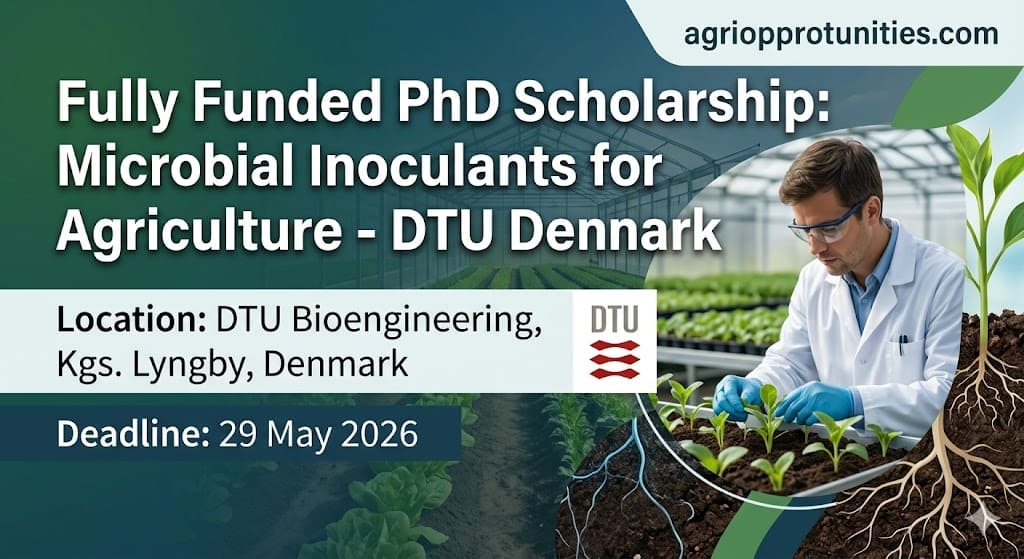
Fully Funded PhD Scholarship: Microbial Inoculants for Agriculture – DTU Denmark

About DTU Bioengineering
Applications are open for a PhD Microbial Inoculants Agriculture Denmark position at DTU Bioengineering. The Lab2Field project investigates why promising microbial bioinoculants fail in the field and how to develop more robust, climate-resilient plant biologicals. DTU is one of Europe’s leading elite technical universities, founded by Hans Christian Ørsted in 1829. The Department of Bioengineering conducts research at the interface of microbiology, bioinformatics, and biotechnology. This PhD project is part of the Lab2Field consortium led by Dr. Tanvi Taparia.
Scholarship Overview
Project Description
This PhD project investigates why promising microbial bioinoculants often fail in the field, and how to fix it. You will study the ecological and evolutionary principles that govern the establishment, persistence, and performance of multi-strain microbial inoculants in real farming systems. The project contributes to fundamental knowledge that directly supports next-generation plant biologicals to be more robust, climate-resilient, and effective under diverse field conditions.
You will investigate the biological constraints that shape how microbial consortia interact with the plant host, the resident soil microbiome, land management factors, and the abiotic environment. This PhD works across diverse scales from laboratory, microcosm, greenhouse, and field experiments.
Why This Scholarship Stands Out
This PhD is unique because it addresses a critical bottleneck in agricultural biotechnology: the gap between lab success and field failure of microbial inoculants. Many microbial bioinoculants show promise in controlled conditions but fail in real farming systems. You will study the ecological and evolutionary principles governing establishment, persistence, and performance of multi-strain microbial consortia. The project integrates microbiology, bioinformatics, soil ecology, plant biology, and agroecology – truly interdisciplinary. You will work across scales from laboratory microcosms to greenhouse and field experiments, with close communication with agricultural partners. For a student interested in microbial ecology and sustainable agriculture, this is an opportunity to do research that directly addresses a real-world problem.
Key Responsibilities
- Investigate biological constraints shaping how microbial consortia interact with plant host, resident soil microbiome, land management factors, and abiotic environment
- Work across diverse scales: laboratory, microcosm, greenhouse, and field experiments
- Communicate closely with agricultural partners to align experimental work with real-world scenarios
- Contribute to supervision of BSc/MSc students
- Support teaching at the department
Candidate Profile and Eligibility
| Requirement | Details |
|---|---|
| Education | Two-year master’s degree (120 ECTS) in Microbiology, Microbial Ecology, Biotechnology, Environmental Engineering, Agriculture or related field |
| Experience | Hands-on experience in molecular microbiology (DNA extraction, qPCR, microscopy) |
| Complex Systems | Demonstrated experience studying interactions within complex microbial systems (synthetic communities, multi-strain consortia, environmental communities) |
| Ecological Knowledge | Solid understanding of community assembly, priority effects, invasion resistance, niche complementarity, and host selection in plant or soil microbiome |
| Bioinformatics | Skills in R or Python (amplicon workflow, metagenomics, or genomics) |
| Domain Knowledge | Strong knowledge of microbial biostimulants or biocontrol agents in plants |
| Language | Excellent written and spoken English |
What They Offer
| Benefit | Details |
|---|---|
| Duration | 3 years (full-time) |
| Start Date | August 1, 2026 |
| Location | Kgs. Lyngby, Denmark |
| Salary | Collective agreement with Danish Confederation of Professional Associations |
| Research Environment | Leading technical university, international environment |
My Application Strategy
- Highlight your molecular microbiology experience – DNA extraction, qPCR, microscopy are essential
- Emphasize bioinformatics skills – R or Python for amplicon workflow, metagenomics, or genomics
- Demonstrate understanding of microbial ecology – Community assembly, priority effects, invasion resistance, niche complementarity
- Prepare a one-page research statement – On the most important bottlenecks preventing successful field application of microbial inoculants in agriculture
- Show knowledge of microbial biostimulants or biocontrol agents – This is a strong requirement
Who Should Apply
This PhD is perfect for a student with a background in microbiology, microbial ecology, or biotechnology who is excited about translating lab discoveries to the field. If you are interested in why promising microbial inoculants fail in real farming systems, and want to study the ecological principles that govern their establishment and persistence, this project offers training across molecular microbiology, bioinformatics, and field experimentation. Candidates with experience in synthetic communities or multi-strain consortia are especially encouraged.
How to Apply
Submit your complete online application as one PDF file by May 29, 2026 (23:59 Danish time).
Required documents (one PDF):
- Letter motivating the application (cover letter)
- Curriculum vitae
- Grade transcripts and BSc/MSc diploma (in English) including official description of grading scale
- One-page research statement on the most important bottlenecks that prevent successful field application of microbial inoculants in agriculture
- Contact details of at least one reference
For questions, contact: Tanvi Taparia – tanta@dtu.dk
Useful Links
Similar Posts
Fully Funded PhD Scholarship: Salmonella Risk Analysis on Poultry Farms – Ireland
Applications are open for a PhD Salmonella Poultry Risk Analysis Ireland position at Teagasc Food Research Centre, Ashtown, in collaboration with University College Dublin. The project investigates sources and dissemination of Salmonella on poultry farms.
Fully Funded Master’s Scholarship: Beef Cattle Finishing Efficiency & GHG Emissions – Ireland
Applications are open for an MSc Beef Cattle Efficiency GHG Ireland position at Teagasc Grange, Co. Meath, in collaboration with University College Dublin. The project investigates factors affecting finishing age and greenhouse gas emissions in Irish beef cattle production systems.
Fully Funded PhD Scholarship: Meiotic Recombination & Barley Breeding – Germany
Applications are open for a PhD Meiotic Recombination Barley Germany position at the Leibniz-Institute for Plant Genetics and Crop Plant Research (IPK) in Gatersleben. The project exploits natural genetic variation in meiotic recombination to overcome breeding barriers in barley.
Fully Funded PhD Scholarship: Plant-Microbe Interactions in a Changing Environment – Aarhus University – Denmark
Applications are open for a PhD Plant Microbe Interactions Climate Change Denmark position at Aarhus University, Research Centre Flakkebjerg. The project uses culturomics, metatranscriptomics, and metagenomics to study how environmental changes affect plant-associated microbial communities.
Fully Funded PhD Scholarship: Arctic Plant Ecology – Germany
Applications are open for a Fully Funded PhD Arctic Plant Ecology Germany position at Leibniz University Hannover, Institute of Earth System Sciences. This PhD project is part of the research initiative “Nuolja muorji observatory: drivers of Arctic wild berry yield and quality under climate and land-use change”.
Fully Funded PhD Scholarship: Quantification of N2O Emissions from Cover Cropping and Organic Manure Management – Teagasc / Trinity College Dublin Ireland
Applications are open for a PhD N2O Emissions Agriculture Ireland position at Teagasc Johnstown Castle and Trinity College Dublin. The project quantifies N2O emissions associated with cover cropping and organic manure management in Irish tillage systems.